The Bank of Canada announced on Wednesday that it will maintain its benchmark interest rate at 2.25 percent, maintaining the level that has been in place since late October 2025.
Citing recent data, the central bank said in a press release on Wednesday that there was a broadening recovery in Canada's economy, however, uncertainty is high and new U.S. tariffs and threats of further action pose risks to the sustainability of the recovery.
The central bank said that with the Middle East conflict still ongoing and little progress in reopening the Strait of Hormuz, upside risks to its inflation forecast have increased.
The longer that high oil prices and elevated refinery margins persist, the greater the risk of spillover to the prices of other goods and services, the bank added.
New U.S. tariffs and Canadian counter-tariffs will also raise costs for some businesses and could feed into consumer prices over time, said the Bank of Canada.
Bank of Canada keeps benchmark rate at 2.25 percent amid tariff, inflation risks
US-China trade talks remain active with both sides still having room to negotiate, and a 30 billion U.S. dollars tariff reduction is on the table, Sean Stein, president of the US-China Business Council, said in an exclusive interview with CGTN on Wednesday in Beijing.
Talking about the ongoing trade talks, Stein drew on his experience in a trade negotiation 25 years ago and said the two sides are still on "Day 3." He noted that the current back-and-forth does not necessarily mean the talks are at an impasse.
"Maybe 25 years ago, I was loaned by the State Department to do some work in a trade negotiation. I was very junior. I was the guy who carried the briefcases. I was not important. And so I'm in a trade negotiation, and we're in Japan. And we've got three days. We've got Wednesday, Thursday, Friday, then we're supposed to be on a plane Saturday morning. Day one, nothing gets done. Day two, nothing gets done. Day three, we get through lunch, and nothing has happened. And I, the new guy, I'm getting really worried. I'm like, oh, we're never going to get through this agenda. And I'm getting more and more worried. And during the afternoon coffee break, I pulled aside the negotiators. I'm like, what are we going to do? We've got just a couple of hours. He said, oh no. Here's what you need to understand about trade deals. If you've got three days to negotiate, don't expect any real progress until day four. And don't expect to be done until day five. The fact that the two sides are still negotiating and haggling about trade, we're still on like day three, we still have a little more time to do it. And so I'm not as worried about that," he said.
In October 2025, China and the United States reached a joint arrangement in Kuala Lumpur to address each other's economic and trade concerns. The arrangement included the suspension of certain tariff and non-tariff measures until November 10, 2026, covering the U.S. 24-percent reciprocal tariffs and China's related countermeasures; the U.S. 50-percent "pass-through" rule on export controls and China's corresponding export control measures; and the U.S. Section 301 investigation measures on China's maritime, logistics, and shipbuilding industries, along with China's related countermeasures.
With the November tariff deadline looming, Stein said both sides could announce a 30 billion U.S. dollars tariff cut as an inaugural act.
"So that message, I think, is going to be both sides will reduce tariffs on 30 billion U.S. dollars worth of goods. We, the American business community, think that's great. We wish it were 40 billion U.S. dollars of goods or 50 billion or 100 billion. But anything we can do to make tariffs lower and more predictable is good for businesses on both sides of the Pacific, and it's good for consumers and for both governments. So this is what we think is going to be, or what we hear is going to be, the inaugural act or what they hope will be the inaugural act," he said.
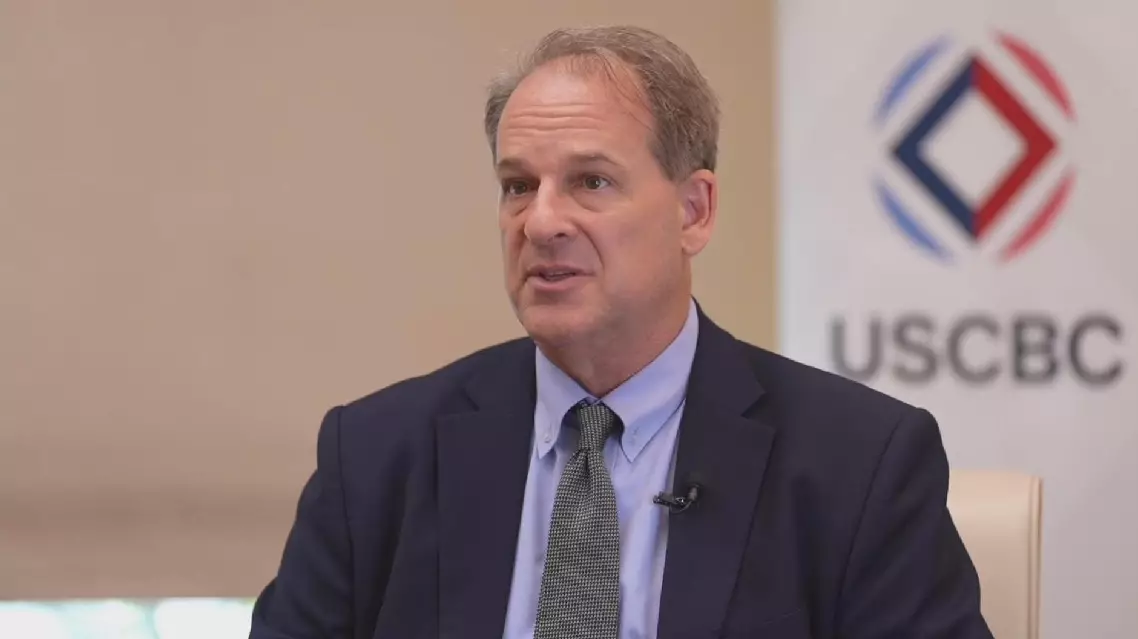
US-China tariff relief on table as trade negotiations move forward: US business leader