DH continues to take multipronged measures to combat illegal import of alternative smoking products and illegal smoking
The Tobacco and Alcohol Control Office (TACO) of the Department of Health (DH) continues to clamp down on activities that are in breach of relevant laws regulating tobacco control. Yesterday (September 2), a woman was arrested at the airport and subsequently prosecuted for illegallyimporting alternative smoking products (ASPs). An enforcement operation was also carried out in Tsim Sha Tsui against illegal waterpipe smoking in no smoking areas with five fixed penalty notices (FPNs) issued.
Illegal import of alternative smoking products
----------------------------------------------------
TACO was notified by Hong Kong Customs yesterday that 20 600 ASPs had been intercepted in the luggage of a woman arriving from Japan. TACO immediately arrested and prosecuted the individual. She was sentenced today at the West Kowloon Magistrates' Courts to three months' imprisonment.
Since the amendments to the Tobacco Control Legislation (Amendment) Ordinance 2025, which conferred arrest powers on TACO inspectors, took effect on September 19, 2025, TACO has prosecuted 30 cases involving the importation of large quantities of alternative smoking products. Thirty-two persons have been convicted and sentenced to prison terms ranging from four weeks to eight months.
According to the Import and Export Ordinance (Chapter 60), a person who imports alternative smoking products, including electronic smoking products, heated tobacco products and herbal cigarettes, commits an offence and is liable on summary conviction to a fine of $500,000 and imprisonment for two years; or liable on conviction on indictment to a fine of $2 million and imprisonment for seven years.
Under the Smoking (Public Health) Ordinance (Chapter 371) (the Ordinance), no person may promote, manufacture, sell, or possess for commercial purposes alternative smoking products. An offender is liable to a fine of $50,000 and imprisonment for six months.
Illegal waterpipe smoking in no smoking areas
-----------------------------------------------------
TACO conducted an operation codenamed "Cloudcrush" in Tsim Sha Tsui last night. During the inspection, TACO issued three FPNs to persons illegally smoking waterpipes in two bars, and issued two FPNs to a person for smoking and possessing a heated tobacco product inside the bar.
During the inspections conducted from January 2024 to date, the DH issued a total of around 300 FPNs for smoking waterpipe tobacco illegally in indoor no smoking areas, in addition to around 150 summonses to the staff of the bar for aiding and abetting smoking in indoor no smoking areas.
Under the Ordinance, conducting a smoking act in a statutory no smoking area (such as indoor areas of bars or restaurants) is prohibited. Any person doing a smoking act in statutory no smoking areas is liable to a fixed penalty of $3,000. Moreover, where smoking products (including waterpipes) are sold, in bars or otherwise, the restrictions on the promotion and sale of smoking products stipulated in the Ordinance apply. Offenders are liable on summary conviction to a maximum fine of $50,000. Venue managers of statutory no smoking areas are empowered by the Ordinance to request a smoking offender cease the act; if the offender is not co-operative, the manager may contact the Police for assistance.
In addition, any person who possesses specified ASPs, including e-cigarette capsules, liquids, heat sticks and herbal cigarettes, in public places is liable to a fixed penalty of $3,000.
"Members of the public must not try or continue consuming ASPs or waterpipes based on the misconception that these products contain less harmful substances. Currently, there is no evidence to show that heated tobacco products and e-cigarettes are less harmful or beneficial for smoking cessation. On the contrary, ASPs have been proven to emit numerous toxic substances that can lead to addiction, illness, or even death. Waterpipe is also a smoking product, and its combustion of fuel (e.g. charcoal) releases carbon monoxide. A typical one-hour waterpipe smoking session exposes the user to 100 to 200 times the volume of smoke inhaled from a single conventional cigarette. Moreover, sharing a waterpipe apparatus increases the risk of transmitting infectious diseases, such as tuberculosis. People should seek medical attention immediately if they suspect they are developing symptoms of carbon monoxide poisoning," the Head of TACO, Dr Manny Lam said.
He stressed that TACO will continue to closely monitor and rigorously enforce the law against illegal activities such as waterpipe smoking in no smoking areas, illegal sales and promotions of smoking products, as well as illegal imports of ASPs.
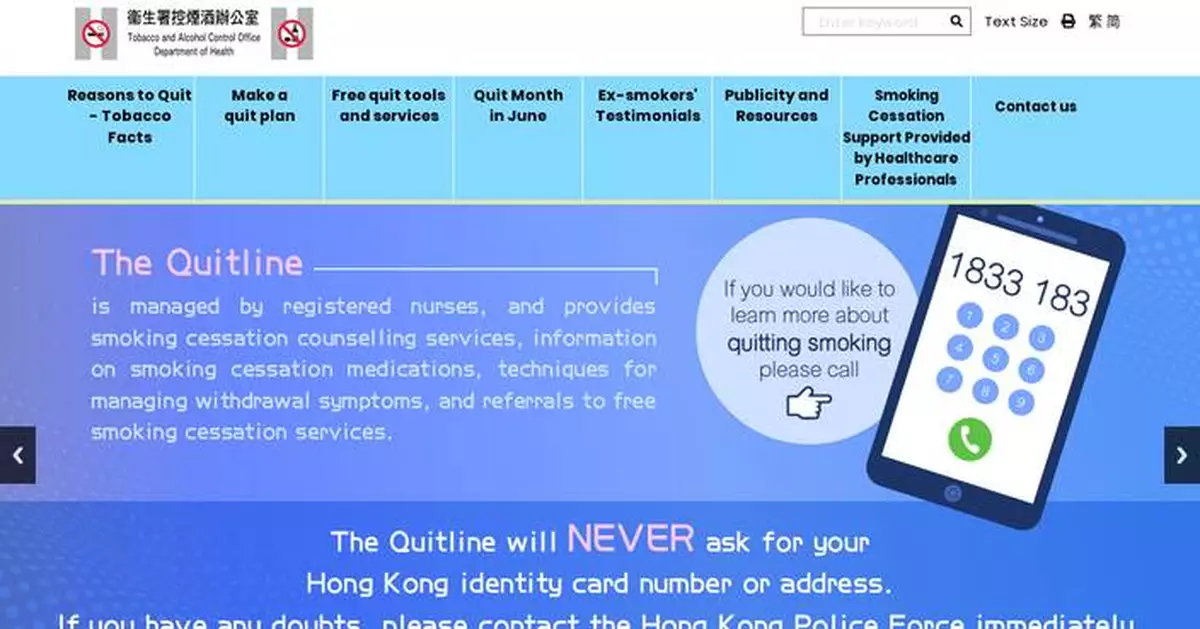
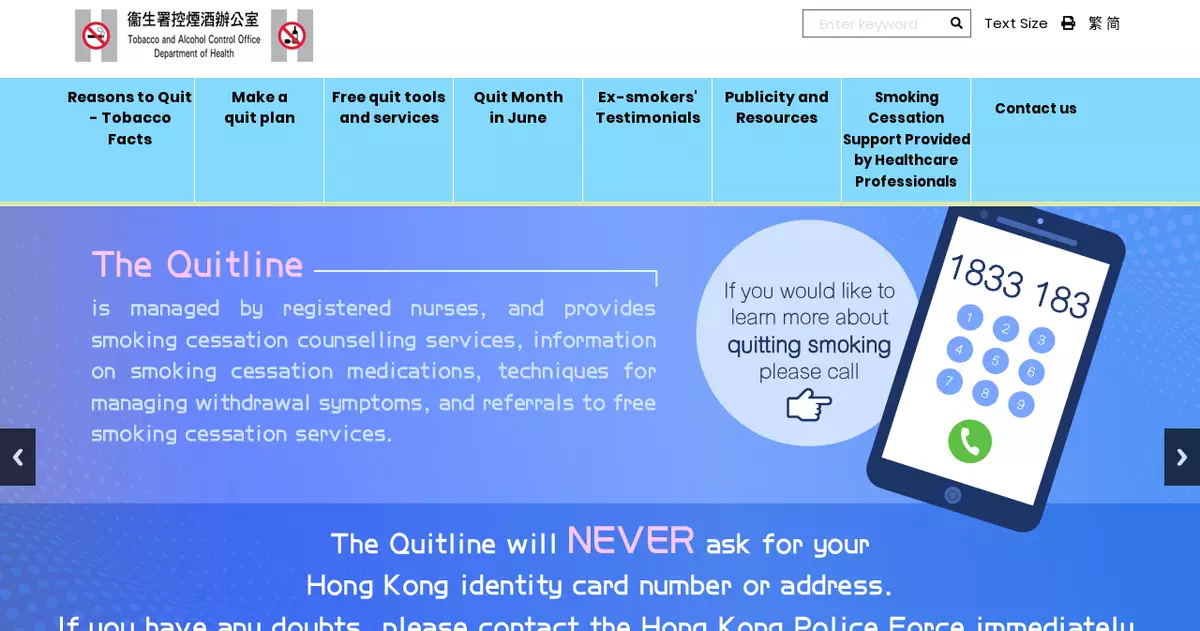
Dr Lam urged that smokers quit smoking as early as possible for their own health and that of others. Members of the public may call the DH's Integrated Smoking Cessation Hotline on 1833 183, or visit TACO's website for information on smoking cessation.
Source: AI-found images
Statistics on vessels, port cargo and containers for the second quarter of 2026
The Census and Statistics Department (C&SD) today (September 3) released the statistics on vessels, port cargo and containers for the second quarter of 2026.
In the second quarter of 2026, total port cargo throughput decreased by 0.2% to 42.3 million tonnes over a year earlier. Within this total, inward port cargo decreased by 3.8% to 24.3 million tonnes, while outward port cargo increased by 5.2% to 18.0 million tonnes.
For the first half of 2026, total port cargo throughput increased by 1.0% to 84.4 million tonnes over a year earlier. Within this total, inward port cargo decreased by 1.6% to 49.0 million tonnes, while outward port cargo increased by 4.8% to 35.4 million tonnes.
On a seasonally adjusted quarter-to-quarter comparison, total port cargo throughput decreased by 6.4% in the second quarter of 2026. Within this total, inward port cargo and outward port cargo decreased by 7.7% and 4.6% respectively compared with the preceding quarter. The seasonally adjusted series enables a more meaningful shorter-term comparison to help identify possible variations in trends.
Port cargo
In the second quarter of 2026, within port cargo, seaborne cargo decreased by 3.2% to 25.6 million tonnes over a year earlier, while river cargo increased by 4.8% to 16.7 million tonnes over a year earlier.
In the first half of 2026, within port cargo, seaborne cargo decreased by 2.7% to 51.0 million tonnes over a year earlier, while river cargo increased by 7.3% to 33.4 million tonnes over a year earlier.
Comparing the second quarter of 2026 with a year earlier, a double-digit increase was recorded in the tonnage of inward port cargo loaded in Chinese Mainland (+10.3%). On the other hand, double-digit decreases were recorded in the tonnage of inward port cargo loaded in Singapore (-54.4%), Korea (-40.5%), Taiwan (-32.4%), Japan (-21.9%) and Vietnam (-12.2%). For outward port cargo, double-digit increases were recorded in the tonnage of outward port cargo discharged in Brazil (+37.4%), Taiwan (+16.6%) and Vietnam (+11.9%). Conversely, double-digit decreases were recorded in the tonnage of outward port cargo discharged in Thailand (-16.6%) and Japan (-13.4%).
Comparing the first half of 2026 with a year earlier, a double-digit increase was recorded in the tonnage of inward port cargo loaded in Chinese Mainland (+10.0%). On the other hand, double-digit decreases were recorded in the tonnage of inward port cargo loaded in Singapore (-28.1%), Chile (-19.4%), Korea (-17.7%), Taiwan (-14.4%) and Vietnam (-13.9%). For outward port cargo, a double-digit increase was recorded in the tonnage of outward port cargo discharged in Brazil (+35.6%). Conversely, double-digit decreases were recorded in the tonnage of outward port cargo discharged in Thailand (-26.7%) and Japan (-11.7%).
Comparing the second quarter of 2026 with a year earlier, double-digit decreases were recorded in the tonnage of inward port cargo of "petroleum, petroleum products and related materials" (-24.4%) and "artificial resins and plastic materials" (-12.0%). As for outward port cargo, double-digit increase was recorded in the tonnage of "live animals chiefly for food and edible animal products" (+11.3%).
Comparing the first half of 2026 with a year earlier, double-digit decrease was recorded in the tonnage of inward port cargo of "artificial resins and plastic materials" (-12.2%). As for outward port cargo, double-digit changes were recorded in the tonnage of "stone, sand and gravel" (+16.6%) and "pulp and waste paper" (-14.2%).
Containers
In the second quarter of 2026, the port of Hong Kong handled 3.24 million twenty-foot equivalent units (TEUs) of containers, representing an increase of 1.1% over a year earlier. Within this total, laden containers increased by 2.5% to 2.64 million TEUs, while empty containers decreased by 4.4% to 0.60 million TEUs. Among laden containers, inward and outward containers increased by 1.6% and 3.5% to 1.39 million TEUs and 1.26 million TEUs respectively.
For the first half of 2026, the port of Hong Kong handled 6.38 million TEUs of containers, representing a decrease of 3.0% over a year earlier. Within this total, laden containers increased by 0.2% to 5.17 million TEUs, while empty containers decreased by 14.8% to 1.21 million TEUs. Among laden containers, inward containers decreased by 0.8% to 2.73 million TEUs, while outward containers increased by 1.4% to 2.44 million TEUs.
On a seasonally adjusted quarter-to-quarter comparison, laden container throughput decreased by 1.9% in the second quarter of 2026. Within this total, inward and outward laden containers decreased by 3.5% and 0.1% respectively.
In the second quarter of 2026, seaborne and river laden containers increased by 1.0% and 6.0% to 1.84 million TEUs and 0.81 million TEUs respectively over a year earlier.
In the first half of 2026, seaborne laden containers decreased by 1.3% to 3.59 million TEUs over a year earlier, while river laden containers increased by 4.0% to 1.58 million TEUs.
Vessel arrivals
Comparing the second quarter of 2026 with a year earlier, the number of ocean vessel arrivals increased by 5.0% to 5 145, increasing the total capacity by 1.7% to 75.2 million net tons. Meanwhile, the number of river vessel arrivals decreased by 2.1% to 19 680, while the total capacity increased by 0.9% to 23.8 million net tons.
Comparing the first half of 2026 with a year earlier, the number of ocean vessel arrivals increased by 5.7% to 9 942, increasing the total capacity by 3.9% to 150.3 million net tons. Meanwhile, the number of river vessel arrivals decreased by 0.2% to 39 800, while the total capacity increased by 4.0% to 48.6 million net tons.
Further information
Port cargo and laden container statistics are compiled from a sample of consignments listed in the cargo manifests supplied by shipping companies and agents to the C&SD. Vessel statistics are compiled by the Marine Department primarily from general declarations submitted by ship masters and authorised shipping agents. Since 2026, statistics on pleasure vessels and fishing/fish processing vessels plying exclusively within the river trade limits have been covered.
Table 1 presents the detailed port cargo statistics.
Table 2 and Table 3 respectively present the inward and outward port cargo statistics by main countries/territories of loading and discharge.
Table 4 and Table 5 respectively present the inward and outward port cargo statistics by principal commodities.
Table 6 presents the detailed container statistics.
Table 7 presents the statistics on vessel arrivals in Hong Kong.
More detailed statistics on port cargo, containers and vessels are published in the report "Hong Kong Shipping Statistics, Second Quarter 2026". Users can browse and download this publication at the website of the C&SD (www.censtatd.gov.hk/en/EIndexbySubject.html?pcode=B1020008&scode=230).
For enquiries about port cargo and container statistics, please contact the Electronic Trading Services and Cargo Statistics Section of the C&SD (Tel: 3863 2473 or email: shipping@censtatd.gov.hk). For enquiries about vessel statistics, readers may contact the Statistics Section under the Planning, Development and Port Security Branch of the Marine Department (Tel: 2852 3662 or email: st-sec@mardep.gov.hk).

Source: AI-found images