Chinese President Xi Jinping's just-concluded state visit to Egypt fully demonstrated the strategic, leading and exemplary nature of China-Egypt relations, marking a milestone in the development of bilateral ties, according to Chinese Foreign Minister Wang Yi.
Xi arrived in Cairo Tuesday evening to pay a two-day state visit to Egypt at the invitation of Egyptian President Abdel Fattah El-Sisi.
The trip marked Xi's first state visit to the North African country in a decade, and coincided with the occasion of the 70th anniversary of the establishment of diplomatic relations between China and Egypt.
Sisi and his wife Entissar Amer welcomed Xi and his wife Peng Liyuan at the Cairo International Airport.
Xi delivered a written speech, extending sincere greetings and best wishes to the Egyptian government and the Egyptian people on behalf of the Chinese government and the Chinese people.
On Wednesday, Xi attended a welcome ceremony held by Sisi at the Al-Ittihadiya Palace in Cairo.
A military band played welcoming music, and a 21-gun salute was fired as Xi's motorcade arrived inside the palace grounds.
Sisi and his wife warmly welcomed Xi and Peng, before the two heads of state headed to the reviewing platform, where the national anthems of both countries were performed.
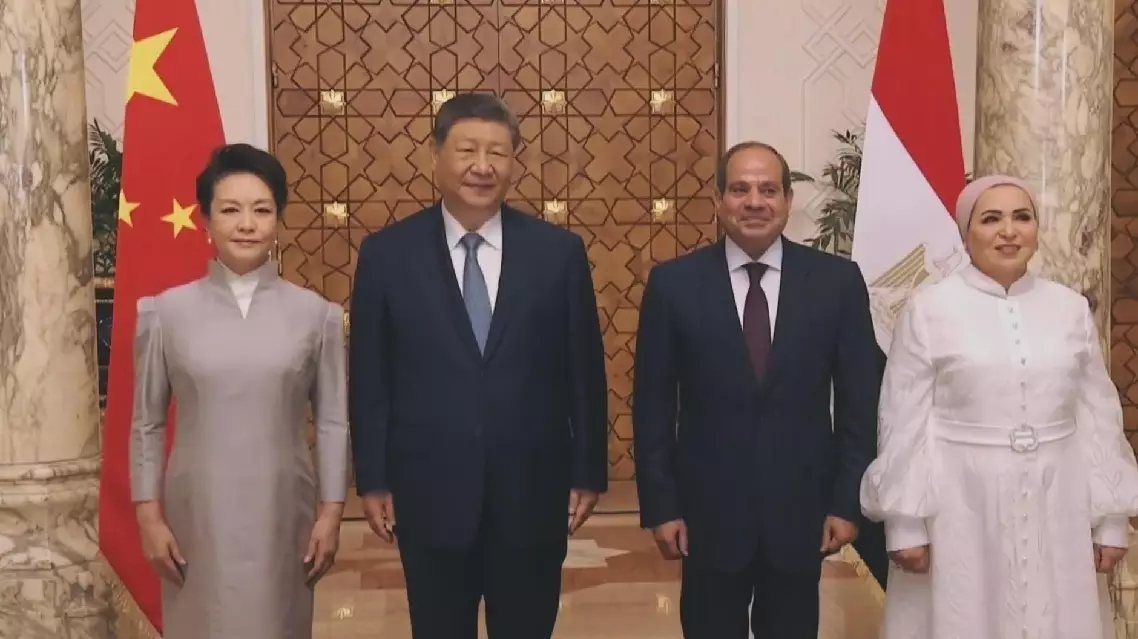
After entering the palace, Xi, Sisi, and their spouses posed for photos in front of the national flags of China and Egypt.
The two heads of state then held talks, during which Xi called for efforts from both China and Egypt to support each other, deepen cooperation, and continue advancing the building of a China-Egypt community with a shared future amid a turbulent international and regional landscape.
Xi said the older-generation leaders of the two countries led their peoples in fighting side by side for national independence and against imperialism and colonialism, forging an unbreakable bond of friendship.
Over the past seven decades, China-Egypt relations have weathered challenges and developed distinctive features of equality and mutual trust, friendship and mutual learning, solidarity and mutual support, as well as win-win cooperation, he said.
Xi said the China-Egypt comprehensive strategic partnership has achieved leapfrog development in recent years under the guidance of the heads of state of the two countries. The two sides share similar views and have closely aligned strategies in pursuing development and revitalization, improving people's well-being, and upholding international fairness and justice, he added.
Xi emphasized that China and Egypt should firmly support each other, maintain the momentum of high-level exchanges, enhance exchanges and cooperation in all fields and at all levels, and strengthen exchanges and mutual learning on governance experience.
Xi said the two sides should promote mutually beneficial cooperation, better align their development strategies, tap the potential for cooperation in traditional fields such as infrastructure development, power, agriculture and communications technology, and foster new highlights of cooperation in green energy, electric vehicles, aerospace, the digital economy and modern agricultural technology.
The two sides should promote people-to-people exchanges, comprehensively expand exchanges and cooperation in culture, education, science and technology, health, sports and other fields, and facilitate personnel exchanges and enhance people-to-people bonds, Xi said.
The two sides should strengthen security cooperation, jointly combat transnational crime, deepen international cooperation in anti-corruption, firmly support each other's anti-terror efforts, and safeguard their common security, Xi said.
The two sides should strengthen multilateral collaboration, further enhance coordination and cooperation on multilateral platforms such as the United Nations and the BRICS, jointly promote the development of the China-Arab States Cooperation Forum and the Forum on China-Africa Cooperation, jointly oppose unilateralism and acts of bullying, and promote a more just and equitable global governance system, Xi said.
The two leaders also had in-depth exchanges on the situation in the Middle East.
The Chinese leader raised a four-point proposal on building a new security architecture in the Middle East via upholding a vision of common, comprehensive, cooperative and sustainable security. Xi said China supports countries in the region in developing good-neighborly and friendly relations, adding that efforts should be made to foster the internal driving force for common security in the region.
People in the Middle East should remain masters of their own affairs, and external interference should be rejected, Xi said, noting that China supports regional countries in strengthening dialogue on peace and security, exploring the building of a new security architecture for the Middle East, and taking their future into their own hands.
Xi said that a comprehensive approach should be adopted to advance common security in the region and that given the multiple hotspots in the Middle East and their close interconnections, comprehensive solutions should be pursued.
The Palestinian issue remains at the core of the Middle East question and should never be overlooked or marginalized, he added.
The foundation for common security should be strengthened through development, Xi said, noting that lasting peace and stability in the Middle East fundamentally depend on development.
China stands ready to work with Middle East countries to safeguard the security of international shipping lanes, advance development cooperation, promote the convergence of interests of regional countries, gradually enhance mutual trust, and eliminate the root causes of the conflict, he said.
Xi said that international coordination for common security in the region should be strengthened, and that the U.N. Charter and other international law should serve as the fundamental principles for handling Middle East affairs.
The international community, especially external powers, should abandon the application of double standards in the Middle East, respect the sovereignty and territorial integrity of regional countries, and safeguard regional peace and stability, Xi added.
He also urged support for the United Nations' effective role in Middle East affairs.
Following the talks, the two heads of state jointly witnessed the signing of multiple cooperation documents covering Belt and Road cooperation, artificial intelligence, economy and trade, industrial and supply chain cooperation, and other areas.
The two sides issued a joint statement on further deepening their comprehensive strategic partnership.
Sisi and his wife held a welcoming banquet for Xi and his wife Peng Liyuan on Wednesday noon.
Noting that China and Egypt are both ancient civilizations and countries rich in World Heritage sites, Xi said that across time and space, the two civilizations have been reaching out to each other, adding new chapters of everlasting friendship between the two peoples.
Xi called for efforts from both sides to uphold the vision of civilization based on equality, mutual learning, dialogue and inclusiveness, and implement the Global Civilization Initiative.
He also urged efforts from both sides to promote inclusive coexistence and mutual learning among different civilizations, and pool greater strength from civilizations to advance the building of a community with a shared future for humanity.
Xi concluded the state visit and left Cairo later on Wednesday.
Sisi and his wife saw Xi and Peng off at the airport.
Briefing reporters on Xi's trip, Wang Yi said that the historic visit to Egypt is not only a journey to carry forward friendship but also one to expand cooperation, adding that it charted a new blueprint for mutually beneficial cooperation between the two countries.
The state visit came after Xi's trip to Kyrgyzstan for the Shanghai Cooperation Organization (SCO) Summit 2026 in the Kyrgyz capital city of Bishkek, and a state visit to the Central Asian country.
Xi's milestone visit highlights strategic, leading and exemplary nature of China-Egypt ties: foreign minister