Skip to Content Facebook Feature Image

California made Gavin Newsom famous. Will it drag down his 2028 presidential ambitions?

News

California made Gavin Newsom famous. Will it drag down his 2028 presidential ambitions?
News

News

California made Gavin Newsom famous. Will it drag down his 2028 presidential ambitions?

2026-09-06 12:01 Last Updated At:12:10

SUMMERVILLE, S.C. (AP) — Gavin Newsom's secret is no secret here in South Carolina.

They were selling “Gavin 2028” buttons outside his events this past week as he trekked across the state that will hold Democrats' first presidential primary. His allies, the state party chair, college presidents and pro-Newsom activists all openly hinted at his national aspirations. And people close to him privately referred to a White House campaign as “the next thing.”

More Images
California Gov. Gavin Newsom, second from left, speaks during a fireside chat at Allen University, Friday, Sept. 4, 2026, in Columbia, S.C. (AP Photo/Mic Smith)
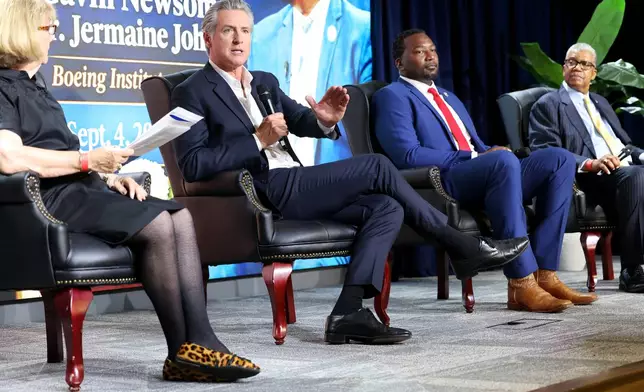
California Gov. Gavin Newsom, second from left, speaks during a fireside chat at Allen University, Friday, Sept. 4, 2026, in Columbia, S.C. (AP Photo/Mic Smith)
California Gov. Gavin Newsom speaks during a fireside chat at Allen University, Friday, Sept. 4, 2026, in Columbia, S.C. (AP Photo/Mic Smith)

California Gov. Gavin Newsom speaks during a fireside chat at Allen University, Friday, Sept. 4, 2026, in Columbia, S.C. (AP Photo/Mic Smith)

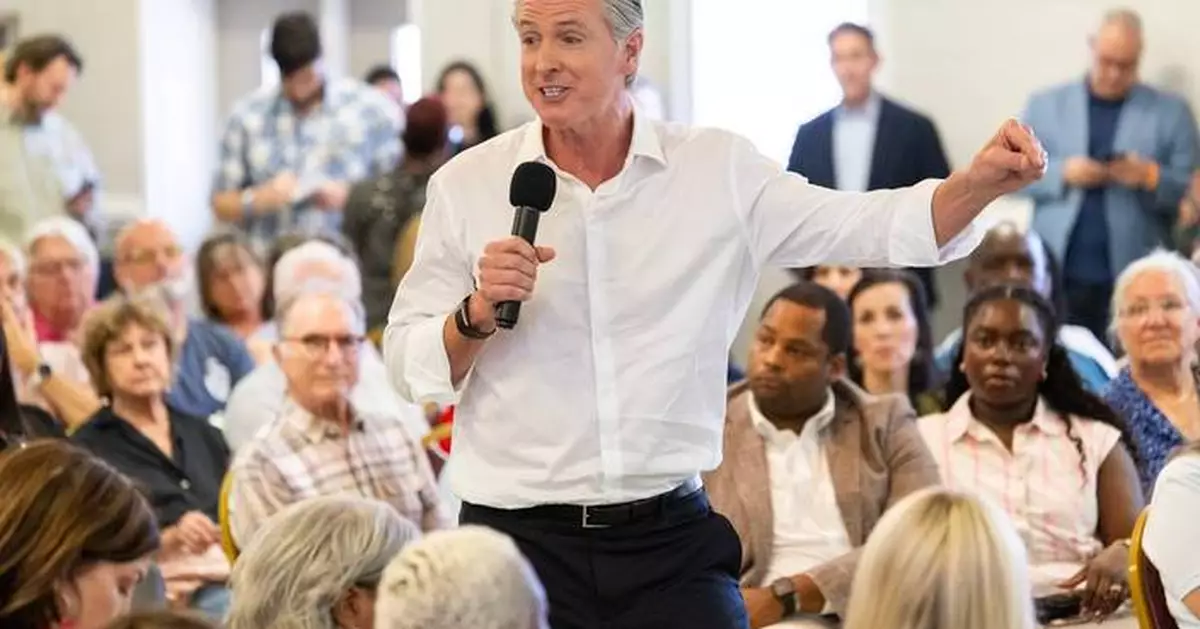
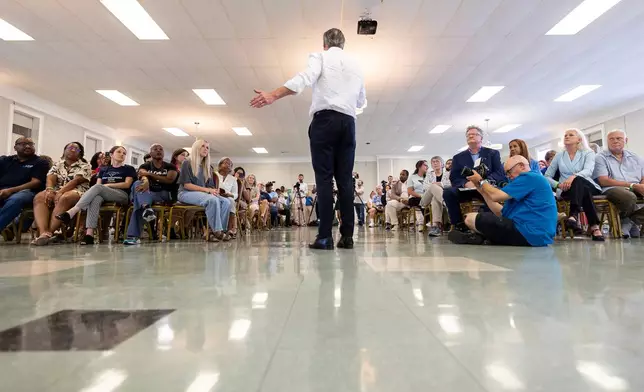
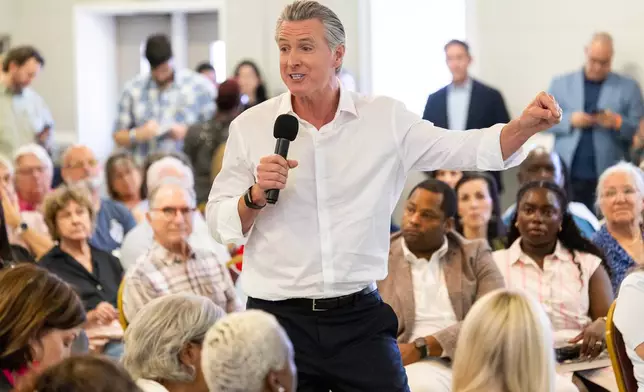
California Gov. Gavin Newsom speaks to supporters during a campaign event at the Brookland-Lakeview Empowerment Center, Friday, Sept. 4, 2026, in West Columbia, S.C. (AP Photo/Mic Smith)
California Gov. Gavin Newsom speaks to supporters during a campaign event at the Brookland-Lakeview Empowerment Center, Friday, Sept. 4, 2026, in West Columbia, S.C. (AP Photo/Mic Smith)
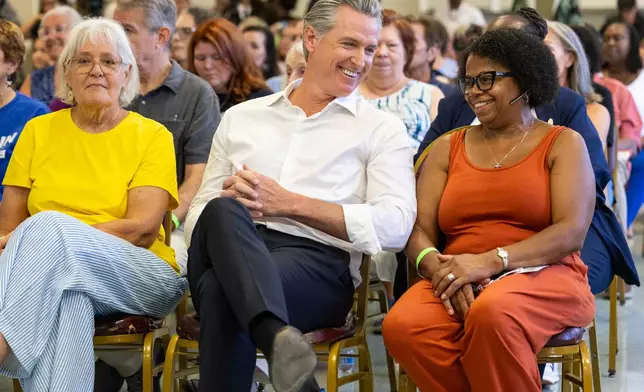
California Gov. Gavin Newsom shares a laugh with Dianne Kittrell, right, during a campaign event at the Brookland-Lakeview Empowerment Center, Friday, Sept. 4, 2026, in West Columbia, S.C. (AP Photo/Mic Smith)

California Gov. Gavin Newsom shares a laugh with Dianne Kittrell, right, during a campaign event at the Brookland-Lakeview Empowerment Center, Friday, Sept. 4, 2026, in West Columbia, S.C. (AP Photo/Mic Smith)

California Gov. Gavin Newsom speaks to supporters during a campaign event at the Brookland-Lakeview Empowerment Center, Friday, Sept. 4, 2026, in West Columbia, S.C. (AP Photo/Mic Smith)

California Gov. Gavin Newsom speaks to supporters during a campaign event at the Brookland-Lakeview Empowerment Center, Friday, Sept. 4, 2026, in West Columbia, S.C. (AP Photo/Mic Smith)

Still, California's Democratic governor has barely begun to address what may be his biggest political liability as he stakes a claim as an early front-runner in the Democratic Party's 2028 shadow primary. That liability, South Carolina voters acknowledged this past week, is something he cannot change — his home state, California, is a symbol of modern-day liberalism that people across the political spectrum love to hate.

Vera DeVito, a 78-year-old Democrat who packed into one of Newsom's eight public events across South Carolina, said she didn't know much about him or his policies — except that he's from the Golden State. On that basis alone, she suggested that supporting Newsom could be “risky.”

“It's going to be hard for him to appeal to the whole country," she said in the town of Summerville. “Everybody thinks California is different — especially in the South. They're not crazy about California.”

Newsom's home state stands in stark contrast with likely primary competitors who hail from battlegrounds like Michigan's Pete Buttigieg and Pennsylvania's Gov. Josh Shapiro. Should they run, which is likely, all could make credible claims that they are in a better position to win over the moderate and independent voters ultimately needed to win the presidency.

Newsom's team acknowledges that “California derangement syndrome” is real. In the almost half-century since former California Gov. Ronald Reagan first won the presidency, the state has produced a long list of failed White House contenders, including Gov. Pete Wilson, Gov. Jerry Brown, businessman Tom Steyer, and most recently Vice President Kamala Harris.

Despite such daunting history, Newsom is not hiding his interest in the presidency. In an interview, he left open the possibility of announcing his decision before the end of the year.

“It’s the right question. Honestly, I don’t know,” Newsom told The Associated Press. “I think this thing’s happening. I mean, you already feel it, right? There are folks out here — they’re saying they’re already starting to interview state directors. So this thing is going to happen very, very quickly.”

Newsom's breakneck pace in South Carolina — which included a handful of private engagements in addition to his public events — mirrored or even exceeded that of a presidential campaign.

His visit was billed as part of his “take it back tour” across states in the Deep South where he argues that President Donald Trump and his Republican allies are rolling back civil rights.

He opened the trip on Wednesday with one day in Alabama and finished on Saturday with two stops in North Carolina. But the overwhelming focus was South Carolina, which will host the Democratic Party’s opening presidential primary contest in little more than a year. It was Newsom's third trip to South Carolina this midterm season.

The voters who crowded into community halls, courthouses and a university lecture hall talked openly about Newsom's presidential ambitions, even as Democrats try to keep the focus on November's midterm elections.

“He has strong potential,” said Kirk Bovill, a 65-year-old semi-retired actor and former Los Angeles resident who now lives in Summerville. “The question is how he's perceived outside of California. People might think he's too Hollywood.”

“The one thing he does very well: He doesn’t have a problem standing up to Trump,” Bovill continued. “He's not intimidated.”

Indeed, Newsom's message this past week was overwhelmingly focused on attacking Trump and rallying Democrats to stand up against him.

“We cannot do business as usual. We need to fight fire with fire,” Newsom told roughly 150 people gathered inside a Lexington, S.C. community center on Friday. “We’ve got to meet this moment and recognize what we’re up against. We’re up against an invasive species in the name of Donald Trump.”

At every stop, Newsom highlighted the hundreds of millions of dollars Trump and his family have made from crypto currency and other private business dealings since the 2024 election; Trump's decision to dispatch the National Guard to Los Angeles and other major U.S. cities; the federal immigration agents that have descended upon Los Angeles and other cities under Trump's direction; and Trump's push to disrupt the midterm elections, including his recent move to limit mail voting.

“Donald Trump is ruthless. He’s ruthless. He’s going to try to steal this election," Newsom charged. “He is not screwing around. Neither can we.”

The White House did not respond to a request for comment.

Republican activists protesting outside of some of Newsom's stops focused largely on his connection to California.

CJ Westfall, the Republican chairman of Dorchester County, described Newsom as “a far-left extreme Democrat who’s probably the front-runner of this (presidential) race right now.” He was surrounded by protesters who waved signs that read things like, “Wrong Coast" and “Clean Up Your State First."

“We don’t want Gavin Newsom to California our South Carolina,” Westfall said.

Newsom's team acknowledges widespread dislike for California, even among some Democrats, but argues that the California governor is gifted and experienced at fighting back against such criticism on the national stage. Newsom is a regular on Fox News, he faced Florida Gov. Ron DeSantis in a debate and he was the most prominent national surrogate for former President Joe Biden's campaign.

Newsom acknowledged that California is both a political liability and “the greatest opportunity" because the California story has only been told on the national stage by “people that have 'California Derangement Syndrome.'" He said it would play far differently if he's able to reframe the conversation in 2028.

“In a Democratic primary, in particular — we’ve got the receipts, things that the party is arguing for, we’ve delivered across a spectrum of issues,” he told AP.

Indeed, some of the achievements that Republican critics attack him for are the same issues that might play well among Democratic base voters.

California under Newsom's leadership has enacted progressive priorities such as expanded healthcare coverage regardless of immigration status, expanded paid sick leave, universal free school meals, a $20 minimum wage for fast food workers, protections for women from other states seeking abortions, aggressive climate change and gun control laws and a death penalty moratorium.

California also remains the nation's most populous state and the world's fourth-largest economy, even as critics decry the state's high taxes that have pushed some businesses and residents alike into other states. The population has been growing since a COVID-era dip, however.

While South Carolina voters may have had mixed views on California, several said they were drawn in by Newsom's celebrity image. The 58-year-old Democrat certainly looked the part of a made-for-TV president as he charmed voters in his plain white dress shirt with his sleeves rolled up and no tie.

“We don’t get that many famous people here in Aiken. He’s pretty famous,” said 73-year-old Monty Fetterolf, who attended one of Newsom's Friday events in Aiken, S.C.

DeVito, the 78-year-old Democrat from Summerville, said Newsom still has work to do.

“He's a little slick — not a lot of meat,” she said after listening to his speech in Dorchester. “But he's good looking, which helps.”
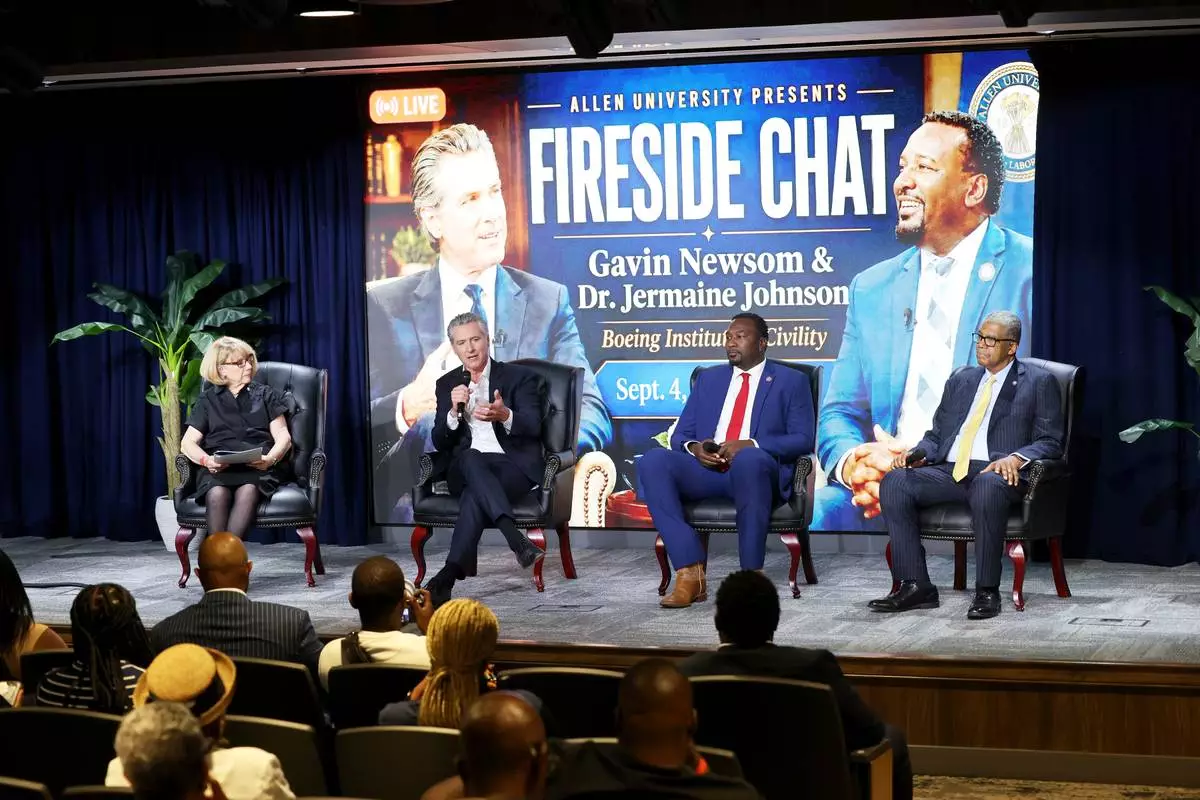
California Gov. Gavin Newsom, second from left, speaks during a fireside chat at Allen University, Friday, Sept. 4, 2026, in Columbia, S.C. (AP Photo/Mic Smith)
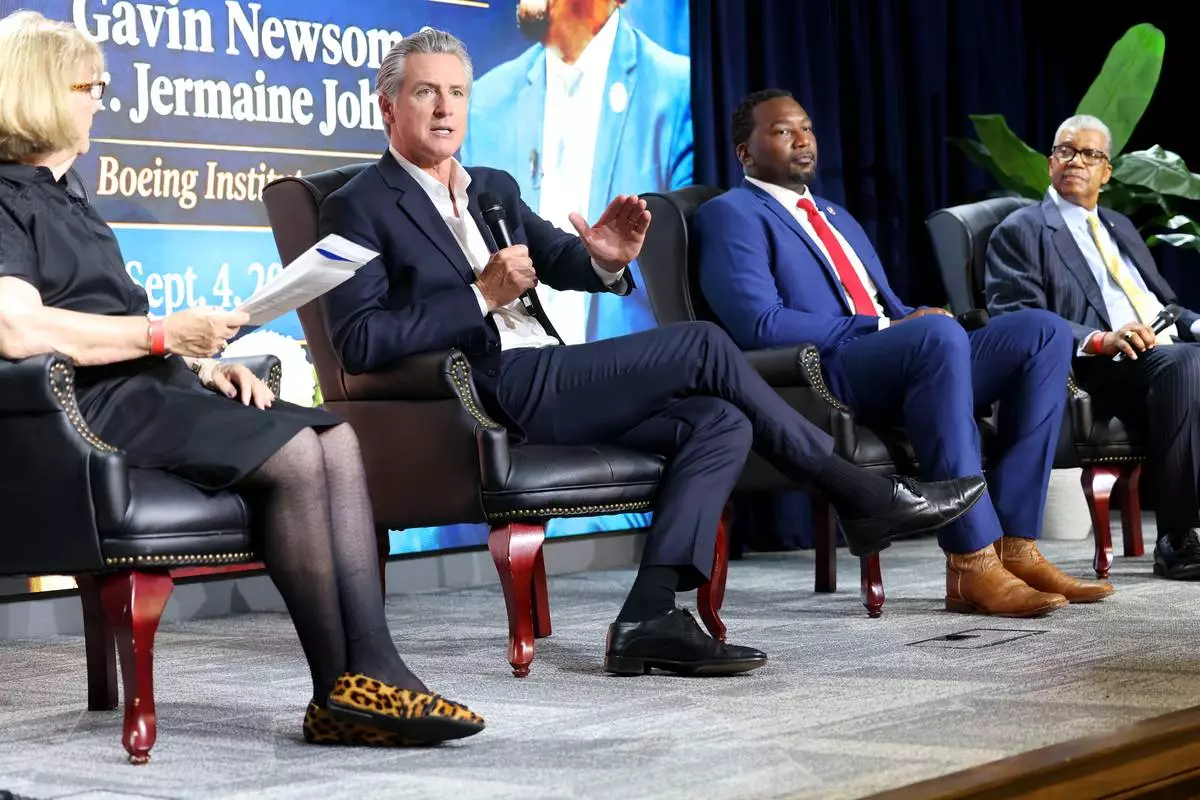
California Gov. Gavin Newsom, second from left, speaks during a fireside chat at Allen University, Friday, Sept. 4, 2026, in Columbia, S.C. (AP Photo/Mic Smith)
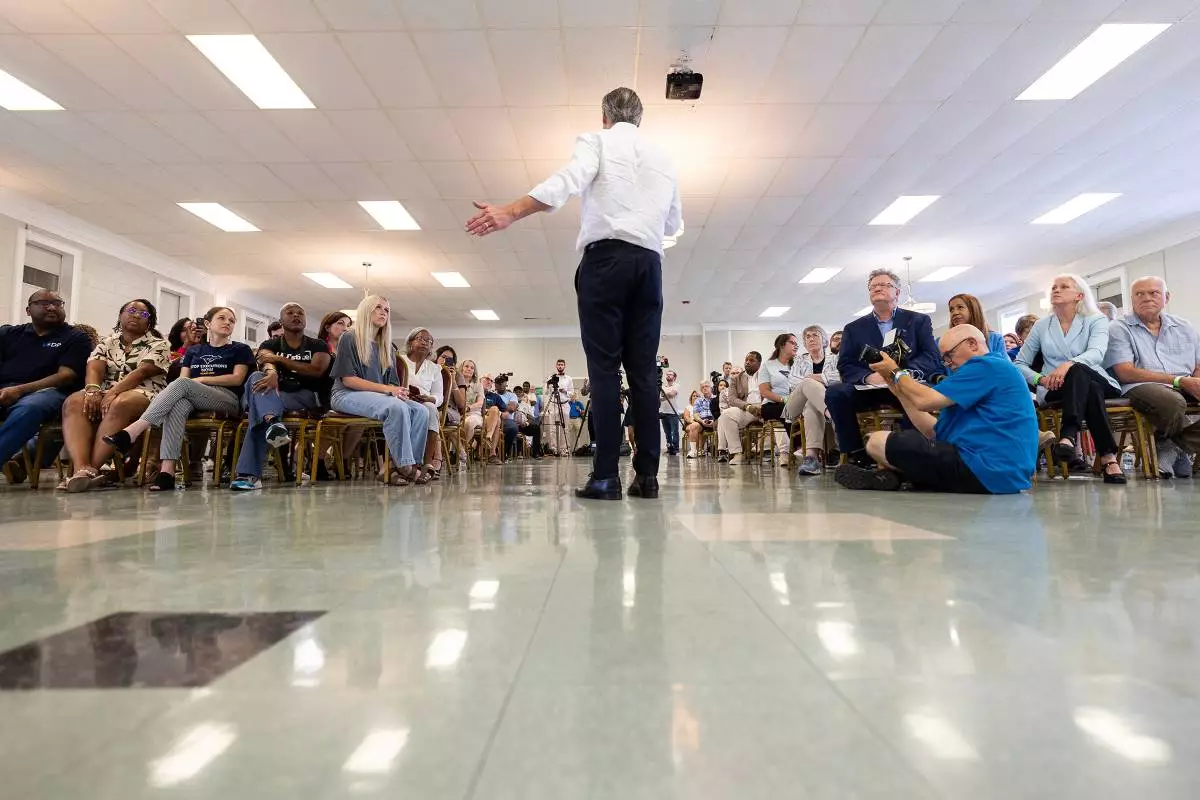
California Gov. Gavin Newsom speaks during a fireside chat at Allen University, Friday, Sept. 4, 2026, in Columbia, S.C. (AP Photo/Mic Smith)

California Gov. Gavin Newsom speaks during a fireside chat at Allen University, Friday, Sept. 4, 2026, in Columbia, S.C. (AP Photo/Mic Smith)

California Gov. Gavin Newsom speaks to supporters during a campaign event at the Brookland-Lakeview Empowerment Center, Friday, Sept. 4, 2026, in West Columbia, S.C. (AP Photo/Mic Smith)
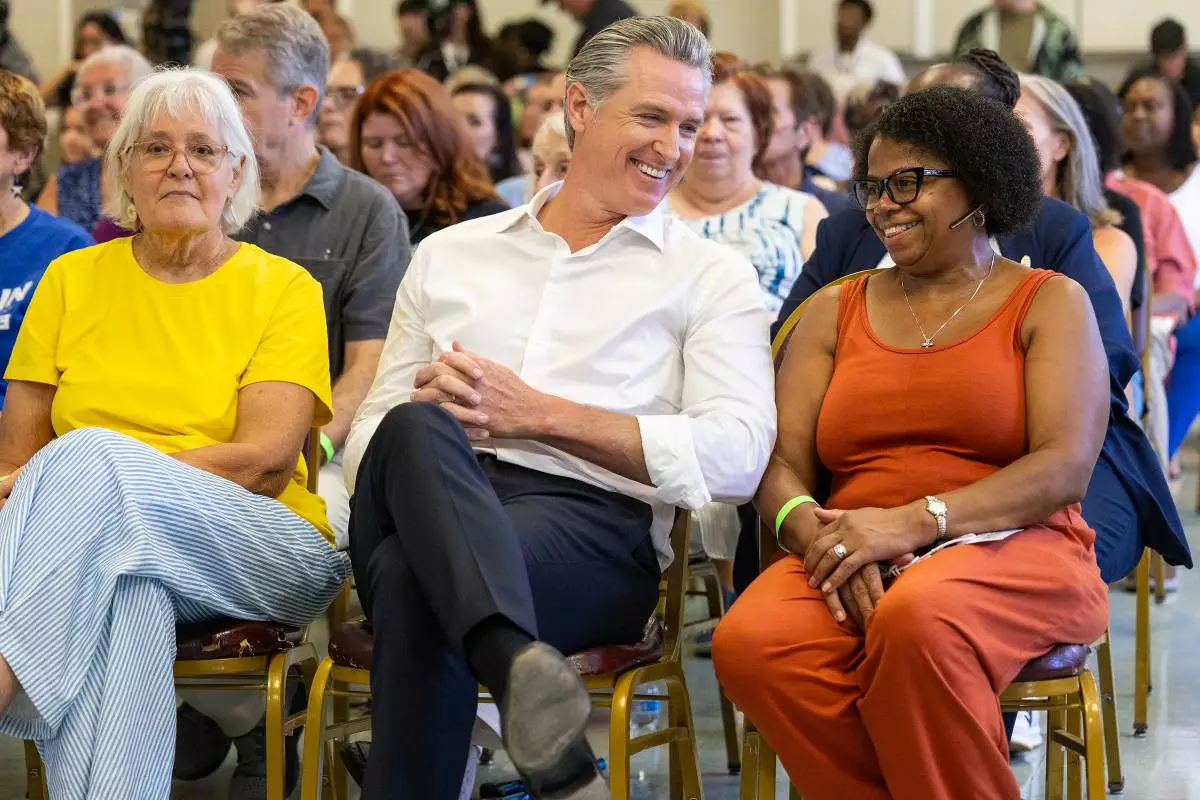
California Gov. Gavin Newsom speaks to supporters during a campaign event at the Brookland-Lakeview Empowerment Center, Friday, Sept. 4, 2026, in West Columbia, S.C. (AP Photo/Mic Smith)
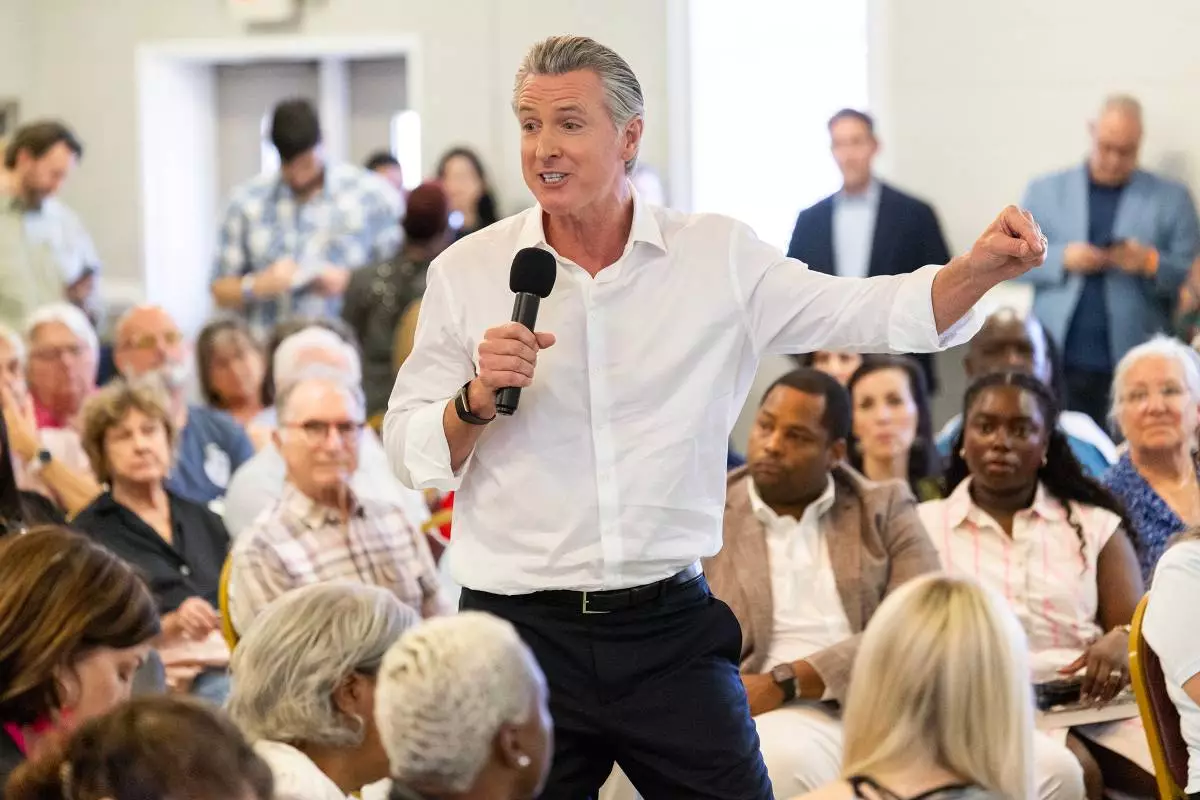
California Gov. Gavin Newsom shares a laugh with Dianne Kittrell, right, during a campaign event at the Brookland-Lakeview Empowerment Center, Friday, Sept. 4, 2026, in West Columbia, S.C. (AP Photo/Mic Smith)

California Gov. Gavin Newsom shares a laugh with Dianne Kittrell, right, during a campaign event at the Brookland-Lakeview Empowerment Center, Friday, Sept. 4, 2026, in West Columbia, S.C. (AP Photo/Mic Smith)
California Gov. Gavin Newsom speaks to supporters during a campaign event at the Brookland-Lakeview Empowerment Center, Friday, Sept. 4, 2026, in West Columbia, S.C. (AP Photo/Mic Smith)
California Gov. Gavin Newsom speaks to supporters during a campaign event at the Brookland-Lakeview Empowerment Center, Friday, Sept. 4, 2026, in West Columbia, S.C. (AP Photo/Mic Smith)
WASHINGTON (AP) — More than a year after President Donald Trump deployed National Guard members to begin patrolling the streets of the nation's capital, a federal appeals court on Wednesday opened a hearing on the legality of his action by asking the government if there were any limits on a president's authority to do so.

The hearing began with the three-judge panel collectively questioning the government’s attorney, Eric McArthur. Judge Cornelia T.L. Pillard asked how the government's argument about an administration's authorities was “not federalization and therefore running up against" the Posse Comitatus Act, an 1878 U.S. law forbidding the use of the federal military for domestic law enforcement unless authorized by the Constitution or Congress.

McArthur, answering Judge Judith Rogers' question on the limits of a president's action, said, “I think the limiting principle in our position is the president has to be calling out the guard in aid of the civil authorities.”

Trump deployed the guard in August 2025 as part of what he said was a crime-fighting mission in Washington, D.C. The force, which rose to a peak of about 5,000 troops over the summer, has supported arrest operations, patrolled city streets and neighborhoods and participated in cleanup efforts.

Trump’s Republican administration says the deployment has contributed to a decrease in crime in the city, where crime was already on the decline before the National Guard arrived. Officials and activists in the overwhelmingly Democratic city say the deployment is a waste of taxpayer money and has normalized the militarization of a major American city.

Mitchell Reich, who was arguing for D.C., did not escape the hearing unscathed, with the panel concentrating on his argument that there are laws and guidelines that lay out a president's ability to call out the guard and there were circumstances when those steps would be unnecessary, including during an invasion or an insurrection.

“If there’s any kind of organized violence in the district, the president can deploy the guard for the purpose of suppressing the same,” he said.

The 90-minute hearing came months after a different three-judge panel paused a lower court’s ruling that Trump's deployment of the guard was illegal.

The three judges who issued the stay last December — two appointed by Trump and one appointed by President Barack Obama, a Democrat — said in a unanimous 32-page ruling that a number of factors favored the Trump administration, including the “disruption to the lives of thousands of service members,” as well as what it said was the president’s interest “in the protection of federal governmental functions and property within the nation’s capital.”

The three judges on the panel on Wednesday were nominated by Democratic presidents: Pillard by Obama, Rogers by Bill Clinton and Bradley Garcia by Joe Biden.

At the heart of the court case, brought by D.C.'s attorney general, is whether the president has the authority to deploy the National Guard to the city, which, as a federal district, has limited autonomy over its own affairs. The U.S. Constitution gives federal lawmakers authority over the District of Columbia, while the Home Rule Act of 1973 lets residents elect a mayor, a council and neighborhood commissioners.

The city has argued that the mobilization is an illegal use of the military for domestic law enforcement, a point Reich made during the hearing.

Last December, the three-judge panel that paused the lower court's ruling said Trump might prevail in his argument that the president “possesses a unique power” to mobilize the guard in Washington.

Those judges found that the district “has not identified any ongoing injury to its statutory interests.”

Even if D.C. wins at the appeals court level, the Trump administration will undoubtedly go to the U.S. Supreme Court, which has already shown deference to the president in a number of cases.

Syracuse law professor William Banks said D.C. might have a slim argument under its home rule, questioning whether National Guard units can be deployed to the city when it isn’t authorized by local law.

But, he said, outside of that argument “there is no overarching federal principle that would bail out the district in this case."

Because D.C. is not a state and because the president is commander in chief, there’s a "tremendous amount of leeway and discretion for the president” to control or delegate control of the local National Guard and out-of-state units, Banks said.

U.S. District Judge Jia Cobb concluded last November that Trump’s military takeover in Washington illegally intrudes on local officials’ authority to direct law enforcement in the district.

Cobb, a Biden nominee, found that while the president does have authority to protect federal functioning and property, he can’t unilaterally deploy the D.C. National Guard to help with crime control as he sees fit or call in troops from other states.

The appeals court stayed the order and has allowed the guard to remain in place while the case is pending.

The mobilization, extended until January 2029 by the Defense Department, has taken on a sense of permanence, despite the court case.

The federal government awarded a $292 million contract to a private company to provide members of the Joint Task Force-D.C. with apartments. The numbers have grown as well, ballooning to around 5,000 during the height of the semiquincentennial celebration. As of last week, that number had dropped to about 2,900.

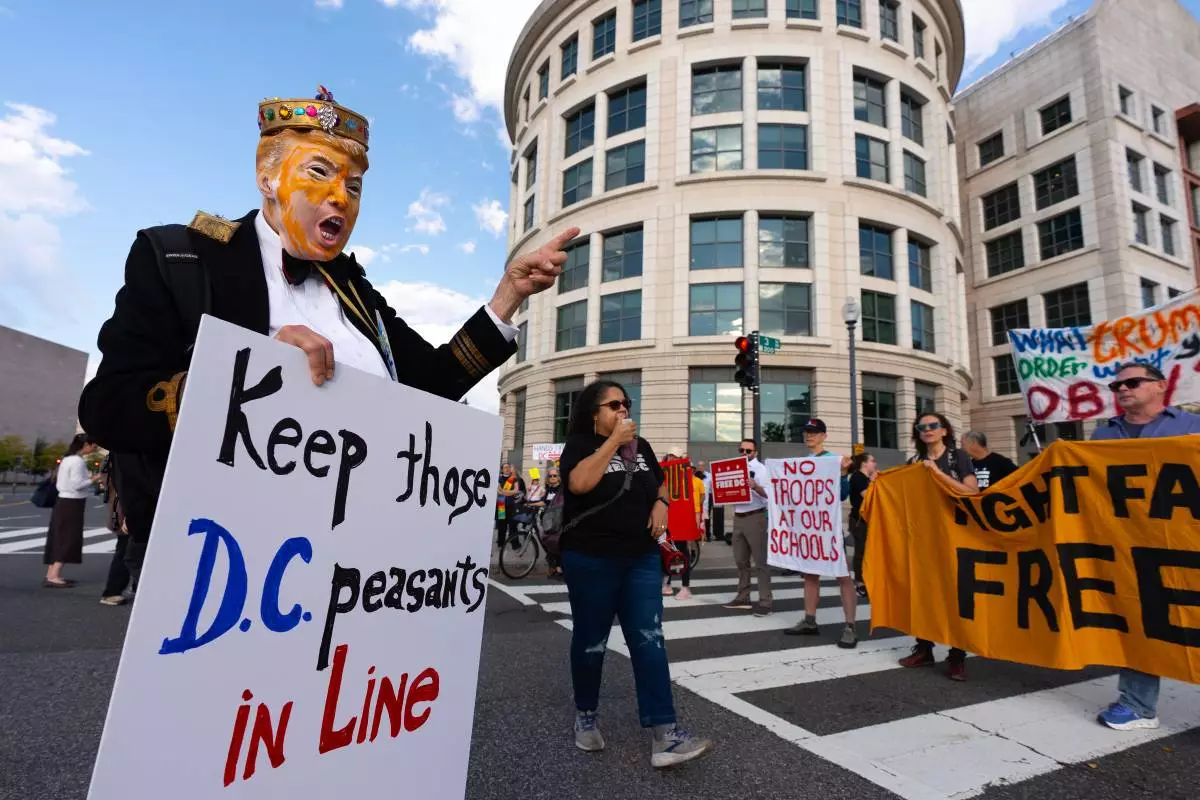
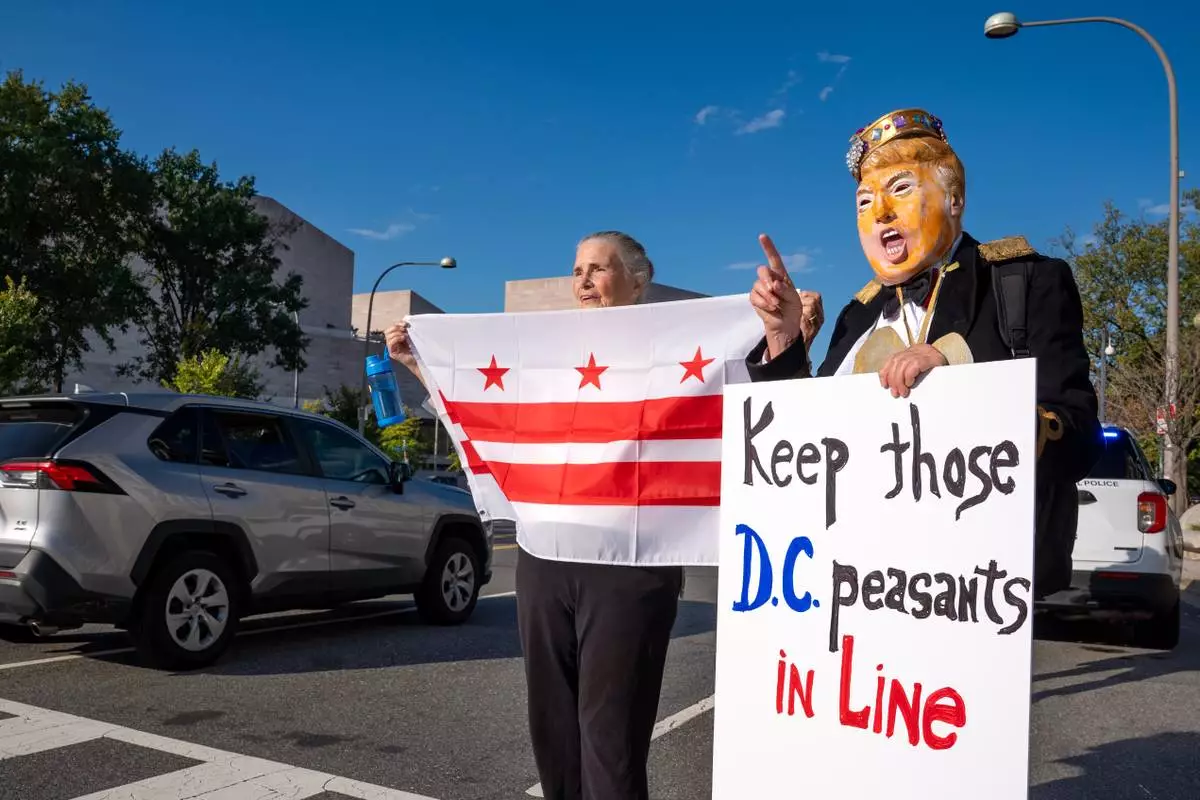
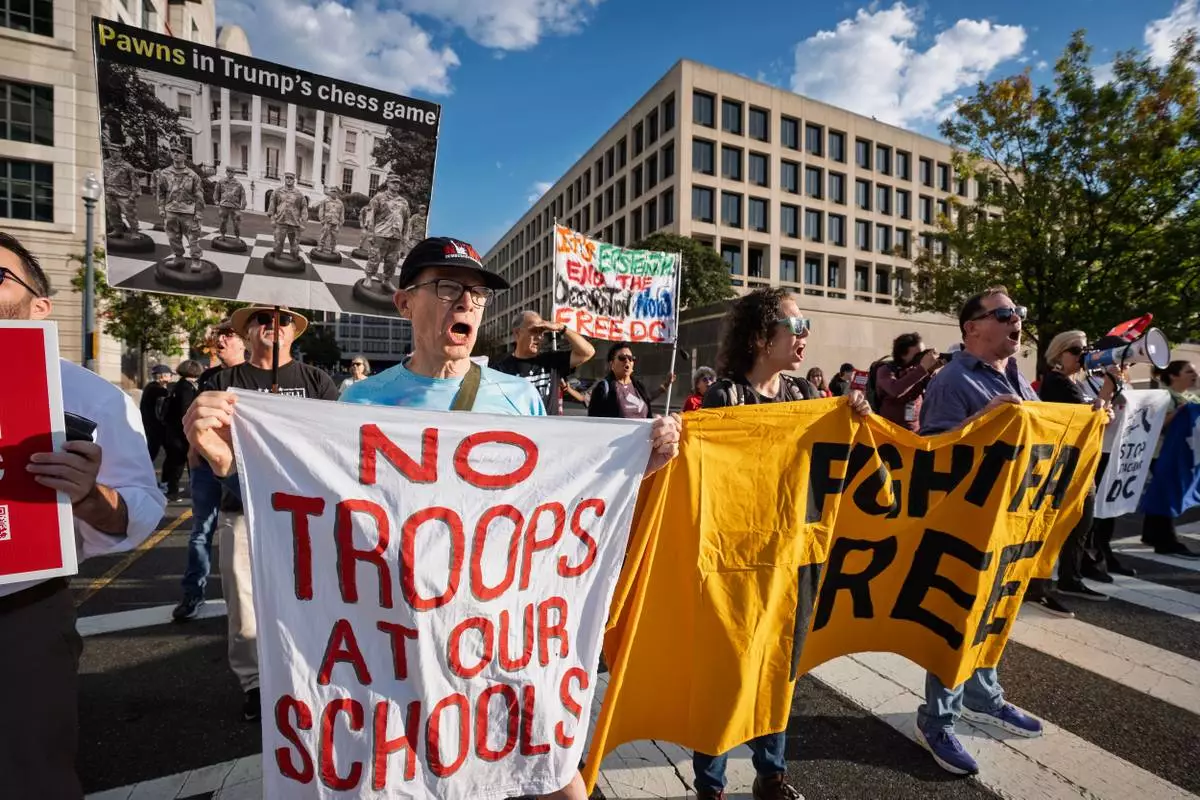
Before the hearing began, several dozen people rallied outside the courthouse to oppose the continuing presence of the military in the city.

David Barrows, a retired office manager and city resident, was dressed in a Trump costume. “It’s easier to boss around the people in Washington, D.C., because we don’t have any representation in either House or Congress. So we’re basically an abused people,” he said. “We pay the highest federal taxes in the land, and we get no representation in both houses. So we’re a cheated people, and we’re scapegoats for Trump.”

He also questioned the premise of the guard's presence: “There's no national emergency here in Washington,” he said.

Jennifer Pace, a longtime resident and former banker, said she suspected the case would continue through the courts.

“But I really want it to move forward so they can just go home,” Pace said. "I’m sure they want to go home, too, because it’s clear they’re bored. They’re just standing around.”

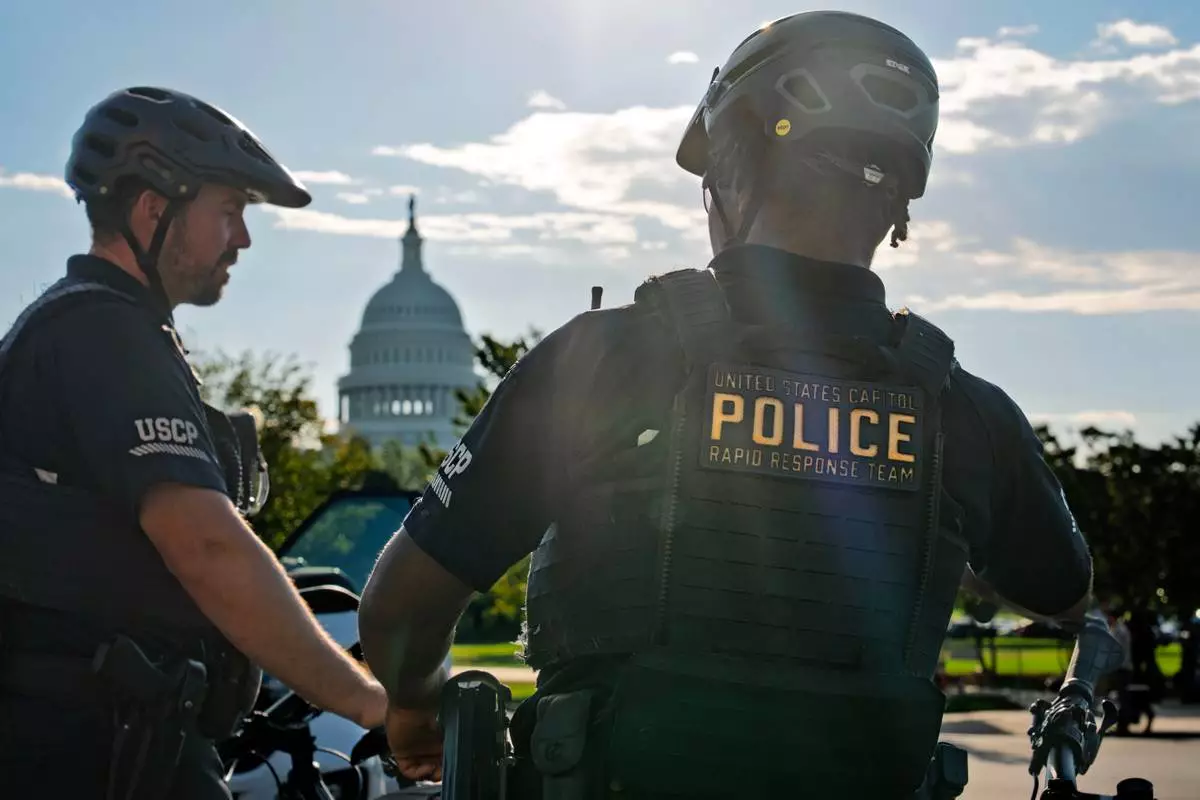
U.S. Capitol Police secure an intersection near the Capitol as activists stop traffic and call for the ouster of President Donald Trump's National Guard deployment in Washington, Wednesday, Oct. 14, 2026. (AP Photo/J. Scott Applewhite)

U.S. Capitol Police secure an intersection near the Capitol as activists stop traffic and call for the ouster of President Donald Trump's National Guard deployment in Washington, Wednesday, Oct. 14, 2026. (AP Photo/J. Scott Applewhite)

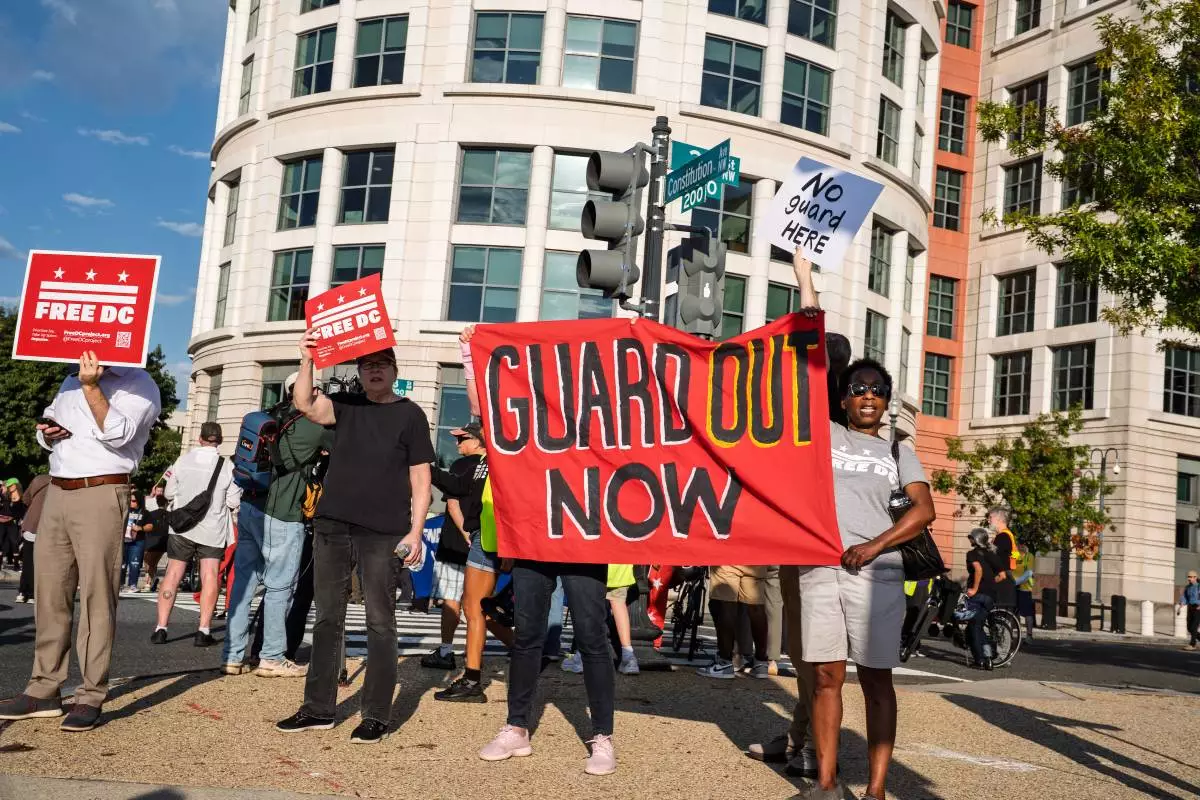
Protestors near the federal courthouse stop traffic and call for the ouster of President Donald Trump's National Guard deployment in Washington, Wednesday, Oct. 14, 2026. (AP Photo/J. Scott Applewhite)

Protestors near the federal courthouse stop traffic and call for the ouster of President Donald Trump's National Guard deployment in Washington, Wednesday, Oct. 14, 2026. (AP Photo/J. Scott Applewhite)

Protestors near the Capitol stop traffic and call for the ouster of President Donald Trump's National Guard deployment in Washington, Wednesday, Oct. 14, 2026. (AP Photo/J. Scott Applewhite)

Protestors near the Capitol stop traffic and call for the ouster of President Donald Trump's National Guard deployment in Washington, Wednesday, Oct. 14, 2026. (AP Photo/J. Scott Applewhite)

Protestors near the federal courthouse stop traffic and call for the ouster of President Donald Trump's National Guard deployment in Washington, Wednesday, Oct. 14, 2026. (AP Photo/J. Scott Applewhite)

Protestors near the federal courthouse stop traffic and call for the ouster of President Donald Trump's National Guard deployment in Washington, Wednesday, Oct. 14, 2026. (AP Photo/J. Scott Applewhite)

Protestors near the federal courthouse stop traffic and call for the ouster of President Donald Trump's National Guard deployment in Washington, Wednesday, Oct. 14, 2026. (AP Photo/J. Scott Applewhite)

Protestors near the federal courthouse stop traffic and call for the ouster of President Donald Trump's National Guard deployment in Washington, Wednesday, Oct. 14, 2026. (AP Photo/J. Scott Applewhite)

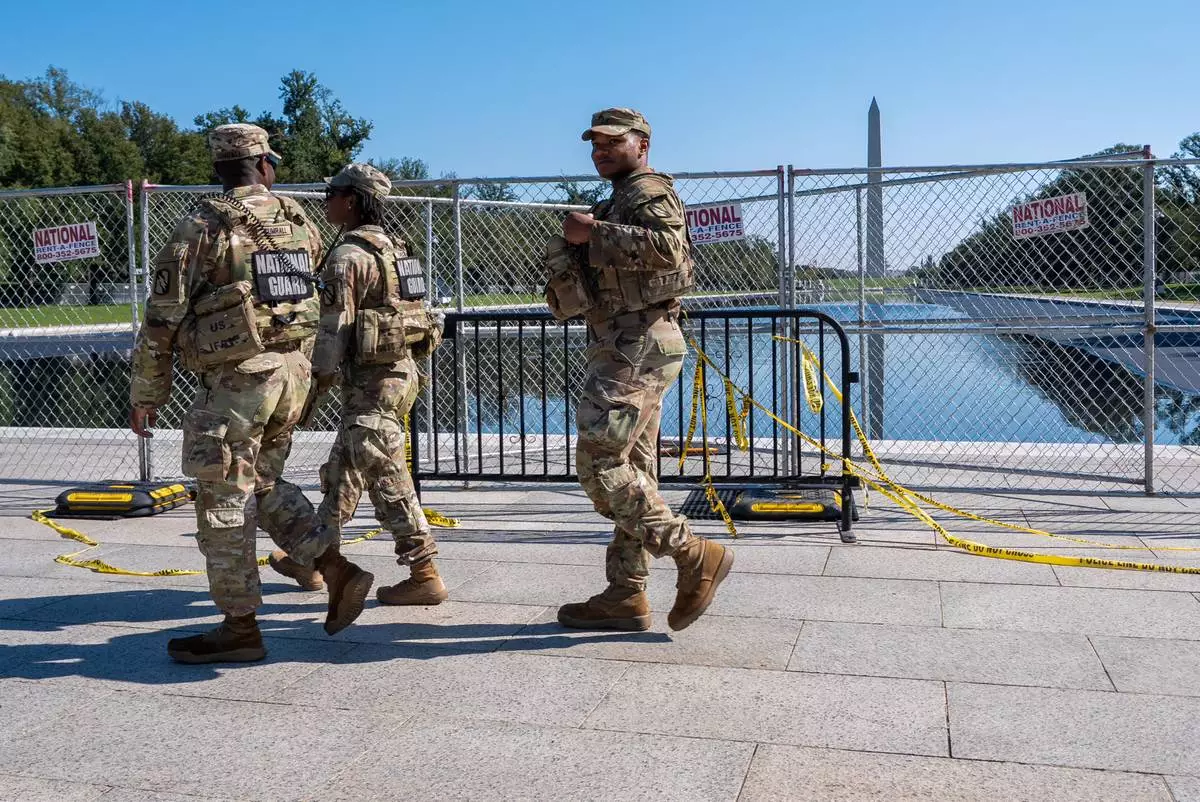
Members of the National Guard walk past the Lincoln Memorial Reflecting Pool, where some water can be seen, Tuesday, Oct. 13, 2026, in Washington. (AP Photo/Jacquelyn Martin)

Members of the National Guard walk past the Lincoln Memorial Reflecting Pool, where some water can be seen, Tuesday, Oct. 13, 2026, in Washington. (AP Photo/Jacquelyn Martin)

Recommended Articles