Skip to Content Facebook Feature Image

Body of war criminal Mladic lies in state in Serbian capital ahead of funeral

News

Body of war criminal Mladic lies in state in Serbian capital ahead of funeral
News

News

Body of war criminal Mladic lies in state in Serbian capital ahead of funeral

2026-09-07 17:02 Last Updated At:17:10

BELGRADE, Serbia (AP) — The body of Ratko Mladic, the Bosnian Serb commander who died while serving a life sentence for war crimes, lay in state on Monday as Serbia defied European Union warnings against allowing public homage to the man found guilty of the continent’s first case of genocide since World War II.

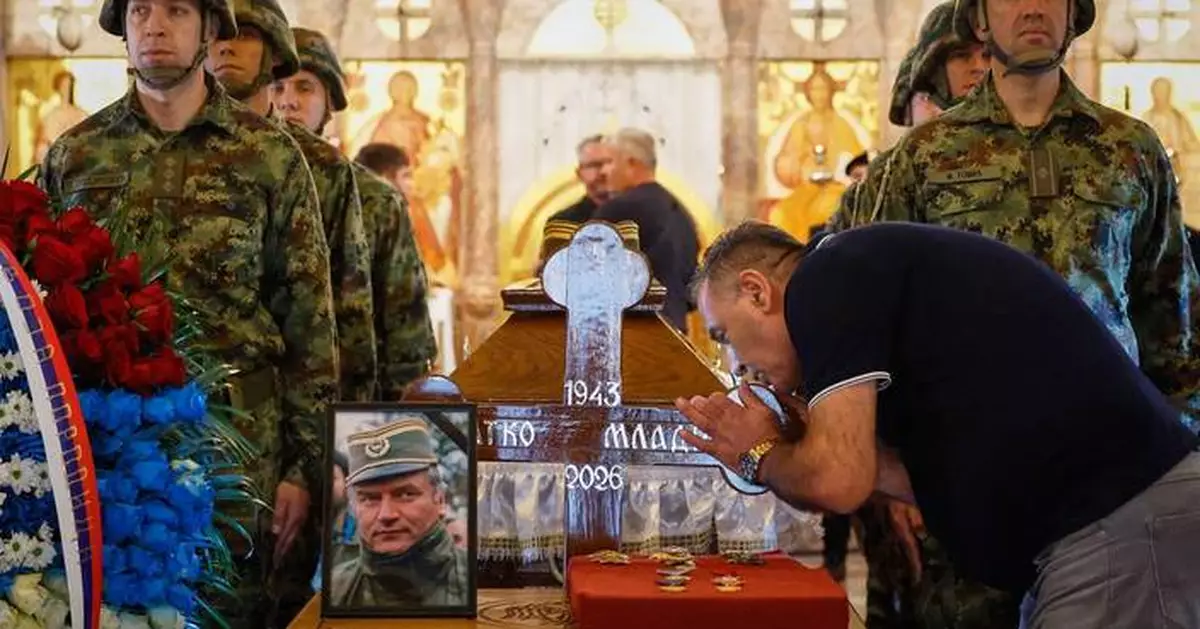
Thousands of mourners arrived early at the small Serbian Orthodox Church of St. Luke in Belgrade to honor Mladic, who is still viewed as a hero by many Serbs. His military officer's cap and saber rested on the coffin, which was flanked by men in fatigues.

More Images
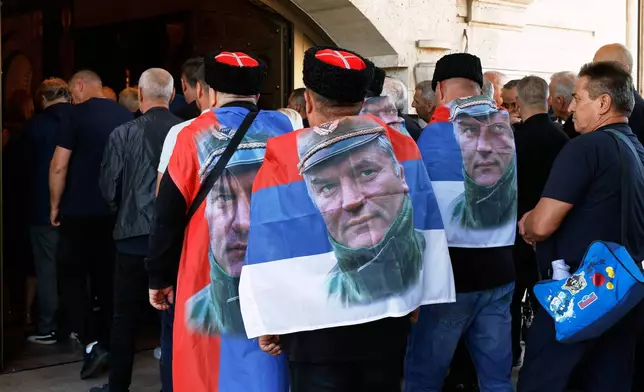
People line up to pay their respects to the former Bosnian Serb army commander Ratko Mladic, seen on the flags, who died last week while serving a life sentence for genocide and other atrocities during the war in Bosnia, at the St. Luka Church, in Belgrade, Serbia, Monday, Sept. 7, 2026. (AP Photo/Marko Drobnjakovic)
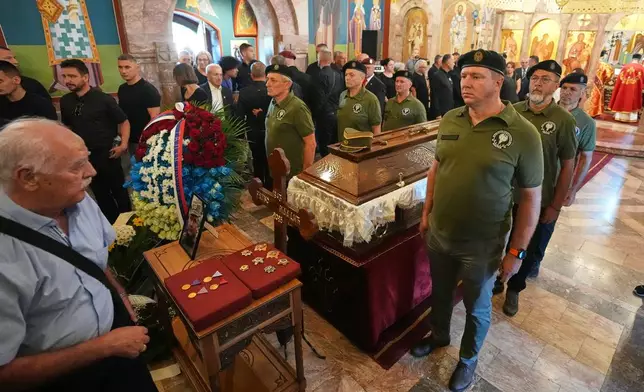
People line up to pay their respects to the former Bosnian Serb army commander Ratko Mladic, seen on the flags, who died last week while serving a life sentence for genocide and other atrocities during the war in Bosnia, at the St. Luka Church, in Belgrade, Serbia, Monday, Sept. 7, 2026. (AP Photo/Marko Drobnjakovic)

People line up to pay their respects as Serbian war veterans stand around the coffin of the former Bosnian Serb army commander Ratko Mladic, who died last week while serving a life sentence for genocide and other atrocities during the war in Bosnia, at the St. Luka Church, in Belgrade, Serbia, Monday, Sept. 7, 2026. (AP Photo/Darko Vojinovic)
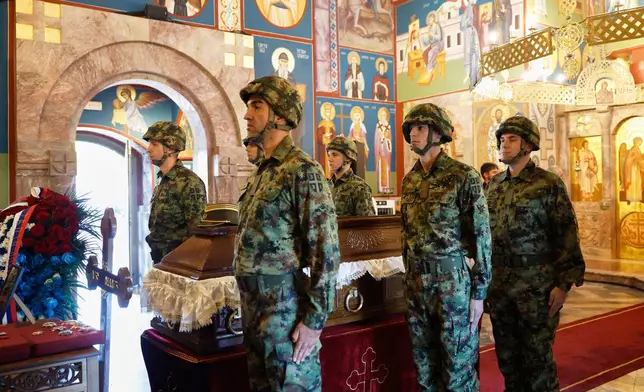
People line up to pay their respects as Serbian war veterans stand around the coffin of the former Bosnian Serb army commander Ratko Mladic, who died last week while serving a life sentence for genocide and other atrocities during the war in Bosnia, at the St. Luka Church, in Belgrade, Serbia, Monday, Sept. 7, 2026. (AP Photo/Darko Vojinovic)

Serbian national military servicemen stand around the coffin of the former Bosnian Serb army commander Ratko Mladic, who died last week while serving a life sentence for genocide and other atrocities during the war in Bosnia, at the St. Luka Church, in Belgrade, Serbia, Monday, Sept. 7, 2026. (AP Photo/Marko Drobnjakovic)
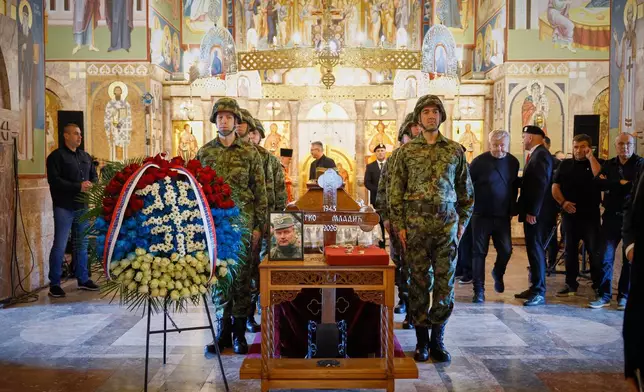
Serbian national military servicemen stand around the coffin of the former Bosnian Serb army commander Ratko Mladic, who died last week while serving a life sentence for genocide and other atrocities during the war in Bosnia, at the St. Luka Church, in Belgrade, Serbia, Monday, Sept. 7, 2026. (AP Photo/Marko Drobnjakovic)
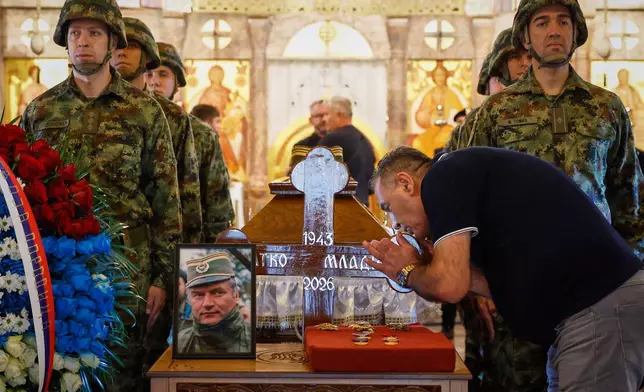
A man touches the cross as Serbian national military servicemen stand around the coffin of the former Bosnian Serb army commander Ratko Mladic, who died last week while serving a life sentence for genocide and other atrocities during the war in Bosnia, at the St. Luka Church, in Belgrade, Serbia, Monday, Sept. 7, 2026. (AP Photo/Marko Drobnjakovic)

A man touches the cross as Serbian national military servicemen stand around the coffin of the former Bosnian Serb army commander Ratko Mladic, who died last week while serving a life sentence for genocide and other atrocities during the war in Bosnia, at the St. Luka Church, in Belgrade, Serbia, Monday, Sept. 7, 2026. (AP Photo/Marko Drobnjakovic)

A man touches the cross as Serbian national military servicemen stand around the coffin of the former Bosnian Serb army commander Ratko Mladic, who died last week while serving a life sentence for genocide and other atrocities during the war in Bosnia, at the St. Luka Church, in Belgrade, Serbia, Monday, Sept. 7, 2026. (AP Photo/Marko Drobnjakovic)

A man touches the cross as Serbian national military servicemen stand around the coffin of the former Bosnian Serb army commander Ratko Mladic, who died last week while serving a life sentence for genocide and other atrocities during the war in Bosnia, at the St. Luka Church, in Belgrade, Serbia, Monday, Sept. 7, 2026. (AP Photo/Marko Drobnjakovic)

Pro-government media in Serbia reported that Mladic will receive full military honors while the head of the Serbian Orthodox Church, Patriarch Porfirije, will lead the funeral service.

Mladic “was a man who gave everything in his life for the Serbian people,” said Milan Dobric, a mourner who traveled from Kosovo for the funeral. “I am glad that this morning people are coming to pay special respect.”

Mladic died at 84 on Aug. 27 in The Hague, Netherlands, while serving a life sentence for genocide, war crimes and crimes against humanity his troops committed during the Bosnian war in 1992-95.

While the funeral arrangements were formally made by Mladic's family, the Serbian government sent a plane last week to bring his remains to Belgrade, and soldiers carried his coffin wrapped in the national flag. A military commemoration was held Saturday at an official Serbian army venue.

Populist President Aleksandar Vucic, a former extreme nationalist who supported Serbia’s expansionist policies during the war, described the funeral as an “emotional outpouring” that “has nothing to do with whether Vucic allowed something or not.”

Serbia is a candidate nation for European Union membership and has faced strong criticism for honoring Mladic after his death.

Marta Kos, the enlargement commissioner for the bloc, canceled an upcoming visit to Serbia in protest, arguing that “the glorification surrounding his death is incompatible with the values on which the EU path is built.”

Serbia, which backed Bosnian Serb forces during the war, remains defiant over its wartime role and accuses the West of anti-Serb bias.

Vucic said that "we (Serbs) have been persecuted and harassed for 30, 40 years ... always guilty whatever happens,” He added that “people just won’t take it any more.”

Vucic, who is not attending the funeral, previously has accused Kos of “lying.” The Serbian president has stepped up his anti-Western rhetoric ahead of an early parliamentary election expected next month.

A number of other European officials joined the criticism of Serbia, along with regional leaders and relatives of Mladic's victims from the war in Bosnia. The conflict left more than 100,000 people dead and over 1 million homeless before it ended in 1995 in a U.S.-brokered peace agreement.

Mladic was sentenced in 2017 for orchestrating the massacre of more than 8,000 Muslims in Srebrenica in 1995; the yearslong siege of the Bosnian capital of Sarajevo and other war crimes, including setting up concentration camps for detained non-Serb civilians and enemy soldiers.

Since Mladic died, his nationalist admirers have held vigils, painted a series of murals with his image in Belgrade and lit flares in his honor. On Sunday evening, soccer fans displayed a huge image of Mladic and chanted his name at a match in Belgrade.

Serbia has refused to recognize that genocide was committed in Srebrenica, calling the massacre a “horrific crime” instead. Last year, Serbia buried another convicted war criminal, the former army chief of staff Nebojsa Pavkovic, with full military honors at a cemetery for distinguished individuals.

The Balkan nation's EU bid has stalled due to democratic backsliding and Vucic’s refusal to join international sanctions against Russia over the invasion of Ukraine.

A U.N. “safe haven” for Bosniaks (Bosnian Muslims), Srebrenica ended up being overrun by Serbs who forced men and boys to strip, killed them and bulldozed their bodies into mass graves. The war started after the breakup of the former Yugoslavia when ethnic Serbs in Bosnia took control over swaths of Bosnian territory to form a country of their own and unite it with Serbia.
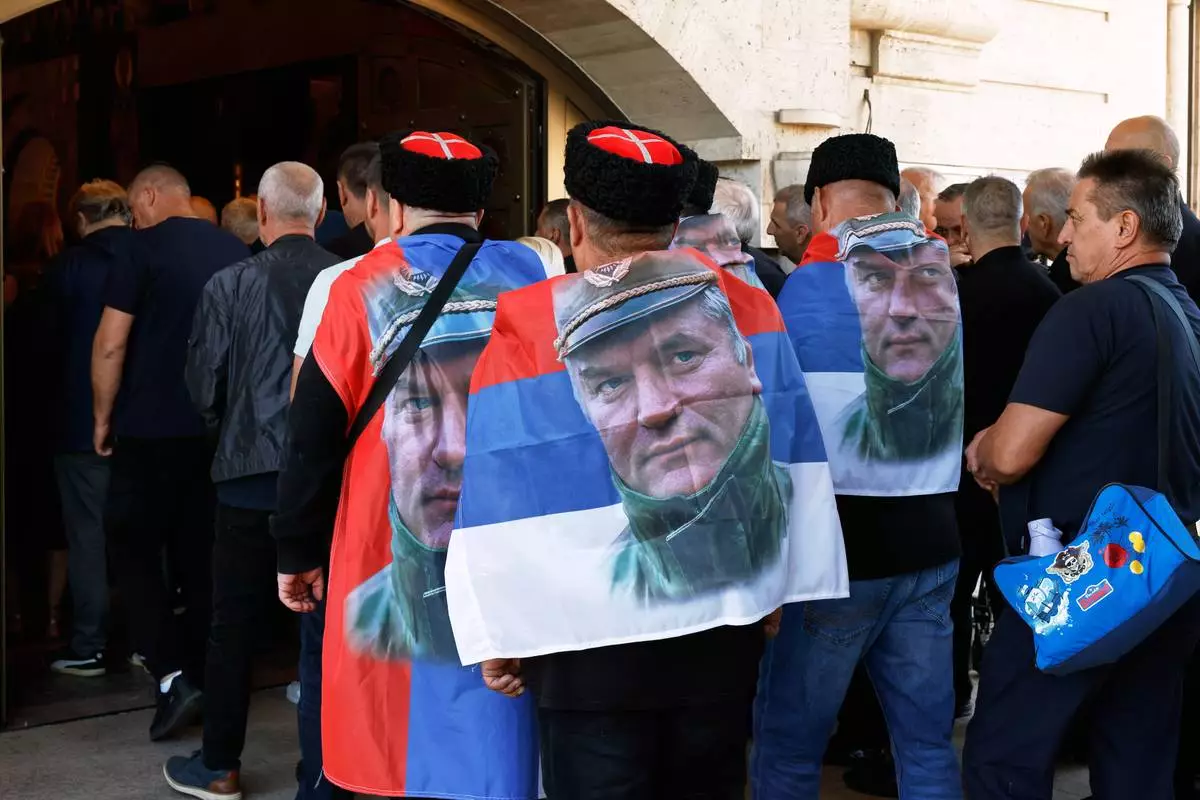
People line up to pay their respects to the former Bosnian Serb army commander Ratko Mladic, seen on the flags, who died last week while serving a life sentence for genocide and other atrocities during the war in Bosnia, at the St. Luka Church, in Belgrade, Serbia, Monday, Sept. 7, 2026. (AP Photo/Marko Drobnjakovic)
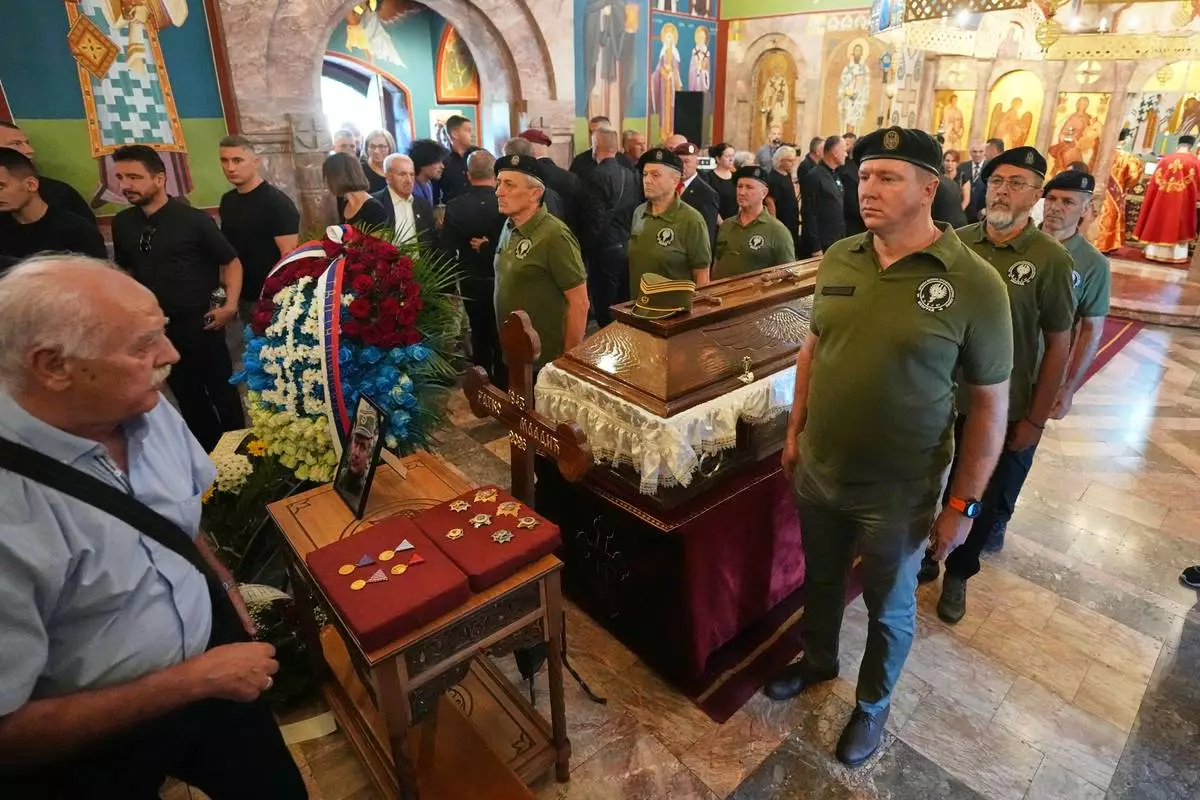
People line up to pay their respects to the former Bosnian Serb army commander Ratko Mladic, seen on the flags, who died last week while serving a life sentence for genocide and other atrocities during the war in Bosnia, at the St. Luka Church, in Belgrade, Serbia, Monday, Sept. 7, 2026. (AP Photo/Marko Drobnjakovic)

People line up to pay their respects as Serbian war veterans stand around the coffin of the former Bosnian Serb army commander Ratko Mladic, who died last week while serving a life sentence for genocide and other atrocities during the war in Bosnia, at the St. Luka Church, in Belgrade, Serbia, Monday, Sept. 7, 2026. (AP Photo/Darko Vojinovic)
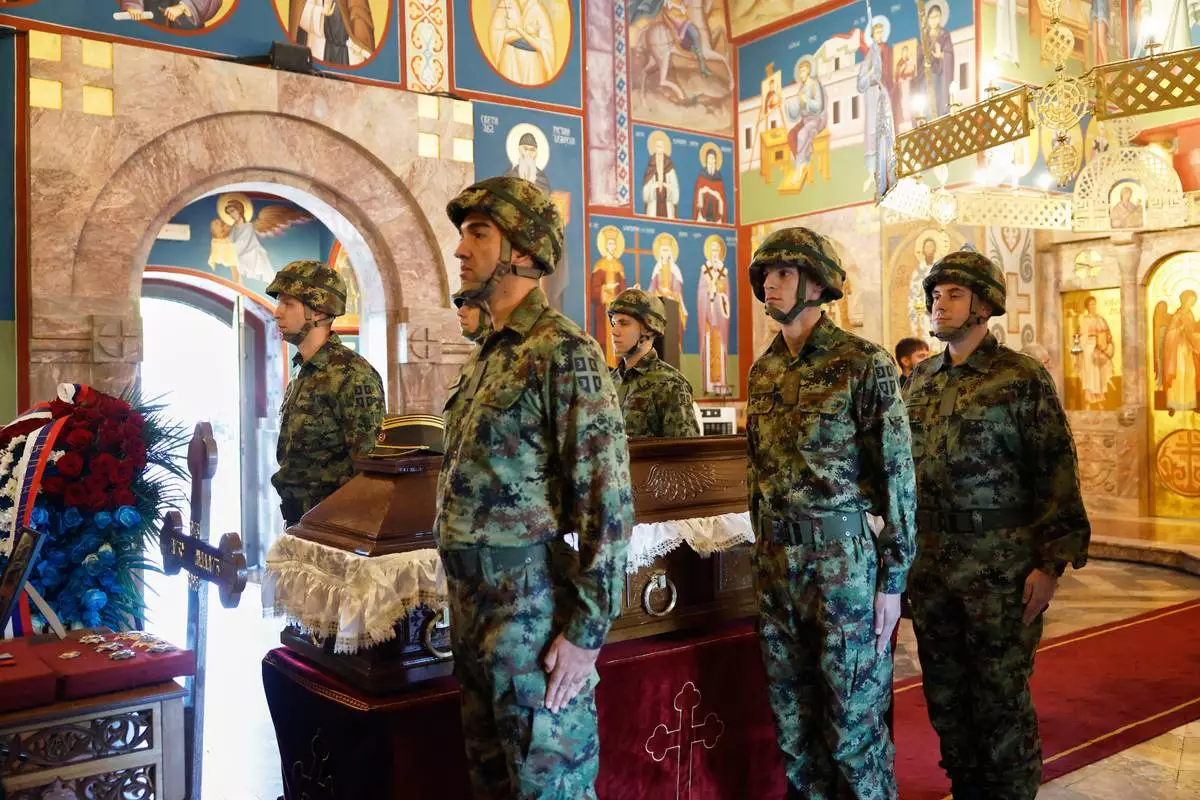
People line up to pay their respects as Serbian war veterans stand around the coffin of the former Bosnian Serb army commander Ratko Mladic, who died last week while serving a life sentence for genocide and other atrocities during the war in Bosnia, at the St. Luka Church, in Belgrade, Serbia, Monday, Sept. 7, 2026. (AP Photo/Darko Vojinovic)

Serbian national military servicemen stand around the coffin of the former Bosnian Serb army commander Ratko Mladic, who died last week while serving a life sentence for genocide and other atrocities during the war in Bosnia, at the St. Luka Church, in Belgrade, Serbia, Monday, Sept. 7, 2026. (AP Photo/Marko Drobnjakovic)
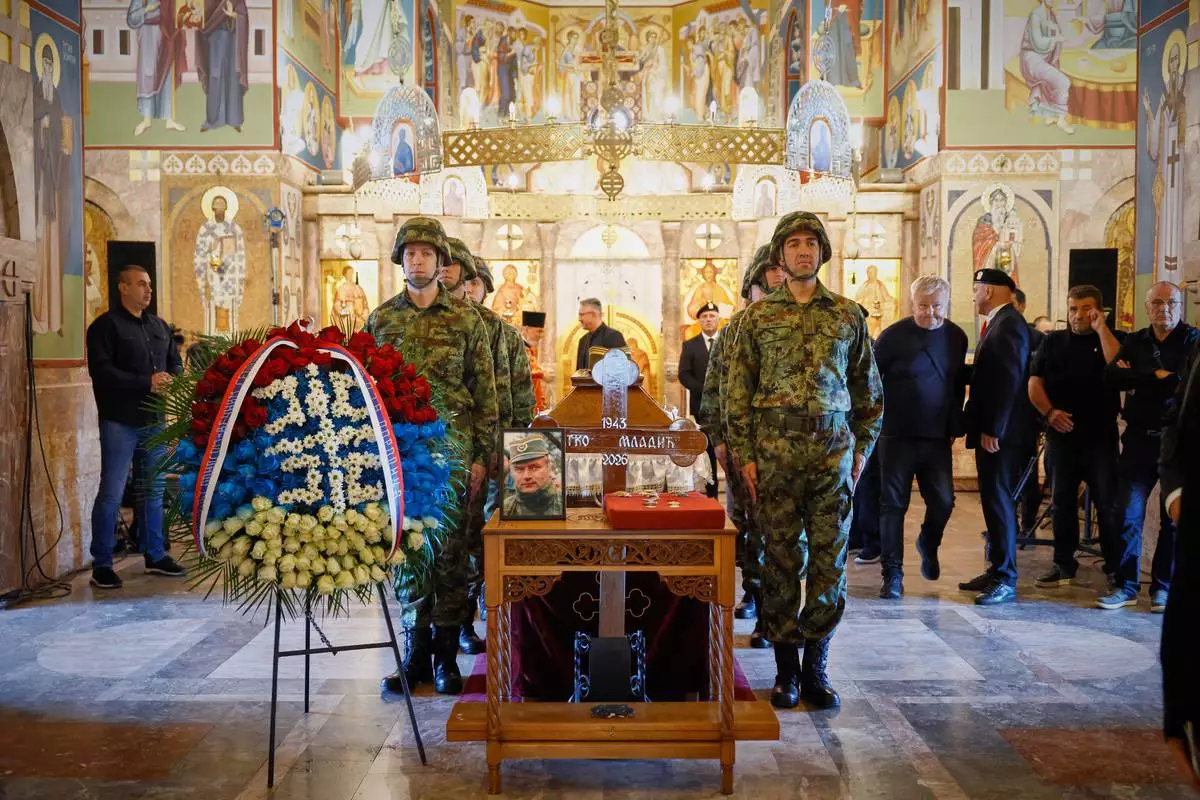
Serbian national military servicemen stand around the coffin of the former Bosnian Serb army commander Ratko Mladic, who died last week while serving a life sentence for genocide and other atrocities during the war in Bosnia, at the St. Luka Church, in Belgrade, Serbia, Monday, Sept. 7, 2026. (AP Photo/Marko Drobnjakovic)
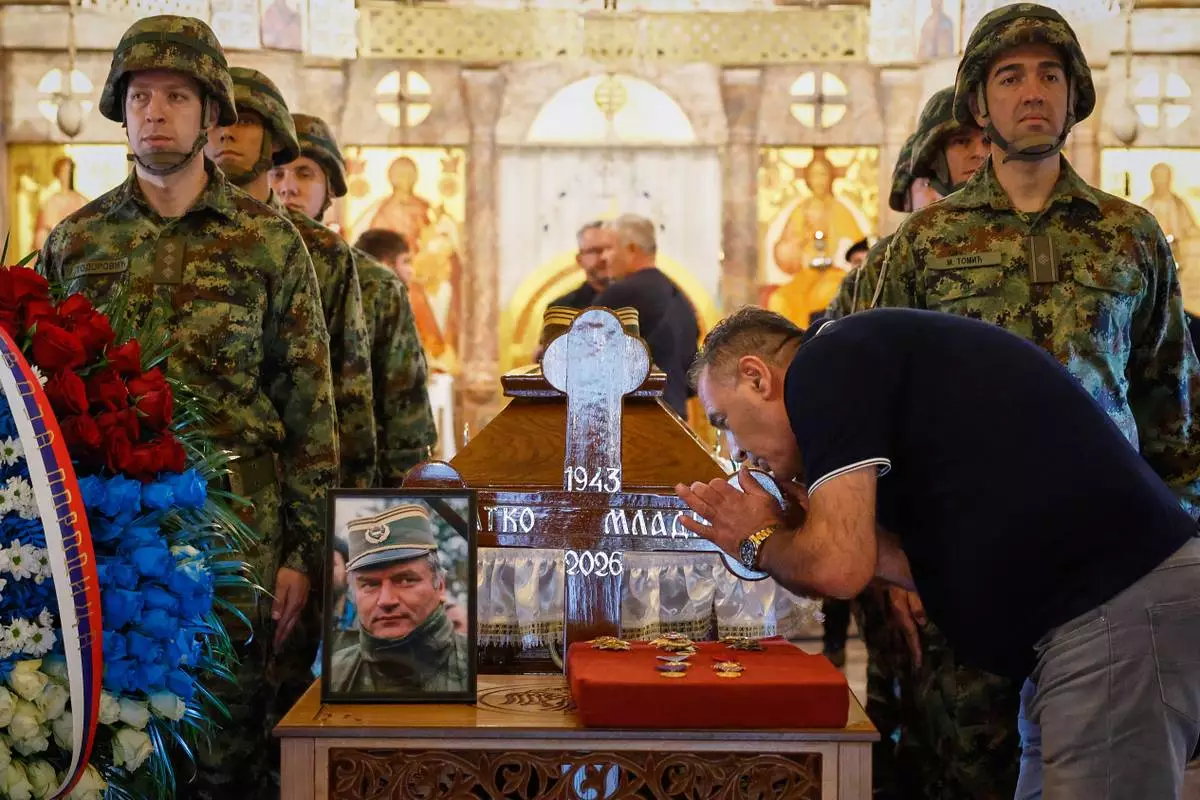
A man touches the cross as Serbian national military servicemen stand around the coffin of the former Bosnian Serb army commander Ratko Mladic, who died last week while serving a life sentence for genocide and other atrocities during the war in Bosnia, at the St. Luka Church, in Belgrade, Serbia, Monday, Sept. 7, 2026. (AP Photo/Marko Drobnjakovic)

A man touches the cross as Serbian national military servicemen stand around the coffin of the former Bosnian Serb army commander Ratko Mladic, who died last week while serving a life sentence for genocide and other atrocities during the war in Bosnia, at the St. Luka Church, in Belgrade, Serbia, Monday, Sept. 7, 2026. (AP Photo/Marko Drobnjakovic)

A man touches the cross as Serbian national military servicemen stand around the coffin of the former Bosnian Serb army commander Ratko Mladic, who died last week while serving a life sentence for genocide and other atrocities during the war in Bosnia, at the St. Luka Church, in Belgrade, Serbia, Monday, Sept. 7, 2026. (AP Photo/Marko Drobnjakovic)
A man touches the cross as Serbian national military servicemen stand around the coffin of the former Bosnian Serb army commander Ratko Mladic, who died last week while serving a life sentence for genocide and other atrocities during the war in Bosnia, at the St. Luka Church, in Belgrade, Serbia, Monday, Sept. 7, 2026. (AP Photo/Marko Drobnjakovic)
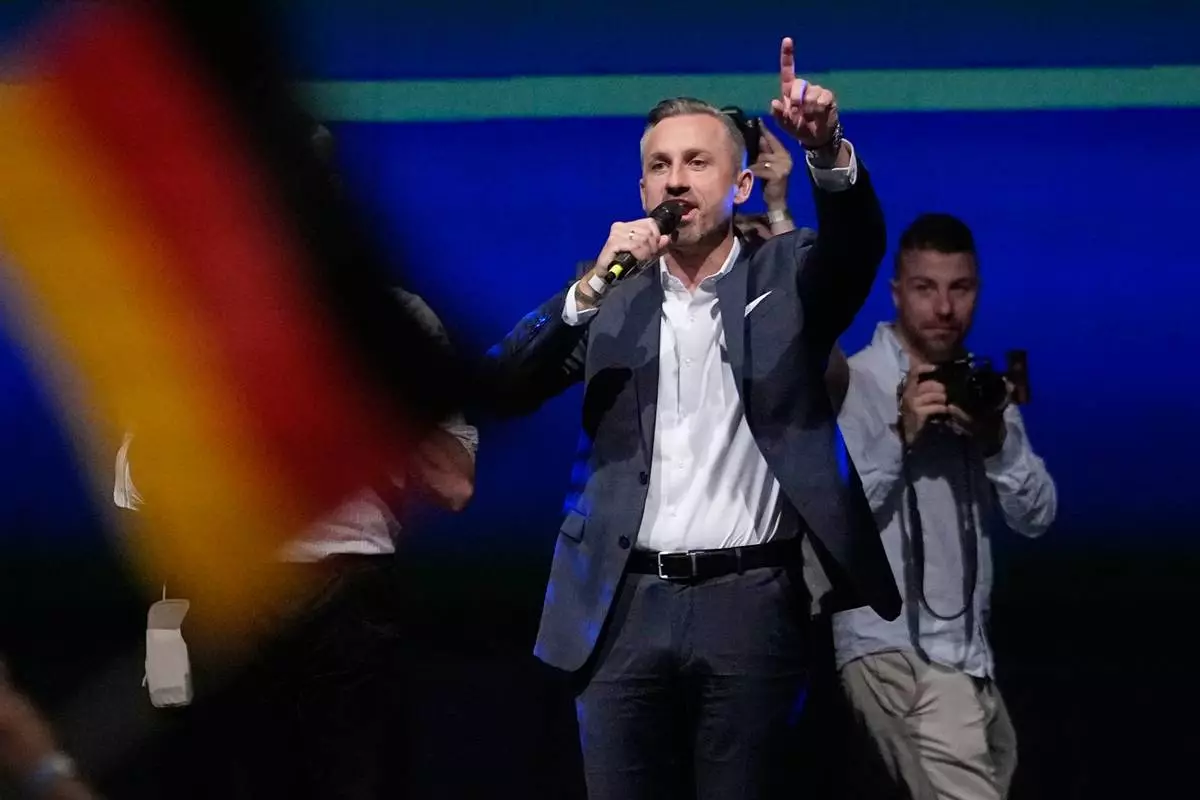
BERLIN (AP) — German Chancellor Friedrich Merz was facing pressure Monday after his party was crushed by the Alternative for Germany party in a regional election that could result in it leading the first far-right state government since the Nazi era.

The AfD, classified by Germany's domestic intelligence agency as an extremist group in some regions of the country, fell just short of a majority in Sunday's election in the eastern state of Saxony-Anhalt.

While Sunday's election was only regional, it has major national implications. Merz had vowed to weaken the AfD when he came to office, and the election result shows that he has been unable to deliver on that promise.

AfD's strong victory is also a major distraction for Germany and Merz at a time when Europe faces several challenges, including Russia's continued aggression against Ukraine and a suspected sabotage campaign targeting NATO countries, and difficult dealings with U.S. President Donald Trump.

Tricky coalition talks lie ahead, and the AfD candidate for governor, Ulrich Siegmund, still aims to become the first head of government from the far-right party on the state level.

“Very clearly, we want voters finally to get after the election what they voted for,” Siegmund told public broadcaster ZDF late Sunday. “Over 44% voted for political change ... and that must be implemented after the election.”

The vote weakens the chancellor and he will be partly held responsible for his party’s historic loss after it led the state for the past 24 years. Merz’s center-right Christian Democrats party, or CDU, saw its election results cut in half, while AfD more than doubled its share of the vote. The result could also energize the AfD in other state elections later this month.

Merz is expected to comment on the election result later Monday after meetings of his party and government leaders.

AfD, known for its pro-Russian and radical anti-immigration stance, is the biggest opposition party in Germany’s national parliament and is strongest in the formerly communist and less prosperous east, where Saxony-Anhalt is located.

Tricky coalition talks in the state are expected in the days and possibly weeks ahead.

Leading a state government would be the biggest prize for AfD in its 13-year history, coming at a time of widespread discontent with a national government that has yet to persuade voters that it can get the country’s sluggish economy moving.

While Siegmund has rejected an AfD minority government, his party could possibly govern with the hard-left BSW party. The two parties share a Russia-friendly course and oppose immigration but do not agree on some other subjects.

On Monday, BSW's lead candidate in the election, Thomas Schulze, expressed his party's willingness again to help an AfD minister-president take office in the state parliament.

Forming a government that excludes the AfD would only be possible if all the other parties that were elected worked together — CDU, Social Democrats, the Greens, the Left Party, and the BSW. However, a coalition involving five partners would be extremely unusual, very complicated and hardly conceivable.

It's also possible that newly elected lawmakers from other parties could defect to AfD — it would only need three people to get a majority to govern.

Either way, coalition negotiations are going to be complicated and likely it will take weeks to form a new government.

Even though Saxony-Anhalt is one of Germany's smaller states and only 2.1 million people live there, the election received outsized attention, not just in the country but also internationally.

Unlike other countries in Europe, modern Germany hasn’t yet had a far-right or right-wing populist party leading a national, state or major-city government — and due to the country's Nazi past, far-right movements have always received strong scrutiny.

However, not everyone was worried about the victorious emergence of AfD.

Billionaire Elon Musk congratulated the party on its election victory with a “Well done!” on his online platform X.

Siegmund immediately thanked him for his support, replying in English: “If we take on responsibility here, I would very much welcome the opportunity for strong and constructive cooperation. Germany would then once again be a place worth investing in. Best regards from Saxony-Anhalt!”

U.S. President Donald Trump posted a screenshot of the election projection on his “Truth Social” platform without any comment.

Russian presidential envoy Kirill Dmitriev on X described the outcome of the election as a “historic win for the pragmatic AfD that will put migration under control.” In a separate post, Dmitriev said that “AfD will restore Germany and Europe by leading the commons-sense approach that migrant-friendly, warmongering Biden-think EU politicians tried to eradicate.”

The leaders of right-wing populist parties in Spain and Portugal also congratulated AfD, German news agency dpa reported.

“Congratulations to Alice Weidel and Ulrich Siegmund on this spectacular result, which offers great hope for Germany and Europe,” Santiago Abascal, leader of the Spanish party Vox, wrote on X.

In Portugal, André Ventura from the Chega party wrote on X that “Germans, too, are increasingly opening their eyes to illegal and uncontrolled immigration, corruption, and the erosion of our freedom and identity. Congratulations!”

Not everybody was excited about the AfD win.

“In Poland, only idiots or traitors could rejoice the AfD triumph in Germany,” Polish Prime Minister Donald Tusk wrote on X on Monday morning.

AfD won 43.8% of the vote, more than double its showing five years ago in the region west of Berlin.

That was far ahead of Merz’s party, which polled 17.2% — losing about half its support — and won 15 seats. The center-left Social Democrats polled 9.3%, the Greens 8.9% and the Left Party 8.6%, winning eight seats apiece.

The BSW party took 5.3% and five seats.

Turnout was very high at 77.8%. AfD appeared to have won over many people who didn’t vote at all five years ago.

AP journalist Claudia Ciobanu contributed from Warsaw.

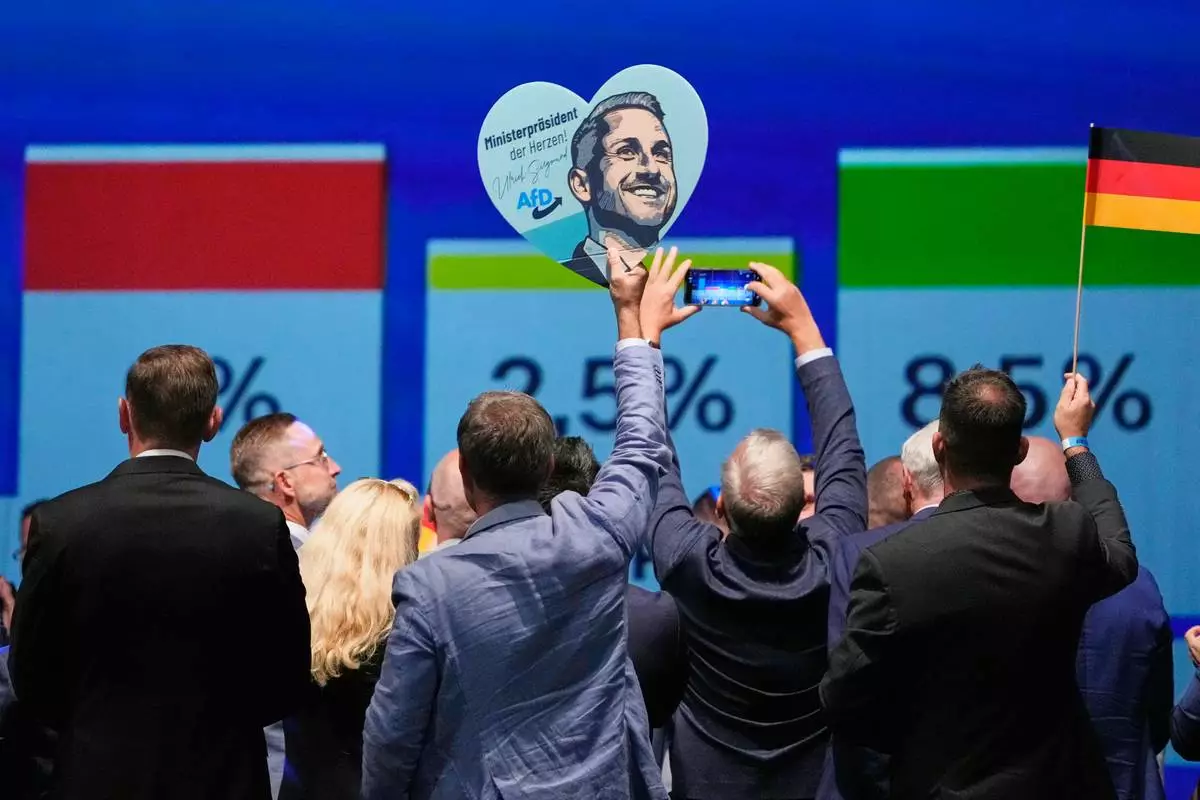
Party members celebrate with a sign of AfD top candidate Ulrich Siegmund after the first results at an election party of the "Alternative for Germany" (AfD) after the Saxony-Anhalt state elections in Magdeburg, eastern Germany, Sunday, Sept. 6, 2026. (AP Photo/Matthias Schrader)

Party members celebrate with a sign of AfD top candidate Ulrich Siegmund after the first results at an election party of the "Alternative for Germany" (AfD) after the Saxony-Anhalt state elections in Magdeburg, eastern Germany, Sunday, Sept. 6, 2026. (AP Photo/Matthias Schrader)

Top candidate Ulrich Siegmund and party leaders Tino Chrupalla and Alice Weidel, speak to party members in front of a reading "it starts here" at an election party of the "Alternative for Germany" (AfD) after the Saxony-Anhalt state elections in Magdeburg, eastern Germany, Sunday, Sept. 6, 2026. (AP Photo/Matthias Schrader)

Top candidate Ulrich Siegmund and party leaders Tino Chrupalla and Alice Weidel, speak to party members in front of a reading "it starts here" at an election party of the "Alternative for Germany" (AfD) after the Saxony-Anhalt state elections in Magdeburg, eastern Germany, Sunday, Sept. 6, 2026. (AP Photo/Matthias Schrader)

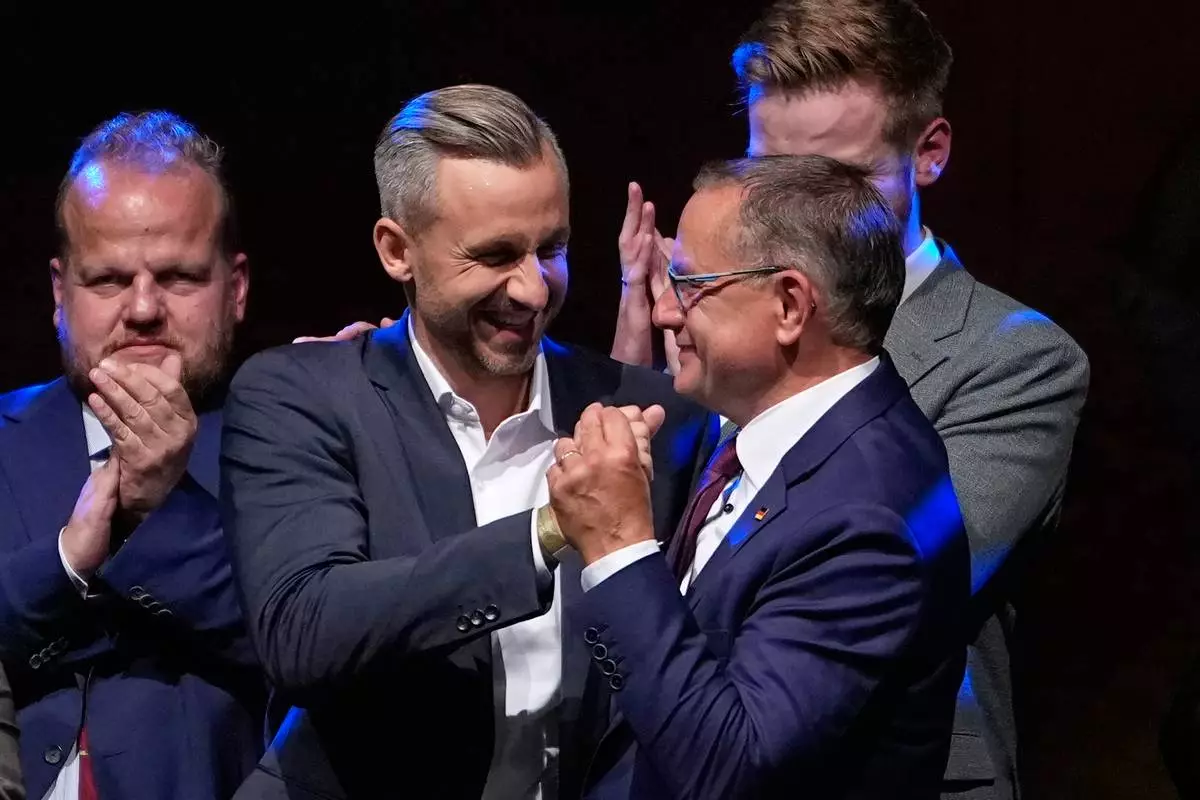
Top candidate Ulrich Siegmund shakes hands with party leader Tino Chrupalla at an election party of the "Alternative for Germany" (AfD) after the Saxony-Anhalt state elections in Magdeburg, eastern Germany, Sunday, Sept. 6, 2026. (AP Photo/Matthias Schrader)

Top candidate Ulrich Siegmund shakes hands with party leader Tino Chrupalla at an election party of the "Alternative for Germany" (AfD) after the Saxony-Anhalt state elections in Magdeburg, eastern Germany, Sunday, Sept. 6, 2026. (AP Photo/Matthias Schrader)

Top candidate Ulrich Siegmund speaks at an election party of the "Alternative for Germany" (AfD) after the Saxony-Anhalt state elections in Magdeburg, eastern Germany, Sunday, Sept. 6, 2026. (AP Photo/Matthias Schrader)

Top candidate Ulrich Siegmund speaks at an election party of the "Alternative for Germany" (AfD) after the Saxony-Anhalt state elections in Magdeburg, eastern Germany, Sunday, Sept. 6, 2026. (AP Photo/Matthias Schrader)

Recommended Articles