Skip to Content Facebook Feature Image

German chancellor faces tough times after first far-right party's state election win since Nazi era

News

German chancellor faces tough times after first far-right party's state election win since Nazi era
News

News

German chancellor faces tough times after first far-right party's state election win since Nazi era

2026-09-07 15:31 Last Updated At:15:40

BERLIN (AP) — German Chancellor Friedrich Merz was facing a tough situation Monday after his party was crushed by the Alternative for Germany party in a regional election that could result in it leading the first far-right state government since the Nazi era.

The AfD, classified by the domestic intelligence agency as an extremist group, fell just short of a majority in Sunday's election in the eastern state of Saxony-Anhalt.

More Images
Party members celebrate with a sign of AfD top candidate Ulrich Siegmund after the first results at an election party of the "Alternative for Germany" (AfD) after the Saxony-Anhalt state elections in Magdeburg, eastern Germany, Sunday, Sept. 6, 2026. (AP Photo/Matthias Schrader)

Party members celebrate with a sign of AfD top candidate Ulrich Siegmund after the first results at an election party of the "Alternative for Germany" (AfD) after the Saxony-Anhalt state elections in Magdeburg, eastern Germany, Sunday, Sept. 6, 2026. (AP Photo/Matthias Schrader)

Top candidate Ulrich Siegmund and party leaders Tino Chrupalla and Alice Weidel, speak to party members in front of a reading "it starts here" at an election party of the "Alternative for Germany" (AfD) after the Saxony-Anhalt state elections in Magdeburg, eastern Germany, Sunday, Sept. 6, 2026. (AP Photo/Matthias Schrader)

Top candidate Ulrich Siegmund and party leaders Tino Chrupalla and Alice Weidel, speak to party members in front of a reading "it starts here" at an election party of the "Alternative for Germany" (AfD) after the Saxony-Anhalt state elections in Magdeburg, eastern Germany, Sunday, Sept. 6, 2026. (AP Photo/Matthias Schrader)

Top candidate Ulrich Siegmund shakes hands with party leader Tino Chrupalla at an election party of the "Alternative for Germany" (AfD) after the Saxony-Anhalt state elections in Magdeburg, eastern Germany, Sunday, Sept. 6, 2026. (AP Photo/Matthias Schrader)

Top candidate Ulrich Siegmund shakes hands with party leader Tino Chrupalla at an election party of the "Alternative for Germany" (AfD) after the Saxony-Anhalt state elections in Magdeburg, eastern Germany, Sunday, Sept. 6, 2026. (AP Photo/Matthias Schrader)

Top candidate Ulrich Siegmund speaks at an election party of the "Alternative for Germany" (AfD) after the Saxony-Anhalt state elections in Magdeburg, eastern Germany, Sunday, Sept. 6, 2026. (AP Photo/Matthias Schrader)

Top candidate Ulrich Siegmund speaks at an election party of the "Alternative for Germany" (AfD) after the Saxony-Anhalt state elections in Magdeburg, eastern Germany, Sunday, Sept. 6, 2026. (AP Photo/Matthias Schrader)

But tricky coalition talks lie ahead, and the AfD candidate for governor, Ulrich Siegmund, still aims to become the first head of government from the far-right party on the state level.

“Very clearly, we want voters finally to get after the election what they voted for,” Siegmund told public broadcaster ZDF late Sunday. “Over 44% voted for political change ... and that must be implemented after the election.”

The vote weakens the chancellor and he will be partly held responsible for his party’s historic loss after it lead the state for the past 24 years. Merz’s center-right Christian Democrats party, or CDU, saw its election results cut in half, while AfD more than doubled its share of the vote. The result could also energize the AfD in other state elections later this month.

Merz is expected to comment on the election result later Monday after meetings of his party and government leaders.

AfD, known for its pro-Russian and radical anti-immigration stance, is the biggest opposition party in Germany’s national parliament and is strongest in the formerly communist and less prosperous east, where Saxony-Anhalt is located.

Tricky coalition talks in the state are expected in the days and possibly weeks ahead.

Leading a state government would be the biggest prize for AfD in its 13-year history, coming at a time of widespread discontent with a national government that has yet to persuade voters that it can get the country’s sluggish economy moving.

While Siegmund has rejected an AfD minority government, his party could possibly govern with the hard-left BSW party — the two parties share a Russia-friendly course and oppose immigration but do not agree on some other subjects.

Forming a government that excludes the AfD would only be possible if all the other parties that were elected worked together — CDU, Social Democrats, the Greens, the Left Party, and the BSW. However, a coalition involving five partners would be extremely unusual, very complicated and hardly conceivable.

It's also possible that newly elected lawmakers from other parties could defect to AfD — it would only need three people to get a majority to govern.

Either way, coalition negotiations are going to be complicated and likely it will take weeks to form a new government.

Even though Saxony-Anhalt is one of Germany's smaller states and only 2.1 million people live there, the election received outsized attention, not just in the country but also internationally.

Unlike other countries in Europe, modern Germany hasn’t yet had a far-right or right-wing populist party leading a national, state or major-city government — and due to the country's Nazi past, far-right movements have always received strong scrutiny here.

However, not everyone was worried about the victorious emergence of AfD.

Billionaire Elon Musk congratulated the right-wing party on its election victory with a “Well done!” on his online platform X.

Siegmund immediately thanked him for his support, replying in English: “If we take on responsibility here, I would very much welcome the opportunity for strong and constructive cooperation. Germany would then once again be a place worth investing in. Best regards from Saxony-Anhalt!”

U.S. President Donald Trump posted a screenshot of the election projection on his “Truth Social” platform without any comment.

Not everybody was as excited as Musk.

“In Poland, only idiots or traitors could rejoice the AfD triumph in Germany,” Polish Prime Minister Donald Tusk wrote on X on Monday morning.

AfD won 43.8% of the vote, more than double its showing five years ago in the region west of Berlin.

That was far ahead of Merz’s party, which polled 17.2% — losing about half its support — and won 15 seats. The center-left Social Democrats polled 9.3%, the Greens 8.9% and the Left Party 8.6%, winning eight seats apiece.

The BSW party, which has said it wouldn’t elect either Siegmund or incumbent Sven Schulze as governor but criticizes the “firewall” against AfD, took 5.3% and five seats.

Turnout was very high at 77.8%. AfD appeared to have won over many people who didn’t vote at all five years ago.

AP journalist Claudia Ciobanu contributed from Warsaw.
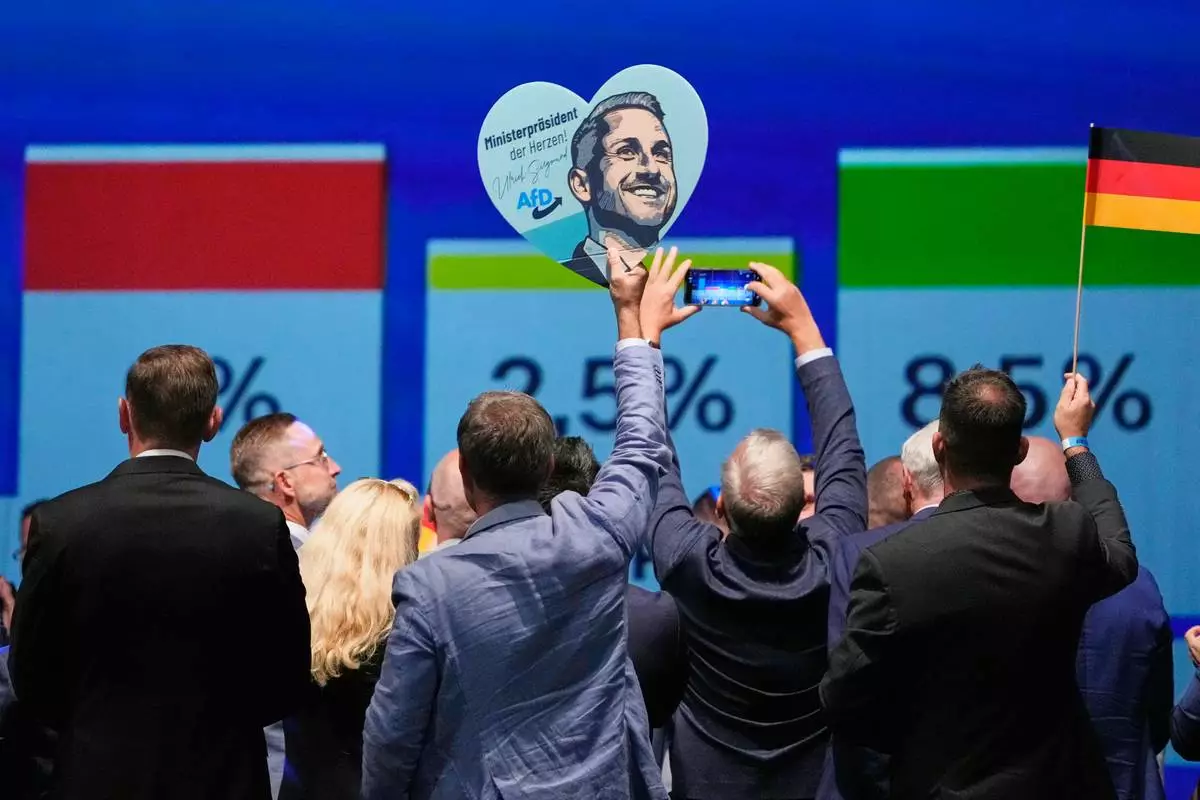
Party members celebrate with a sign of AfD top candidate Ulrich Siegmund after the first results at an election party of the "Alternative for Germany" (AfD) after the Saxony-Anhalt state elections in Magdeburg, eastern Germany, Sunday, Sept. 6, 2026. (AP Photo/Matthias Schrader)

Party members celebrate with a sign of AfD top candidate Ulrich Siegmund after the first results at an election party of the "Alternative for Germany" (AfD) after the Saxony-Anhalt state elections in Magdeburg, eastern Germany, Sunday, Sept. 6, 2026. (AP Photo/Matthias Schrader)

Top candidate Ulrich Siegmund and party leaders Tino Chrupalla and Alice Weidel, speak to party members in front of a reading "it starts here" at an election party of the "Alternative for Germany" (AfD) after the Saxony-Anhalt state elections in Magdeburg, eastern Germany, Sunday, Sept. 6, 2026. (AP Photo/Matthias Schrader)

Top candidate Ulrich Siegmund and party leaders Tino Chrupalla and Alice Weidel, speak to party members in front of a reading "it starts here" at an election party of the "Alternative for Germany" (AfD) after the Saxony-Anhalt state elections in Magdeburg, eastern Germany, Sunday, Sept. 6, 2026. (AP Photo/Matthias Schrader)

Top candidate Ulrich Siegmund shakes hands with party leader Tino Chrupalla at an election party of the "Alternative for Germany" (AfD) after the Saxony-Anhalt state elections in Magdeburg, eastern Germany, Sunday, Sept. 6, 2026. (AP Photo/Matthias Schrader)
Top candidate Ulrich Siegmund shakes hands with party leader Tino Chrupalla at an election party of the "Alternative for Germany" (AfD) after the Saxony-Anhalt state elections in Magdeburg, eastern Germany, Sunday, Sept. 6, 2026. (AP Photo/Matthias Schrader)
Top candidate Ulrich Siegmund speaks at an election party of the "Alternative for Germany" (AfD) after the Saxony-Anhalt state elections in Magdeburg, eastern Germany, Sunday, Sept. 6, 2026. (AP Photo/Matthias Schrader)
Top candidate Ulrich Siegmund speaks at an election party of the "Alternative for Germany" (AfD) after the Saxony-Anhalt state elections in Magdeburg, eastern Germany, Sunday, Sept. 6, 2026. (AP Photo/Matthias Schrader)
SEOUL, South Korea (AP) — North Korean leader Kim Jong Un put his second naval destroyer into service and called for building a more reliable nuclear deterrent, state media reported Monday, as the U.S., South Korea and Japan held a trilateral military exercise he views as a security threat.

The ship's commissioning comes as North Korea is dialing up pressure on the U.S. after rebuffing President Donald Trump's decision to scale back a major military drill with South Korea in a conciliatory step toward Kim. Observers say North Korea wants to wrest bigger U.S. concessions.

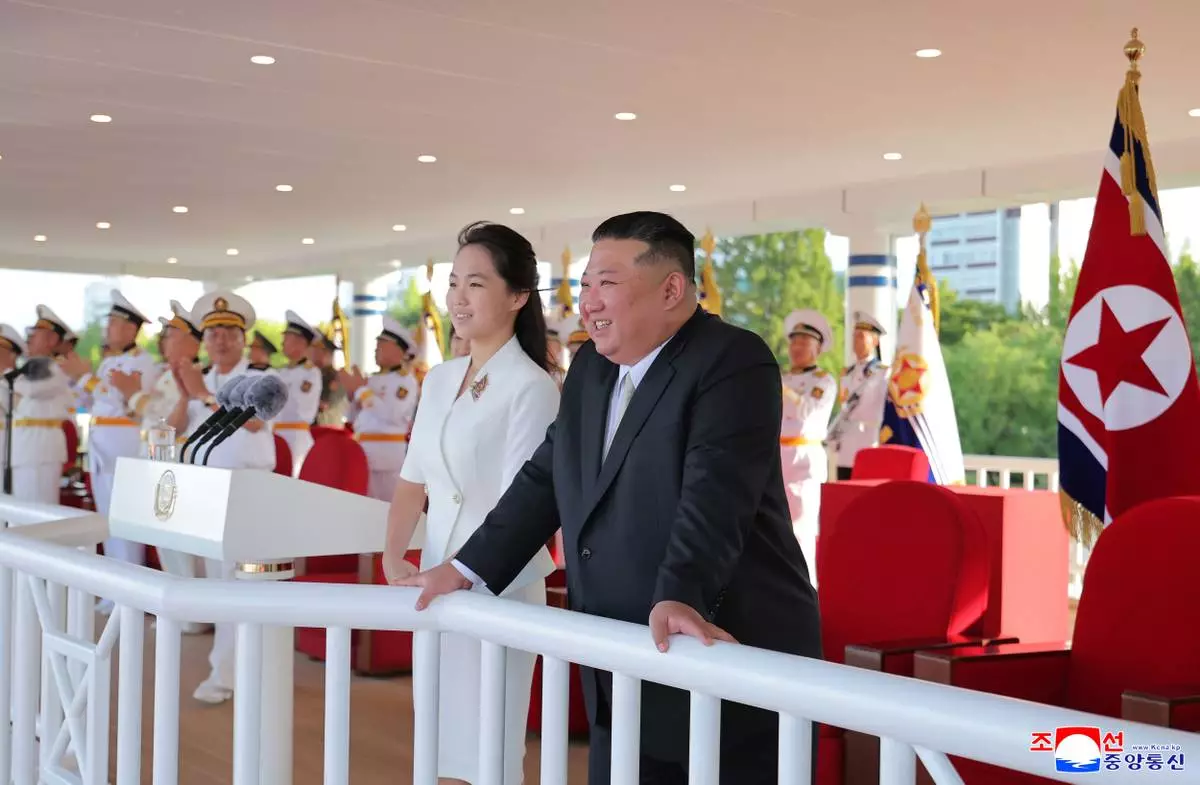
The destroyer Kang Kon was commissioned into North Korea's navy in the eastern port city of Wonsan Sunday at a ceremony attended by Kim and his teenage daughter, whom South Korea’s spy service calls his likely heir. North Korean state media photos showed the girl dressed in a white dress and blazer walking alongside her father on a red carpet, touring the warship and posing with sailors together.

The ship and the Choe Hyon, which was put into service in June, are both 5,000-ton destroyers that state media said can carry various conventional and nuclear weapons. Considered North Korea’s biggest and most advanced warships, the two destroyers were likely built with Russian assistance, experts say. In July, North Korea said it test-fired nuclear-capable cruise missiles from the Kang Kon.

In a speech at the ceremony, Kim said the back-to-back warship additions instilled fear in the enemies as the nuclear armament of North Korea's navy made it possible to exercise its nuclear deterrent in a more diversified, practical manner.

“Concerns of the enemies will be surely deepened,” Kim said. "We must establish more clearly a powerful and reliable nuclear war deterrent, to put into practice the diverse and effective operation of our nuclear combat systems and further strengthen our military activities for maritime defense and war deterrence.”

After years of prioritizing ballistic missile development, Kim has increasingly turned his focus to modernize the navy, which he admitted in Sunday’s speech lacked warships befitting its mission until a few years ago. Outside experts said the North Korean destroyers’ weapons and radar systems would enhance its offensive and defensive capabilities.

Kim said North Korea is pursuing another “significant" naval advancement that would be unveiled in eight months. Many observers say the project could be related to Kim's stated goal of acquiring a nuclear-powered submarine.

On Monday, the U.S., South Korea and Japan kicked off their five-day Freedom Edge exercise in the waters off South Korea's southern Jeju island. South Korea's military said the exercise is defensive in nature and meant to enhance a joint response capability against North Korean nuclear threats. It said the exercise involves key maritime and aerial military assets of South Korea, the U.S. and Japan.

Last week, North Korea's Foreign Ministry accused the U.S. of more clearly expressing its confrontational posture against the North. It cited the Freedom Edge exercise and U.S. officials' reported comments that the U.S. remains committed to the complete denuclearization of North Korea.

On Aug. 21, the U.S. and South Korean militaries ended their annual Ulchi Freedom Shield exercise six days earlier than originally planned, after Trump said he had ordered the Pentagon to “substantially reduce” the drill. Trump cited what he described as a good relationship with Kim, who views the drill as an invasion rehearsal.

But Kim's sister and senior official, Kim Yo Jong, shrugged off Trump's outreach, saying just shortening the drill won’t change its “provocative, aggressive nature.” North Korea launched about 10 short-range ballistic missiles toward the sea, apparently delivering on its previous threat to respond to the U.S.-South Korean drill.

Kim Jong Un has previously said he could return to talks if the U.S. drops its “hostile policy” against North Korea and respects what he calls North Korea's status as a nuclear state.

Kim and Trump's earlier diplomacy collapsed in 2019 due to disputes on how much economic benefits North Korea should get in return for a limited denuclearization step. Now with his advancing nuclear program and deepened ties with Russia and China, experts say Kim has greater leverage than before.

Protesters shout slogans demanding to stop the South Korea, U.S. and Japan trilateral military drill called "Freedom Edge" near the U.S. Embassy in Seoul, South Korea, Monday, Sept. 7, 2026. The letters read "Oppose the Freedom Edge." (AP Photo/Lee Jin-man)

Protesters shout slogans demanding to stop the South Korea, U.S. and Japan trilateral military drill called "Freedom Edge" near the U.S. Embassy in Seoul, South Korea, Monday, Sept. 7, 2026. The letters read "Oppose the Freedom Edge." (AP Photo/Lee Jin-man)

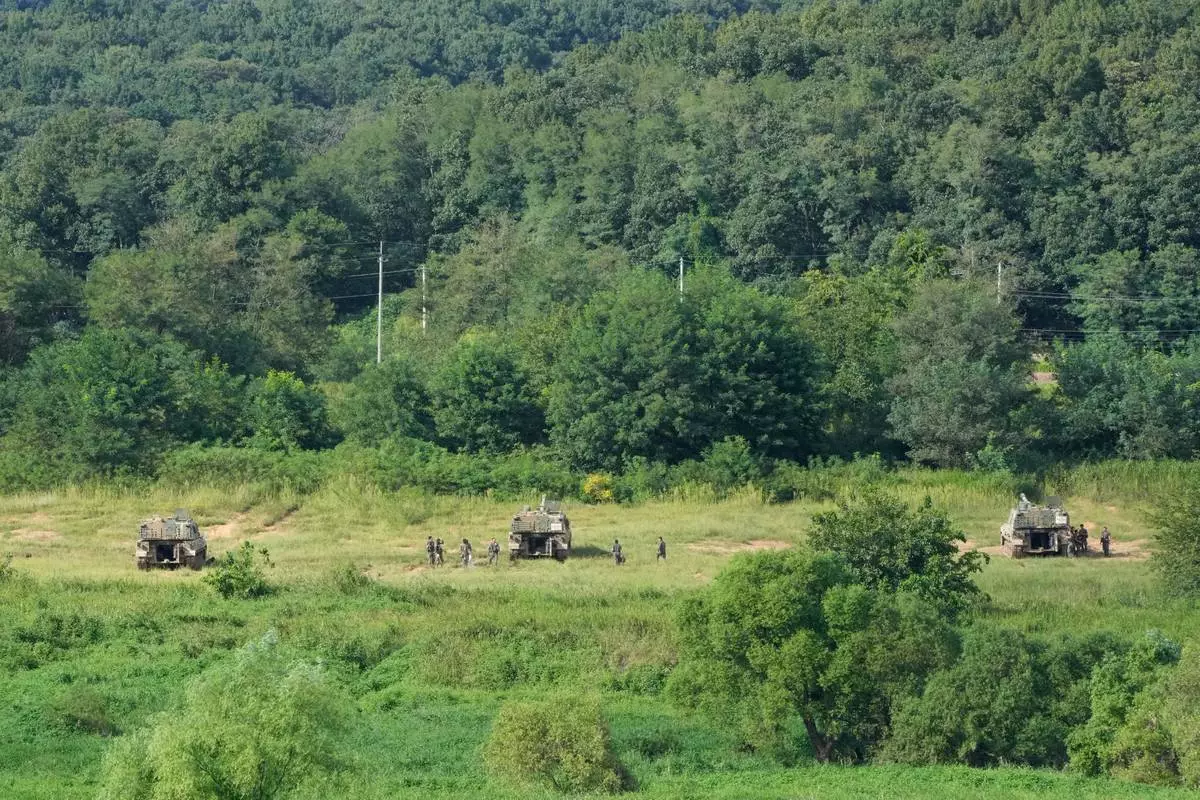
South Korean army K-9 self-propelled howitzers take positions in Paju, South Korea, near the border with North Korea, Sunday, Sept. 6, 2026. (AP Photo/Ahn Young-joon)

South Korean army K-9 self-propelled howitzers take positions in Paju, South Korea, near the border with North Korea, Sunday, Sept. 6, 2026. (AP Photo/Ahn Young-joon)

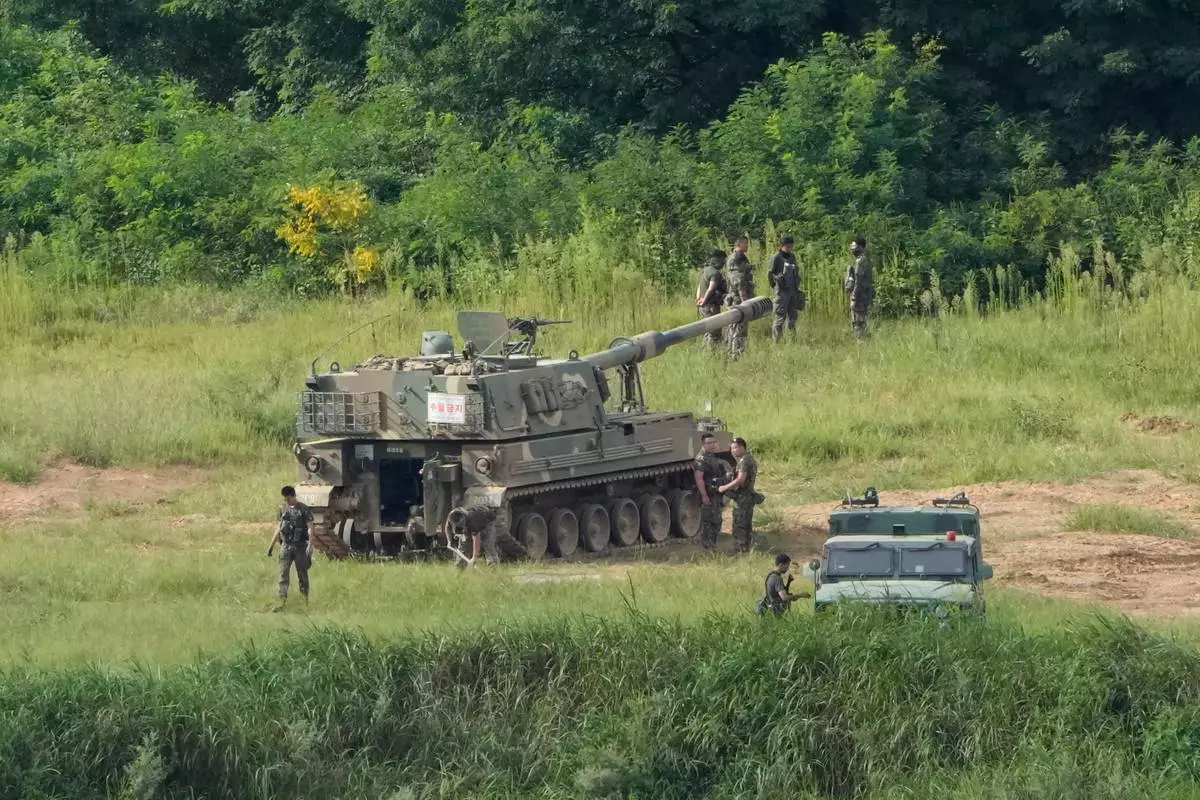
South Korean army soldiers work near their K-9 self-propelled howitzer in Paju, South Korea, near the border with North Korea, Sunday, Sept. 6, 2026. (AP Photo/Ahn Young-joon)

South Korean army soldiers work near their K-9 self-propelled howitzer in Paju, South Korea, near the border with North Korea, Sunday, Sept. 6, 2026. (AP Photo/Ahn Young-joon)

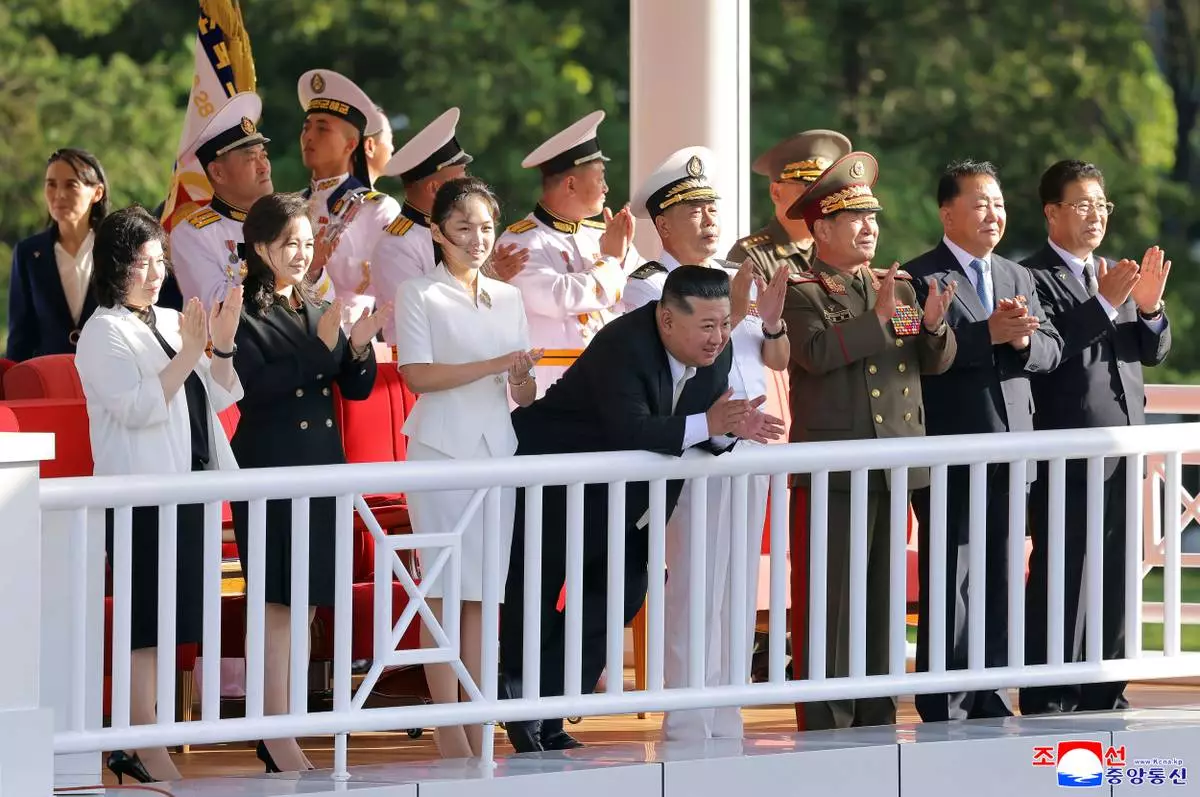
In this photo provided by the North Korean government, its leader Kim Jong Un, front center, his daugther, third left in front, and his wife Ri Sol Ju, second left in front, attend a commissioning ceremony of a destroyer, Kang Kon at a port in Wonsan, North Korea Sunday, Sept. 6, 2026. Independent journalists were not given access to cover the event depicted in this image distributed by the North Korean government. The content of this image is as provided and cannot be independently verified. Korean language watermark on image as provided by source reads: "KCNA" which is the abbreviation for Korean Central News Agency. (Korean Central News Agency/Korea News Service via AP)

In this photo provided by the North Korean government, its leader Kim Jong Un, front center, his daugther, third left in front, and his wife Ri Sol Ju, second left in front, attend a commissioning ceremony of a destroyer, Kang Kon at a port in Wonsan, North Korea Sunday, Sept. 6, 2026. Independent journalists were not given access to cover the event depicted in this image distributed by the North Korean government. The content of this image is as provided and cannot be independently verified. Korean language watermark on image as provided by source reads: "KCNA" which is the abbreviation for Korean Central News Agency. (Korean Central News Agency/Korea News Service via AP)

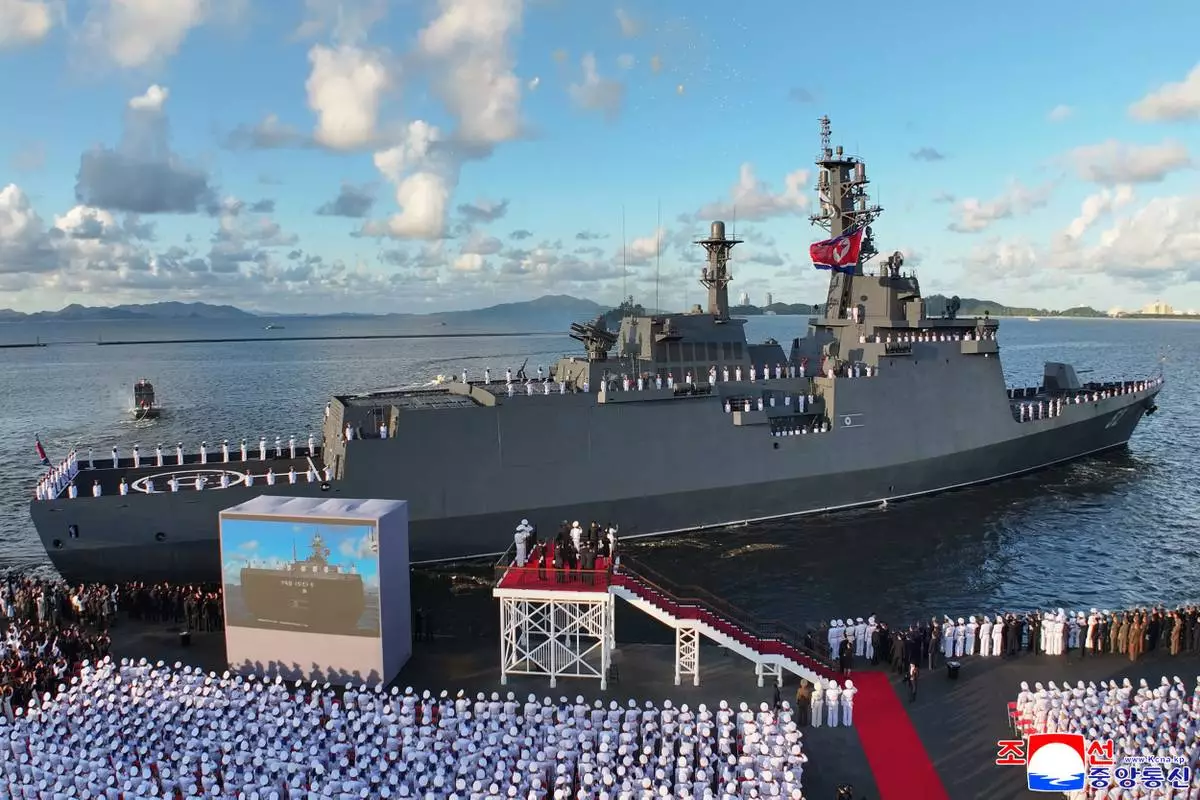
This photo provided by the North Korean government, shows a destroyer, Kang Kon at a commissioning ceremony at a port in Wonsan, North Korea Sunday, Sept. 6, 2026. Independent journalists were not given access to cover the event depicted in this image distributed by the North Korean government. The content of this image is as provided and cannot be independently verified. Korean language watermark on image as provided by source reads: "KCNA" which is the abbreviation for Korean Central News Agency. (Korean Central News Agency/Korea News Service via AP)

This photo provided by the North Korean government, shows a destroyer, Kang Kon at a commissioning ceremony at a port in Wonsan, North Korea Sunday, Sept. 6, 2026. Independent journalists were not given access to cover the event depicted in this image distributed by the North Korean government. The content of this image is as provided and cannot be independently verified. Korean language watermark on image as provided by source reads: "KCNA" which is the abbreviation for Korean Central News Agency. (Korean Central News Agency/Korea News Service via AP)

In this photo provided by the North Korean government, its leader Kim Jong Un and his daugther attend a commissioning ceremony of a destroyer, Kang Kon at a port in Wonsan, North Korea Sunday, Sept. 6, 2026. Independent journalists were not given access to cover the event depicted in this image distributed by the North Korean government. The content of this image is as provided and cannot be independently verified. Korean language watermark on image as provided by source reads: "KCNA" which is the abbreviation for Korean Central News Agency. (Korean Central News Agency/Korea News Service via AP)

In this photo provided by the North Korean government, its leader Kim Jong Un and his daugther attend a commissioning ceremony of a destroyer, Kang Kon at a port in Wonsan, North Korea Sunday, Sept. 6, 2026. Independent journalists were not given access to cover the event depicted in this image distributed by the North Korean government. The content of this image is as provided and cannot be independently verified. Korean language watermark on image as provided by source reads: "KCNA" which is the abbreviation for Korean Central News Agency. (Korean Central News Agency/Korea News Service via AP)

Recommended Articles