The commercial vessel traffic through the Strait of Hormuz has fallen to its lowest level since May, the latest data from maritime data firm Kpler showed.
According to the data, over the 10 days ending Sunday, an average of only 10 commercial vessels transited the Strait of Hormuz, the lowest figure since May, underscoring the impact of the ongoing tit-for-tat maritime attacks between the Unitted States and Iran on commercial shipping.
The data also showed that the average daily traffic through the Strait of Hormuz stood at nearly 13 vessels as of Saturday, while the corresponding figure as of Friday exceeded 15. Five ships transited the strait on Sunday, compared with only two on Saturday. No very large crude carriers have exited the Strait of Hormuz since Wednesday.
The U.S. forces struck three Iranian crude oil carriers, the U.S. Central Command (CENTCOM) said Saturday on social media.
According to the U.S. military, the operation was a response to the attack by the Islamic Revolutionary Guard Corps (IRGC) of Iran on two U.S. warships patrolling in regional waters.
The Navy of the IRGC announced on Saturday that it had targeted three U.S. vessels and three oil tankers sailing on unauthorized routes in the Strait of Hormuz.
The Saturday attacks represented a "major escalation in the maritime conflict," Greek maritime intelligence firm Marisks said.
Marisks assessed that the navigation of Iranian or Iran-related cargo vessels in the Strait of Hormuz and the Gulf of Oman carries an "extremely high" risk.
According to the weekly report from the United Kingdom Maritime Trade Operations (UKMTO), there have been 27 vessel attack incidents in the Strait of Hormuz and its surrounding waters since July 6.
Secretary of Iran's Supreme National Security Council Mohsen Rezaei has said that his country would announce a restricted zone outside the Strait of Hormuz in the coming days and place any ship attempting to transit the area on Tehran's sanctions list.

Ship traffic through Strait of Hormuz hits lowest level since May: Kpler
A rare rock carving of a four-horse chariot was recently discovered in the Helan Mountains of northwest China's Ningxia Hui Autonomous Region, marking the first finding of its kind in the area and filling a long-standing archaeological gap.
The carving was found on a boulder partially buried in an alluvial fan area. Surrounded by thick grass, only about 15 centimeters of the rock was exposed above ground, making it extremely difficult to spot.
"At first, we didn't notice it's a four-horse chariot pattern because there was a color difference between the grooves and the outer surface of the rock. Then I outlined the pattern with chalk and that's when we realized it features four horses. Unfortunately, part of the carving was broken," said Xu Xiaolong, a member of the Helan Mountains rock art survey team.
The carving measures 24 by 20 centimeters with groove marks about 1.5 millimeters deep.
The discovery fills a gap in similar themes, while enhancing the richness, diversity and uniqueness of the Helan Mountains rock carvings.
"The most common rock carvings we've found depict two-horse chariots, and this is the first time we've discovered a four-horse chariot here. In fact, four-horse chariot rock carvings are quite rare even across the country. They are usually associated with tribal communities, like those linked to grassland cultures, where a tribal chief or someone of high status might travel in a four-horse chariot," said Zhang Xu, deputy head of the cultural relics management department of the Helan Mountains Rock Art Management Office.
The Helan Mountains rock carvings are generally believed to date from between 3,000 and 10,000 years ago. Although the four-horse chariot rock carving cannot be precisely dated at present, an assessment based on the chisel marks, subject matter, carving techniques and general patterns excludes the Neolithic period.
"We think it might date to the late Bronze Age, possibly during the Spring and Autumn and Warring States periods (770 BC-221 BC) or possibly the Han Dynasty (202 BC-AD 220). It was likely created by nomadic people living in this area," said Zhang.
Stretching 250 km, Helan Mountains are home to over 20,000 ancient rock carvings created by early inhabitants with stones, metal tools or mineral pigments. The carvings depict diverse subjects ranging from natural images like human faces, animals and handprints, to ancient life scenes such as herding, hunting and rituals.
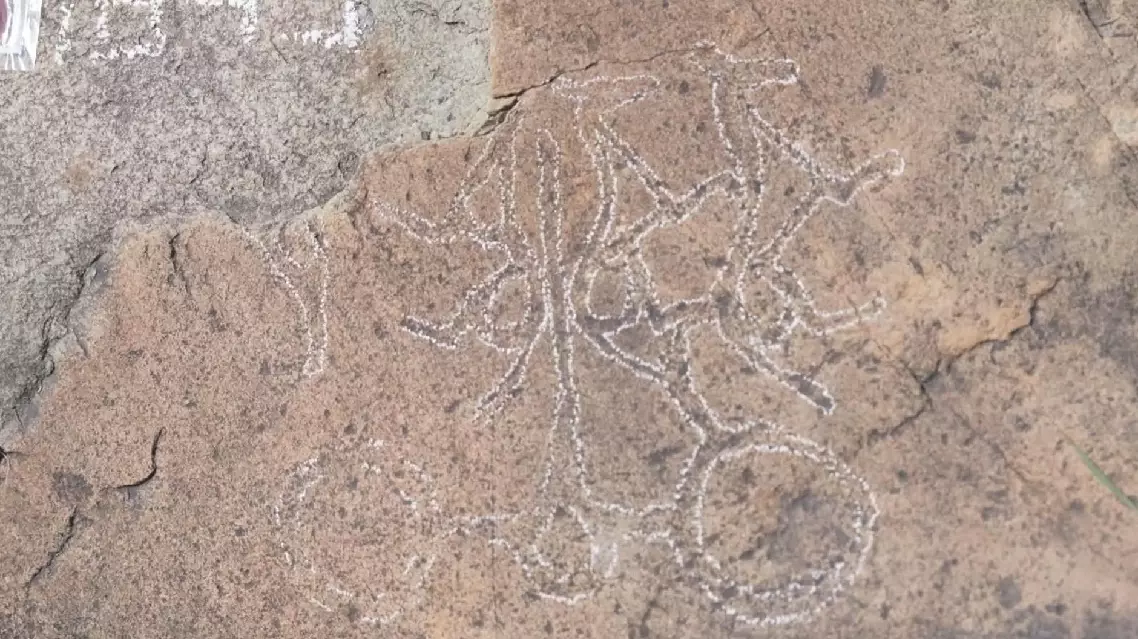
Rare four-horse chariot rock carving discovered in northwest China