The 26th China International Fair for Investment and Trade (CIFIT) will open on Tuesday at the Xiamen International Expo Center in east China's Fujian Province.
Organizers said all preparatory work are fully in place for the event running from September 8 to 11.
As a flagship platform for the "Invest in China" campaign, the event has drawn registrations from more than 1,200 government agencies, business councils and corporate delegations across 129 countries and regions, as well as 30 international organizations.
"This year's CIFIT refines the exhibition layout and promotes the integrated development of exhibition and negotiation. The financial exhibition area will double in size, highlighting the platform role of finance in supporting the real economy. Professional programs will be richer as we'll continue to roll out activities of policy releases, thematic seminars and project matchmaking," said Yu Guangsheng, deputy director general of Investment Promotion Agency of Ministry of Commerce.
This fair debuts a dual-guest-country and dual-guest-province model, with Finland and Saudi Arabia serving as guest countries of honor, while Guangdong and Qinghai serving as guest provinces of honor.
With 200,000 square meters of exhibition space, 14 specialized zones, 46 themed events and 52 project roadshows, the fair will create a broad stage for two-way investment cooperation.

26th China International Fair for Investment and Trade ready to open in Xiamen
Substantial progress has been made under the Kunming-Montreal Global Biodiversity Framework, according to a dialogue on collective progress in the implementation of the landmark global action plan aiming at reversing biodiversity loss, in support of the global review, which was held in Kunming, southwest China's Yunnan Province on Monday.
The framework, a key outcome of the 15th meeting of the Conference of the Parties to the UN Convention on Biological Diversity (COP 15), sets out the roadmap to halt and reverse biodiversity loss by 2030, and establishes the long-term goals for biodiversity conservation, restoration, sustainable use, sharing of the benefits, and implementation guarantee through 2050.
To date, 172 parties have submitted national targets aligned with the framework. An additional 193 million hectares of land have been incorporated into ecosystem restoration plans. Protected land areas have increased by more than 2 percent, and protected marine areas by nearly 3 percent.
The commitments under the framework are being translated into tangible action.
China has elevated biodiversity conservation to a national strategy, shifting its focus from preventing risks and halting losses to systematic restoration.
The country has enacted the world's first legislation named after "ecological environment," setting a precedent for biodiversity protection under the rule of law.
It has comprehensively advanced the development of the national park-based system of protected areas, set up and strictly enforced scientific eco-environmental conservation red lines.
China has downgraded the endangered level of nearly 500 wild species, with populations of more than 300 rare and endangered wildlife species steadily increasing.
"The whole of the Kunming-Montreal Global Biodiversity Framework is crucial for international biodiversity protection, and China's role in that has been crucial. As we can see here, we're back in Kunming at the Kunming Dialogue and China again taking a leadership role, helping us assess the progress we have made four years into the framework with four years to go," said Astrid Schomaker, executive secretary of the Secretariat of the Convention on Biological Diversity.
"There are several initiatives in China at national level, which are pretty impressive, whether we are talking about conservation of species, like for example, elephants in Yunnan, or if we are talking about conservation of forests and expanding the areas of forest. It definitely can put a number of examples for other countries how to treat biodiversity, and how to work together with people and the whole of society to move forward the biodiversity agenda," said Alexander Shestakov, an expert with Russia's Ministry of Natural Resources and Environment.
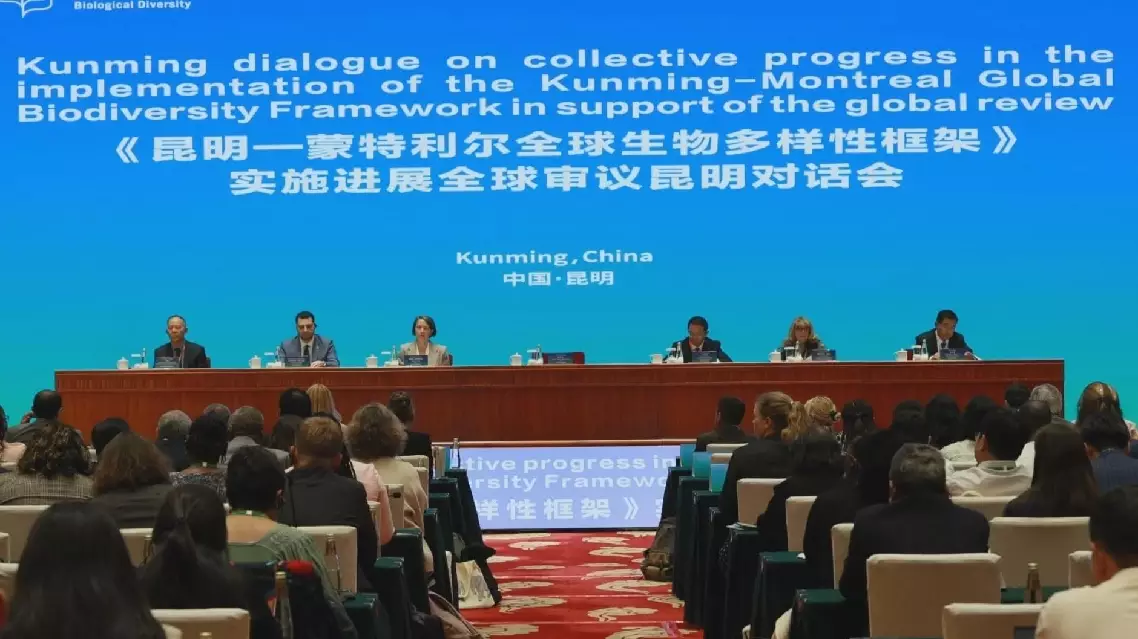
Significant progress made under Kuming-Montreal Global Biodiversity Framework