When the baseball postseason starts in a few weeks, the format will probably be a major discussion topic.
If the playoffs began now, these would be the seeds in the American League:
1. Tampa Bay (85-58)
2. Chicago White Sox (75-68)
3. Houston (73-71)
4. New York Yankees (81-62)
5. Boston (79-65)
6. Cleveland (73-71)
That means the teams with the two worst records — Houston and Cleveland, would face each other in the opening round, with the winner taking on the White Sox in the Division Series. Meanwhile, the teams with the three best records would all be on the other side of the bracket, fighting for one spot in the AL Championship Series.
The reason the matchups are on track to work out this way is because the White Sox and Houston would be seeded above the Yankees and Red Sox by virtue of being division champions. After all, if division titles don't mean anything, what's the point in having them?
But the question that is likely to come up is this: Why not re-seed the field after the Wild Card round, with the top seed facing the No. 6 seed if it advances? Or the seeds could be reassigned completely for the Division Series based on regular-season record, meaning if Houston wins in the first round, the Astros would be the team with the worst remaining record and would face the Rays.
Instead, the way the system is currently set up, top-seeded Tampa Bay would face either the team with the second-best record in the league or the team with the third-best mark. Not exactly a big reward.
Alex Bregman hit three home runs Monday night to lift the Chicago Cubs to a 17-3 win over Milwaukee. The Cubs hit nine homers in the game, one shy of the major league record, and they finished the month of August with 62. Chicago now leads the majors with 201 home runs.
The Cubs haven't led the majors in home runs since 1958. In a 154-game season before the designated hitter rule, 182 homers was enough to finish first. How many players on that team reached 30 home runs?
The Colorado Rockies were down to their final out in both the ninth and 11th innings against Baltimore on Wednesday. With nobody on in the ninth and the Orioles up 3-2, Cole Carrigg and Zac Veen hit consecutive doubles to tie it.
Then in the 11th, after Baltimore took a 5-3 lead, TJ Rumfield hit an RBI single. Two outs later, Adael Amador hit a ground-rule double to put men on second and third, and Brett Sullivan followed with a two-run single to win it.
Baltimore's win probability in the ninth was 95.3% according to Baseball Savant. That defeat was part of a skid for the Orioles that has reached six games, knocking them four games off the pace in the race for the AL's last postseason spot.
In a week when everyone lost at last twice, the Boston Red Sox come out on top with a 5-2 mark. If the Red Sox and Yankees end up meeting in a Wild Card Series, there's now a chance it could end up happening at Fenway Park instead of Yankee Stadium. However, New York still has a 2 1/2-game lead on Boston, plus the head-to-head tiebreaker.
The Red Sox took four in a row in Baltimore, holding the Orioles to one run over the final three games.
Just one player on the 1958 Cubs hit 30 homers — Ernie Banks had 47. Chicago did have four other players with at least 20 — Walt Moryn, Lee Walls, Bobby Thomson and Dale Long.
See AP’s full MLB coverage here
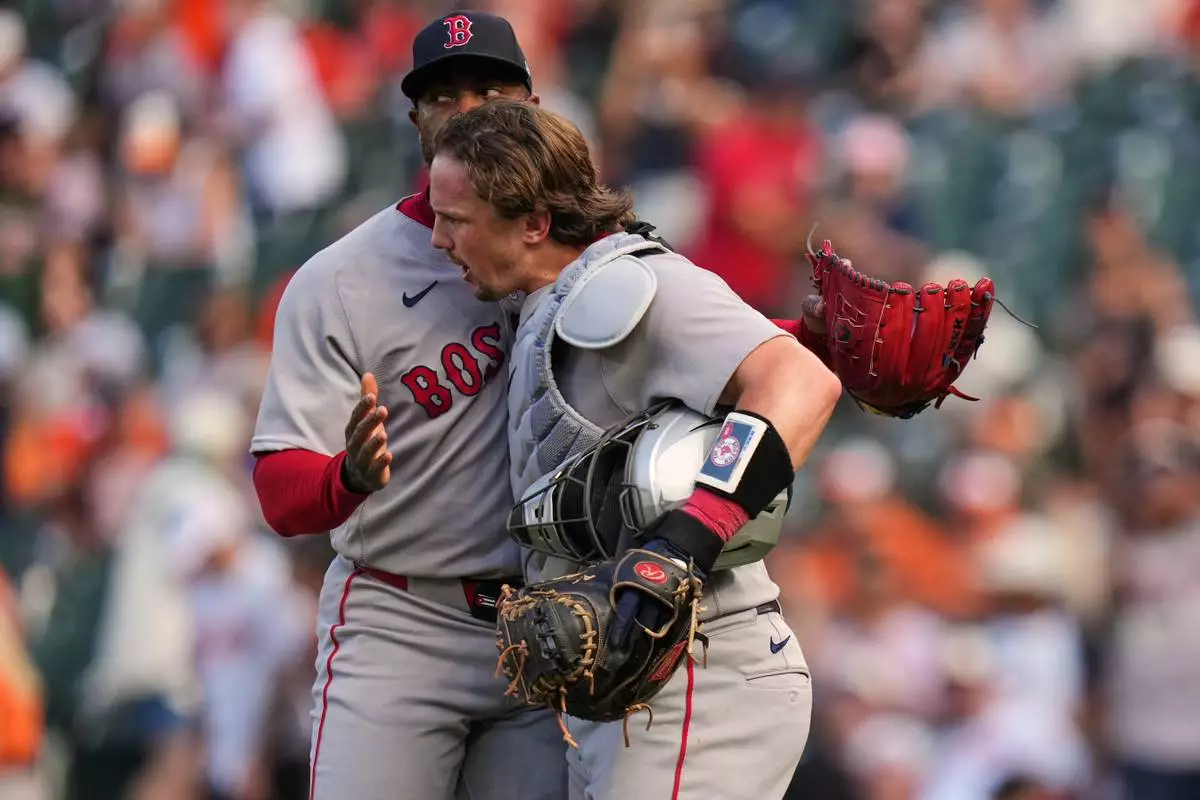
Boston Red Sox pitcher Aroldis Chapman, left, and catcher Adley Rutschman, right, celebrate after their team's victory over the Baltimore Orioles in a baseball game, Sunday, Sept. 6, 2026, in Baltimore. (AP Photo/Stephanie Scarbrough)

New York Yankees pitcher Tim Hill, right, celebrates with catcher Austin Wells after the Yankees defeated the San Diego Padres 5-1 in a baseball game Saturday, Sept. 5, 2026, in San Diego. (AP Photo/Gregory Bull)

Tampa Bay Rays pitcher Steven Matz turns around on the mound after throwing a pitch to the Texas Rangers during the fifth inning of a baseball game Sunday, Sept. 6, 2026, in Arlington, Texas. (AP Photo/Tony Gutierrez)
BERLIN (AP) — German Chancellor Friedrich Merz was facing pressure Monday after his party was crushed by the Alternative for Germany party in a regional election that could result in it leading the first far-right state government since the Nazi era.
The AfD, classified by Germany's domestic intelligence agency as an extremist group in some regions of the country, fell just short of a majority in Sunday's election in the eastern state of Saxony-Anhalt.
Unlike other countries in Europe, modern Germany hasn’t yet had a far-right or right-wing populist party leading a national, state or major-city government — and due to the country’s Nazi past, far-right movements have always received strong scrutiny.
While Sunday's election was only regional, it has major national implications. Merz had vowed to weaken the AfD when he came to office, and the election result shows that he has been unable to deliver on that promise.
AfD's strong victory is also a major distraction for Germany and Merz at a time when Europe faces several challenges, including Russia's continued aggression against Ukraine and a suspected sabotage campaign targeting NATO countries, and difficult dealings with U.S. President Donald Trump.
Tricky coalition talks lie ahead, and the AfD candidate for governor, Ulrich Siegmund, still aims to become the first head of government from the far-right party on the state level.
"I am telling you today that we must reclaim our old, safe, beautiful Germany — we proved that yesterday, and therefore this is the path we will now take together," Siegmund told reporters in Berlin on Monday.
The vote weakens the chancellor significantly and he will be partly held responsible for his party’s historic loss after it led the state for the past 24 years. Merz’s center-right Christian Democrats party, or CDU, saw its election results cut in half, while AfD more than doubled its share of the vote. The result could also energize the AfD in other state elections later this month.
Merz is expected to comment on the election result later Monday after meetings of his party and government leaders.
AfD, known for its pro-Russian and radical anti-immigration stance, is the biggest opposition party in Germany’s national parliament and is strongest in the formerly communist and less prosperous east, where Saxony-Anhalt is located.
Tricky coalition talks in the state are expected in the days and possibly weeks ahead.
Leading a state government would be the biggest prize for AfD in its 13-year history, coming at a time of widespread discontent with a national government that has yet to persuade voters that it can get the country’s sluggish economy moving.
While Siegmund has rejected an AfD minority government, his party could possibly govern with the hard-left BSW party. The two parties share a Russia-friendly course and oppose immigration but do not agree on some other subjects.
On Monday, BSW's lead candidate in the election, Thomas Schulze, expressed his party's willingness again to help an AfD minister-president take office in the state parliament.
Forming a government that excludes the AfD would only be possible if all the other parties that were elected worked together — CDU, Social Democrats, the Greens, the Left Party, and the BSW. However, a coalition involving five partners would be extremely unusual, very complicated and hardly conceivable.
It's also possible that newly elected lawmakers from other parties could defect to AfD — it would only need three people to get a majority to govern.
“The task before us is a very clear mandate to form the government,” Siegmund said, adding that his party would reach out to all other new factions in parliament and even to single lawmakers. “Our goal now is to build precisely this stable majority in the coming days and weeks."
AfD once previously won a state election but didn’t end up governing. That was two years ago in neighboring Thuringia, where a CDU governor took power with a minority government, but AfD was much further short of a majority there. So far, the country's mainstream parties have adhered to the so-called firewall, meaning they refused to work with AfD.
Billionaire Elon Musk congratulated the party on its election victory with a “Well done!” on his online platform X.
Siegmund immediately thanked him for his support, replying in English: “If we take on responsibility here, I would very much welcome the opportunity for strong and constructive cooperation. Germany would then once again be a place worth investing in. Best regards from Saxony-Anhalt!”
Trump posted a screenshot of the election projection on his “Truth Social” platform without any comment.
Russian presidential envoy Kirill Dmitriev on X described the outcome of the election as a “historic win for the pragmatic AfD that will put migration under control.” In a separate post, Dmitriev said that “AfD will restore Germany and Europe by leading the commons-sense approach that migrant-friendly, warmongering Biden-think EU politicians tried to eradicate.”
The leaders of right-wing populist parties in Spain and Portugal also congratulated AfD, German news agency dpa reported.
The Polish prime minister was critical. “In Poland, only idiots or traitors could rejoice the AfD triumph in Germany,” Donald Tusk wrote on X.
AfD won 43.8% of the vote, more than double its showing five years ago in the region west of Berlin.
That was far ahead of Merz’s party, which polled 17.2% — losing about half its support — and won 15 seats. The center-left Social Democrats polled 9.3%, the Greens 8.9% and the Left Party 8.6%, winning eight seats apiece.
The BSW party took 5.3% and five seats.
Turnout was very high at 77.8%. AfD appeared to have won over many people who didn’t vote at all five years ago.
Alice Weidel, one of the two leaders of AfD on the national level, praised the turnout and said the strong result was a clear signal that the people of Saxony-Anhalt want change.
“No chancellor before has been as unpopular as Friedrich Merz, who has become a major obstacle to Germany’s prosperous development," she said.
“The people in this country no longer want business as usual when it comes to illegal immigration, open borders, skyrocketing crime rates among foreign nationals, refused deportations, and a disastrous energy policy.”
Associated Press writer Claudia Ciobanu in Warsaw contributed to this report.

Party members celebrate with a sign of AfD top candidate Ulrich Siegmund after the first results at an election party of the "Alternative for Germany" (AfD) after the Saxony-Anhalt state elections in Magdeburg, eastern Germany, Sunday, Sept. 6, 2026. (AP Photo/Matthias Schrader)

Top candidate Ulrich Siegmund and party leaders Tino Chrupalla and Alice Weidel, speak to party members in front of a reading "it starts here" at an election party of the "Alternative for Germany" (AfD) after the Saxony-Anhalt state elections in Magdeburg, eastern Germany, Sunday, Sept. 6, 2026. (AP Photo/Matthias Schrader)

Top candidate Ulrich Siegmund shakes hands with party leader Tino Chrupalla at an election party of the "Alternative for Germany" (AfD) after the Saxony-Anhalt state elections in Magdeburg, eastern Germany, Sunday, Sept. 6, 2026. (AP Photo/Matthias Schrader)

Top candidate Ulrich Siegmund speaks at an election party of the "Alternative for Germany" (AfD) after the Saxony-Anhalt state elections in Magdeburg, eastern Germany, Sunday, Sept. 6, 2026. (AP Photo/Matthias Schrader)