

Record year for investment product sales in Hong Kong with robust demand for FICC-related products: SFC-HKMA joint survey 2025
The following is issued on behalf of the Hong Kong Monetary Authority:
Click to Gallery
HKMA, Photo source: reference image
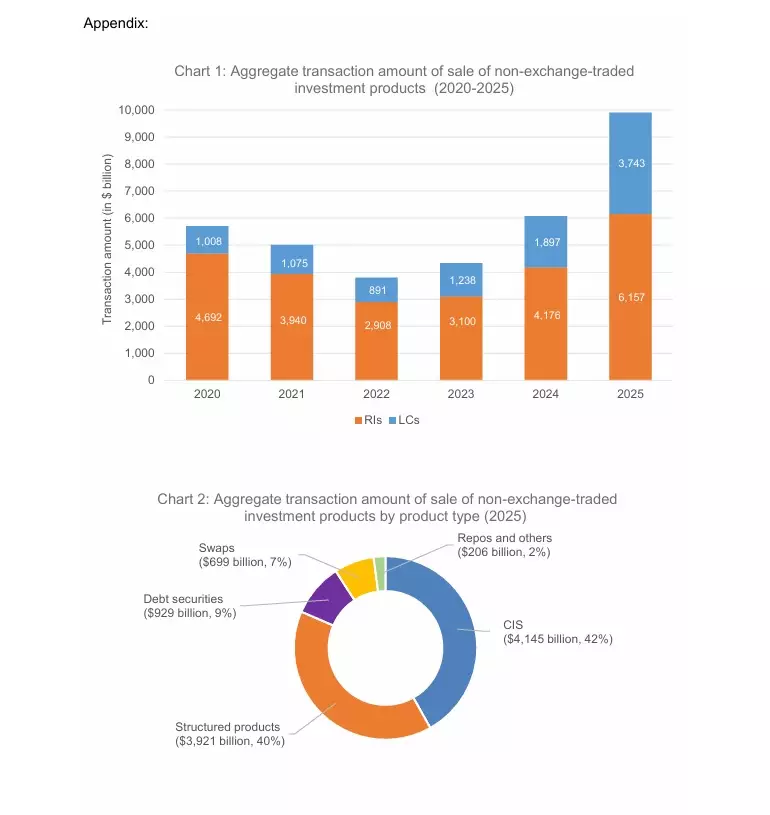
Photo source: HKSAR Government Press Releases
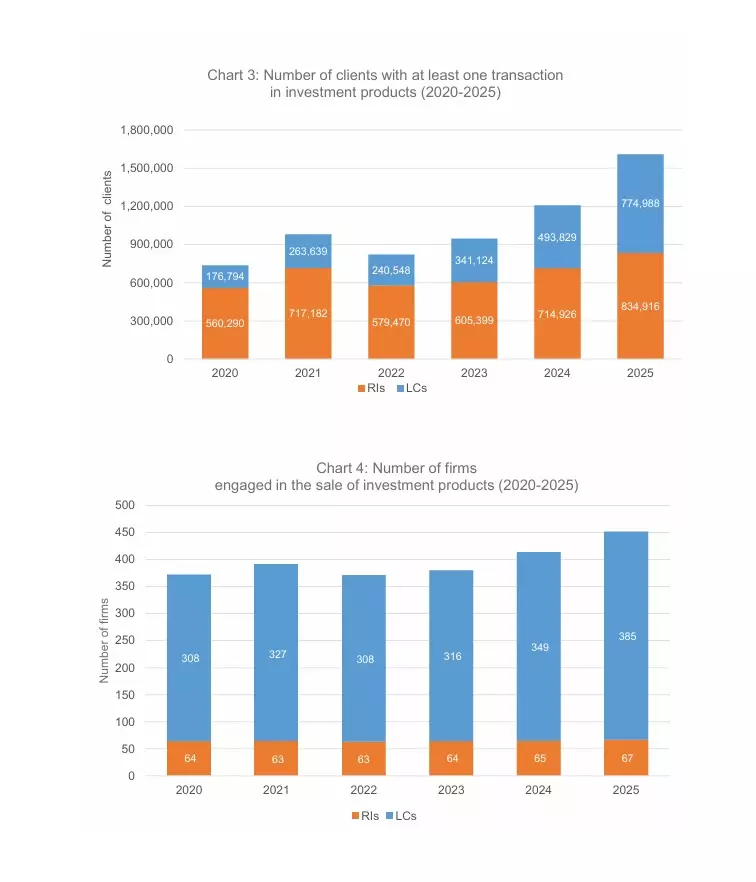
Photo source: HKSAR Government Press Releases

Source: AI-created image
HKMA, Photo source: reference image
Sales of non-exchange-traded investment products surged 63 per cent year-on-year (YoY) to an all-time high of $9.9 trillion in 2025, driven by a record level of market participation with strong demand for fixed-income, currency and commodity (FICC)-related products, according to the annual joint survey by the Securities and Futures Commission (SFC) and the Hong Kong Monetary Authority (HKMA) published today (September 8) (Notes 1 and 2).
Record numbers of participating clients and firms propelled the strong growth in the total transaction amount (Note 3). The number of clients who completed at least one transaction in non-exchange-traded investment products jumped by 33per cent to more than 1.6 million (Note 4), while the number of licensed corporations (LCs) and registered institutions (RIs) engaged in investment product sale grew by 9 per cent to 452. Notably, the number of large firms increased by 27 per cent to 128 (Note 5).
Collective investment schemes (CIS) (up 85 per cent) and structured products (up 53 per cent) were both key engines for record-breaking sales. Notably, CIS overtook structured products for the first time as the top-selling product type since 2020.
FICC-related products played a central role in investors' asset allocations as the investors continued to favour income-generating assets and liquidity-management solutions amidst fast-changing market conditions. Money market funds accounted for 88 per cent of the top five CIS sales reported by the large firms, up from 80per cent in 2024. Currency-linked product sales also increased by 50 per cent YoY to $698 billion.
Debt securities sales continued on a solid long-term growth trajectory, up 43per cent from 2022. The growth was primarily driven by sovereign bonds (up 138 per cent) and investment-grade corporate bonds (up 43 per cent). Chinese Mainland-related issuers were the leading contributors to corporate bond transactions, illustrating Hong Kong's vital role as an offshore fund-raising hub.
"The new records of sales and market participation reflect global investors' confidence in Hong Kong as a leading international financial centre. The robust performance of FICC-related products also underscores the city's evolving role as an up-and-coming FICC hub," said the Executive Director of Intermediaries of the SFC, Dr Eric Yip. "By grasping new industry trends, the SFC will continue to collaborate closely with stakeholders to drive the quality growth of Hong Kong's financial ecosystem."
"The strong growth captured in this year's survey is a clear testament to investor confidence in Hong Kong's asset and wealth management industry," said the Executive Director (Banking Conduct) of the HKMA, Mr Kenneth Hui. "The HKMA will continue to adopt a balanced, proportionate regulatory approach, to ensure robust investor protection while fostering a positive customer experience and supporting the industry's continued growth."
Other major observations from the survey included:
- CIS, the top-selling product type,accounted for 42 per cent ($4.1 trillion) of the total transaction amount in 2025. Structured products and debt securities ranked second and third, making up 40 per cent($3.9 trillion) and 9per cent($929 billion), respectively.
- Equity-linked products continued to dominate structured product sales, with the transaction amount rising 58per centYoY to $2.7 trillion and accounting for 70per centof structured products sold in 2025 (2024: 67 per cent). The major underlying equities of the top five products were from the technology (44 per cent), internet (20 per cent) and automotive (18 per cent) sectors, according to the large firms.
- Product distribution became increasingly digitalised, as online sales accounted for 21per cent(2024: 17 per cent) of the aggregate transaction amount. The number of respondent firms distributing investment products online increased by 17per centto 122 in 2025. CIS remained the top product type sold online, making up 84 per centof the total online sales, followed by debt securities at 11 per cent.
Photo source: HKSAR Government Press Releases
Photo source: HKSAR Government Press Releases
Note 1: The annual survey questionnaires were sent to 2 502 licensed corporations and 109registered institutions licensed or registered for Type 1 (dealing in securities), Type 4 (advising on securities) or both regulated activities, and more than 99per cent of them responded. The survey covered the sale of non-exchange-traded investment products from January 1 to December 31, 2025 (the reporting period) by respondent firms to non-professional investor clients, individual professional investors (PIs) and certain corporate PIs. The first SFC-HKMA joint survey was published in 2021.
Note 2:FICC-related products include money market funds, bond funds, debt securities, currency-linked and commodity-linked structured products, currency swaps.Currency-linked instruments, interest rate-linked instruments, and currency and interest rate-linked instruments issued by authorized financial institutions and sold by registered institutions were excluded from the survey.
Note 3:Transaction amount refers to the amount paid or payable by investors for investment products. For structured products and derivative products, the transaction amount refers to the maximum exposure of the contracts at the point of sale. Respondent firms were requested to report only one side of the transaction. Rollovers, redemptions and position close-outs were not included.
Note 4:The numbers of clients who completed at least one transaction in non-exchange-traded investment products during the reporting period were 774 988 forlicensed corporations and 834 916 for registered institutions, respectively.
Note 5:Large firms refer to LCs and RIs with total transactions of $1 billion or more and $30 billion or more respectively during the reporting period. They were requested to provide details about the investment products sold, including the transaction amount by investor type and the details of the top five products ranked by transaction amount.
Source: AI-created image