PALO ALTO, Calif.--(BUSINESS WIRE)--Sep 8, 2026--
This press release features multimedia. View the full release here: https://www.businesswire.com/news/home/20260908670401/en/
The project brought Modular's MAX and Mojo ecosystem to Google TPU in months, a class of hardware enablement effort that has traditionally taken years. It provides practical validation of an alternative model for AI infrastructure: a portable software layer, combined with specialized compiler and runtime engineering, that can make new compute architectures usable faster.
As demand for AI compute grows, organizations are looking beyond a single hardware ecosystem to improve performance and scalability, while reducing exposure to cost, capacity and supply constraints. The barrier is often software. Each new accelerator can require extensive work across compilers, runtimes and inference systems before AI workloads can be used effectively.
Modular is addressing that barrier with technology designed to make AI workloads portable across silicon. HTEC applied its specialized compiler engineering and runtime systems expertise to extend that foundation to Google TPU, working from ambitious technical requirements and with significant engineering autonomy.
Darko Todorovic, CTO at HTEC commented: “We proved that Modular’s MAX and Mojo ecosystem could reach a new silicon target in months rather than years. That validates both Modular’s architecture and a practical path for organizations to adopt new AI hardware faster.”
Chris Lattner, CEO, Modular, added: “AI cannot afford a full software rebuild for every new accelerator. HTEC’s work on Google TPU shows how a common software foundation can bring new silicon into the AI ecosystem faster and at scale. That fundamentally changes the equation for silicon companies: instead of rebuilding an entire software stack, they can focus their engineering on what makes their hardware unique.”
Beyond the Google TPU milestone, the project validates HTEC’s long-term investment in AI hardware enablement and Modular's approach to hardware-agnostic AI software. The experience further strengthens HTEC’s ability to support future semiconductor and AI inference initiatives across the industry.
About HTEC
HTEC Group Inc. is a global technology and engineering firm headquartered in Silicon Valley, providing AI-first, full-stack solutions that move organizations from strategy to production in a repeatable way. Combining premium engineering talent with digital strategy, design, and venture-building capabilities, HTEC supports the entire product lifecycle—from ideation to deployment.
With more than 15 years of experience applying AI and machine learning in enterprise environments, HTEC brings deep expertise across the technology stack—from silicon to application, including data engineering, model optimization, and AI application development. This ensures that emerging technologies translate into measurable ROI, scalable growth, and enduring business impact. By bridging the gap between vision and execution, HTEC helps the world’s leading companies define what’s possible— and scale it successfully.

HTEC, a global AI-first engineering and technology services company, and Modular have demonstrated Modular's AI software stack running on Google's TPU architecture. Presented at ModCon 2026, the work shows that support for a new silicon target can be delivered by extending an existing software foundation rather than rebuilding it for each accelerator.
LONDON (AP) — Britain is set to ban goods from Israeli settlements in the occupied West Bank in response to an expansion program that is imperiling efforts to establish a Palestinian state, the U.K. government said Tuesday.
Foreign Secretary Ed Miliband is due to give details in the House of Commons later, after saying last week that he would “reset” U.K. relations with Israel.
Before the announcement, Work and Pensions Secretary Pat McFadden said that it “isn’t intended to be a boycott of all Israeli goods.”
He said that the measures were “specifically targeted at the expansion of these settlements, which are illegal under international law, in the West Bank.”
“At the heart of the statement is the idea that the U.K., along with many other countries, do not want to see the possibility of a two-state solution in Israel and Palestine being erased by changes to the facts on the ground,” McFadden told Times Radio.
The government of Israeli Prime Minister Benjamin Netanyahu is the most ultranationalist and religious in Israel’s history. It has presided over a surge of settlement construction in the West Bank, which Israel seized in the 1967 Mideast war and which would make up the main part of a future Palestinian state.
Netanyahu's government views the West Bank as the biblical and historical homeland of the Jewish people and is opposed to the creation of a Palestinian state.
The United Kingdom, a longtime ally of Israel, recognized Palestinian statehood last year in an attempt to revive dwindling efforts to achieve a two-state solution.
The center-left Labour Party government has previously sanctioned some Israeli settlers and illegal outposts over violence against Palestinians and illegal development in the West Bank. Tuesday's announcement is set to expand sanctions to cover trade in goods, and possibly some services, with all West Bank settlements.
U.K. Prime Minister Andy Burnham has voiced concerns about the E1 settlement project approved by Israel, which would effectively cut the territory in two. Palestinians and rights groups say it could destroy hopes for a future Palestinian state.
A tougher line on settlements is likely to be welcomed by many Labour voters and lawmakers, who have urged the government to go further in sanctioning Israel and supporting the Palestinians.
But some expressed concern that the move could boost support for Netanyahu, who is facing a tough battle for reelection in October.
Senior Israeli ministers condemned the U.K. government’s impending announcement. Foreign Minister Gideon Saar warned that “if Britain acts against Israel, Israel will act against Britain.”
Itamar Ben-Gvir, Israel’s hard-line public security minister, called on Netanyahu to recognize Argentina’s claim to the Falkland Islands, a British overseas territory in the South Atlantic known in Argentina as Islas Malvinas.
The move also was criticized by the U.S. ambassador to Israel, Mike Huckabee, who said that it was “discrimination against the Jewish people.” He said that the U.K. could face “repercussions or retaliations” from the U.S. if it imposed the sanctions.
Several U.S. states have laws banning contracts or investments with businesses that boycott Israeli firms, including those based in the West Bank. U.S. Rep. Randy Fines, R-Fla., said in a post on social media that the U.K. ban could put at risk “billions of dollars” in trade between British businesses and Florida.
Burnham’s office said that the prime minister spoke to U.S. President Donald Trump on Monday and set out “the U.K.’s commitment to working toward peace and security in the region” and achieving a two-state solution. There was no word on how Trump responded.
—-
Megan Mineiro contributed to this report from Jerusalem.
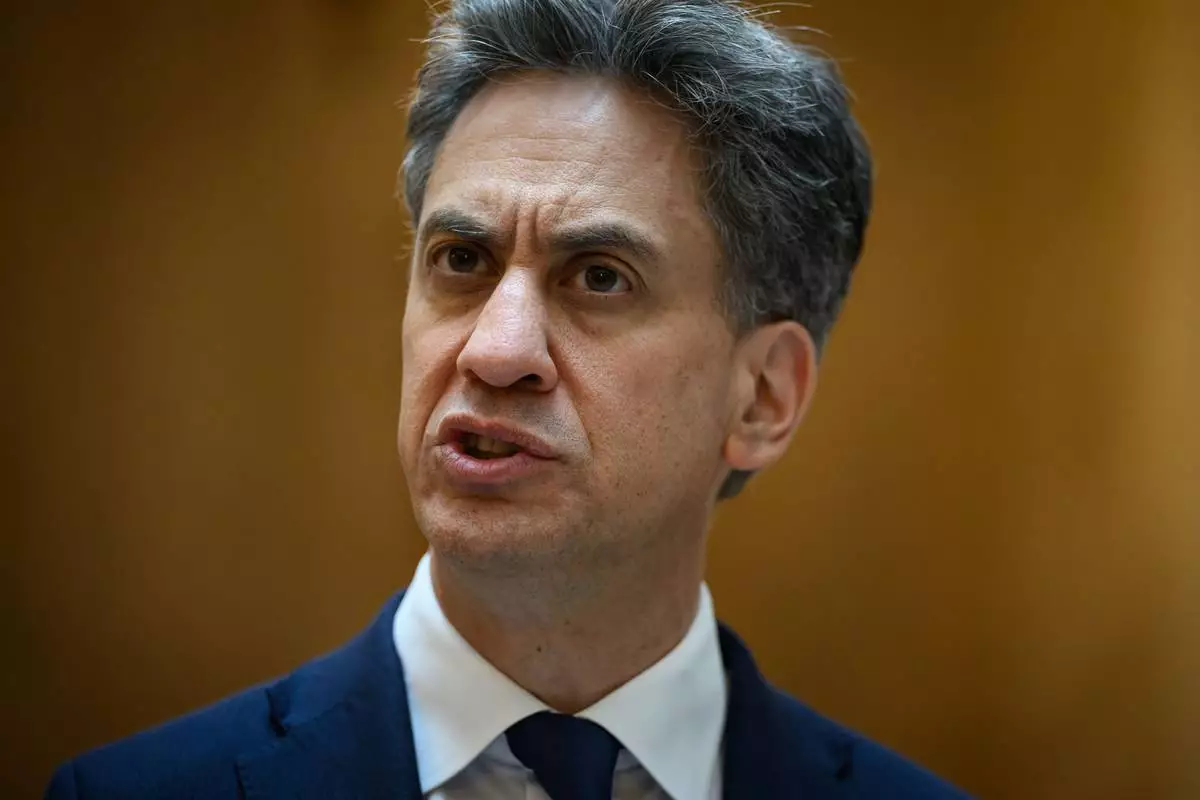
FILE - Britain's Foreign Secretary Ed Miliband speaks during a press conference in Madrid, Spain, on July 29, 2026. (Leon Neal/Pool Photo via AP, File)