HARRISBURG, Pa. (AP) — Election-season trading on prediction markets, including in this fall’s biggest races, is skyrocketing while states fight to outlaw the platforms as unlicensed casinos and begin to worry about how high-stakes odds will affect American democracy in unpredictable ways.
Already this year, prediction market odds have gotten tangled up with real-life elections, and it is quickly becoming a hot topic for election administrators, who for years have battled misinformation and conspiracy theories.
Their concerns are broad, but many revolve around the fear that pervasive financial incentives will further damage confidence in elections and democracy if Americans think they are influencing the outcome.
“This is a troubling trend that election administrators across the nation must deal with,” said Jared DeMarinis, the administrator for the Maryland State Board of Elections.
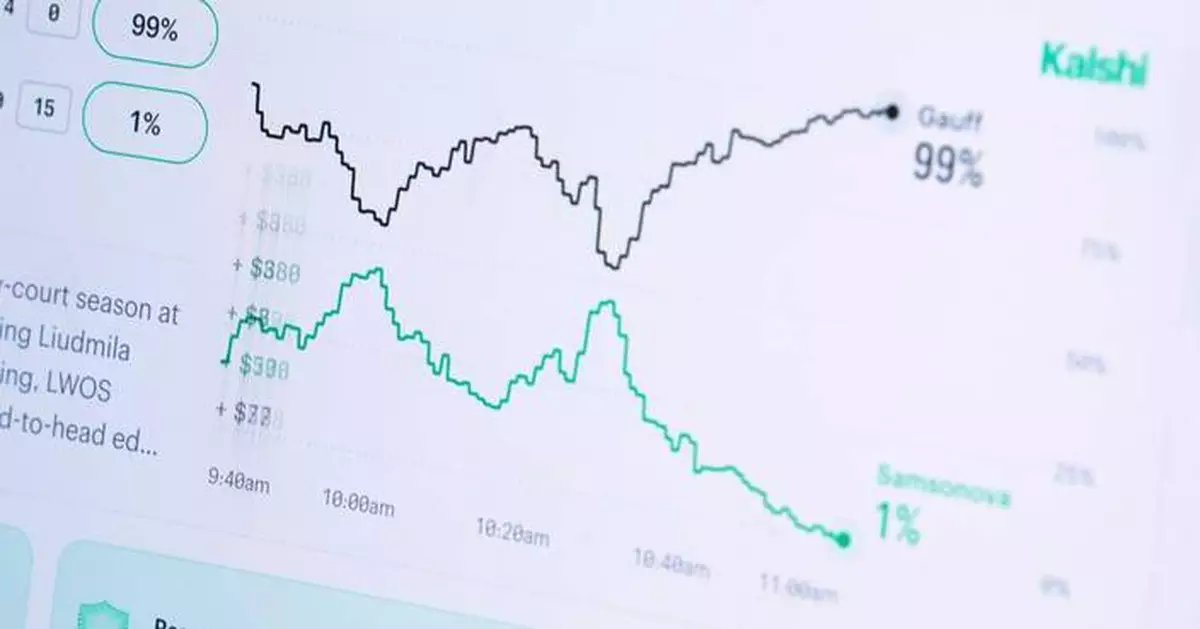
Polymarket, Kalshi and other prediction markets allow participants to buy and sell contracts tied to the probable outcome of an event. The contracts are typically priced between 1 and 99 cents, and customers can trade on everything including races for mayor, governor and U.S. Senate.
The explosion in prediction market trading comes as President Donald Trump has pressed sweeping changes to voter identification and voting by mail procedures to address what he falsely claims is rampant fraud in mail voting and widespread voting by noncitizens.
Kalshi and Polymarket officials, for their part, contend that the activity is neither gambling nor a danger to elections or democracy.
It is, they say, barely different from people who trade stocks, bonds or commodities ahead of an election to protect themselves against how the eventual winner's policies might affect their investments or business. Some independent analysts agree.
“One can make the argument that the entire stock market, at some level, is affected by elections and outcomes,” said Joshua Mitts, a Columbia Law School professor who researches corporate and securities law.
Kalshi and Polymarket officials say they have insider trading protections, required by federal law, that are meant to prevent, for instance, candidates and their campaign staffers from trading on their own races. On Aug. 31, Kalshi disclosed that it gave a three-year suspension and fine to a North Carolina congressional candidate, Republican Laurie Buckhout, for trading on her own race.
And Kalshi says its research shows that its markets correlate strongly to outcomes — for instance, events given a 60% chance end up happening nearly 60% of the time — and that any effort to manipulate the odds is kept in check by traders who profit by putting money on the correct outcome.
Still, prediction markets have suffered black eyes this year. In one example, they heavily favored a losing candidate in a primary for Wisconsin governor. The polls were way off in that race, too. And in Los Angeles, as votes were being counted for its mayoral primary, online influencers accused election officials of cheating to oust Republican candidate Spencer Pratt from qualifying for the runoff, pointing to market odds that favored him finishing in second place.
For now, courts are crammed with litigation over whether states can regulate prediction markets — or ban them — under state gambling laws that, among other things, cover casinos and sports betting.
Half the states also have statutes that broadly ban betting on elections, according to information from the National Conference on State Legislatures, laws that were motivated by a desire to ensure people vote based on who they think is the best candidate, and not due to a financial stake in the outcome.
Courts are unlikely to decide the litigation before the election, all but ensuring that trading will play out on platforms like Kalshi and Polymarket at levels never seen before in nearly every state.
Billions of dollars could be traded on questions like whether Democrats will gain control of the House or Senate or who will be governor of the largest states.
In state and local election offices, administrators are talking about the need to proactively educate the public about how prediction markets odds are not the same thing as a polls or vote counts.
They are also talking about how they can use their office's policy to protect elections.
In Delaware County, in suburban Philadelphia, elections director Jim Allen asked the election board to add prediction market trading to the state-required oath that requires each polling place and county election worker to swear not to bet on the election.
DeMarinis, the Maryland election administrator, said he will ask the state election board to impose a similar requirement statewide.
One key question for the midterms is how prediction markets could be used or manipulated to help candidates.
For instance, wealthy partisans who don't care about losing money could bid up the odds on their favored candidate in hopes of swaying public opinion. Some voters might see the long odds against their candidate and stay home, rather than go to the polls, analysts say.
Candidates could point to the favorable odds, like they might with a poll, and use it to fundraise or garner endorsements.
“And all of a sudden, they’re the front-runner, for no reason other than an outside actor places a large bet on them,” said Ben Schiffrin, director of securities policy for Better Markets, a nonprofit that advocates for the public interest in financial markets.
Eric Talley, a Columbia University law professor who co-hosts the Beyond Unprecedented podcast, cited research by behavioral economist Colin Camerer that showed that one person betting a large sum in the run-up to a horse race induced others to bet on that same horse. It temporarily skewed the odds before dying off closer to the race.
“Other people thought, ‘Oh my god, people know something I don’t,’ and they all started betting on the same horse,” Talley said. It was “an interesting analog to the current moment.”
That sort of advantage is short-lived, prediction markets officials say. Financially motivated traders will descend on a bad trade because they know they can win it — and that returns the odds to where an unbiased market might otherwise set them, they say.
“If you’re going to try to manipulate the pricing in a highly liquid market with strong traders, it’s not going to work. The pricing will snap back, and you’ll simply lose money,” Kalshi general counsel Rick Heaslip said.
Columbia's Mitts said a variant that might concern states could be a candidate in a state or local election encouraging people to put money on them in a prediction market — thus motivating people to vote with their wallet.
That sort of gambit would presumably be logistically easier to pull off in a smaller election — say, one that might be decided by 100 votes or so — although the idea is somewhat abstract because the financial incentive would have to be big enough, Mitts said.
Still, it creates a headache for law enforcement.
“You can understand why states would say from the election integrity standpoint, ‘We don’t want this sort of contract to trade at all,’” Mitts said.
Follow Marc Levy at http://twitter.com/timelywriter.
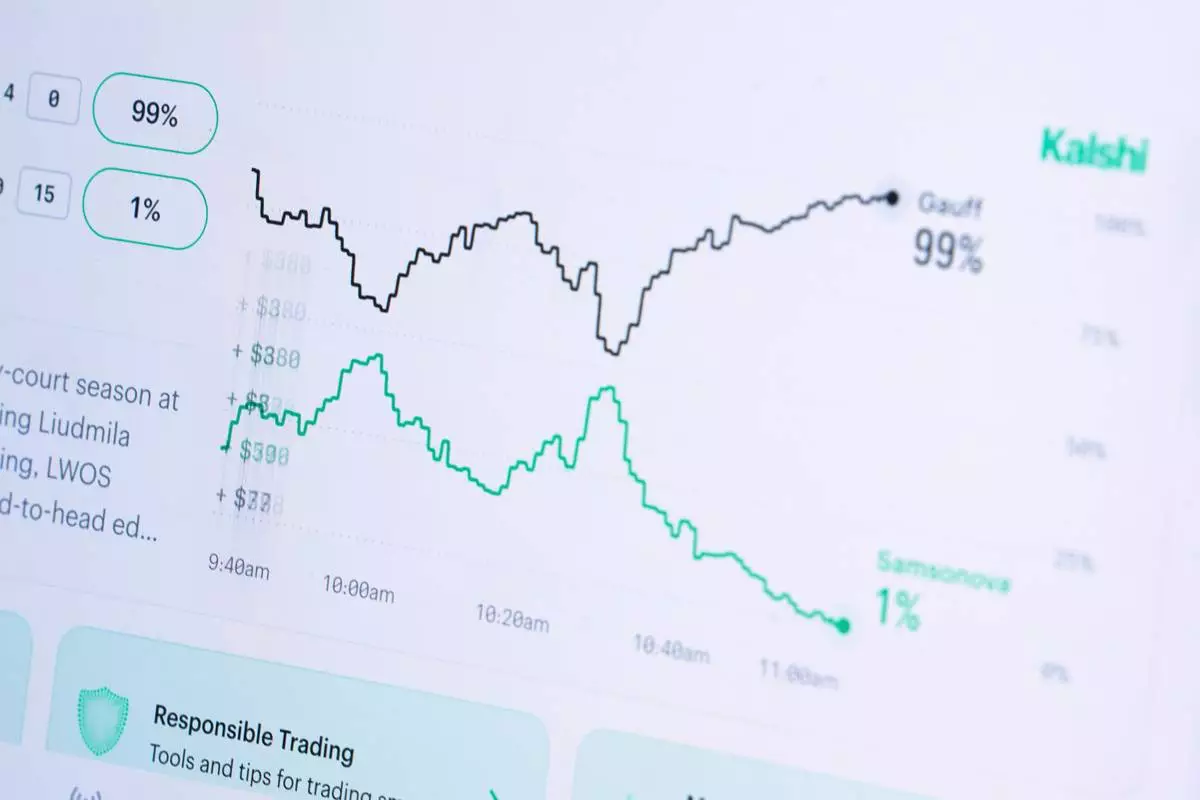
FILE - A laptop screen displays trades on the Kalshi website, April 16, 2026, in Portland, Ore. (AP Photo/Jenny Kane, File)