China has stepped up its monitoring and early warning efforts after a mudslide in Gyirong County, southwest China's Xizang Autonomous Region, with authorities deploying over 170 technical experts and 150 sets of equipment to support safe rescue operations at the disaster site.
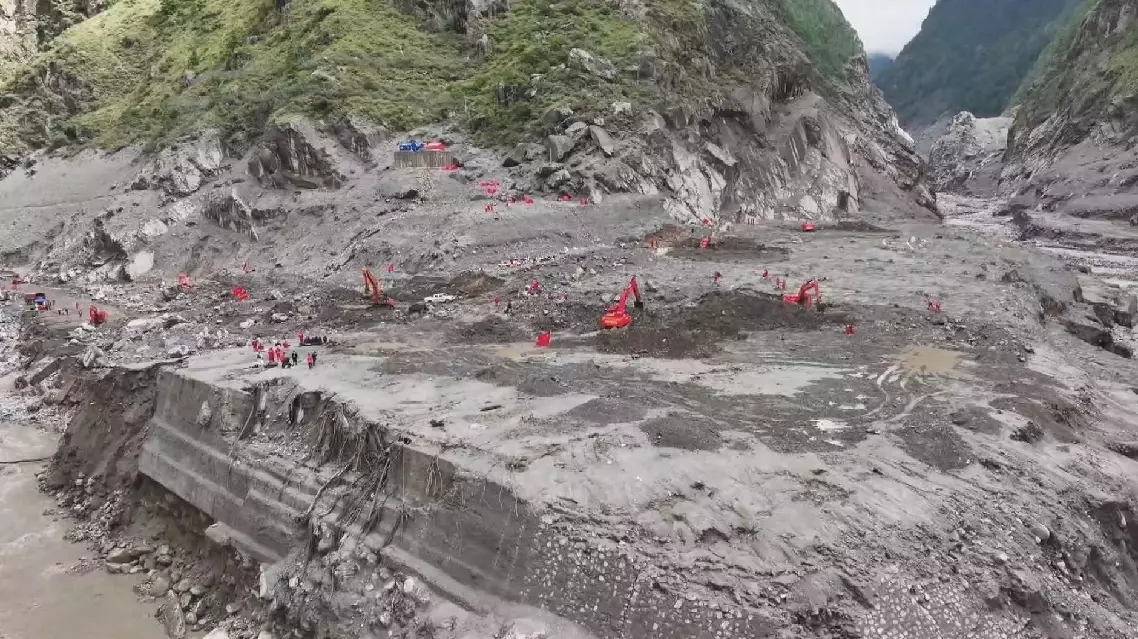
The mudslide, triggered by a high-altitude glacier collapse in Nepal, hit Gyirong Port on August 26, killing at least 43 and leaving 519 missing as of Saturday.
Officials say the mudslide occurred in a complex, high-altitude and frigid region of the plateau where weather conditions are highly unpredictable, bringing difficulties to the ongoing emergency work.
They also warn there is a significant risk of secondary disasters along both sides of the valleys where rescue operations are underway, along the main rescue routes, and in the vicinity of the Gyirong Port.
Multiple departments including the emergency management, natural resources, water conservancy and meteorology have jointly stepped up monitoring and early warning efforts, establishing an on-site risk detection and early warning assessment system to support safe rescue operations and efficient work on the ground, according to rescue teams.
In response to the complex risk points and evolving conditions at the site, a special monitoring and early warning task force set up to handle the emergency work has deployed over 170 technical experts, mobilized 150 sets of specialized monitoring equipment, and integrated various operational monitoring systems and comprehensive monitoring data.
"This is a hydrological monitoring system installed by the water resources department. It monitors changes in the flow of the Gyirong Tsangpo in real time. This is a comprehensive monitoring system for flash floods and debris flows that was jointly brought here by the Ministry of Emergency Management and the Chinese Academy of Sciences. Its primary function is to monitor sudden changes in water flow caused by flash floods. Secondly, it monitors and detects debris flows and it also has meteorological monitoring capabilities," said Wang Chenglei, deputy director of the Department of Risk Monitoring and Comprehensive Fire Prevention under the Ministry of Emergency Management.
The monitoring and early warning task force is standing by to detect any abnormal data or early signs of risk, and will promptly issue risk alerts and implement prevention and control measures if required.
Wang said that subsequent risk prevention and hazard mitigation efforts in the disaster-hit county is likely to be a long-term undertaking.
"This area is prone to a wide variety of disaster types, so the pressure and challenges of subsequent prevention and response are immense. We are currently consulting with the on-site command center, planning to station necessary monitoring facilities and technical personnel here to assist local governments in enhancing disaster risk assessments in the future, expanding the deployment of monitoring stations and further promoting the comprehensive monitoring and situational awareness capabilities across the entire region," he said.
China steps up monitoring, early warning after mudslide in Xizang