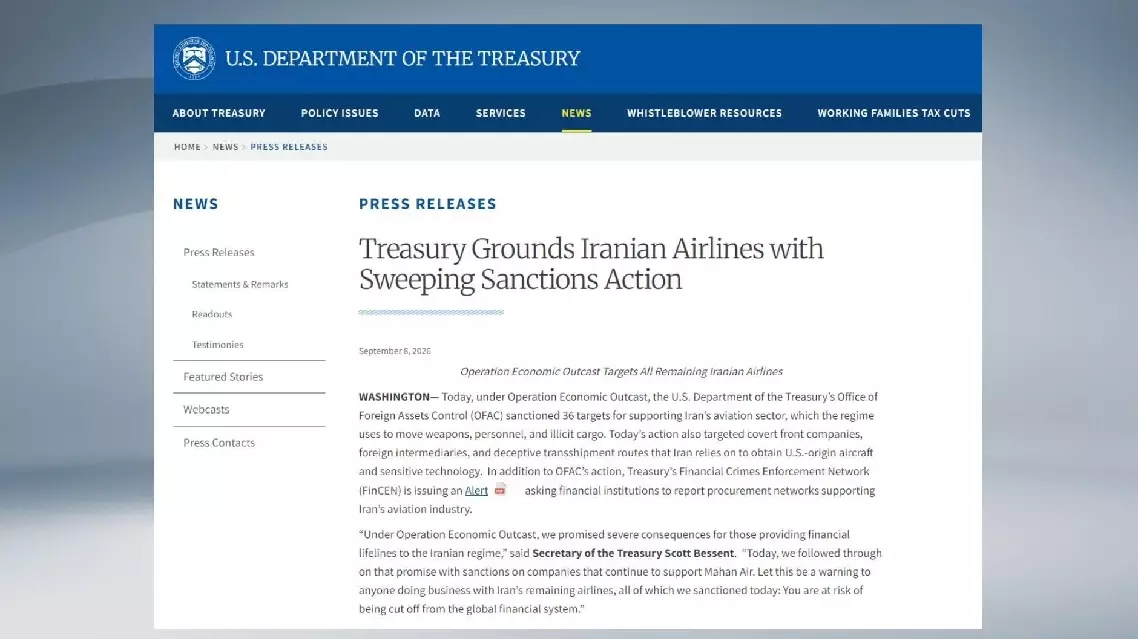
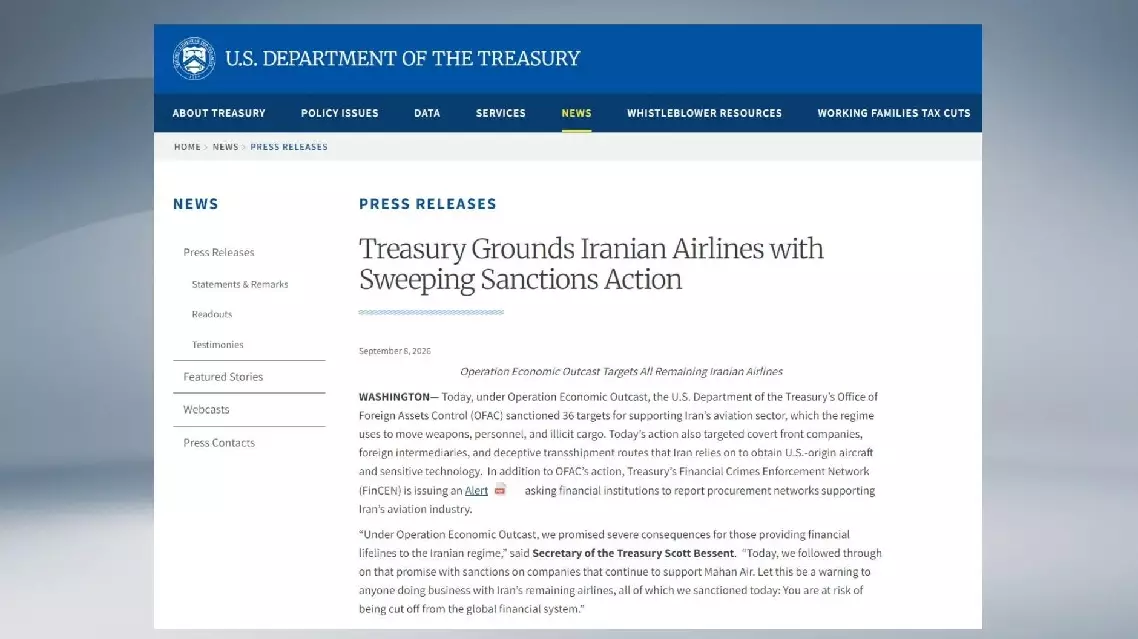
The U.S. Treasury Department on Tuesday announced sanctions on 27 Iranian airlines, while Iranian President Masoud Pezeshkian vowed continuing resistance until making "aggressors" regretful.
In a press release, the Treasury Department said that Iran's commercial airlines have long supported the Iranian regime's destabilizing activities, with the Islamic Revolutionary Guard Corps (IRGC) using ostensibly private airlines for the procurement and transport of weapons and the ferrying of personnel.
The United States first sanctioned Iranian airline Mahan Air in October 2011, and targeted multiple companies seen as general sales agents of Mahan Air on July 30.
The sanctions also targeted "covert front companies, foreign intermediaries, and deceptive transshipment routes that Iran relies on to obtain U.S.-origin aircraft and sensitive technology," according to the release.
The Treasury Department's Office of Foreign Assets Control (OFAC) also suspended authorizations that allowed for overflights, and for non-U.S. airlines to fly U.S.-origin or U.S.-controlled commercial aircraft into Iran.
Also on Tuesday, Iranian President Masoud Pezeshkian said in a social media post that Iran will continue its resistance with strength until the "aggressors" are brought to "complete regret."
He also underscored Iran's opposition to war.
"The Islamic Republic of Iran has always been opposed to war and considered the preservation of the people's interests and ensuring the (West Asia) region's security to lie in refraining from warmongering," Pezeshkian said.
He added "However, just as it has courageously risen to defend against aggression up to this day, Iran will continue this resistance with strength until the aggressors are brought to complete regret, and will remain the guardian of the rights of the great Iranian people."
US sanctions Iranian airlines, Iran vows continuing resistance
US sanctions Iranian airlines, Iran vows continuing resistance
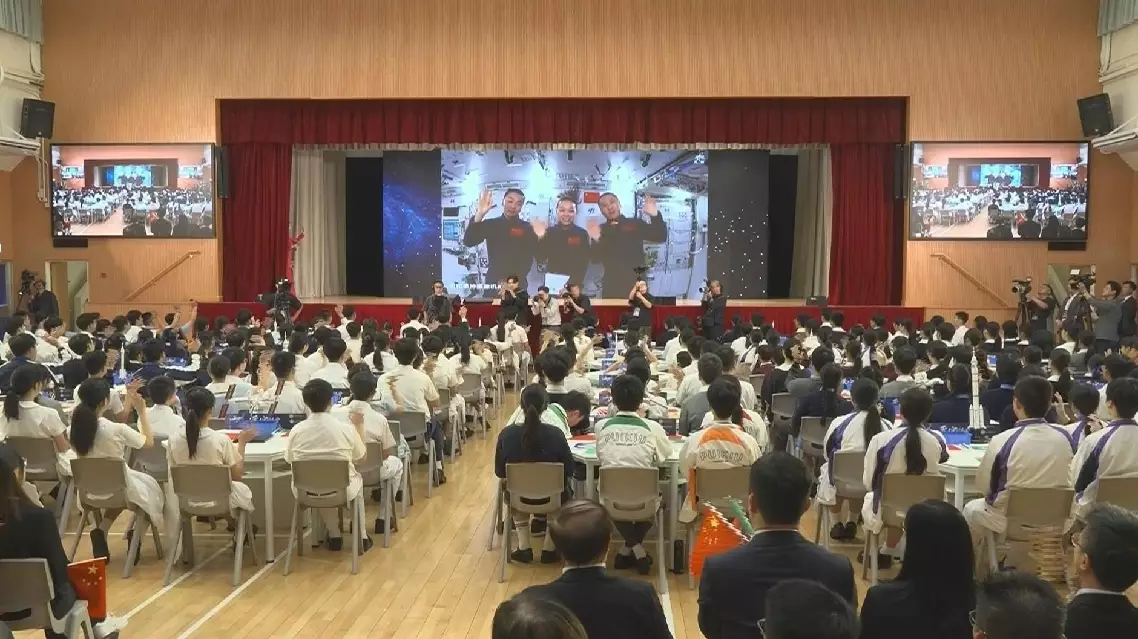
Chinese astronauts aboard the Tiangong space station delivered a live-broadcast class designated to students in China's special administrative regions of Hong Kong and Macao on Wednesday, marking the fifth Tiangong Class session.
Shenzhou-23 commander Zhu Yangzhu, spacecraft pilot Zhang Zhiyuan and payload specialist Lai Ka-ying conducted the class, which features in-orbit demonstrations and a question-and-answer session.
Lai is the first payload specialist from the Hong Kong Special Administrative Region (SAR).
The astronauts introduced the station's three-module layout and demonstrated how a gyroscope maintains its direction in microgravity. They also showed daily life aboard the station, including baking a cake in the space kitchen, exercising on a treadmill and wringing out a wet towel.
Lai introduced rice, noodles and bread as staple foods available to the crew, and showed plants growing in the station's plant-growing facility, including sweet potato leaves, mint, several varieties of lettuce and kale.
Other demonstrations included a bauhinia flower -- Hong Kong's floral emblem -- floating in the microgravity environment, and a water-ball ping-pong demonstration. The crew also introduced the Tianyun camera, a space station instrument developed with input from a Hong Kong research team.
In the question-and-answer session, students asked about cuisine in orbit, astronaut training, artificial intelligence applications aboard the station, silkworm rearing and biology experiments, preparations for spacewalks and career choices.
The event was jointly organized by the governments of the Hong Kong SAR and the Macao Macao SAR, along with the China Manned Space Agency. More than 200 primary and secondary school students from the two regions attended the ground class at Tsuen Wan Public Ho Chuen Yiu Memorial College in Hong Kong, Lai's alma mater.
HKSAR Chief Executive John Lee Ka-chiu and officials from both regions also attended the session. At the close of the event, Lee spoke with Lai in a live link, while the crew encouraged young people in Hong Kong and Macao to pursue scientific exploration.
The session was broadcast live to primary and secondary schools across both regions, as well as through official online platforms and local broadcasters.
Chinese astronauts give Hong Kong, Macao students live lesson from orbit