LONDON--(BUSINESS WIRE)--Sep 9, 2026--
New Omdia research shows that US PC shipments (excluding tablets) grew 1.0% year-over-year (YoY) in 2Q26 to 18.8 million units, returning to growth following a 7.0% decline in 1Q26. Growth was driven by demand being brought forward as retailers and channel partners secured inventory ahead of price increases resulting from memory and storage supply constraints. Average PC sell-in prices in the US exceeded $1,000 for the first time, up 12.0% YoY. However, the return to growth is expected to be short-lived, with Omdia forecasting US PC shipments to decline 10.7% for the full year and 18.4% in the second half of 2026.
This press release features multimedia. View the full release here: https://www.businesswire.com/news/home/20260909439059/en/
Component constraints influence market dynamics in 2Q26
The US PC market faced sustained supply pressure in 2Q26 – primarily from DRAM and NAND constraints contributing to higher PC prices. PC OEMs maximized available volumes, while retailers and channel partners increased inventory to mitigate anticipated cost increases and secure supply. Looking further ahead, Omdia forecasts US PC shipments to decline a further 4.9% in 2027.
Premiumization and component costs drive double-digit ASP growth
“The US PC market in 2Q26 benefited from rising average selling prices (ASPs) driven by organic premiumization and supply-driven cost inflation,” said Scott Braverman, Senior Analyst at Omdia. “While shipment growth was muted at 1.0%, US PC market revenue increased by 13.1% as OEMs prioritized production of higher-margin, higher-cost PCs amid component constraints. The impact was most pronounced in the business segment, where ASPs rose 19.0% as enterprises sought to secure pricing amid uncertainty over future costs. Consumer ASPs also increased 9.7%, as higher costs were passed on to end users.”
The same trend was visible across the US channel, with Best Buy, CDW, and Insight Enterprises each reporting that higher computing selling prices helped offset softer unit volumes in their most recent quarters.
Rising component cost had the greatest impact on entry-level systems. Shipments of PCs priced below $699 dropped 6.5%, while shipments of PCs priced above $1,500 increased 36.8%, reflecting a shift toward premium products. Growth in AI PCs also contributed to higher ASPs, with AI PCs accounting for 48.3% of US PC shipments during the quarter and forecast to exceed 50% for the first time in 3Q26.
"The shipment volume observed in the second quarter represents borrowed volume from 2027," added Braverman. "Combined with persistent supply constraints and elevated prices, we anticipate continued pressure on buyer demand, and subsequently shipment volumes, throughout 2027."
ASPs are forecast to continue rising in early 2027. However, higher prices are not expected to offset declining shipment volumes, with total US PC market revenue projected to decline 6.0% in 2027.
Consumer and commercial PC shipments face continued pressure
The consumer segment outperformed the overall US market in 2Q26, with shipments growing 2.8%. However, rising prices are expected to weigh on demand for the remainder of the year, with consumer PC shipments expected to decline 13.6% in 2026. Commercial PCs are expected to be more resilient, although shipments are still forecast to decline 9.3% for the full year.
Both consumer and commercial shipments are projected to remain under pressure through 2027, with neither segment forecast to return to growth before 2028. Supply constraints are only part of the challenge. Many US enterprises completed PC fleet refreshes in 2025 ahead of the end of Windows 10 support, reducing refresh activity in subsequent years.
Government PC shipments recorded the largest contraction in 2Q26, declining 24.4% as rising ASPs put further pressure on federal budgets. Education shipments continued to stabilize, rising 9.9% during the quarter although volumes remained below 2Q24 levels. For the full year, Omdia forecasts US shipments to decline 19.2% in the government segment and 2.6% in education.
Apple outpaces US PC market in 2Q26
Apple moved into third place ahead of Lenovo, with US PC shipments growing 32.1% YoY, supported by a full quarter of MacBook Neo availability. This lifted Apple’s share of the US consumer PC segment to 29.4%. Apple also continued to expand in the business segment, where shipment grew 50.6%.
Dell recorded the largest decline among the major PC vendors, with shipments falling 8.8% as component allocation shifted away from entry-level systems; its US Chromebook shipments fell 47.0%, against a 10.0% decline for the overall US Chromebooks market. HP shipments fell 3.7%, although both HP and Dell recorded revenue growth as higher ASPs offset lower shipment volumes. Lenovo shipments increased 2.0%, slightly outperforming the overall market, supported by consumer demand.
ABOUT OMDIA
Omdia, part of TechTarget, Inc. d/b/a Informa TechTarget (Nasdaq: TTGT), is a technology research and advisory group. Our deep knowledge of tech markets, grounded in real conversations with industry leaders and hundreds of thousands of data points, make our market intelligence our clients’ strategic advantage. From R&D to ROI, we identify the greatest opportunities and move the industry forward.

US PC estimates and forecast avg. selling price, 2026 - 2027

US PC estimates and forecasts by segment, 2025–2030
KYIV, Ukraine (AP) — On the eve of her wedding, Liudmyla Ryzhak pressed her delicately embroidered dress, laid out a full white tulle skirt and her husband’s traditionally patterned shirt, then hung them on the bedroom door.
After repeated delays caused by the war with Russia, she was only hours away from marrying her partner, a Ukrainian soldier, in a ceremony in the capital.
But as the couple slept, a Russian strike hit a warehouse across the street from their building, sending a blast wave through the apartment and threatening to stop the wedding scheduled for Tuesday morning.
The pair was soon digging their wedding clothes out of the rubble. Ryzhak had to pull her skirt from beneath the debris, shaking off pieces of broken glass.
The strike came soon after U.S. envoys visited Ukraine on Sunday, a trip that brought a lull in Russian attacks. The assaults then resumed with drones and missiles. Explosions were heard in Kyiv for almost five hours overnight. Strikes continued during the day Tuesday.
Like many others in Kyiv, the couple decided the attacks would not derail their lives and forged ahead with the ceremony. It had taken a long time for her fiance, Leonid Ryzhak, to make it back from the front lines in eastern Ukraine.
“If God gave me a continuation of life, then why should I put it off?” the bride said. “For someone, it ended. And who can guarantee this won’t happen again tomorrow? That tomorrow won’t come for us? At least for now, I have the right to be happy. Both him and me.”
Liudmyla and Leonid awoke from the blast, which blew out the apartment's windows and scattered its furniture. A burned curtain hung in shreds.
Their ears deafened by the explosion, the couple's only immediate thought was the risk of a second strike. They fled to a shelter with Liudmyla’s 6-year-old daughter and two guinea pigs but without the cat, which had hidden in fright and could not be found.
They were lucky: By the time the second strike hit, they were already safe. The apartment was rendered uninhabitable until repairs are made.
The two met three years ago through mutual friends, coming together as adults who weren’t looking for anything serious. Both had children from previous marriages.
But the friendship deepened. She supported him through his deployments to the front, and slowly the relationship grew into love. Leonid Ryzhak, who serves as part of a team that deploys bomber drones in the Pokrovsk area, arrived in Kyiv for a long-awaited vacation a week and a half earlier, just as near-constant air-raid alerts and daytime attacks began disrupting life in the capital.
For six days straight, the couple went to the registry office but could not submit their documents because of constant air-raid sirens.
When they finally succeeded, they were assigned Sept. 8. Nobody could have predicted that their apartment would be badly damaged on the same day.
It wasn’t the first time for Liudmyla. She had already lived through one attack, on Aug. 20, when a strike cut the gas lines and shattered windows in her home. She was badly frightened and for a time was afraid to go back.
Eventually, ordinary life pulled her back in: The wedding was coming, and the children had to go to school.
Eventually, the two put on their wedding clothes and headed to the registry office.
Leonid tried to keep their spirits up. What mattered most to him, he said, was for his bride to be smiling.
“It’s fine. We’ll get through it,” he said.
When they stepped outside their apartment, the courtyard looked almost apocalyptic, with a column of black smoke rising behind a brightly colored children’s playground. Neighbors clearing debris stopped to congratulate the couple.
“We should all be celebrated, that we survived,” Liudmyla replied.
The couple arrived at the registry office on time, at 10:40 a.m.
Leonid wore an embroidered vyshyvanka, a traditional Ukrainian shirt, with a pattern that matched the one on Liudmyla’s dress.
In place of black dress pants, he wore army trousers — he couldn’t dig his own out of the rubble — and black sneakers with fluorescent yellow soles and laces, for the same reason. Liudmyla’s white tulle overlay had tiny, barely visible holes that were torn as she pulled it out from the rubble and broken glass.
Shortly after they arrived, a siren sounded: Another attack had begun, and the registry office closed for safety. The couple waited in the courtyard, unsure how long it would last.
Explosions echoed nearby as strikes hit surrounding districts and fires broke out. Almost three hours passed before the alert finally ended, and the couple hurried back inside.
Just before entering the hall for the ceremony, they paused, trading nervous jokes.
“I didn’t even get to finish the repairs at home,” Leonid joked about their now-wrecked apartment.
“I’ve never had such a spectacular day,” his bride replied.
The ceremony went ahead as the officiant told them, “Love is when two people become a team.”
Moments later, the two were officially married.
“We’re gaining a new life, because we survived,” Liudmyla said. “You could probably call (it) a new life because it could have ended today, and none of this would happen.”
In a different scenario, “I wouldn’t be wearing this dress. Someone would be picking out something else for me instead, something darker.”

Liudmyla Ryzhak gets ready for her wedding to her fiancee Leonid Ryzhak in their damaged apartment, following a Russian missile and drone attack in Kyiv, Ukraine, Tuesday, Sept. 8, 2026. (AP Photo/Francisco Seco)

Liudmyla Ryzhak gets ready for her wedding to her fiancee Leonid Ryzhak in their damaged apartment, following a Russian missile and drone attack in Kyiv, Ukraine, Tuesday, Sept. 8, 2026. (AP Photo/Francisco Seco)

Newly-married couple Liudmyla Ryzhak, right, and her husband Leonid Ryzhak leave after getting married, following a Russian missile and drone attack in Kyiv, Ukraine, Tuesday, Sept. 8, 2026. (AP Photo/Francisco Seco)
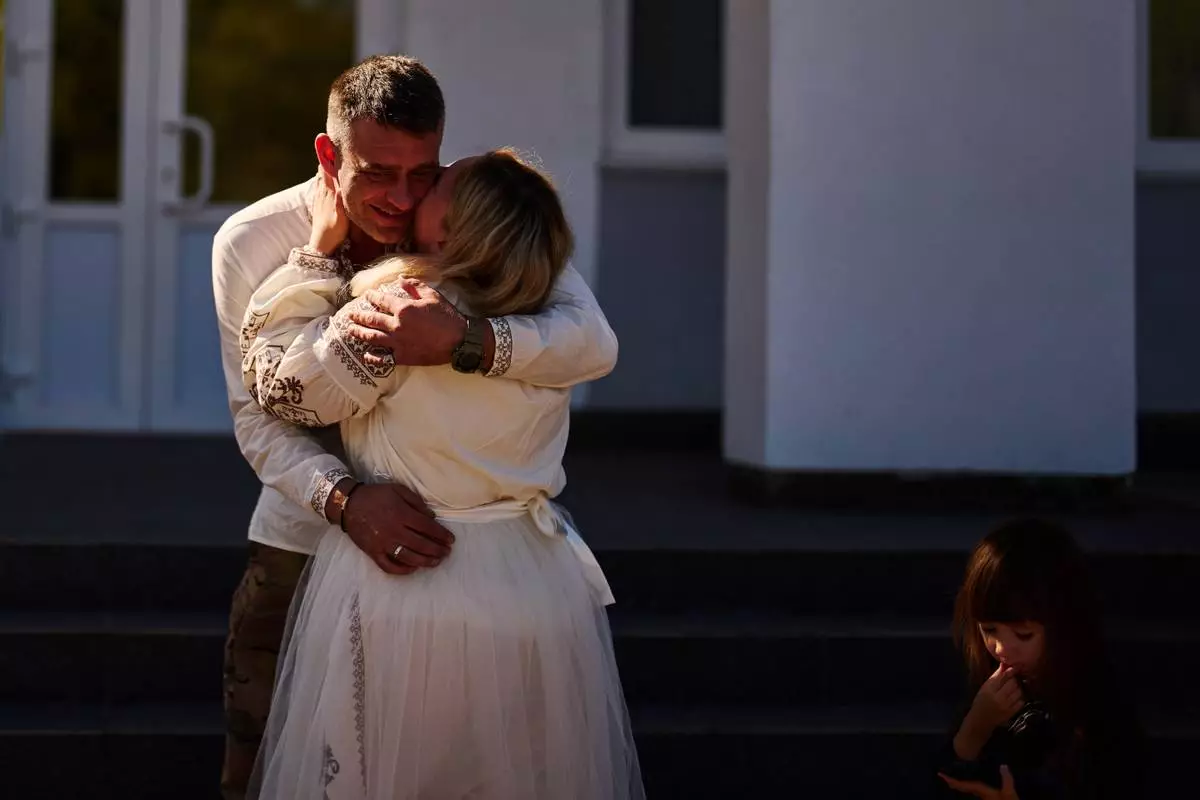
Liudmyla Ryzhak, right, kisses her fiancee Leonid Ryzhak before their wedding ceremony, following a Russian missile and drone attack, in Kyiv, Ukraine, Tuesday, Sept. 8, 2026. (AP Photo/Francisco Seco)
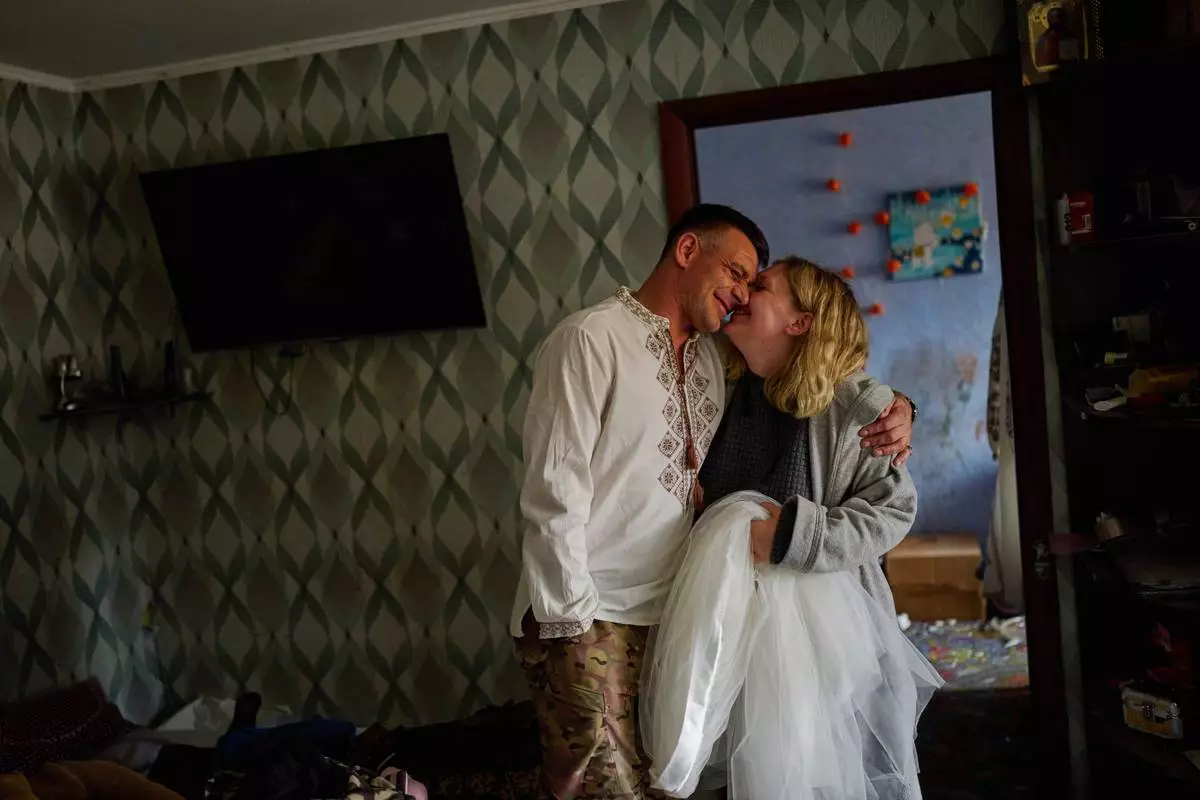
Liudmyla Ryzhak, right, and her fiancee Leonid Ryzhak get ready for their wedding ceremony in their damaged apartment, following a Russian missile and drone attack in Kyiv, Ukraine, Tuesday, Sept. 8, 2026. (AP Photo/Francisco Seco)

Liudmyla Ryzhak, right, and her fiancee Leonid Ryzhak get ready for their wedding ceremony in their damaged apartment, following a Russian missile and drone attack in Kyiv, Ukraine, Tuesday, Sept. 8, 2026. (AP Photo/Francisco Seco)