Skip to Content Facebook Feature Image

Alcaraz says 'I leave with a smile' after epic US Open loss to Shelton

Sport

Alcaraz says 'I leave with a smile' after epic US Open loss to Shelton
Sport

Sport

Alcaraz says 'I leave with a smile' after epic US Open loss to Shelton

2026-09-09 19:32 Last Updated At:19:40

NEW YORK (AP) — At the end, when five riveting sets and one agonizingly tight tiebreak were over — and when the latest-finishing match in U.S. Open history had concluded — Ben Shelton was not the only player smiling.

Carlos Alcaraz, the player Shelton had just defeated in an entertaining, spine-tingling marathon, was smiling too.

The dethroned defending champ grinned as he walked to the net to hug Shelton. And he did so again a few minutes later when he stood in a hallway surrounded by reporters, reflecting on a night that seemed to have taken every ounce of his strength to endure.

“I leave the court happy,” Alcaraz said. “I leave the court with a smile. I am proud of myself, how I fought.”

There was probably not a single person in Arthur Ashe Stadium who would have disagreed.

Though many of the thousands of fans who remained until the 3:33 a.m. conclusion – yes, you read that time right – cheered for Shelton, the top-ranked American who now meets compatriot Frances Tiafoe in the semis, there were plenty who cheered for Alcaraz, one of the most charismatic players of his or any generation, and one of the most naturally gifted players ever born.

“Ole, Ole Ole Ole,” Alcaraz’s fans chanted, and “Vamos Carlos!” — competing with shouts of “USA, USA” or just “Let’s Go Ben!”

Most importantly, Alcaraz said he was leaving healthy. That had been a real concern going into this U.S. Open after a four-month break due to a wrist injury.

“As I said before the tournament began, my expectation was to go there, compete, play these kind of matches, be healthy,” he said after his 6-7 (5), 6-1, 6-3, 1-6, 7-6 (10-7) defeat.

“I mean it was close, it really was close, so I was disappointed I didn’t get the win in the end, but I’m just happy … physically I was really tired, but I found a way to push myself.”

The Spaniard also had nothing but praise for Shelton, who played the match of his young career to defeat the seven-time Grand Slam champion.

“Shelton played a very complete, very mature match,” Alcaraz said in Spanish. "He knew exactly what to do at every moment. And, physically, he’s a beast. It seemed like he had no weaknesses whatsoever. “

"It was a war,” Shelton said. “Carlos is one of the greatest champions of our sport. It was the most enjoyable match I’ve had in my career, for sure.”

Alcaraz had arrived at the U.S. Open with much uncertainty as to how much of a liability his wrist injury remained.

But he seemed healthy from the start, and said he felt better than expected. In his first four rounds he lost only one set.

“It feels like I’ve been competing the whole time,” he said of his extended break. “I surprise myself the way that I’m feeling, and the way that I’m recovering after every match. I’m just really happy about it,” he had said after advancing to the fourth round, "that I’m able to perform at my best after every match.”

Alcaraz also said he’d be taking more long breaks in the future, since he didn’t need to depend on a rhythm or to play a lot of tournaments. And he was so relaxed, he didn’t even know, after handily defeating Tommy Paul in his fourth-round match, who he’d be facing next. Former U.S. Open champ Andy Roddick, a commentator for ESPN, let him know.

Then came Tuesday's (and Wednesday's) quarterfinals, and Shelton. After Alcaraz won the first, tight set, Shelton started playing out of his mind. He took the next two sets. Alcaraz rallied for the fourth, and then the two traded games in a nerve-wracking fifth.

Among those in the crowd cheering for Alcaraz were Anushka Sancheti and Prajakti Kapde. The two friends, both 28, had traveled to attend together — Sancheti from Atlanta, and Kapde from Raleigh, North Carolina.

The two are Alcaraz supporters, and yet, they'd not only never seen him play in person — they’d never been to a professional tennis match.

They’d bought their tickets not knowing who would be playing. And, somehow, they managed to see not only their favorite player, but their favorite player in a match that will surely be talked about for years to come. Both for the record it broke, and for the incredible fight it featured, between two extraordinary 23-year olds.

“We do understand how historic this is,” Sancheti said.

Added Kapde: “We really can’t believe it!”

See AP’s full tennis coverage here
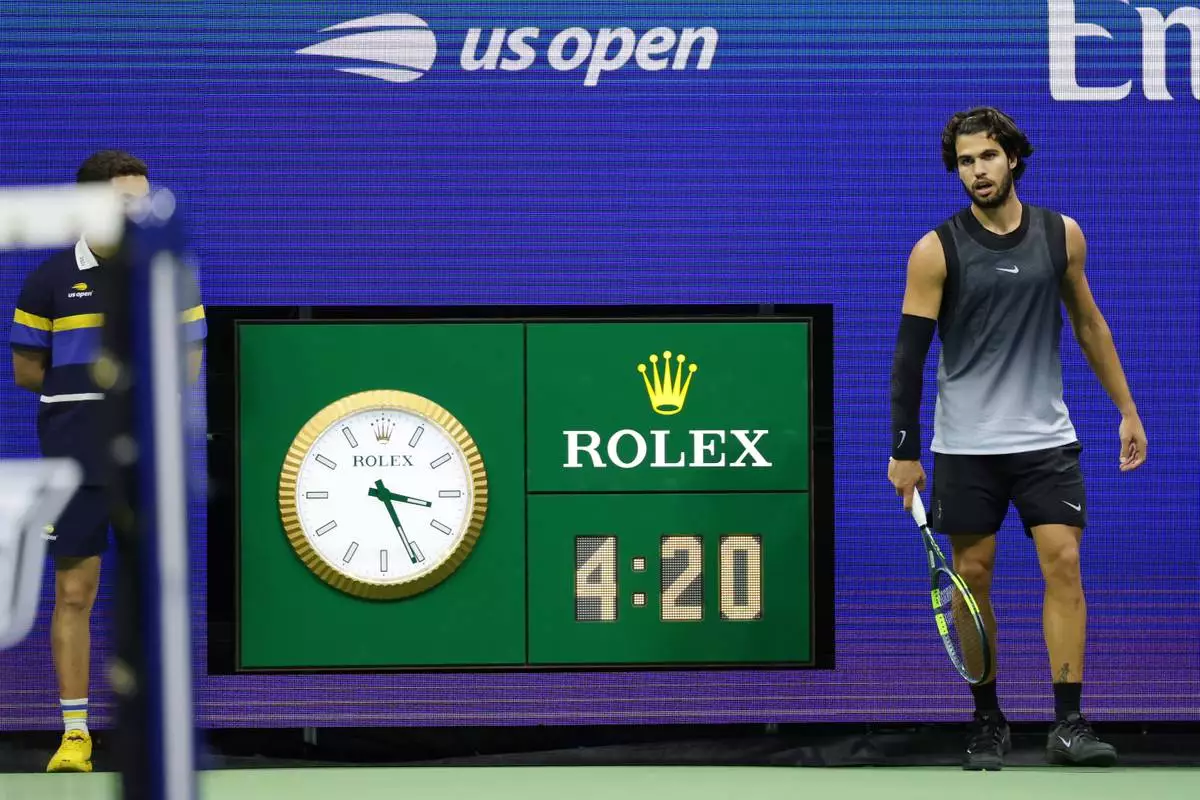
The clock reads 3:21 a.m. as Carlos Alcaraz, of Spain, plays in the fifth set against Ben Shelton, of the United States, during the quarterfinal round of the U.S. Open tennis championships, early Wednesday, Sept. 9, 2026, in New York. (AP Photo/Adam Hunger)


The clock reads 3:21 a.m. as Carlos Alcaraz, of Spain, plays in the fifth set against Ben Shelton, of the United States, during the quarterfinal round of the U.S. Open tennis championships, early Wednesday, Sept. 9, 2026, in New York. (AP Photo/Adam Hunger)
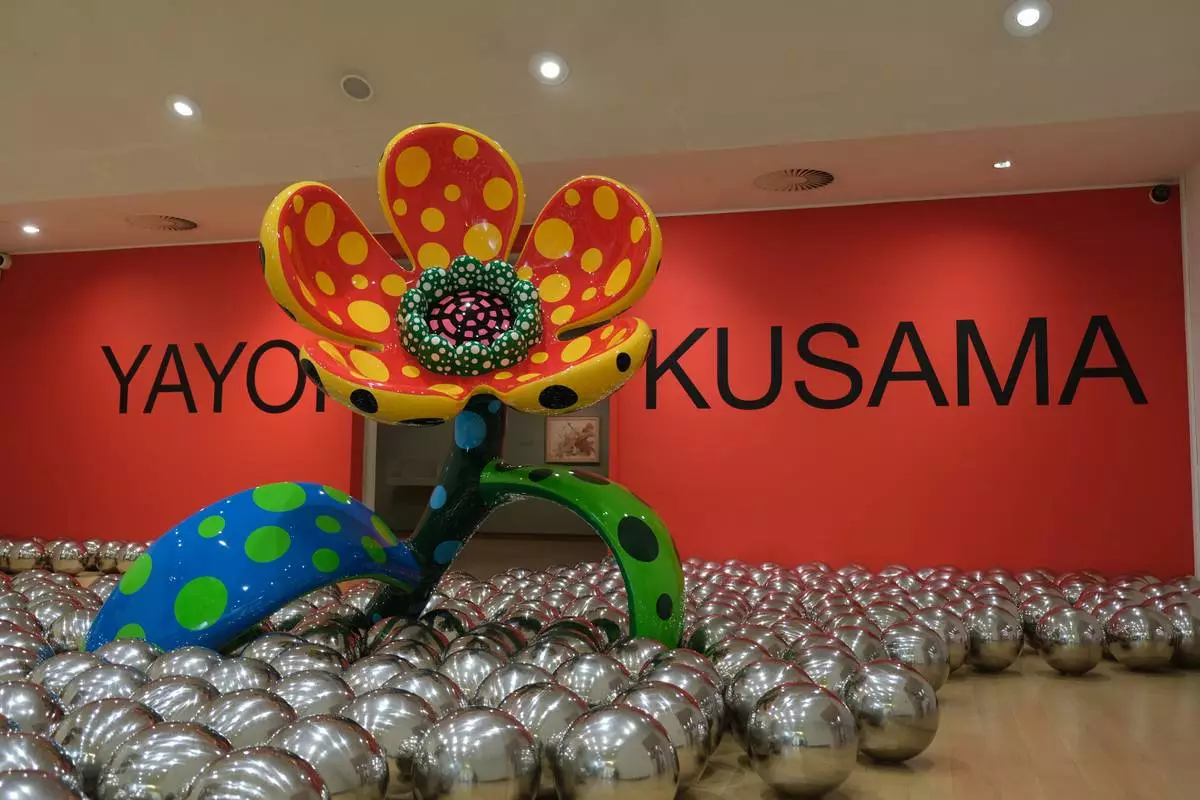
AMSTERDAM (AP) — Yellow tentacles decorated with rhythmic patterns of dots swirl around a room, the patterns echoed on the floor and the walls. Reflections bounce off mirrors, blurring the boundaries of the space at Amsterdam 's Stedelijk Museum.

The installation — specially created for an exhibition of the work of Japanese artist Yayoi Kusama, who died Aug. 14 at age 97 — is titled “Infinity Mirrored Room — The Hope Of The Polka Dots Buried In Infinity Will Eternally Cover The Universe.”

The room is at the heart of the exhibition at the Stedelijk that opens this week, just two weeks after her death. What was to have been a retrospective has turned into a posthumous celebration of one of the globe's best known contemporary artists, who depicted her world splashed with polka dots and other repetitive motifs.

“We heard about her passing,” exhibition curator Leontine Coelewij told The Associated Press. “We decided to make it really a tribute. A tribute to her life. Tribute to her work, so that everybody can see what she is ... to us. So many wonderful works.”

Kusama's signature dots greet visitors before they even get into the museum in Amsterdam — they are plastered across its facade and even on red fabric wrapped around trees on the adjacent Museum Square.

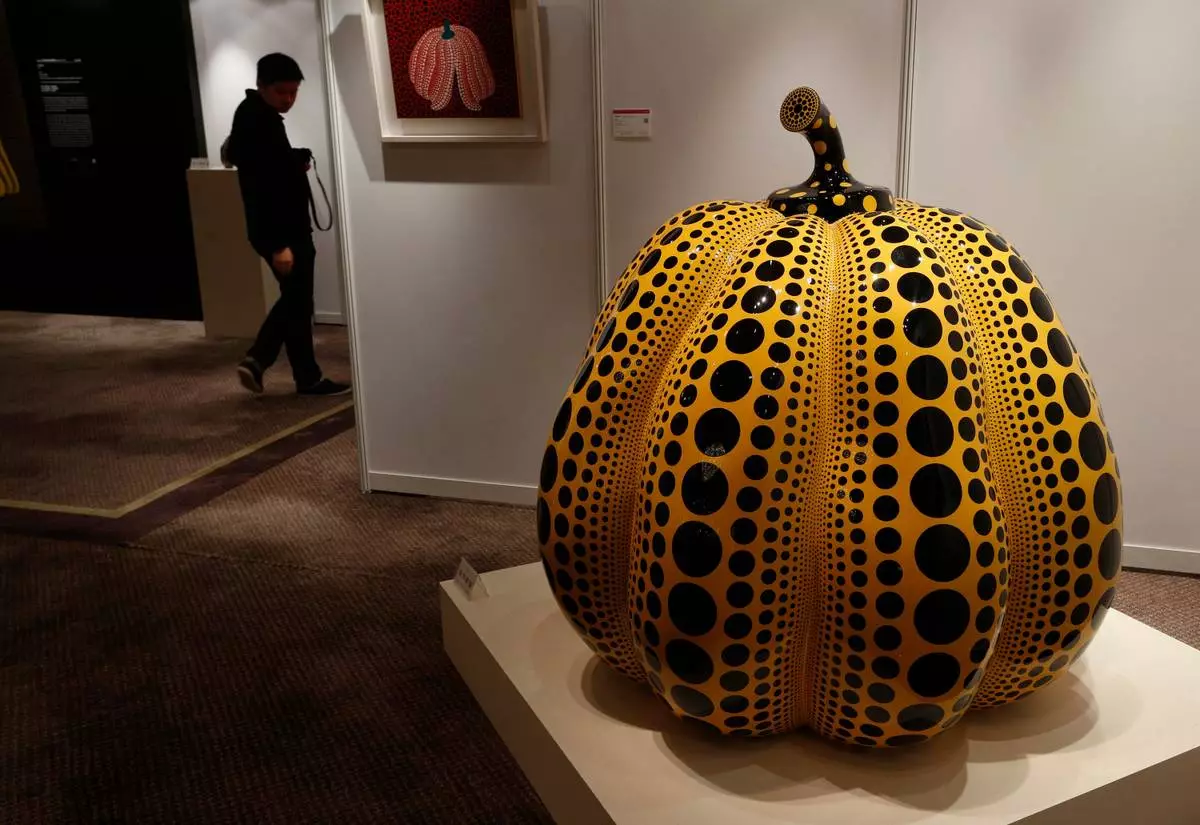
Coelewij said that painting the dots was a way for the artist to process hallucinations she had from a young age. Among the works on display is a huge pumpkin made of fiber-reinforced plastic and polyurethane paint, its yellow skin covered in lines of black dots of varying sizes.

“So a lot of her work comes from these mental issues that she had,” Coelewij said. “And I think she made something beautiful out of it for her. It was also a way to explore ideas about infinity, for instance, like, how do we relate to the universe, to the cosmos, to the world around us?”

Kusama had long-standing links to the Netherlands and the Stedelijk. She was active in Amsterdam and other Dutch cities in the freewheeling 1960s, and her work was closely aligned to the ZERO movement established in the late 1950s by German artists, Heinz Mack and Otto Piene.

She was part of a landmark exhibition by the movement, also at the Stedelijk, in 1965. A photo from that Amsterdam exhibition shows Kusama, wearing a white kimono, standing among artists from the movement — mostly men in suits and ties.

In a famous “happening” in 1967, Kusama covered the naked body of Dutch artist Jan Schoonhoven with painted dots in the chapel of the Stedelijk Museum Schiedam near Rotterdam.

“She really liked the whole atmosphere in the Netherlands, which was rather open and tolerant, liberal,” Coelewij said. “She was also part of the counterculture of that moment, the hippie culture. You know, Amsterdam was the magical center, and she felt very much at home here.”

The new exhibition spans through several rooms before going up an escalator lined with mirrors to reach the infinity room installation one floor up.

It's Coelewij's favorite part of the show, created for the exhibition that was previously staged at Museum Ludwig in the German city of Cologne.

“There’s a lot of mirrors, there’s tentacles, there’s a lot of color, and it’s a ... you can say hallucinating world. You really step into her mind,” Coelewij said.

It's a fitting tribute to the artist who said 10 years ago that she felt her life was nearing its end but she was “still fighting to the death for my art.”

“I am giving all I have so that many people will continue to be interested in my art, even after I am dead,” Kusama had said.

The exhibition at Amsterdam’s Stedelijk opens on Friday and runs through Jan. 17.

Two people stand outside the Stedelijk Museum that is opening a major retrospective of recently deceased Japanese artist Yayoi Kusama, in Amsterdam, Netherlands, Wednesday, Sept. 9, 2026. (AP Photo/Mike Corder)

Two people stand outside the Stedelijk Museum that is opening a major retrospective of recently deceased Japanese artist Yayoi Kusama, in Amsterdam, Netherlands, Wednesday, Sept. 9, 2026. (AP Photo/Mike Corder)

FILE - A man walks past a work " Pumpkin " by Japanese artist Yayoi Kusama during the Ravenel auction press preview in Hong Kong Friday, Nov. 23, 2012. (AP Photo/Vincent Yu, File)

FILE - A man walks past a work " Pumpkin " by Japanese artist Yayoi Kusama during the Ravenel auction press preview in Hong Kong Friday, Nov. 23, 2012. (AP Photo/Vincent Yu, File)

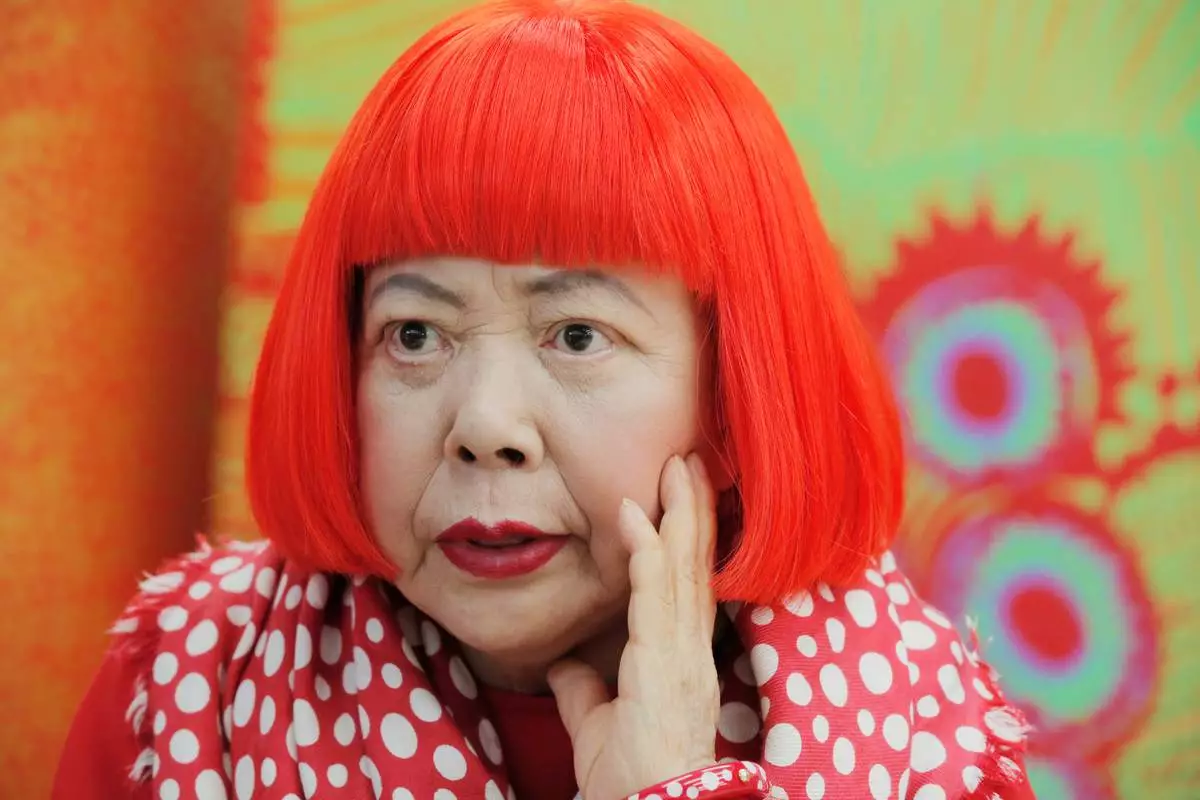
FILE - Japanese avant-garde artist Yayoi Kusama, wearing a bright red wig and a Louis Vuitton polka dot scarf, speaks during an interview at her studio in Tokyo, on Aug. 1, 2012. (AP Photo/Itsuo Inouye, File)

FILE - Japanese avant-garde artist Yayoi Kusama, wearing a bright red wig and a Louis Vuitton polka dot scarf, speaks during an interview at her studio in Tokyo, on Aug. 1, 2012. (AP Photo/Itsuo Inouye, File)

Flowers and reflective balls are seen at a major retrospective of works by recently deceased Japanese artist Yayoi Kusama at the Stedelijk Museum in Amsterdam, Wednesday, Sept. 9, 2026. (AP Photo/Mike Corder)

Flowers and reflective balls are seen at a major retrospective of works by recently deceased Japanese artist Yayoi Kusama at the Stedelijk Museum in Amsterdam, Wednesday, Sept. 9, 2026. (AP Photo/Mike Corder)

Recommended Articles