New Generation, New Cinematic Language: Osmo Pocket 4P Sparks a New Conversation About Storytelling, Creative Freedom, and Professional Tools.
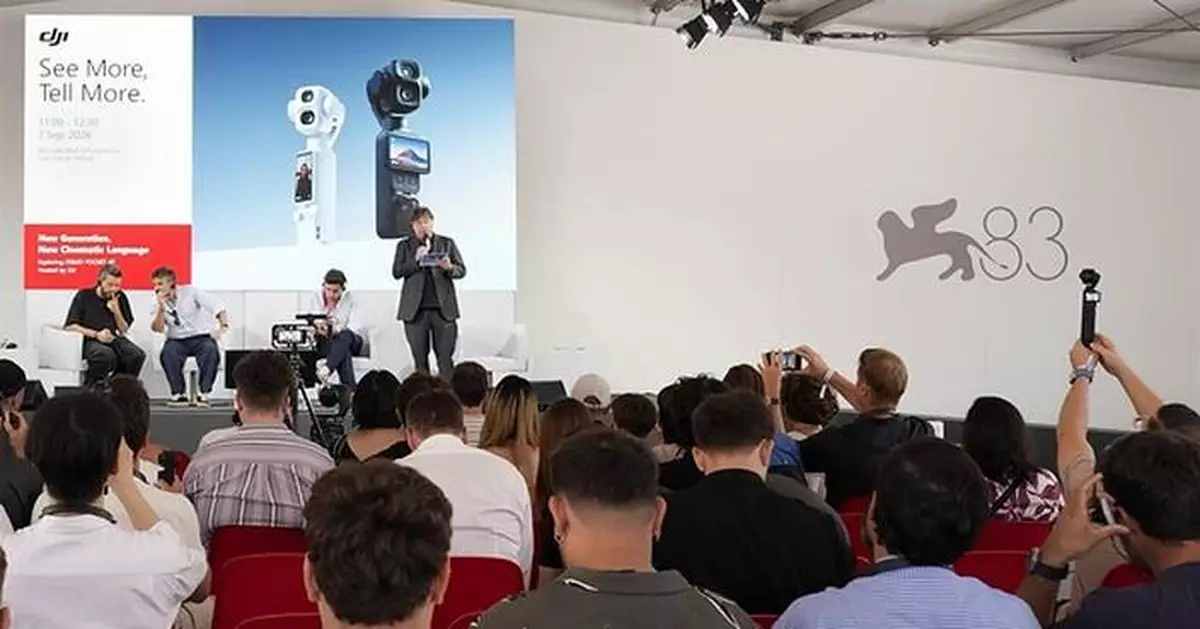
VENICE, Italy, Sept. 9, 2026 /PRNewswire/ -- DJI, the global leader in civilian drones and creative camera technology, hosted the "Filmmakers & Visionaries Session," a professional forum during Venice Production Bridge at the 83rd Venice International Film Festival. The gathering brought together emerging directors and cinematographers to explore a question the industry is only beginning to answer: when a cinema camera fits in the palm of your hand, how does the language of film itself change?
From Cannes to Venice: A Unified Vision
The Venice Production Bridge session continued the creative journey that the Osmo Pocket Series began this year. Following the global unveiling at Cannes in May, DJI entrusted the Osmo Pocket 4P to two of cinema's most distinctive visual voices, each working independently on separate continents. The results revealed a striking convergence.
In "FAMILIARITÉ," Cannes- and Venice-honored actress Isabelle Huppert starred in and creatively directed an original meditation on literature and memory, shot entirely on the Osmo Pocket 4P. Concurrently, acclaimed Japanese cinematographer Mikiya Takimoto conceived and directed "Looking for Her"—a road-movie-style narrative set in a historic silver-mining town that traces a quiet search for human connection—also entirely on the Osmo Pocket 4P. What emerged from these two independent creative processes was a unified conviction: a camera lightweight enough to disappear into one's hand carries no compromise to emotional depth or technical precision. Both films demonstrate the full capabilities of cinematic storytelling compressed into a pocketable form. At Venice, this private creative truth became a public industry question.
Screening the Future: From Theory to Practice
The session is structured as a genuine industry dialogue, rooted entirely in filmmaking practice rather than product demonstration. Four short films created by an international group of emerging cinematographers were screened: Gabriele Mencaroni and Alessandro Tempestini (Italy), Liu Yadi (China/France), and Zhou Chengzhou (China/Netherlands). Their collective work spanned experimental film, commercial production, and festival-recognized documentaries—a diversity reflecting a generation operating across traditional creative boundaries.
Following the screening and a live shooting demonstration, three internationally acclaimed cinematographers provided rigorous professional critique: Valentin Vignet, a French cinematographer known for his work on Faces Places and the Oscar-nominated short Nefta Football Club; Cristiano Di Nicola, an award-winning Italian cinematographer represented in Venice with "L'Estranea" in Official Competition; and Michele D'Attanasio, a two-time David di Donatello Award winner known for films including Veloce come il vento, Freaks Out, and L'ombra di Caravaggio. All three, experienced in commanding large-scale productions, evaluated the young directors' visual storytelling against the uncompromising standards of professional cinema, demonstrating that the technical sophistication of the work met, rather than compromised, traditional cinematography benchmarks.
The Roundtable: Industry Discussion of Reframing Cinema
The centerpiece was a roundtable discussion: "How is a new generation reframing cinema?" The conversation wove together the distinct perspectives of veteran cinematographers and emerging directors, organically exploring four fundamental dimensions: how compact, gimbal-stabilized tools reshape the relationship between the camera, the performer, and the environment; whether lighter, more flexible equipment democratizes professional filmmaking while demanding greater visual discipline; how production workflows and on-set dynamics transform with lightweight setups; and ultimately, whether a tool can actually change cinematic language itself, or if the visual idea must always come first.
Valentin Vignet reflected on the mental shift when the massive camera rig disappears from set: the performer no longer accommodates the apparatus, and the camera becomes a witness rather than an obstacle. "What struck me most about these four short films is that none of the filmmakers needed to compromise on quality to use a more lightweight camera," said Cristiano Di Nicola. "There were so many shots that I didn't even think were possible before, and that's because the Osmo Pocket 4P frees you as a filmmaker. We can focus more on how to tell the story, specifically on how to get closer to the action than on the setup."
For cross-cultural cinematographers like Liu Yadi and Zhou Chengzhou, the emphasis shifted: How do young cinematographers maintain truly cinematic expression within the tight constraints of limited budgets and skeleton crews? The answer emerged organically through the dialogue: professional standards—color science, dynamic range, stabilization precision—are now decoupled from equipment scale. A cinematographer working alone in a confined space can deploy the same technical sophistication as a Hollywood crew. The barrier to entry has been lowered not by sacrificing quality, but by redistributing where that quality can reside.
The Venice Production Bridge session hosted by DJI crystallizes a moment when cinema's fundamental question shifts from "What equipment do we need?" to "What becomes possible when equipment stops being an obstacle?" The Osmo Pocket 4P is DJI's answer: professional imaging power untethered from industrial scale, empowering every storyteller in any environment—from Tokyo's narrow streets to a canoe on a quiet garden lake—to bring the full technical and emotional weight of cinema to their vision. This is a new era defined by accessibility, making cinema-quality tools available to more visionaries, enabling more creative freedom in how they tell their stories. With smaller cinema cameras, the true power of imaging technology emerges: not as a constraint on imagination, but as liberation.
** This press release is distributed by PR Newswire through automated distribution system, for which the client assumes full responsibility. **
DJI Hosts Filmmakers & Visionaries Session at Venice Production Bridge During the 83rd Venice International Film Festival