MINNETONKA, Minn. & REHOVOT, Israel--(BUSINESS WIRE)--Sep 9, 2026--
Stratasys Ltd. (NASDAQ: SSYS) announced the launch of the new F870™ FDM® system, a large-format additive manufacturing platform designed for industrial manufacturers, automotive OEMs, aerospace & defense production lines, looking to scale production on the factory floor.
This press release features multimedia. View the full release here: https://www.businesswire.com/news/home/20260909980551/en/
Extending the Stratasys production-grade FDM portfolio, the F870 combines unrivaled large-format capabilities in a heated chamber backed by a suite of the strongest, most durable materials, all with a lower total cost of ownership so manufacturers can expand additive across manufacturing applications. Manufacturers increasingly demand larger, production-ready systems capable of producing tooling, fixtures, manufacturing aids and end-use parts at the size, throughput, and reliability needed for factory-floor deployment. The F870™ FDM® machine addresses this need.
Systems are currently being adopted by leading manufacturers, including Toyota Production Engineering in Georgetown, Kentucky, and Rivian Automotive in Plymouth, Michigan. These organizations are assessing the platform across a range of applications, from factory-floor tooling and manufacturing aids to advanced prototyping workflows, ahead of commercial availability.
Early deployments address customer needs for automotive tooling, manufacturing aids, and other production-support applications, including large fixtures, assembly tools, and inspection gauges that traditionally require lengthy machining lead times.
"Manufacturers are looking for proven solutions to speed up production, reduce cost, and respond in real-time to ever-changing supply chain and manufacturing requirements," said Rich Garrity, Chief Business Unit Officer, Stratasys. "The F870 is a very unique solution, demonstrating our advanced manufacturing expertise and our deep understanding of customer demand for additive manufacturing solutions that produce larger tooling, fixtures, and manufacturing aids on the factory floor. The new platform is geared towards real manufacturing environments, delivering our leading industrial-scale capabilities with increased build capacity, combined with Stratasys’ proven materials, and production reliability at a competitive price-point."
"We've already seen the value Stratasys additive manufacturing can deliver," said Dallas Martin, Additive Manufacturing Engineer at Toyota North America. "The next challenge is expanding its use across more applications. The F870's combination of build size, material performance and industrial features aligns with the kinds of manufacturing needs we're looking to address."
Designed for production-support applications, the F870 features a build volume of 1000 x 610 x 610 mm (39.4 x 24 x 24 in.) and combines the market's longest build capacity in a fully heated chamber with a portfolio of industrial-grade materials, including Nylon 12CF™, ASA, ABS and the new FDM® ABS Draft (Gray). In particular, Nylon 12CF Carbon Fiber provides the strength, stiffness and durability required for demanding manufacturing-floor tooling and fixture applications. The platform enables manufacturers to produce larger tooling, fixtures, manufacturing aids and end-use parts with the repeatability, durability and throughput required for factory-floor deployment.
Built on Stratasys' industrial FDM® foundation, the F870 expands Stratasys's portfolio of production-focused additive manufacturing solutions, helping manufacturers reduce production costs, improve responsiveness and scale additive manufacturing across manufacturing operations.
Experience the F870 at IMTS 2026
Stratasys will showcase the new F870 platform and other manufacturing-focused innovations at IMTS 2026, Booth 338460, South Hall, Chicago, September 14–19, 2026.
To learn more about the F870, visit https://www.stratasys.com/en/3d-printers/printer-catalog/fdm-printers/f870-printer/ or stop by the booth at IMTS.
To learn more about our large-format 3D Printers click here
About Stratasys
Stratasys is leading the global shift to additive manufacturing with innovative 3D printing solutions for industries including aerospace, automotive, consumer products, and healthcare. Through smart and connected 3D printers, polymer materials, a software ecosystem, and parts on demand, Stratasys solutions deliver competitive advantages at every stage of the product value chain. The world’s leading organizations turn to Stratasys to transform product design, bring agility to manufacturing and supply chains, and improve patient care.
To learn more about Stratasys, visit www.stratasys.com, the Stratasys blog, X/Twitter, LinkedIn, or Facebook. Stratasys reserves the right to utilize any of the foregoing social media platforms, including Stratasys’ websites, to share material, non-public information pursuant to the SEC’s Regulation FD. To the extent necessary and mandated by applicable law, Stratasys will also include such information in its public disclosure filings.
Forward-Looking Statements
This press release contains forward-looking statements within the meaning of the Private Securities Litigation Reform Act of 1995. Those forward-looking statements are based on current information that is, by its nature, subject to potential change, due to risks and uncertainties faced by the Company, including those risks described in Item 3.D “Key Information - Risk Factors” of Stratasys’ annual report on Form 20-F for the year ended December 31, 2025, which Stratasys filed with the SEC on March 6, 2026, and in other reports and documents that Stratasys files with or furnishes to the SEC from time to time, which are designed to advise interested parties of the risks and factors that may affect Stratasys’ business, financial condition, results of operations and prospects. Any forward-looking statements made in this press release are made as of the date hereof, and Stratasys undertakes no obligation to publicly update or revise any forward-looking statements, whether as a result of new information, future events or otherwise, except as required by law.
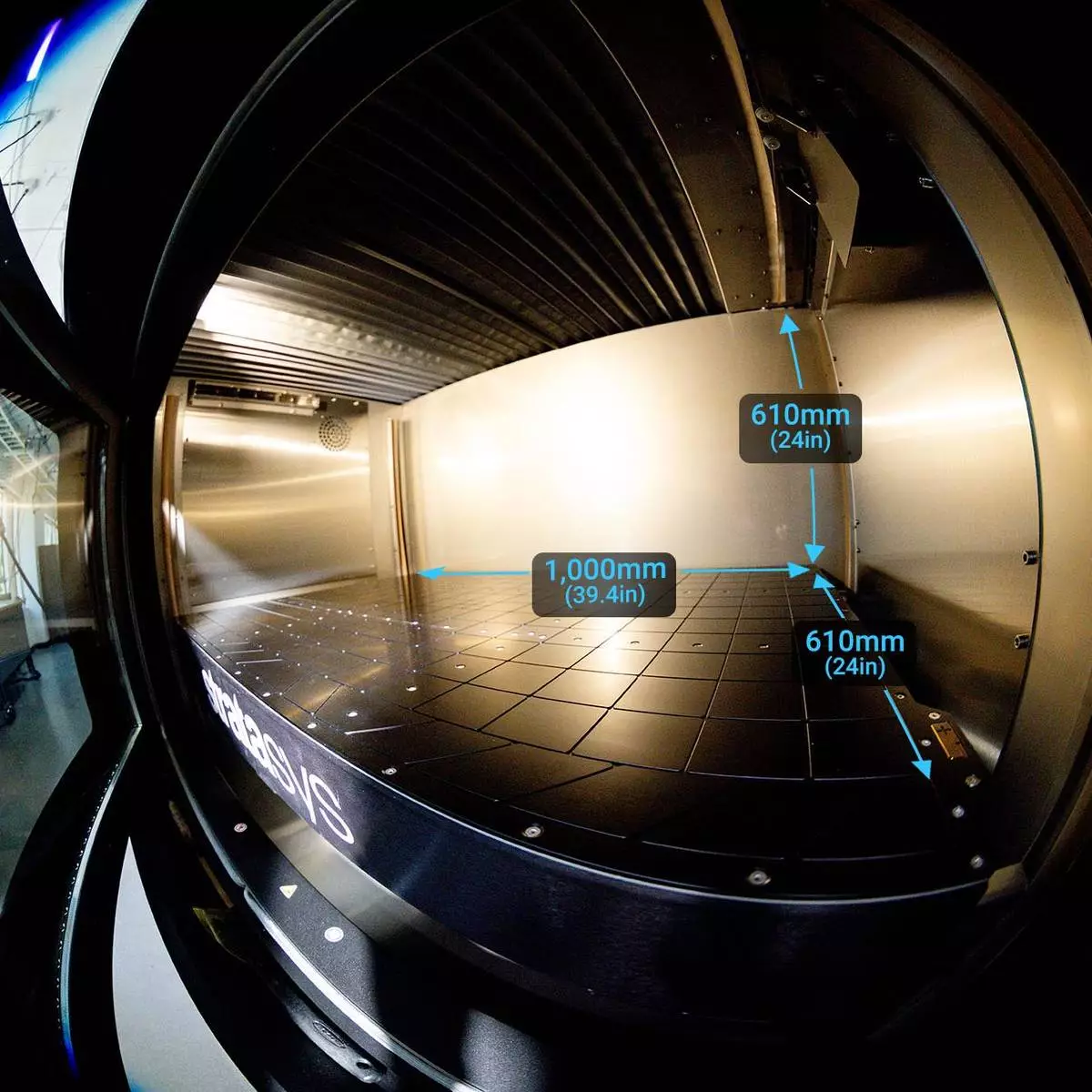
Stratasys F870™ FDM® system features a build volume of 1000 x 610 x 610 mm (39.4 x 24 x 24 in.) and combines the market's longest build capacity in a fully heated chamber with a portfolio of industrial-grade materials, including Nylon 12CF™, ASA, ABS and the new FDM® ABS Draft (Gray).

Stratasys F870™ FDM® system, a large-format additive manufacturing platform designed for industrial manufacturers, automotive OEMs, aerospace & defense production lines, looking to scale production on the factory floor.
CAIRO (AP) — The latest attack on the international airport in Saudi Arabia's capital of Riyadh killed 12 people and injured over 300 others, civil aviation authorities said early Sunday, with some in critical condition. A Saudi-led coalition blamed Iran-backed Houthi rebels in neighboring Yemen.
It was the deadliest attack in any Gulf Arab country since the start of the Iran war, whose fronts have expanded to include the recent surge in fighting between the Houthis and Saudi-backed Yemeni government forces.
A missile struck a King Khalid International Airport complex housing terminals 3 and 4 for domestic flights, a regional official said, speaking on condition of anonymity because they weren’t authorized to speak to the media.
The Saudi statement said the dead included four Saudi citizens as well as two Bangladeshi nationals, a Palestinian, a U.S. citizen, an Egyptian, a Jordanian, a Syrian and a Sudanese. It said the injured were being treated at several hospitals.
Footage posted on social media following the attack and analyzed by The Associated Press shows emergency vehicles outside the airport.
Saudi civil aviation authorities on Saturday said airport operations were suspended. The closure was later extended by 24 hours until 9 p.m. Sunday, according to the flight tracking platform Flightradar 24.
The attack — the latest of several in the past week on the airport — is expected to increase Saudi pressure on allies including the United States to provide military support for the kingdom, which has seemingly tried to avoid all-out war with the Houthis.
Shortly after the attack on Saturday afternoon, U.S. President Donald Trump said he was evaluating whether the U.S. should join Saudi strikes against the rebels. “We may. We’re going to look at it,” he said. “We just found out about the recent attack. So we’ll make a decision. We move very quickly.”
Trump later Saturday said he planned to speak to Crown Prince Mohammed bin Salman and said “what happened in Saudi Arabia is not acceptable.” Asked if the U.S. might get involved, Trump responded, “We’ll find out.”
U.S. Secretary of State Marco Rubio acknowledged in a social media post that an American citizen had been killed in the attack, which he condemned.
“These reprehensible attacks demonstrate a blatant disregard for innocent civilian life. They must stop now,” he said.
The Saudi-led coalition fighting the Houthis blamed them for the attack, calling it a “fully-fledged war crime” and vowing a firm response. The airport has no military facilities.
There was no immediate statement from the rebels, who earlier Saturday accused Saudi Arabia of striking Sanaa International Airport in the Houthi-held Yemeni capital.
The Houthis claimed attacks earlier in the week on King Khalid International Airport that killed three Saudis, including a pilot. The surge in attacks, including against other Saudi airports, military facilities and oil infrastructure, has come in the week since a Saudi-led coalition launched a major military offensive against the Houthis.
The airport had a heavy police presence on Saturday, with all entrances blocked, and lights around the complex were dimmed. Flights diverted elsewhere, Flightradar24 said. Countries including the United States, Britain, Germany, Australia and Canada warned citizens to avoid the airport.
Also Saturday, U.S. Central Command said a fighter jet struck and disabled a commercial cargo vessel with a precision munition in the Gulf of Oman, part of U.S. efforts to maintain a naval blockade of Iranian ports. The Panama-flagged M/V Ocean Molica had departed an Iranian port and did not heed repeated warnings. The ship’s crew was unharmed, CENTCOM said.
The attacks on Saudi Arabia, the world's top oil exporter, have rattled markets and the region. And yet the Saudi energy ministry hours after the latest one was still promoting a major international energy conference set to begin in Riyadh on Sunday.
Until recently, the Houthis had been largely on the sidelines of the Iran war. Now the rebels are a way for Tehran to apply pressure on a key U.S. ally.
The Saudis and the Houthis began fighting in 2015 when the kingdom entered Yemen’s civil war on behalf of the internationally recognized government. Relative calm after a 2022 ceasefire ended in July when the Houthis resumed attacks, saying the Saudis fired on the Sanaa airport as a plane from Iran was trying to land. That revived anger over the Saudi-led blockade that has largely isolated Houthi-run areas.
Now fighting has escalated, with the Saudi-led coalition providing air support for Yemeni government forces attempting to reverse recent Houthi gains along the Red Sea. Those gains gave the rebels better surveillance of shipping on a corridor that is a crucial alternative to the Strait of Hormuz, where Iran has been attacking ships.
While the Houthis have said they are only targeting Saudi shipping as part of a blockade in retaliation for the one imposed on them, concerns about wider attacks persist. The Houthis previously attacked dozens of ships after the war in Gaza began, calling it solidarity with Palestinians. A U.S. bombing campaign sharply limited that.
Saudi Arabia is running low on missile interceptors and has asked France, Britain, Pakistan and Egypt to deploy air defense support to the region, regional officials told the AP last month, with one noting that the U.S. has seen its own stock dwindle during the war with Iran.
Officials have said U.S. assistance has included intelligence sharing, target identification and planning for the latest offensive against the Houthis.
On Saturday, Saudi Arabia said its foreign minister and Omani counterpart spoke by phone about the importance of “supporting diplomatic solutions to de-escalate tensions” in the region. Oman, which lies across the Strait of Hormuz from Iran, has played a mediator role at times in the region.
The Houthis this week warned global airlines “for the last time” about the potential consequences of operating in Saudi airspace, which they described as a theater for their military operations.
Before the latest attack, Air India, FlyDubai, Lufthansa Group and Pakistan International Airlines were among airlines suspending flights to and from Riyadh and other Saudi airports for varying periods.
The European Union Aviation Safety Agency had expanded its guidance on Saudi airspace, noting the Houthis’ ability to strike targets deeper inside the kingdom, including Riyadh, and a “greater focus on aviation infrastructure.”
The missile and drone attacks and interception efforts “create an increased risk of misidentification of civil aircraft,” it said.
Two regional officials said Houthi attacks on the Riyadh airport on Thursday damaged three planes. The officials spoke on condition of anonymity because they weren’t authorized to brief the media. The Saudi national carrier said one of its aircraft was damaged while it was on the ground, with no passengers on board.
Meanwhile, Saudi authorities warned the public this week that “filming, publishing or sharing information related to countering missiles and drones and their impact sites exposes you to legal liability.”
Anna reported from Jerusalem. Associated Press writers Victoria Eastwood in Cairo, Collin Binkley in Washington and Sally Abou AlJoud in Beirut contributed to this report.
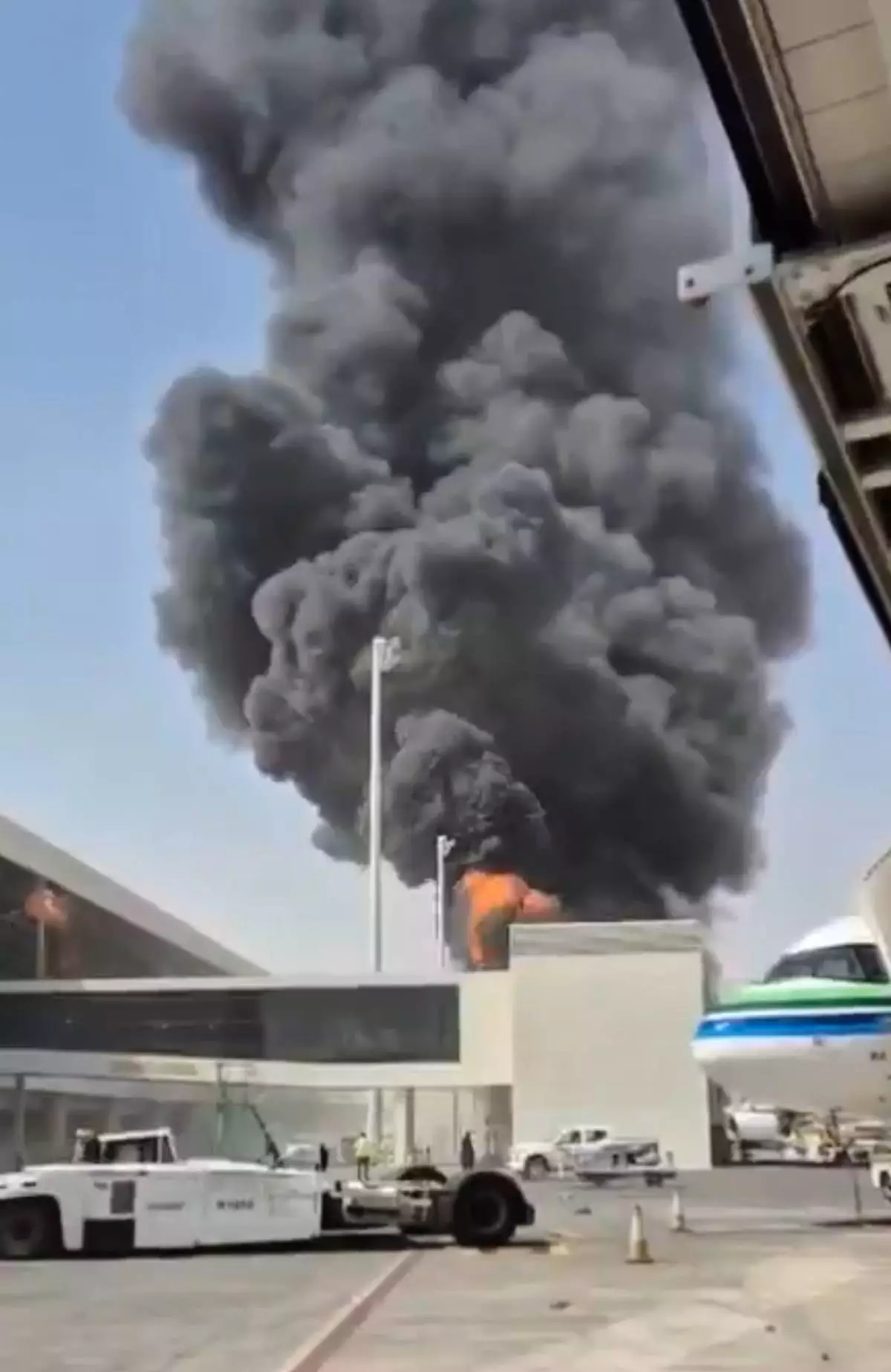
This image from video obtained and verified by AP shows thick black smoke and flames rising from a fire at King Khalid International Airport in Riyadh, Saudi Arabia, Friday, Oct. 9, 2026. (UGC via AP)