RIO DE JANEIRO (AP) — Brazilian President Luiz Inácio Lula da Silva signed a decree and a provisional measure Wednesday aimed at lowering fuel prices, weeks ahead of the presidential election and as the U.S.-Iran war drives up the cost of filling the tank.
The cost of fuel is a particularly sensitive issue for voters, who will decide in October whether to grant Lula a fourth, nonconsecutive term, or elect Sen. Flávio Bolsonaro, a son of former President Jair Bolsonaro.
Brent crude, the international standard, surged above the $100 threshold on Wednesday for the first time since July, after attacks on oil facilities and ships in the Middle East threatened to further strain an already weakened supply chain.
“We’re not going to allow this irresponsible war to hit your pocket,” said Lula as he signed the measures, which extend policies to control fuel prices introduced at the beginning of the U.S.-Iran war.
The measures announced Wednesday include tax cuts on the import and sale of ethanol, gasoline and gasoline blends (excluding aviation gasoline), effective for 30 days from Sept. 10 to Oct. 9. A provisional measure authorizes a subsidy of one Brazilian real ($0.19) per liter for producers and importers of road diesel.
Crude oil prices shot up shortly after Israel and the U.S. began their war with Iran in late February, largely because the fighting halted most shipping through the Strait of Hormuz, a narrow waterway where roughly a fifth of the world’s oil supply passed before the conflict.
Brazil is a major producer and exporter of crude oil, and its revenues from the sector have surged this year due to the hike in international prices. But the country still relies on imports to meet domestic demand for refined fuels.
Stabilizing diesel prices is also critical to prevent truck driver strikes and keep food inflation in check. In 2018, a truckers’ strike caused food prices to spike, left grocery market shelves and gas stations depleted, and caused billions in losses, underscoring the power of organized truckers.
Former President Jair Bolsonaro, then a lawmaker and months away from winning the presidential election, was an outspoken supporter of the truckers, who later became an important constituency for him.
Wednesday’s measures “have a significant electoral component,” according to Armando Castelar Pinheiro, an economics professor at the Federal University of Rio de Janeiro. If it weren’t for the political calendar, “there would be some subsidy, but it would likely be lower,” he said.
Diesel in Brazil is 28% cheaper than international prices and gasoline is 21% cheaper, according to an Itaú BBA market analysis cited by local media Wednesday.
Follow AP’s coverage of Latin America and the Caribbean at https://apnews.com/hub/latin-america

Brazilian President Luiz Inacio Lula da Silva attends a ceremony at the Planalto Palace in Brasilia, Friday, Sept. 4, 2026, marking the signing of measures related to funding for the justice system. (AP Photo/Eraldo Peres)
JEFFERSON CITY, Mo. (AP) — A battle over Missouri’s congressional districts vaulted back to the U.S. Supreme Court on Wednesday, two months before a pivotal November election that will determine control of Congress and affect the fate of President Donald Trump’s agenda.
A series of conflicting court rulings has left a scar on Missouri — and left voters befuddled and unsure which U.S. House districts they will be voting in and which candidates will appear on their ballots.
A federal appeals court panel on Wednesday sided with Republicans, declining to halt a federal judge’s order favoring a new map backed by Trump. But that decision immediately was appealed to the U.S. Supreme Court, which just a day earlier had let stand a ruling by Missouri's top court against the Trump-backed districts.
Time is rapidly expiring to figure it out. Federal law sets a Sept. 19 deadline to mail absentee ballots to overseas citizens and military voters.
Here's a look at how Missouri arrived at this point and the difficulties it now faces.
Trump urged Republican-led states last year to redraw congressional districts to their advantage ahead of the midterm elections. Texas went first. Missouri was the second GOP state to act. State lawmakers passed new U.S. House districts last September targeting a Kansas City-based seat held by Democratic Rep. Emanuel Cleaver.
The new districts were intended to help Republicans win seven of the state's eight House seats in the midterm elections — a gain of one seat.
Redistricting opponents collected hundreds of thousands of petition signatures seeking to force a statewide vote on the new districts. They submitted the signatures in December. But Republican Secretary of State Denny Hoskins waited until August — on the same day as Missouri's primary — to reject the petition. Hoskins asserted that a referendum petition could not be used for congressional redistricting.
The delay by Hoskins was intentional. It allowed Missouri's new congressional districts to be used in the primaries.
The Missouri Supreme Court said Hoskins was wrong. It ordered him to put the redistricting referendum on the November ballot, which he did. But more than that, the court said the new districts never became law and instead were suspended retroactively to the December petition submission.
The court barred Hoskins from using the new map and said the old map — passed by Republican lawmakers in 2022 after the last census — must be used in the November election. The U.S. Supreme Court on Tuesday declined to hear an appeal.
Mere minutes after the U.S. Supreme Court's action, federal District Judge Stephen Clark of Missouri issued a contradictory decision. He temporarily barred Hoskins from using any map other than the new congressional districts in the November election. Clark said switching districts between the primary and general election could violate voters' federal rights.
Redistricting opponents asked the 8th U.S. Circuit Court of Appeals to reverse Clark's order, but it declined to do so. So they quickly asked the U.S. Supreme Court to intervene.
Redistricting opponents also have asked the Missouri Supreme Court to hold Hoskins in contempt for taking steps to use the new districts in November. The court set a contempt hearing for Thursday.
State attorneys for Hoskins, meanwhile, want the federal judge to block the contempt hearing. They contend Hoskins was merely following orders, arguing that a federal court order — based on the U.S. Constitution — supersedes a state order based on the state constitution.
After a U.S. Supreme Court ruling in April weakened the federal Voting Rights Act, Alabama lawmakers voted to change some of their congressional districts. The high court allowed it to happen, even though voting had occurred in a May primary. Alabama instead held a new primary for the revised districts in August.
A similar scenario unfolded in Texas three decades ago. After Texas held its 1996 primaries, a federal court struck down several congressional districts. The state subsequently held an open primary for those districts in the November election, putting candidates from both parties on the same ballot. If no one got a majority, the top two advanced to a runoff.
In Missouri's case, no court has suggested redoing the primary. Candidates who won in August already have been certified for the November ballot according to the number of the district that they won.
“Here in Missouri, we’ve witnessed a series of unprecedented actions, one after another,” said Travis Crum, a law professor at Washington University in St. Louis, who specializes in election law.
Do voters have a right for congressional district boundaries to stay the same from the primary to the general election? “That is a tough and complicated legal question, and there is no definitive ruling from the Supreme Court that one could point to for an answer,” Crum said.
Candidates knew of the ongoing litigation when they signed up to seek office.
“The fact that the district lines changed, that was a chance that you take when you run,” said Michael Wolff, a former Missouri chief justice who later served as dean of the Saint Louis University Law School.
Over the past year, more than a dozen lawsuits have been filed over Missouri's redistricting. Some voters have rallied against it at the state Capitol and courthouses. Others have winced in confusion when listening to explanations about which district they reside in.
Toby Thacker, who lives on a farm near Sedalia, has shifted from the 4th District, currently held by Republican Rep. Mark Alford, to Cleaver's 5th District under the new map. Thacker said he generally supports Republicans, who redrew the map.
But “I'm not very happy with them for doing that,” Thacker recently told The Associated Press.
Cliff Keith, of Washington, Missouri, recently joined protesters outside the Missouri Capitol.
“They have absolutely no business redrawing the districts right now, just before an election,” Keith said.
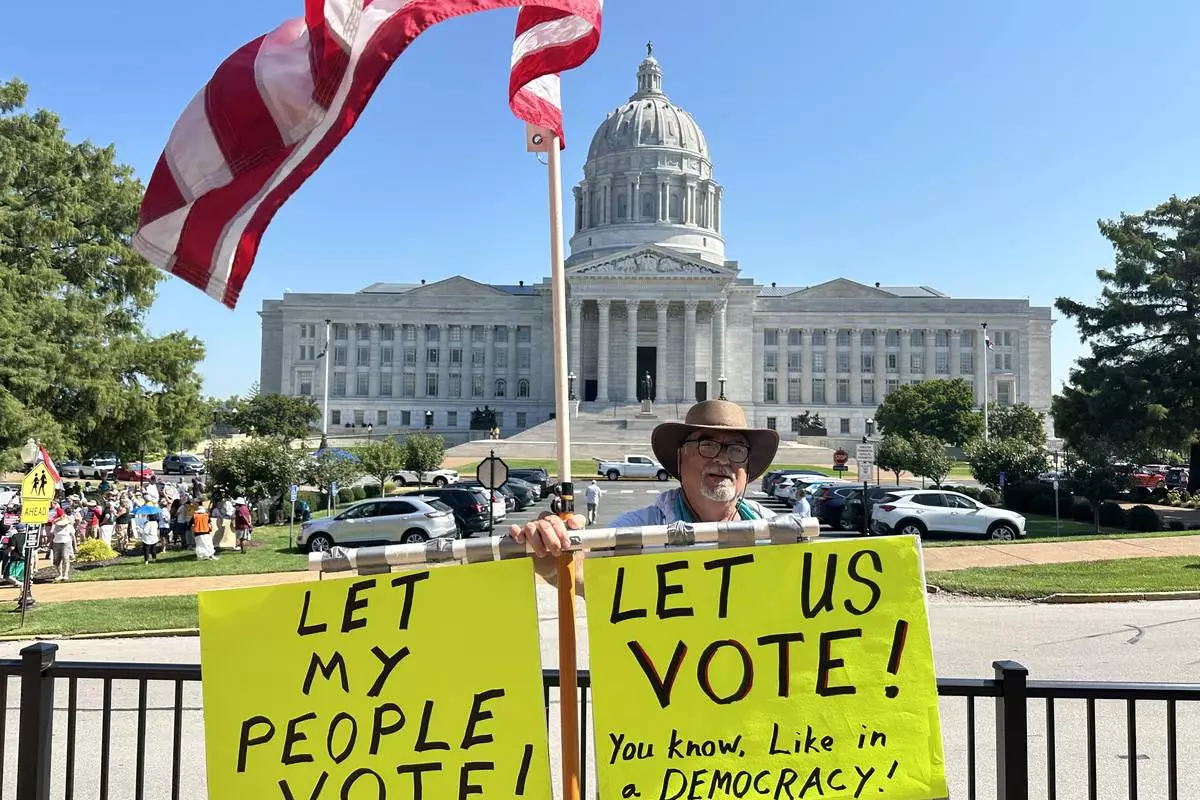
In this photo taken with a smartphone, Steve Dakopolos demonstrates in front of the state Capitol in Jefferson City, Mo., Wednesday, Sept. 2, 2026, in support of a referendum petition seeking a statewide vote on a congressional redistricting plan. (AP Photo/David A. Lieb)