Submarine Networks World x Subsea Security World 2026: the flagship annual event for the global subsea industry returns to Singapore
SINGAPORE, Sept. 10, 2026 /PRNewswire/ -- Submarine Networks World 2026 (organised by Terrapinn), steps up another level and will be welcoming over 1,500 subsea fibre leaders and 150+ industry speakers from across the globe to Sands EXPO & Convention Centre in Singapore on September 23rd and 24th.
The introduction of the new Subsea Security World theatre, focused on the biggest talking point of the last twelve months, increases attendance and participation from security sector specialists, national and regional government entities, navy, coastguard, policymakers and academics from the Americas, Europe, Asia, Oceania.
"Subsea cables connect the world and protecting them has never mattered more. With the launch of Subsea Security World alongside our flagship event, 2026 brings together the commercial and security sides of the industry in one place for the first time. We're thrilled to welcome back the global subsea community, as well as the policy makers and defence specialists shaping its future, to Singapore for what will be the largest edition yet, and the edition the industry has been waiting for", Paul Clark, Managing Director (Asia), Terrapinn.
Everyone from cable owners/operators, consortium members, technology providers, innovators, consultants, service partners, government entities, financiers, surveying companies – the whole industry - will be onsite at the true 'one-stop shop' for any subsea cable project.
Meet with more than 80 sponsors, exhibitors and partners, including Title Sponsor - Nokia, Diamond Sponsors - Ciena and HMN Tech and Gold Sponsors ASN, APTelecom, BAE Systems, Center3, Digital Realty, EXFO, FiberHome, Fibersense, Huawei, Prysmian, ShinewayTech, SMD, Solwake, Starboard Maritime Intelligence and Telecom Egypt.
Attendees will hear from 150+ influential speakers from every inhabited continent around the world. Both mornings begin with the daily Keynote sessions, followed by 4 specialist theatres each day - Strategy, Cable, Data Centres & CLS, Network, O&M and Subsea Security World.
Keynote Speakers include:
- Alan Mauldin, Research Director, TeleGeography
- Andy Palmer-Felgate, Submarine Cable Engineer, Meta
- Giuseppe Valentino, VP Product Management, Backbone & Infrastructure Solutions, Sparkle
- Nelson McMillan, Royal Navy Maritime Domain Awareness Adviser, Southeast Asia, UK Ministry of Defence
- Kent Bressie, Partner – HWG LLP / Legal Advisor, ICPC
- Nadia Krivetz, Director, Cable Resilience & Connectivity Centre, DFAT Australia
- Captain Brett Dawe, Chief of Navy Liaison Officer to the Republic of Singapore Navy, Royal Australian Navy
- Sean Bergin, President & Co-Founder, APTelecom
- Bevan Slattery, Founder, SUBCO
- Mark Procter, Deputy CEO, Stavian HighTech Infrastructure
- Ambrogio Michetti, Chief Corporate & Revenue Officer, Sparkle
- Amajit Gupta, Group CEO and MD, Lightstorm
- Jim Fagan, Chief Executive Officer, EXA Infrastructure
- Sasha Pearson, Policy Analyst, European Centre for Development Policy Management (ECDPM)
- Woon Sien Loh, Senior Director, Infrastructure Planning & Market Development, Info-Communications Media Development Authority (IMDA)
- Emily Kiernan, Head of Strategy and Investments, Telstra Digital Infrastructure
- Robert Pepper, Senior Fellow, Global Digital Inclusion Partnership
- Walid Wakim, Chief Technology Officer of Systems, Nokia
- Savy Wei, Senior Network Solution Manager, HMN Tech
- Amit Malik, Vice President, APJI Sales, Ciena
For event information and the full conference agenda, visit https://www.terrapinn.com/ExperienceSNW2026
PRNewswire is the Official Media Partner of Submarine Networks World x Subsea Security World 2026.
Press attendance is complimentary. Enquiries should be directed to:
Jessica Foong
Terrapinn Pte Ltd
Jessica.foong@terrapinn.com
About Submarine Networks World x Subsea Security World 2026:
Submarine Networks World x Subsea Security World 2026 will take place on 23-24 September 2026 at Sands Expo & Convention Centre in Singapore. Firmly established as the world's largest annual gathering of the global subsea communications community, Submarine Networks World is the dedicated platform to exchange knowledge, explore the latest projects, develop strategies and form lucrative new partnerships to drive the industry forward. For 2026, Subsea Security World joins the event for the first time, bringing together the public, private and policy-making stakeholders shaping the future of cable security and protection.
About Terrapinn:
Terrapinn has been sparking ideas, innovations and relationships that transform business for over 30 years. Using our global footprint, we bring innovators, disrupters and change agents together, discussing and demonstrating the technology, strategies and personalities that are changing the way the world does business. Whether you're looking to make new connections, introduce a product or inspire change in your industry, we invite you to join us as agitators of change. Terrapinn – spark something.
** This press release is distributed by PR Newswire through automated distribution system, for which the client assumes full responsibility. **

Submarine Networks World x Subsea Security World 2026 - enacting GUIDE starts here!
SINGAPORE, Sept. 10, 2026 /PRNewswire/ -- BIT Trust Whitepaper V2.0 highlights 24-hour risk monitoring, layered security controls, and a verifiable trust framework across digital assets and traditional financial services.
Recent security incidents across the digital asset industry have once again brought platform security into sharp focus. As attack methods continue to evolve, risks are no longer confined to a single wallet or technical vulnerability. They can span account privileges, private key management, asset transfers, and third-party infrastructure.
For users, the more practical question is not simply whether a platform is "secure," but whether it can identify and contain risks early when anomalies occur. Are critical operations subject to sufficient authorization and checks and balances? And as financial services expand into U.S. stocks, real-world assets (RWA), and other asset classes, can security and risk controls evolve alongside those expanding business boundaries?
Against this backdrop, global digital financial services platform BIT (formerly Matrixport) has released BIT Trust Whitepaper V2.0. Built around security, compliance, transparency, and verifiability, the new whitepaper provides a structured view of BIT's risk governance, security architecture, compliance and regulatory framework, and independent verification arrangements. It also covers governance, regulatory, and transparency arrangements across business areas including U.S. stocks, RWAs, and asset management.
As a platform supports a broader range of assets and financial services, how can security and trust scale with it?
What Can a Platform Do Before Risk Becomes an Incident?
No platform can eliminate every risk simply by claiming to be "secure." What matters more to users is whether defenses are in place before risks materialize, and whether mechanisms exist to identify and contain anomalous activity when it occurs.
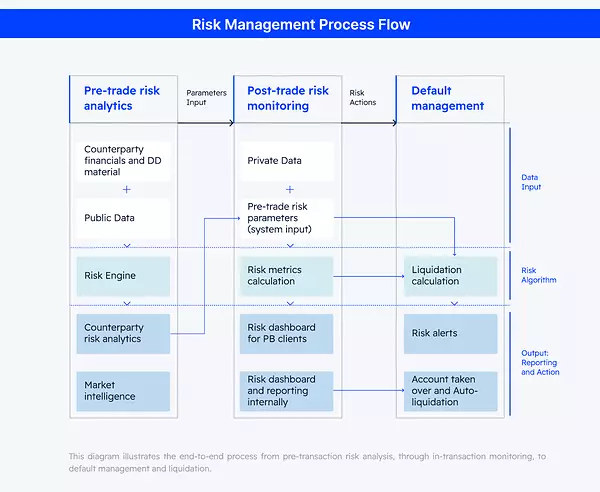
BIT's whitepaper treats risk management as an institutional capability rather than merely a post-event control function. Under its Risk Management and Governance Framework, risk controls are embedded across the full business lifecycle, including pre-transaction assessment, in-transaction monitoring, and post-transaction handling. In specific scenarios such as margin lending and collateralized lending, these controls extend to due diligence, transaction-specific risk parameters, real-time monitoring, risk alerts, default management, and liquidation.
These mechanisms ultimately translate into account and asset protections that users can more readily see. BIT maintains continuous monitoring of user behavior and transaction activity, with automated detection of anomalous logins, devices, and withdrawal behavior. Risk-based alerts can trigger delays or manual review, allowing the security system not only to determine what happened after an incident, but also to identify and respond to anomalies as they emerge.
At the digital asset protection layer, the majority of assets are stored in cold wallets, while private keys are stored using FIPS 140-3 Level 3 certified Hardware Security Modules (HSMs) and are never exposed in plaintext form under any circumstances.
But beyond technical controls lies another critical question: when business priorities conflict with security requirements, who has the authority to say "no"?
The whitepaper states that BIT's security function holds Security Veto Authority. Where product designs, business requirements, architectural changes, or production deployments present material security risks or fail to meet BIT's security baseline or compliance requirements, the security team is authorized to suspend relevant activities and require remediation and re-review before continuation or release.
For critical operations, BIT applies the "Four-Eyes" Principle, requiring the participation of at least two authorized individuals to establish internal checks and balances and reduce single-point failure and operational risk. This applies to high-risk or sensitive actions, including asset transfers, account security changes, privilege modifications, and transaction approvals.
The logic behind these mechanisms is not to promise that risk will never occur. Rather, it is to place security ahead of risk wherever possible-identifying anomalies earlier, establishing controls sooner, and reducing the potential impact of a single point of failure.
From Digital Assets to U.S. Stocks: How Does Security Extend Across New Business Boundaries?
As financial services expand from digital assets into U.S. stocks, RWAs, and asset management, the meaning of "security" expands with them. Users are no longer concerned only with account protection or how digital assets are stored. They also need to understand who operates a service, how it is regulated, and how assets move through the underlying financial infrastructure.
For BIT Securities, the new whitepaper provides further detail on the operating entity, regulatory arrangements, account and clearing structure, and client asset arrangements. BIT's securities business is operated by Matrix Gelephu Pte Ltd, which holds a Financial Services Licence issued by the Gelephu Financial Services Office (GFSO) and is subject to applicable GFSO regulatory requirements. Its U.S. stock trading services are supported through applicable regulatory licensing, account and clearing arrangements, participation of licensed third-party institutions, and publicly verifiable regulatory information.
What appears to a user as a single "buy" order is supported by multiple layers behind the scenes, including operations, regulation, order execution, clearing, and asset custody. For a financial platform, broader business boundaries therefore require risk governance and compliance mechanisms to extend alongside the business, rather than simply adding new product access.
The same principle applies across BIT's broader operations. Trust Whitepaper V2.0 also provides additional regulatory and governance information relating to Matrixport Asset Management (MAM) and presents BIT group entities' regulatory and licensing presence across Hong Kong, Bhutan, Singapore, Switzerland, the United Kingdom, the United States, and the British Virgin Islands.
From digital assets to traditional financial assets, what BIT presents is not a security mechanism designed around a single product, but a risk governance and trust framework that extends as its business boundaries expand.
Beyond Security: Why Does Trust Need to Be Verifiable?
Risk controls address how risks are identified and managed. But for a financial platform spanning multiple asset classes and business lines, simply telling users that "we have risk controls" is not enough. If security, compliance, and asset arrangements can only be explained by the platform itself, trust ultimately still depends on taking the platform at its word.
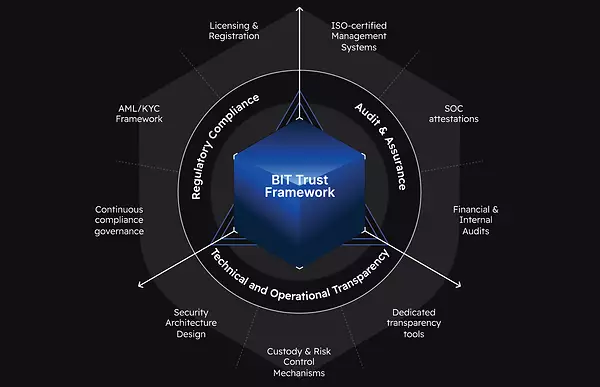
BIT therefore structures its Trust Framework around three mutually reinforcing pillars: Compliance and Regulatory Foundations, Independent Audit and Assurance Mechanisms, and Technical and Operational Transparency. Together, they break "trust" down into more concrete questions: Who regulates the platform? How are assets protected? How are risks controlled? And can these mechanisms be independently verified?
Within its Audit & Assurance Framework, BIT combines international standards-based management system audits (ISO), independent third-party assurance (SOC), annual financial audits, and internal audit mechanisms. Applicability varies by entity and business line, creating complementary layers of assurance rather than relying on any single audit or assurance as the sole basis of trust.
Transparency answers whether information can be seen. Verifiability goes one step further: can that information be independently reviewed?
As security once again becomes a defining issue for digital asset platforms, what matters may not be how often a platform says, "we are secure," but whether users can see the mechanisms behind that claim.
Trust is not built through a single promise or one-off audit. It is shaped through sustained institutional practices and independent verification over time. Security must operate continuously. Trust must remain verifiable.
Read the full BIT Trust Whitepaper V2.0:
https://www.bit.com/whitepaper
Disclaimer: Products and services may not be available in all jurisdictions and are subject to applicable regulatory requirements and eligibility restrictions.
** This press release is distributed by PR Newswire through automated distribution system, for which the client assumes full responsibility. **
As Security Returns to the Spotlight, How Does BIT Make Trust Verifiable?
As Security Returns to the Spotlight, How Does BIT Make Trust Verifiable?
As Security Returns to the Spotlight, How Does BIT Make Trust Verifiable?