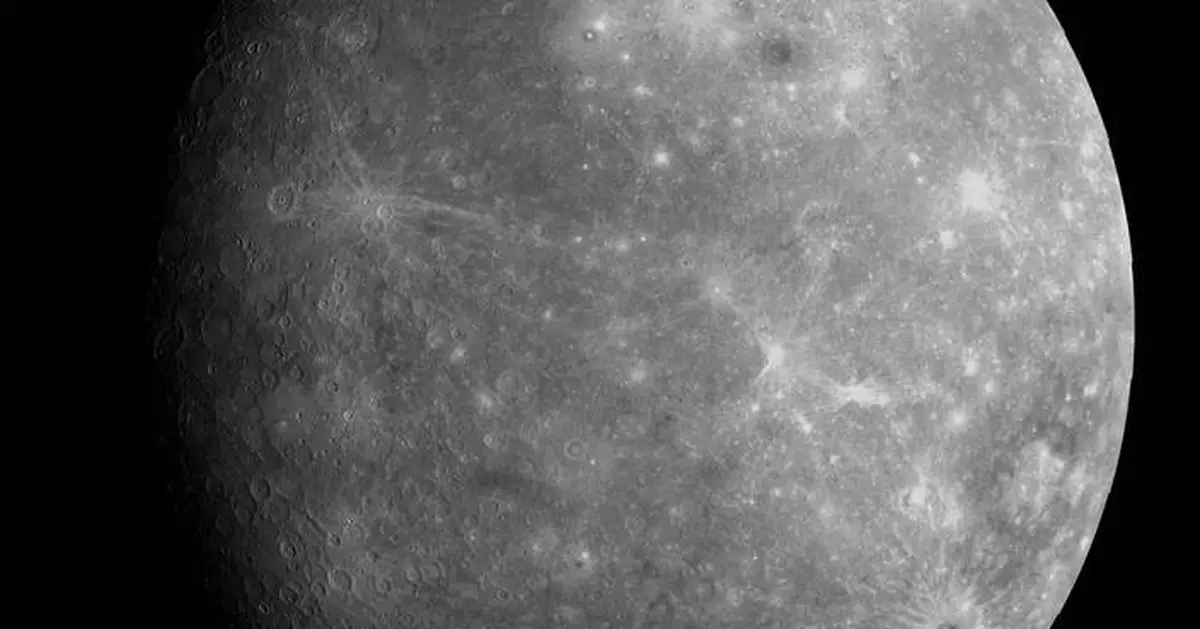
CAPE CANAVERAL, Fla. (AP) — A new study shows that little, wrinkly Mercury may be shrinking faster than expected, the cosmos’ version of a grape shriveling into a raisin under the sun.
Scientists from the German Aerospace Center’s Institute of Space Research reported Thursday that Mercury’s shrinkage may be 30% greater than previously believed — a loss in diameter of as much as 14 miles (23 kilometers). That’s significant for a planet barely 3,000 miles (4,900 kilometers) across.
Mercury’s rough surface, continually reshaped by debris hurled from impact craters, may have hidden the true extent of the loss, according to the researchers whose findings appear in the journal Geophysical Research Letters.
The news comes one week after a pair of European and Japanese spacecraft shed its cruising platform and advanced toward Mercury. Known as BepiColombo, the linked craft are expected to enter orbit around Mercury in November before splitting up for a fuller survey.
BepiColombo’s laser instrument should confirm how much Mercury is withering as a result of internal cooling, said Gaku Nishiyama, the study’s lead author who is taking part in the space mission.
The shrinkage could be even more than his team is estimating based on measurements from NASA’s Messenger spacecraft in the 2010s. Only one other spacecraft has ever visited Mercury, NASA’s Mariner 10 in the 1970s.
Our solar system’s smallest and innermost planet has been shrinking ever since its formation 4.5 billion years ago. Its hot iron core — oversized for such a small world — cools and contracts along with the mantle and crust, tightening the surface like a girdle to fit its new slimmer self.
Nishiyama and his team compared maps showing faults and other geologic signs of contraction at Mercury with newer maps highlighting surface roughness. They discovered that the roughest patches exhibited fewer shrinkage wrinkles. The missing wrinkles could be buried under impact debris, they said.
After accounting for these obscured regions, the researchers provided a fresh take on Mercury’s shrinkage that could shed light on other contracting worlds, said Nishiyama, who is affiliated with Hokkaido University in Japan.
“We are quite excited,” Nishiyama said in an email, adding that it feels like “we are approaching the reality of Mercury’s evolution.”
The Associated Press’ health and science coverage receives financial support from the AP Fund for Journalism and private foundations. AP is solely responsible for all content. Find AP’s standards for working with philanthropies, a list of supporters and funded coverage areas at AP.org.
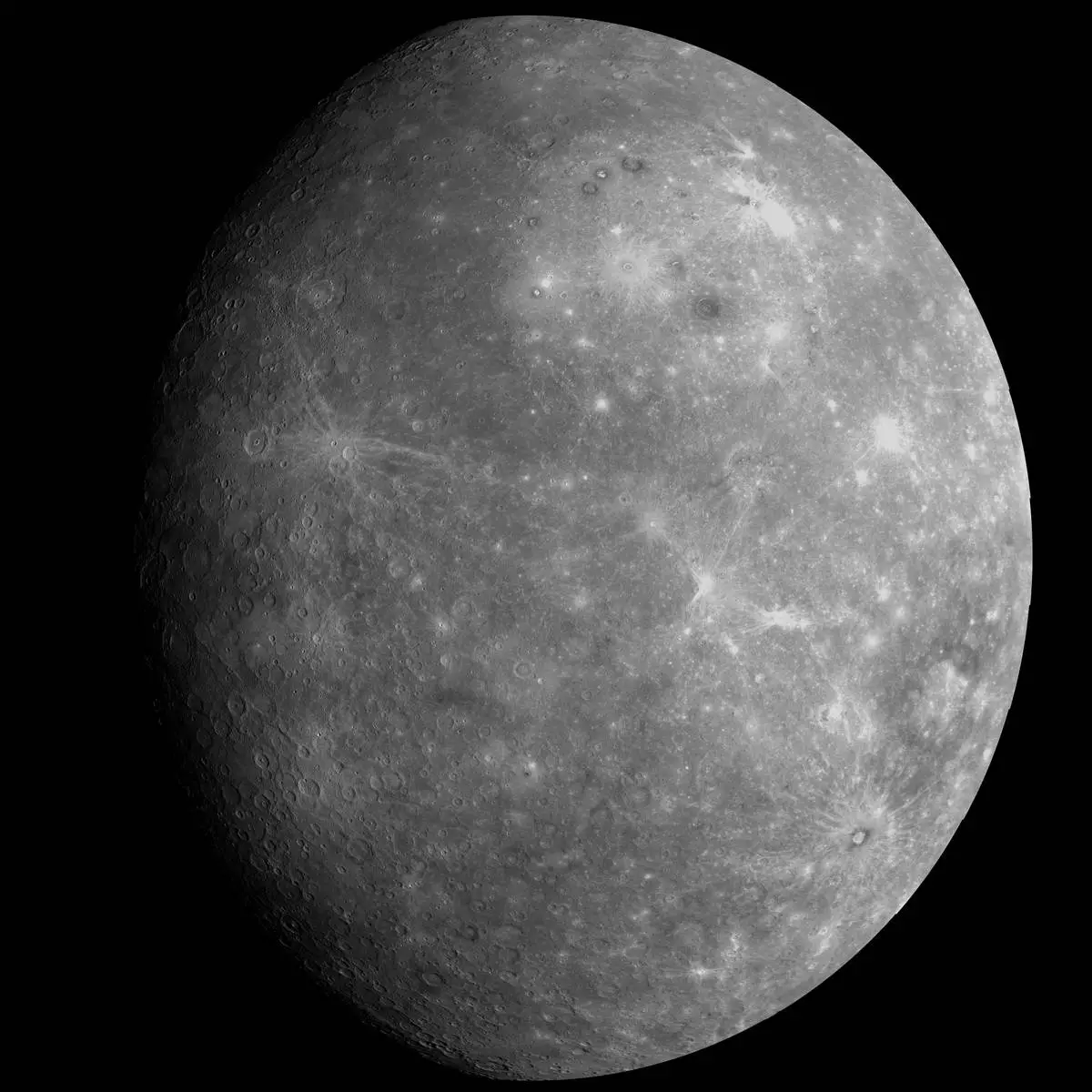
This composite image provided by NASA/Johns Hopkins University Applied Physics Laboratory/Carnegie Institution of Washington on Oct. 22, 2013, shows Mercury as it appeared to the Messenger spacecraft following a flyby of the planet. (NASA/Johns Hopkins University Applied Physics Laboratory/Carnegie Institution of Washington via AP)
JEFFERSON CITY, Mo. (AP) — A federal judge has allowed Missouri’s top court to proceed with a contempt hearing Thursday against Republican Secretary of State Denny Hoskins in a tense and twisting legal battle over whether new congressional districts supported by President Donald Trump can be used in the November election.
Missouri’s battle over its congressional districts has spanned more than a year and spawned confusion over which districts will be in place for voters.
The state’s top court previously ordered Hoskins not to use a Trump-backed map in the general election and instead use districts passed after the last census. But U.S. District Judge Stephen Clark on Tuesday barred Hoskins from using anything other than the new map Trump supports.
The state Supreme Court then ordered Hoskins to appear for a contempt hearing Thursday for not following its orders and instructing local election authorities to use the Trump-backed districts.
State attorneys representing Hoskins had asked Clark to halt the contempt hearing. But Clark declined to do so.
The contempt hearing for Hoskins is scheduled to occur as the U.S. Supreme Court simultaneously considers a request from redistricting opponents to halt Clark's order favoring the Trump-backed congressional map.
Missouri was the second Republican-led state, after Texas, to enact new districts after Trump urged Republicans last year to redraw House districts to their advantage ahead of the midterm elections.
The revised Missouri districts target a Kansas City-based seat held by Democratic Rep. Emanuel Cleaver by shedding parts into neighboring districts and stretching the remainder into rural Republican areas. The goal is to help Republicans win seven of the state’s eight House seats in the midterm elections — a gain of one seat.
Redistricting opponents collected hundreds of thousands of petition signatures seeking to force a statewide vote on the new districts. They submitted the signatures in December. But Hoskins waited until August — on the same day as Missouri’s primary — to reject the petition. Hoskins asserted that a referendum petition could not be used for congressional redistricting.
The delay allowed Missouri to use the new districts in its August primary. Republican state officials have argued it would violate voters' federal rights to switch districts before the general election.
But the Missouri Supreme Court last week ordered Hoskins to put the redistricting referendum on the November ballot, which he did. It also ruled that the new districts never became law and instead were suspended retroactively to the December petition submission.
The court barred Hoskins from using the new map and said the old map — passed by Republican lawmakers in 2022 after the last census — must be used in the November election. The U.S. Supreme Court on Tuesday declined to hear an appeal of that decision. But Clark issued his conflicting order moments later.

FILE - Missouri Secretary of State Denny Hoskins talks to reporters Tuesday, Aug. 4, 2026, at his office in the state Capitol in Jefferson City, Mo. (AP Photo/David A. Lieb, File)

In this photo taken with a smartphone, people opposed to a congressional redistricting plan rally outside the Missouri Capitol in Jefferson City, Mo., Wednesday, Sept. 2, 2026. (AP Photo/David A. Lieb)