NORTHBROOK, Ill.--(BUSINESS WIRE)--Sep 11, 2026--
Impossible Objects, a manufacturing technology company bringing the flexibility of 3D printing to industrial-scale production, today announced a $40 million Series B funding round to scale its Composite-Based Additive Manufacturing (CBAM) technology and meet growing customer demand. Inflection Equity led the financing, with participation from Aaron Wealth Management, OCA Ventures, Impact Capital and Excell Partners.
This press release features multimedia. View the full release here: https://www.businesswire.com/news/home/20260911835265/en/
For decades, 3D printing promised to transform production but has largely remained a prototyping technology, limited by speed, materials and cost. Impossible Objects’ CBAM technology is revolutionizing 3D printing by bringing its advantages to mass production. Using high-speed production and advanced composite materials, including carbon fiber, CBAM can produce strong, lightweight parts at volume for applications traditionally served by processes such as CNC machining and injection molding, while eliminating the need for expensive tooling and associated costs.
“We’ve created a fundamentally new way to manufacture,” said Robert Swartz, founder and chairman of Impossible Objects. “We live our lives through things, and we have changed how things are made. This is as important as the mill, precision measurement and interchangeable parts. This funding gives us the resources to bring that vision to more customers and make it real at scale.”
The technology is already moving into customer environments. Since launching the CBAM 25 in early 2025, the company has taken five orders and begun deploying the system across aerospace, defense and advanced manufacturing, including with the U.S. Air Force, the National Institute for Aviation Research, the Oregon Manufacturing Innovation Center and Rochester Institute of Technology. At U.S. Army Rock Island Arsenal, the technology can support production of up to 10,000 drone bodies per month. The CBAM 25 can print up to 25 layers per minute and is 15 times faster than competing production additive technologies. Its process can produce composite parts with strength up to 200 MPa, up to four times that of competing additive manufacturing processes, with minimal shrinkage and warpage.
“We’re excited to double down on our investment in Impossible Objects and lead this Series B as the company enters its next phase of commercial scale,” said Gintaras Vaisnys, managing partner at Inflection Equity. “Impossible Objects has developed a 3D printing system that can operate at production rates, and the company is seeing explosive demand across commercial and government applications. This funding will help it scale to meet that demand.”
Impossible Objects has also secured $20 million in U.S. government contracts and awards. Its Small Business Innovation Research (SBIR) Phase I and Phase II awards support work on high-strength long range drones, additively manufactured composites with strengths comparable to traditional composites manufacturing, integrated wiring inside of additively manufactured parts and lightweight aircraft wing and fuselage structures. The company’s technology has also been sold to or deployed with U.S. Army Rock Island Arsenal and Air Force Research Laboratory and is included in the U.S. Air Force Technology Roadmap.
“The nature of warfare is changing as new technologies are deployed,” said Stephen Farmen, retired U.S. Army major general. “As a result, the defense industrial base needs new advanced manufacturing technologies that can deliver robust and flexible distributed production so we can get new technologies such as drone and counter-drone systems and repair parts to our warfighters faster, more flexibly and with radically shorter delivery timelines.”
Impossible Objects will use the financing to increase production of its industrial additive manufacturing systems, expand customer deployments and build out the service and commercial organization required to support a growing installed base.
“Our CBAM 25 system is designed from the ground up to meet the high productivity and high reliability needs of advanced manufacturing combined with the flexibility and tool-less manufacturing that modern flexible supply chains require,” said Steve Hoover, CEO of Impossible Objects. “We're seeing high demand for manufacturing that can adapt faster without sacrificing the performance and reliability customers expect in production. This funding will help us scale to meet that demand. We are proud to be at the forefront of creating the modern manufacturing supply chains that advanced economies need.”
About Impossible Objects
Impossible Objects is transforming manufacturing by combining digital flexibility with industrial-scale production. Its technology combines the freedom of additive manufacturing with the throughput, reliability and economics required for real production, enabling manufacturers to build strong, lightweight parts while adapting designs without the tooling constraints of traditional manufacturing. Founded in 2017, Impossible Objects, Inc. serves customers across aerospace, defense and advanced manufacturing and operates in Northbrook, Illinois, and Rochester, New York. The company is backed by Aaron Wealth Management, OCA Ventures, Impact Capital and Excell Partners, and works with organizations including the U.S. Army, U.S. Air Force, the National Institute of Research Aviation, the Oregon Manufacturing Innovation Center and Rochester Institute of Technology. Learn more at impossible-objects.com.
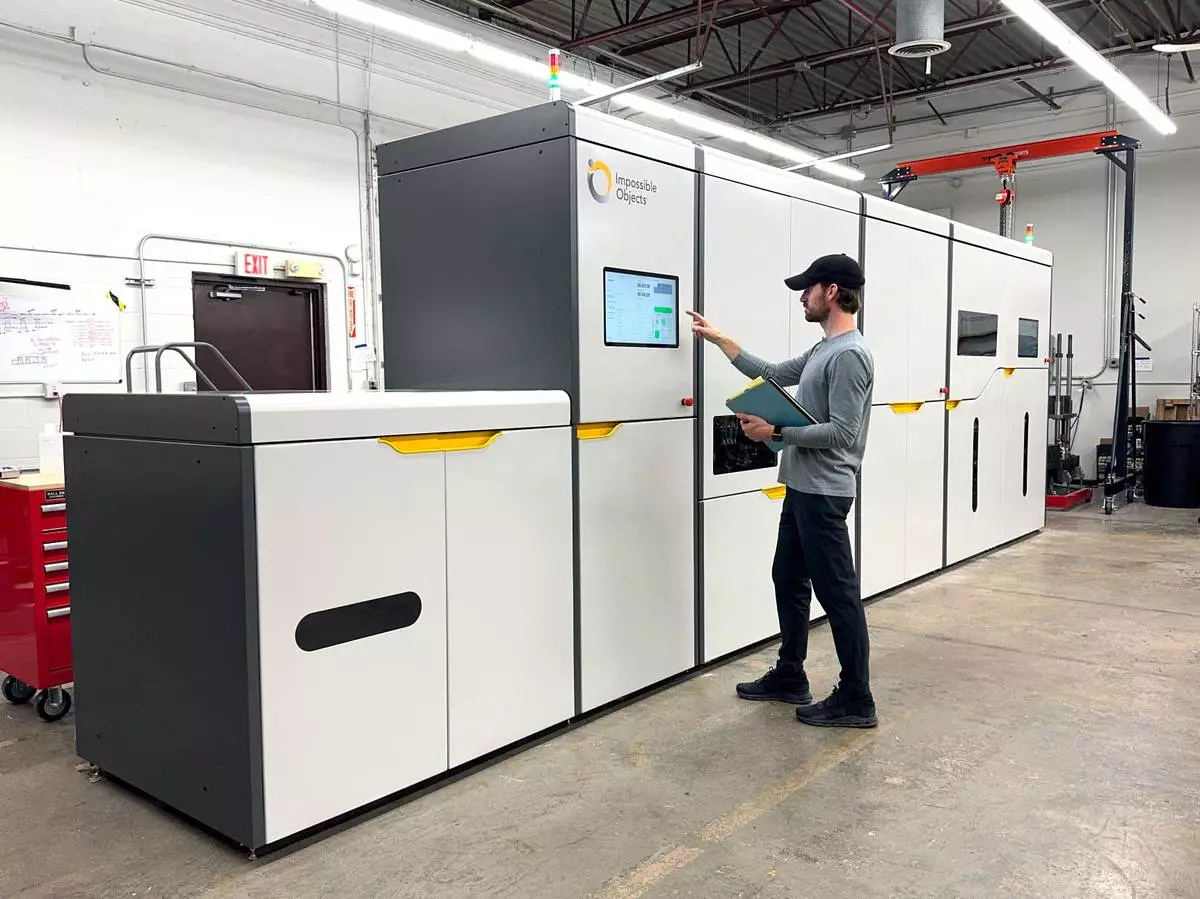
Impossible Objects’ CBAM 25 industrial additive manufacturing system in operation. The system uses the company’s Composite-Based Additive Manufacturing (CBAM) technology to produce strong, lightweight composite parts at mass-production speeds and is 15 times faster than competing production additive technologies.
SEOUL, South Korea (AP) — In shutting down a month-old Swiss diplomatic office in Pyongyang and expelling its head, North Korea has signaled it will set its own terms as it pursues a more assertive foreign policy. But experts say the move could potentially risk the loss of many European nations as alternative diplomatic partners.
The Swiss drew the anger of North Korean leader Kim Jong Un after they imposed sanctions on a youth camp over its alleged role in the transfer of children from Russian-occupied areas of Ukraine.
Just a few days earlier, in a more upbeat diplomatic moment, Kim received credentials from 10 newly appointed ambassadors, including envoys from ally Russia and longtime diplomatic partner Sweden, in the first such event of his 15-year rule.
Kim used the meeting with ambassadors to defend his nuclear arms buildup and call for the world to respect North Korea’s sovereignty, a standard Pyongyang later accused Switzerland of failing to meet by sanctioning the camp.
Here's a look at the closure of the Swiss office in Pyongyang and what it says about North Korea’s foreign policy.
North Korea’s Foreign Ministry on Wednesday summoned Sylvain Astier, head of the Swiss diplomatic office that opened in Pyongyang last month, declared him persona non grata and handed him a notice demanding the office’s closure and his departure from the country within 48 hours.
In a statement provided to The Associated Press on Thursday, Switzerland’s Federal Department of Foreign Affairs said it regrets the North Korean decision and was arranging for Astier to return to the Swiss embassy in Beijing. It said diplomatic relations will be maintained through the Swiss embassy in Beijing and the North Korean embassy in Bern and that Switzerland will continue to pursue dialogue through these channels.
Kim Jong Un’s powerful sister, Kim Yo Jong, earlier condemned Switzerland for imposing sanctions on the Songdowon International Children’s Camp in the North’s eastern coastal city of Wonsan. She called the Swiss steps an “open hostile act” that violated the North’s sovereignty, but didn’t directly address Western accusations that some Ukrainian children abducted by Russian forces were sent there to be reeducated with pro-Russian propaganda.
North Korea is one of Russia’s allies and has sent thousands of troops to fight in Russian President Vladimir Putin’s invasion of Ukraine.
Switzerland earlier this month added the Songdowon camp to its sanctions over Russia’s invasion of Ukraine. The United Kingdom in May and the European Union in September imposed similar sanctions on the camp, freezing its assets and banning financial transactions with it. The measures were seen as largely symbolic, given North Korea’s limited financial ties with Europe.
North Korea said in August it downgraded the level of diplomatic relations with the U.K. to that of chargé d’affaires in response to its sanctioning of the Songdowon camp.
Switzerland, which established diplomatic relations with North Korea in 1974, has been one of the few Western countries to maintain talks with Pyongyang. Switzerland previously operated a humanitarian-focused cooperation office in Pyongyang, which closed when North Korea sealed its borders during the COVID-19 pandemic. It was among the few countries allowed to open a new diplomatic office after North Korea reopened.
Kim Jong Un and his sister spent several of their teenage years at Swiss schools in the 1990s, and that may have deepened the sense of betrayal when Switzerland sanctioned the Songdowon camp, said Koh Yu-hwan, former president of South Korea’s Institute of National Unification.
But more importantly, North Korea is sending a broader warning that it could cut off diplomatic access to any country that expands sanctions or pursues policies it considers hostile, effectively putting pressure on the North's remaining Western contacts like Sweden, Koh said.
While Russia and China have blocked recent efforts to tighten U.N. sanctions over North Korea’s nuclear and missile programs, the United States and its European and Asian allies have imposed their own sanctions over illicit activities Pyongyang uses to fund its weapons programs, including information-technology worker fraud and cryptocurrency theft.
Kim Jong Un's diplomatic clout on the global stage has been bolstered in recent years as he's aligned with Russia and has taken steps to strengthen cooperation with China, North Korea's economic lifeline.
Leif-Eric Easley, a professor at Seoul’s Ewha University, said North Korea is benefiting enough from its ties with Moscow that it’s willing to make an example of Switzerland.
“By ordering the Swiss office closed just weeks after it opened, the Kim regime wants to show other states it intends to reengage only from a position of strength and on its own terms,” he said.
However, the strategy carries some risk, warned Moon Seong Mook, an analyst at the Seoul-based Korea Research Institute for National Strategy.
“Kim Jong Un may win Russia’s favor, but I think this could further deepen North Korea’s isolation from the international community,” he said.
Park Won Gon, a professor at Ewha University, said the North’s move could have long-term consequences, risking the loss of Europe as an alternative partner while further increasing its dependence on China. About 98% of North Korea’s external trade was with China in 2025.
“For European countries, this move will only reinforce the perception that North Korea cannot be trusted,” Park said.
Kim's advancing nuclear arsenal and deepened cooperation with Russia have bolstered his international standing, and he has steadfastly insisted that he will not engage in talks with the United States unless Washington drops its demand for denuclearization.
As Pyongyang increasingly believes it has the leverage to deal directly with Washington, rather than through intermediaries, European countries such as Switzerland or Asian U.S. allies such as South Korea — which Kim in recent years declared as his most hostile enemy — have likely significantly less value to the North.
“They think they no longer need to make compromises with individual countries ... as they portray their status as a nuclear-armed state on an equal footing with the United States," Koh said.

FILE - North Korean leader Kim Jong Un's younger sister Kim Yo Jong, center, arrives at the Jinbu train station in Pyeongchang, South Korea, Feb. 9, 2018. (AP Photo/Lee Jin-man, File)
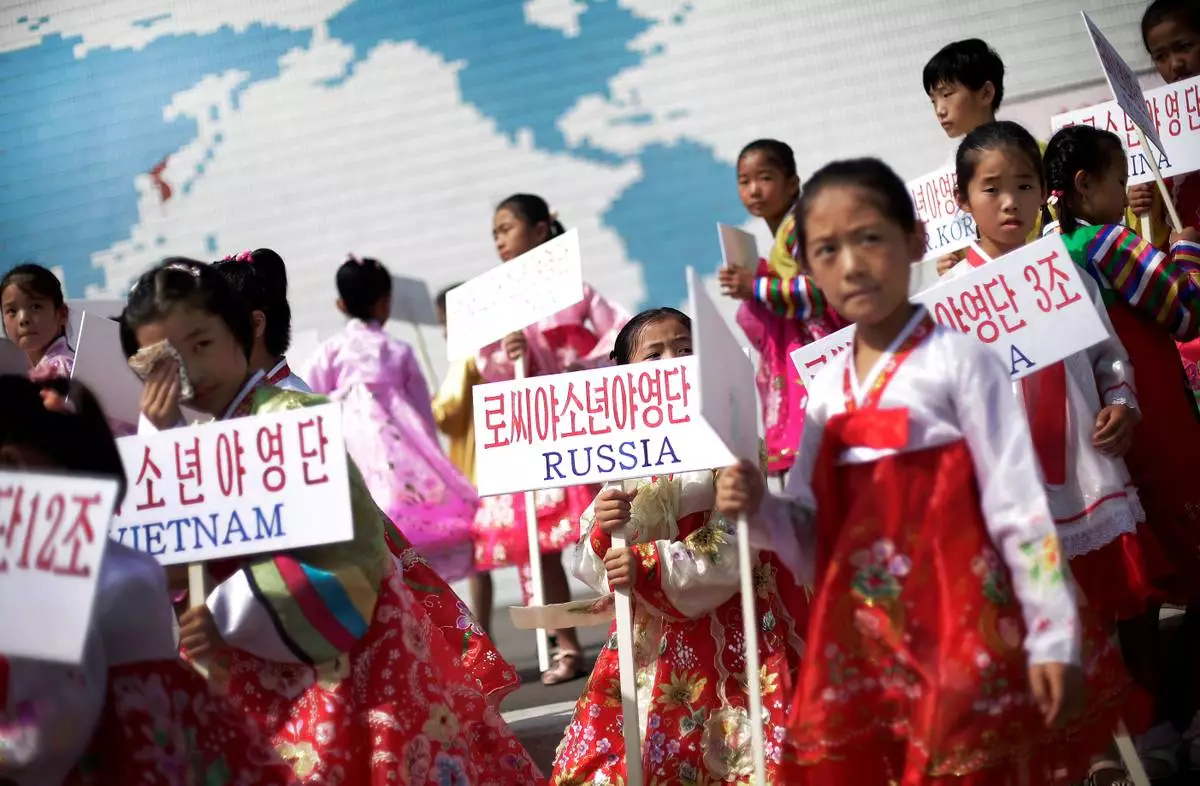
FILE - Young North Korean girls hold up signboards with the names of participating countries during an opening ceremony at the Songdowon International Children's Camp, July 29, 2014, in Wonsan, North Korea. (AP Photo/Wong Maye-E, File)
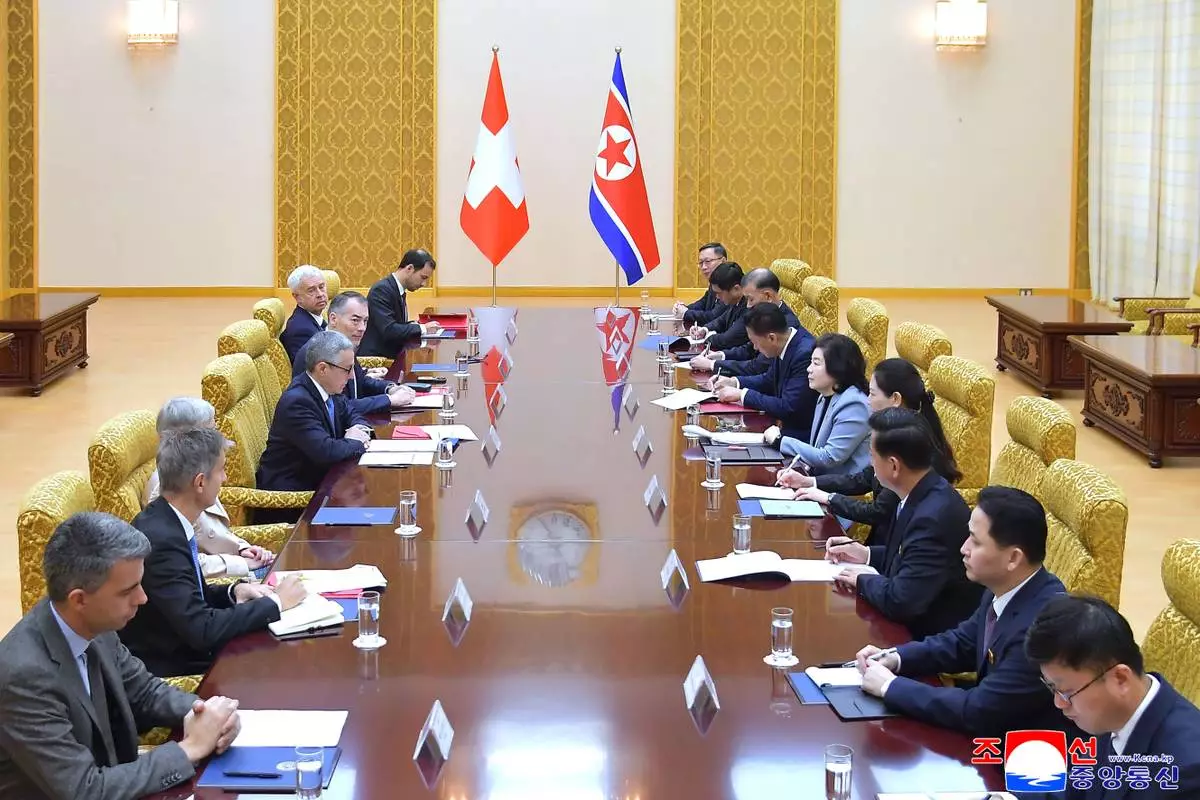
FILE - In this photo provided on Oct. 31, 2026, by the North Korean government, Swiss Foreign Minister Ignazio Cassis holds a talk with North Korean Foreign Minister Choe Son Hui at Pyongyang Assembly Hall in Pyongyang, Friday, Oct. 30, 2026. Independent journalists were not given access to cover the event depicted in this image distributed by the North Korean government. The content of this image is as provided and cannot be independently verified. Korean language watermark on image as provided by source reads: "KCNA" which is the abbreviation for Korean Central News Agency. (Korean Central News Agency/Korea News Service via AP, File)