Yemen's Houthi group seized the strategic Mayun Island in the Bab al-Mandab Strait on Friday after government troops withdrew, according to a local government official.
The official, speaking on condition of anonymity, said Houthi forces had arrived on the island early Friday aboard several boats and took control without military resistance. The Houthis also deployed armored vehicles and other military equipment along the nearby coast, he said.
Houthi forces have also advanced into Dhubab district near the strait after government troops withdrew southward following the Houthis' capture of the Red Sea port city of Mocha on Thursday, the official said.
Mayun, also known as Perim, lies inside the Bab al-Mandab and divides the narrow waterway into two shipping channels. Its capture, following the Houthis' recent advances along Yemen's western coast, gives the group control of key positions overlooking the vital maritime trade route linking the Red Sea with the Gulf of Aden.
However, a Yemeni government military officer said that the government forces have withdrawn to areas near Aden and are regrouping.
Meanwhile, the Yemeni government army issued a statement on Thursday evening, saying that it had shelled Houthi positions along the country's west coast.
After Houthi forces captured the Red Sea port city of Mocha, the number of ships passing through the Bab el-Mandeb Strait on Thursday dropped sharply.
According to data cited by Saudi magazine "Logistics Middle East," as of around 15:00 local time on Thursday, only six ships had transited the Bab el-Mandeb Strait that day, compared with 30 on Wednesday, 26 on Tuesday, and 29 on Monday.
Of the six ships that passed on Thursday, five carrying grain, crude oil, coal and fertilizer exited the strait, while one ship entered it.
The Bab al-Mandab, between Yemen and the Horn of Africa, is a critical corridor for international trade and energy shipments, linking the Red Sea and Suez Canal with the Gulf of Aden and the Arabian Sea.
Following U.S.-Israeli strikes on Iran on Feb. 28, Tehran restricted passage through the Strait of Hormuz.
After shipping through the Strait of Hormuz is disrupted, the Bab el-Mandeb Strait became an alternative route for Saudi Arabia's crude oil exports.
According to data from the U.S. Energy Information Administration, oil transit through the Bab el-Mandeb Strait averaged 5.6 million barrels per day in the first quarter of 2026, rising to an average of 8.1 million barrels per day in the second quarter, accounting for about eight percent of global oil supply.
The Bab el-Mandeb Strait is within the Houthi armed group's strike range. A Houthi blockade of the strait would once again disrupt global energy supplies.
The latest developments come amid an escalation in Yemen's conflict. The country has been mired in conflict since late 2014, when the Houthis seized Sanaa and much of northern Yemen, forcing the internationally recognized government out of the capital. A Saudi-led coalition intervened in the conflict in 2015 in support of the Yemeni government.
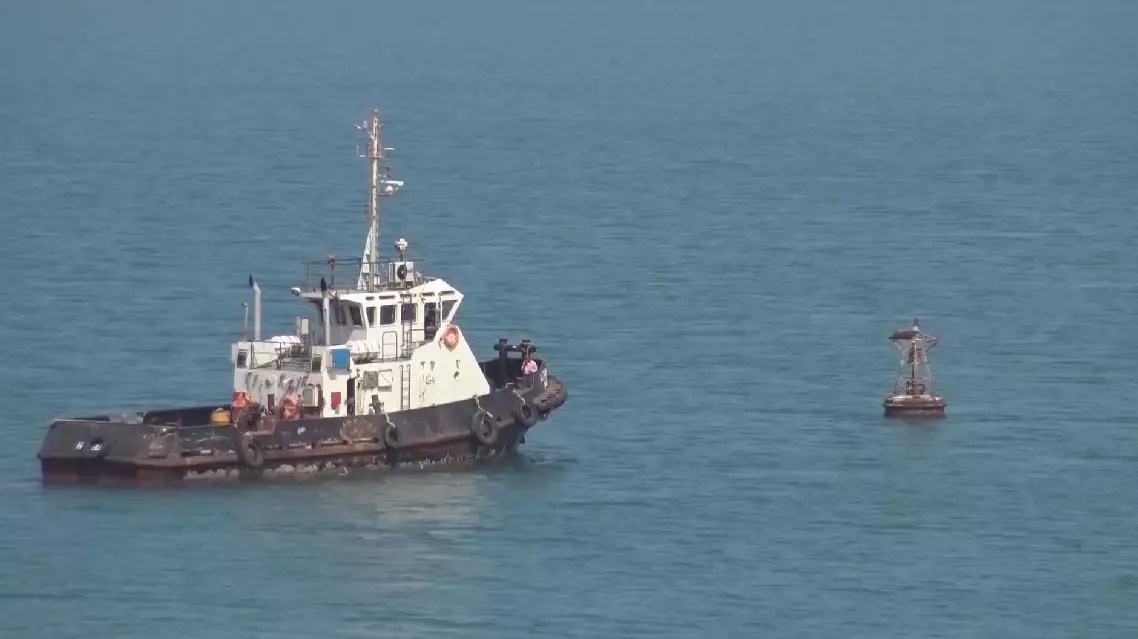
Yemen's Houthis seize strategic Mayun Island in Bab al-Mandab Strait