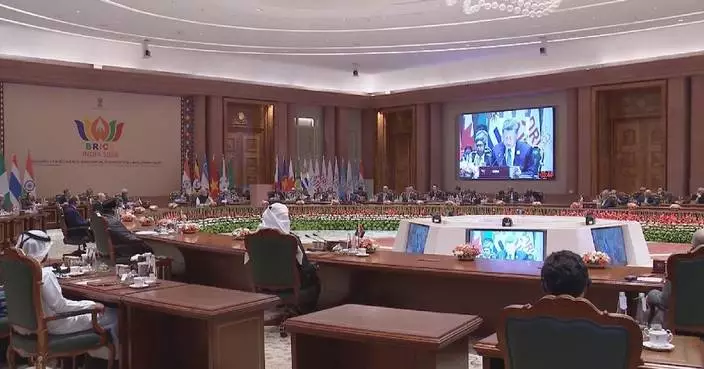
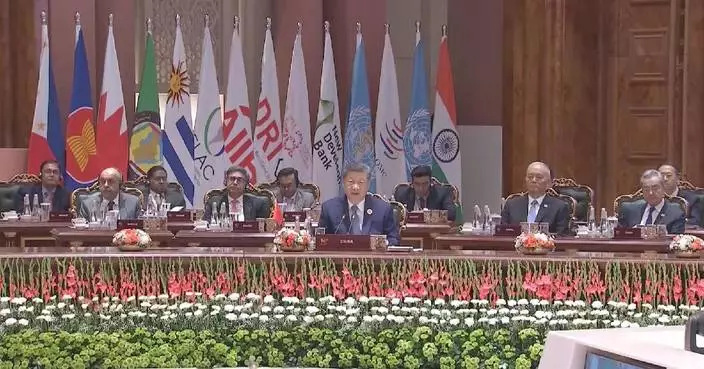
The expansion of BRICS has opened greater opportunities for emerging markets and developing countries to contribute to global affairs and strengthened the voice of the Global South, said an Egyptian expert ahead of this year's BRICS Summit in India.
BRICS has expanded to 11 member countries and 10 partner countries, becoming a force for advancing a multipolar world and greater democracy in international relations.
During an interview with China Global Television Network (CGTN) in Egypt on Saturday, Hisham Abu Bakr Metwally Mohamed, first economic researcher at the Egyptian Ministry of Foreign Trade and Industry, discussed the significance of a larger BRICS in fostering cooperation among developing nations.
"Now, with the expansion, a big room now was open to other countries to contribute. We can see the power of the BRICS in the energy sector, and then the agriculture sector. Meanwhile, the bigger BRICS means the bigger chance for more representative of the [Global] South voice in the global institutions, and also more stability for the world. There is a big room for advance for the trade between the countries, and also there is a big room for cooperation and the global governance, and to initiate and the reform with the global institutions," he said.
BRICS was initially formed by Brazil, Russia, India and China, later expanding with the addition of South Africa and, subsequently, new members including Egypt in early 2024. This expansion has strengthened Global South representation and increased the grouping's economic and political weight.

BRICS expansion amplifies Global South voice, boosts cooperation: Egyptian expert
Former Jordanian prime minister Omar Razzaz commended China's all-round development, saying the country has combined cultural heritage with rapid modernization, a balance he described as increasingly relevant as nations worldwide grapple with how to pursue growth without losing identity.
In an interview with China Media Group (CMG) released on Friday, Razzaz shared his impressions against the backdrop of China's ongoing transformation and its rising role in global cooperation.
Razzaz believes that understanding China's progress requires experiencing its diverse landscape firsthand, stressing that direct exposure helps dispel stereotypes and offers insight into how cultural continuity and technological innovation can advance together.
"You've touched upon what resonated with me the most, that combination of modernity and culture, the fact that these cities are at the cutting edge in terms of applied research, manufacturing, services, etc. The beauty of the landscape and the respect people show for each other and the fact that this is not a question of 'do you want to be a modern country,' or 'do you want to be a traditional country?' No, you can maintain your value system, your culture, etc. and move forward with prosperity and innovation. The two are not necessarily contradictory to each other," he said.
"If you go to most countries, it looks either an ultra-modern city or, because it's poor, it'll look like an old rural community, etc. And what's really amazing is this sort of multi-faceted development that takes culture as well as technology and AI and all of these things," he added.
Razzaz stressed that China's rapid transformation must be seen on the ground to appreciate its scale, diversity and cultural continuity.
"There's no way to understand where China is without, in my view, without actually visiting because the story is complex. China is a huge country with a large population and a lot of diversity in a lot of different groups. So, you come in with certain stereotypes about what China is and what it isn't. And these will break when you get to China," he said.
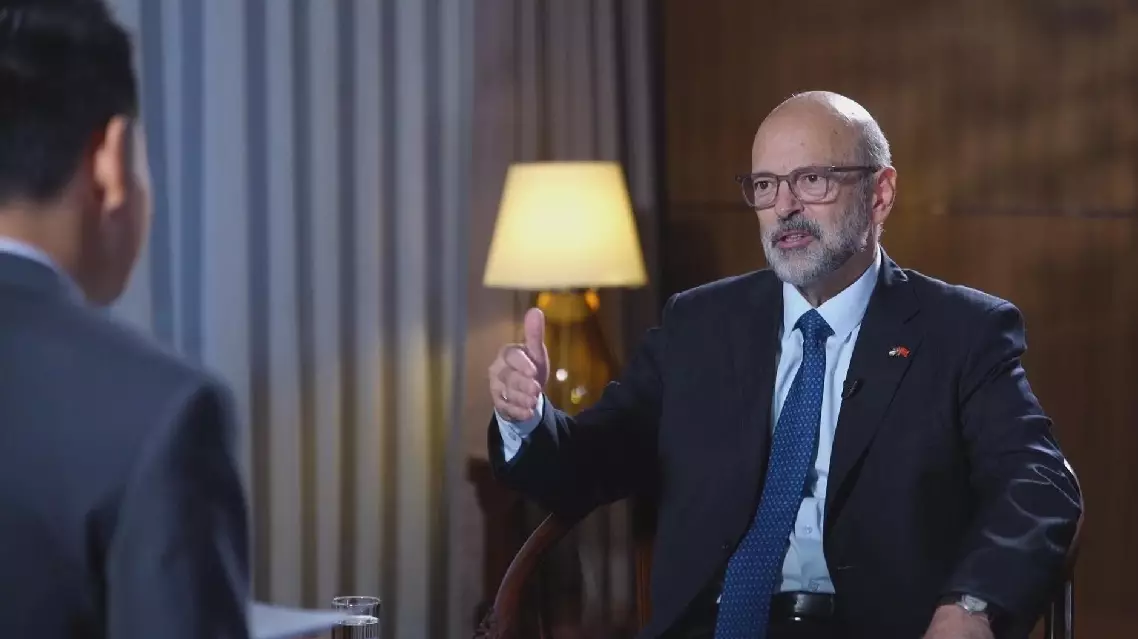
Former Jordanian PM highlights China's cultural continuity amid rapid development