Shandong Province in east China has transformed abandoned salt caverns into a compressed air energy storage (CAES) station that can deliver zero carbon electricity to the grid within minutes, marking a breakthrough in China’s push for efficient green power.
In Feicheng, 46 abandoned salt caverns stretching 800 to 1,300 meters underground, with a combined volume of more than 20 million cubic meters, have been repurposed into vast reservoirs for compressed air. Once seen as industrial waste, they now serve as storage chambers that allow energy to be banked during off peak hours and released quickly to meet surging demand.
"Once fully charged, this 300-megawatt project can generate up to 1.8 million kilowatt-hours of electricity, which can satisfy one day's power use for 200,000 households. The whole process from receiving dispatching orders to grid-connected power generation merely takes 6 to 8 minutes, with no coal or oil being consumed. The power is supplied with no carbon emissions being discharged," said Hou Hucan, director of Feicheng project of Zhong Chu Guo Neng (Beijing) Technology Co., Ltd.
The power generation station has been contributing to the broader power generation in Shandong. When the province's power demand is high, its 172 new-type energy storage stations will generate power simultaneously, with a maximum output exceeding 10 million kilowatts.
"Power demand has been high throughout the whole summer. In this control hall, we monitor in real time the charging and discharging status of the compressed air energy storage station in Feicheng to ensures it can respond immediately to provincial unified dispatching calls in emergencies," said Li Zongrang, leader of power grid operation team at Tai'an Power Supply Company under Shandong Electric Power Company of the State Grid Corporation of China.
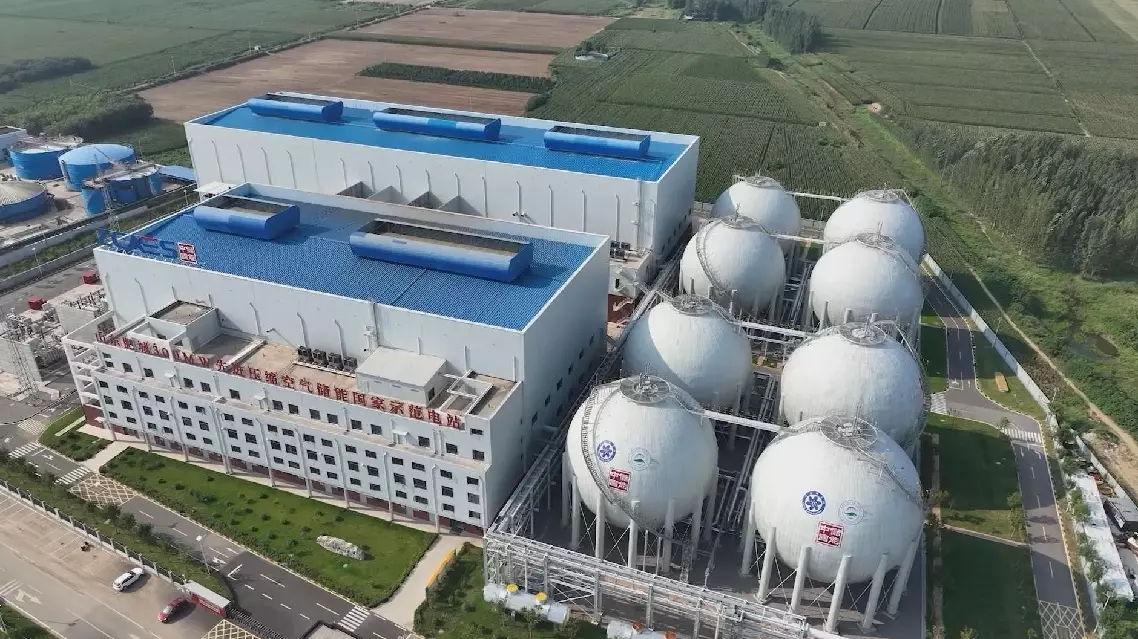
Compressed air energy storage boosts green power in Shandong