SAN FRANCISCO--(BUSINESS WIRE)--Sep 14, 2026--
Unit21, the leading AI Risk Infrastructure platform for fraud prevention and AML monitoring, today announced it has been recognized in two categories of the 2026 Datos Impact Awards in Fraud & AML: as winner for Best Crypto/Digital Asset AML Innovation, and as silver medalist for Best AI-Driven Innovation Across Fraud & AML in the Financial Crime Convergence group.
This press release features multimedia. View the full release here: https://www.businesswire.com/news/home/20260914646844/en/
The Datos Impact Awards in Fraud & AML recognize innovation across 14 categories spanning fraud prevention, anti-money laundering, and financial crime convergence. Datos sets a deliberately narrow entry bar: "all nominated innovations were required to be in production and developed within the past two years (after January 1, 2024)," meaning every recognized innovation was judged as software running inside financial institutions, not as a roadmap or demo.
Unit21 is the only company named in both the AML Innovation and Financial Crime Convergence groups. It is also the only fraud and AML operations platform recognized in the AI-Driven Innovation category.
"The same platform that won a crypto category runs fraud and AML for sponsor banks, credit unions, payments companies, and sports betting operators," said Tyler Allen, CEO of Unit21. "We go deep where a vertical demands it, and crypto demands a lot, resulting in one flexible and highly customizable platform. Underneath every vertical, the same agents do the work: they pull transaction history, check watchlists, trace entity relationships, and hand an analyst a finished package with a recommended disposition and a regulator-ready narrative. Flexibility is easy to claim. Earning recognition in a specialist vertical and a cross-domain AI category is the proof."
Unit21’s AI agents carry an investigation the whole way, from detection through casework to a filing-ready narrative, and they do it on both the fraud and the AML side of the same customer. When a vertical brings its own typologies, data model, and regulatory clock, as crypto does, the same platform is configured to meet them rather than swapped for a point solution. The AI agents cited in the convergence category are the same agents that carry out crypto investigations. Agentic AI is the engine, and crypto is where it meets some of its hardest data problems.
Winner: Best Crypto/Digital Asset AML Innovation
Datos Insights recognized Unit21 as best in Crypto/Digital Asset AML Innovation for unifying on-chain blockchain intelligence with off-chain transaction monitoring, AI-driven investigation, and regulatory filing in a single workflow.
Typically, blockchain analytics stop at the risk score, disconnected from the monitoring, case management, and filing workflows that close an investigation. Unit21 connects those layers directly through bidirectional Chainalysis integration, native TRM Labs wallet screening, and a self-service rules engine built for crypto-native transaction types.
The recognition arrives as deadlines tighten. Stablecoin issuers face AML program enforcement under the GENIUS Act beginning in January 2027, and the EU's AML Regulation applies to crypto-asset service providers from July 2027.
Datos Insights also recognized Unit21 in AI-Driven Innovation Across Fraud & AML for deploying agentic AI across fraud detection, AML transaction monitoring, case investigation, and regulatory filing in a single system.
The architecture separates interpretive work from compliance-critical decisions. Customizable language model agents analyze alert narratives and draft the investigation write-up, while deterministic rules set detection thresholds, classify typologies, and decide what escalates. An investigator can point to the exact logic behind any action. Customers configure which workflows agents handle autonomously and which require explicit human review.
Institutions using these agents have reported measurable results. Nexo reported a 93% reduction in false positives with 57% of alert reviews automated by AI Investigation Agents, and Uphold reported 44% faster alert reviews with suspicious transaction report preparation time falling from nearly a week to under 30 minutes.
To learn more, read a full breakdown of Unit21 Datos Impact Awards for crypto/digital asset AML innovation and AI-driven innovation.
About Unit21
Unit21 is the leader in AI Risk Infrastructure, trusted by over 200 customers across 90 countries, including Sallie Mae, Chime, Intuit, and GreenDot. The platform unifies fraud and AML detection, investigation, and regulatory filing with AI agents that execute investigations end-to-end, gathering evidence, drafting narratives, and filing reports so teams can scale safely without expanding headcount. Unit21’s AI agents have processed over 1.5 million alerts to date, and its Fraud Consortium covers over 100M unique individuals across a network of fintechs, banks, and crypto platforms. Every AI decision is explainable, auditable, and defensible to regulators. Unit21 is backed by Tiger Global Management, Gradient Ventures (Google’s AI-focused venture fund), ICONIQ Capital, and others. Learn more at unit21.ai.

Unit21 named silver medalist of Datos Impact Award: Best AI-Driven Innovation Across Fraud & AML.
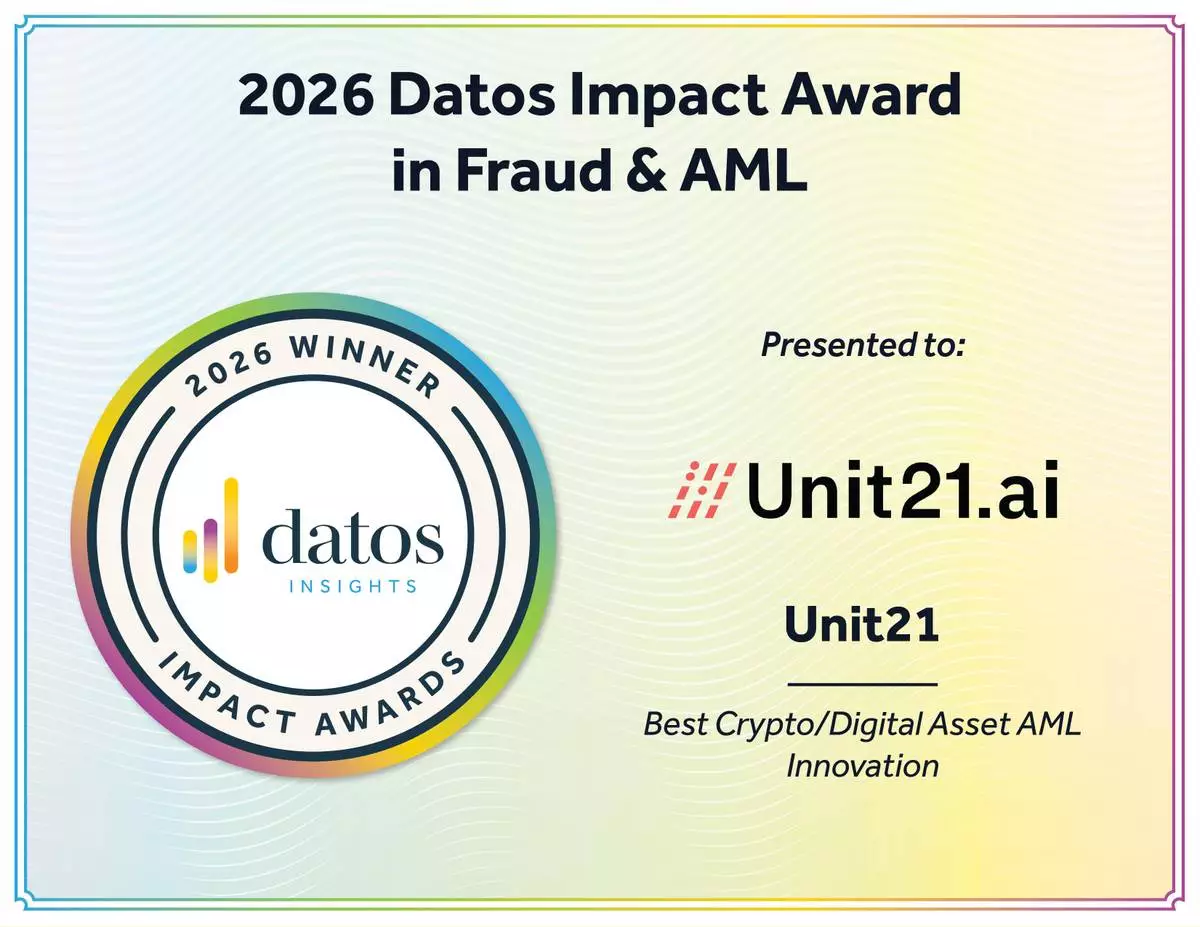
Unit21 named winner of Datos Impact Award: Best Crypto/Digital Asset AML Innovation.