VANCOUVER, British Columbia--(BUSINESS WIRE)--Sep 14, 2026--
iQmetrix, the global provider of Intelligent Commerce Operating Systems for telecom, today opened registration for the 2026 Telecom Industry Address and Product Announcements, taking place Wednesday, October 28, 2026. For the first time in the event's history, iQmetrix will run two dedicated virtual sessions: one built specifically for European audiences, alongside its long-running North American event. Both are free to attend.
This press release features multimedia. View the full release here: https://www.businesswire.com/news/home/20260914992633/en/
Now in its seventh year, the Industry Address has become the telecom channel's annual checkpoint: an unfiltered read on where the market is heading, delivered by a company that sits at the intersection of telcos, retailers, and the partners who serve them. The 2026 edition draws on a year of research and direct conversations across international markets.
"We spend the year listening — to telcos, to retailers, to the partners building alongside us, in a dozen different markets," said Megan Howse, Senior Vice President, Marketing at iQmetrix. "The Telecom Industry Address is where all of that turns into something the industry can actually use. Adding a European session means we're no longer asking half our audience to take the North American view and translate it."
The 90-minute program runs in two parts. The first covers the trends, pressures, and openings shaping telecom commerce globally. The second is iQmetrix's annual product announcement, including an early look at what is coming next for the Intelligent Commerce Operating System — the category iQmetrix has defined around one orchestrated system connecting point of sale, ecommerce, inventory, activations, and customer journeys, with AI embedded in how the system runs rather than layered on top.
The event is open to the wider industry: telcos, retailers, repair providers, device and accessory manufacturers, distributors, industry media, and the broader telecom ecosystem. Attendees will leave with a clearer read on where the market is moving and practical direction for their commerce strategy in the year ahead.
Session details — Wednesday, October 28, 2026
Both sessions cover the same content; attendees need only join the one that suits their schedule.
Registration is now open here. A recording will be sent to everyone who registers, whether or not they attend live.
About iQmetrix
iQmetrix is the global provider of Intelligent Commerce Operating Systems for telecom. It replaces fragmented legacy stacks with a modern, modular layer that orchestrates telcos, retailers, and OEMs into one intelligent flow across channels and markets. The result is less complexity, lower cost, and the speed to move ahead.
For 27years, iQmetrix has helped the leading brands in telecom grow by providing best-in-class software, services, and expertise. Its solutions powered $17 billion in sales last year, handling nearly 53 million invoices and more than 28 million activations, and are used by more than 370,000 telecom retail professionals across almost 1,000 clients. iQmetrix is a privately held software-as-a-service (SaaS) company with employees in Canada, the U.S., India, and Europe. For more information, visit www.iqmetrix.com.

iQmetrix to Deliver 2026 Telecom Industry Address and Product Announcements, Unveiling the Next Wave of Intelligent Commerce
NEW YORK (AP) — Artificial-intelligence stocks slid worldwide Monday after leaders of the industry warned a slowdown is needed for the safety of humanity. Another jump in oil prices, meanwhile, briefly sent the yield of the 10-year Treasury to 5% for the bond market ’s latest pressure-raising milestone.
Despite all the downers for Wall Street, gains for many stocks outside AI helped limit the market’s losses. So did a midday tempering of oil prices, and the S&P 500 fell a relatively modest 0.5%. More stocks rose within the index than fell.
The Dow Jones Industrial Average dropped 152 points, or 0.3%, and the Nasdaq composite sank 0.6% after clawing back most of an early loss of 1.3%.
AI stocks have been under pressure a while because of worries their prices shot too high in the frenzy around the technology. The concerns jumped to another level over the weekend after one of the industry’s leading voices, Anthropic CEO Dario Amodei, called for a deliberate and global slowdown in the development of AI.
He cited safety issues, including the risk that AI becomes capable of leading a swarm of agents that could take over the entire internet within six to 12 months.
Nvidia, whose profits have soared because its chips are helping to train AI models, sank 3.4% and was the heaviest weight on the market because of its massive size.
SpaceX, which gets a chunk of its business from AI, fell 2% after Elon Musk said over the weekend that he agrees with Amodei. Softbank Group, the Japanese giant that is a major investor of OpenAI, lost 10.7% in Tokyo after OpenAI’s Sam Altman likewise supported the concept of a slowdown.
Altman also said in an interview with Fortune published Saturday that the company behind ChatGPT would likely wait until next year for a sale of its stock on Wall Street. That would delay a potential gusher of cash for Softbank and other early investors in OpenAI.
In South Korea, the Kospi index dropped 3.3% due to losses for its two most influential stocks, Samsung Electronics and SK Hynix.
President Donald Trump played down the need for his administration to check the development of AI, saying he worried about ceding his country’s edge over China in a global competition and that winning would help address the risks from the advancing technology.
Even with many voices inside and outside the AI industry calling for a slowdown to protect humanity, Trump said on his social media network Monday that the only guardrail it needs “is a STRONG AND SMART (High IQ!) PRESIDENT, and the U.S.A. has that, in spades!”
Helping to limit Wall Street’s losses on Monday were several software companies that tumbled earlier on worries AI-powered competitors would undercut their businesses.
Intuit, the company behind TurboTax and QuickBooks, rose 5.5%. Autodesk, whose software helps designers, climbed 7.8%, and Adobe added 5.3%.
All told, the S&P 500 slipped 37.00 points to 7,619.98. The Dow Jones Industrial Average dropped 152.09 to 54,421.20, and the Nasdaq composite fell 146.62 to 26,186.41.
Oil prices, meanwhile, continued to climb as fighting in the Middle East keeps squeezing the global flow of crude. The price for a barrel of Brent crude rose 1% to $105.68 after getting near $110 in the morning.
An important Saudi oil pipeline will mostly be out of service for weeks following an attack last week, two regional officials told The Associated Press. The pipeline offered a way for Saudi Arabia to shift exports to the Red Sea and avoid the Persian Gulf’s Strait of Hormuz, where Iranian attacks have stifled the movement of oil tankers.
Brent has jumped from less than $72 in early July as doubts rise that the United States and Iran can come to an agreement that would allow oil tankers to freely exit the Persian Gulf through the strait again.
While the prospect of a de-escalation of war in Iran may have dimmed, ING commodities strategists Warren Patterson and Ewa Manthey wrote in a commentary on Monday that the situation is still fluid and “sizable” volumes of oil have still been moving through the strait.
So far, the jump in oil prices has sent the average cost of a gallon of regular gasoline across the country to nearly $4.32 from $4.08 a month ago and $3.18 a year ago, according to AAA.
Such upward pressure on inflation has much of Wall Street expecting the Federal Reserve will hike its main interest rate on Wednesday at the end of its next meeting.
Besides high inflation, worries about rising debt for the U.S. and other governments and other concerns have sent longer-term Treasury yields to their highest levels in years.
The yield on the 10-year Treasury briefly breached the 5.00% level during the morning for the first time in nearly three years. That’s up from 4.96% late Friday and just 3.97% before the war with Iran began in February.
But the 10-year yield later pulled back to 4.98% after oil prices came off their highs for the day.
The 10-year yield has not consistently remained above 5% since the turn of the millennium, and its jump has already made it more expensive for U.S. households and companies to borrow. That includes the highest average long-term mortgage rate in more than 14 months.
AP Business Writers Chan Ho-him and Michelle Chapman contributed to this report.

Electronic displays show financial news on the floor at the New York Stock Exchange in New York, Monday, Sept. 14, 2026. (AP Photo/Seth Wenig)
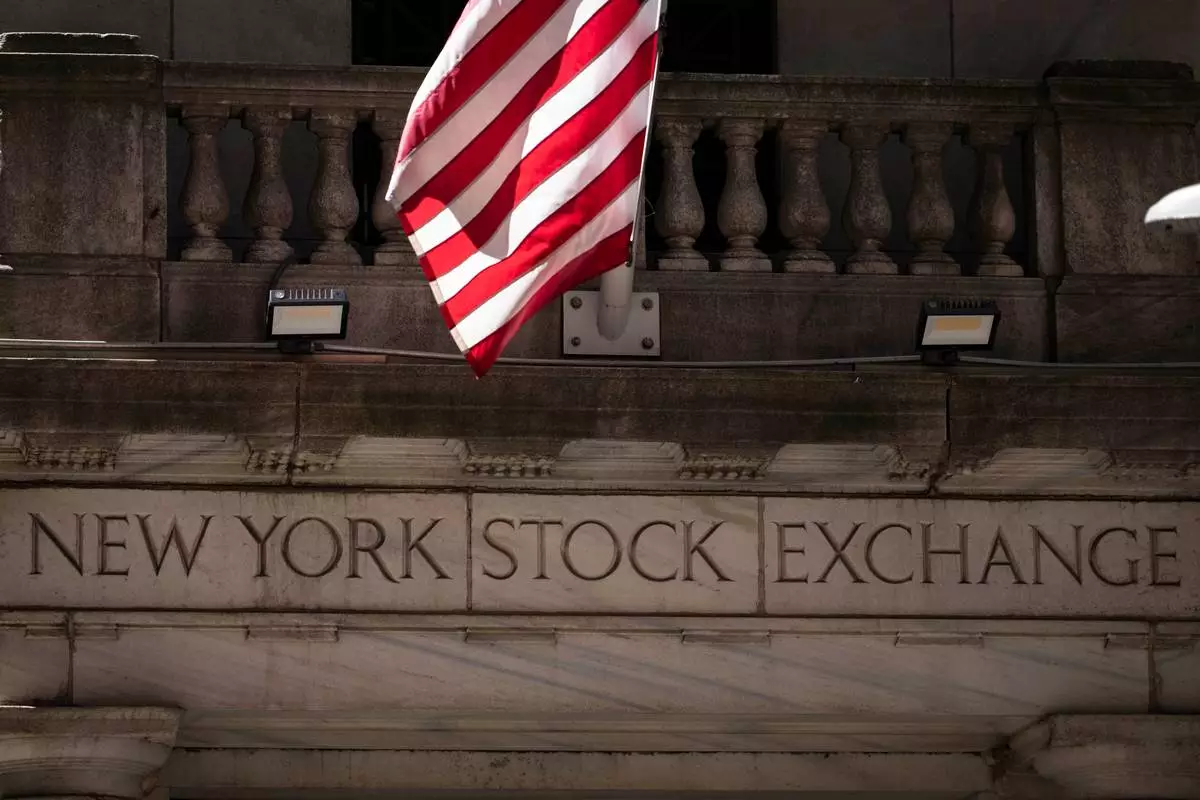
FILE - A general view shows the New York Stock Exchange, Friday, Aug. 7, 2026, in New York. (AP Photo/Yuki Iwamura, File)
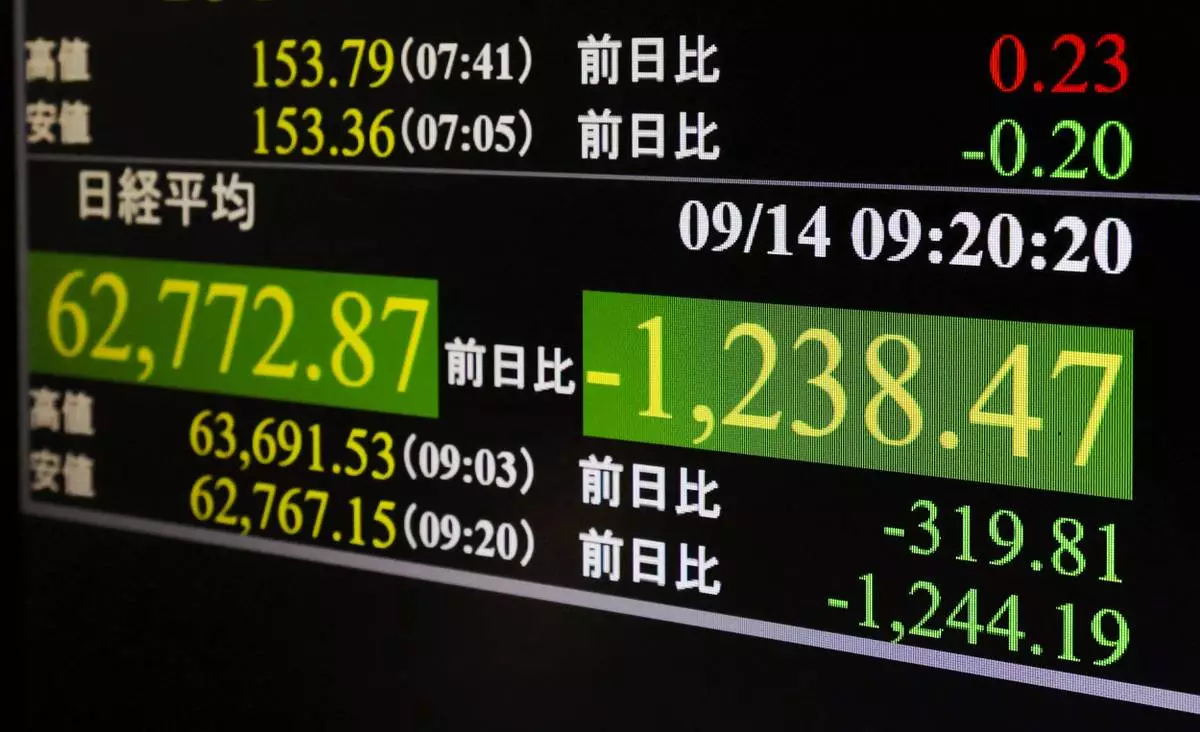
A monitor shows the Nikkei 225 stock index in Tokyo Monday, Sept. 14, 2026. (Miyuki Saito/Kyodo News via AP)