SAN FRANCISCO--(BUSINESS WIRE)--Sep 15, 2026--
Subsense, an AI-native neurotechnology company developing non-surgical, nanoparticle-based brain-computer interfaces (BCIs), today announced a major expansion of its AI-driven NanoBCI strategy, bringing together AI, nanotechnology and neural interfaces to advance a new category of BCI technology. Unlike traditional approaches that either rely on implanted hardware or capture neural activity from outside the skull, Subsense is developing a nanoparticle-based interface intended to eventually enable neural activity to be read or stimulated without permanently implanted electrodes.
This press release features multimedia. View the full release here: https://www.businesswire.com/news/home/20260915540008/en/
Subsense is developing what it describes as the first AI-native NanoBCI, designed to eventually enable neural activity to be read or stimulated without permanently implanted electrodes. Subsense is using AI across the development process to design, score and evaluate nanoparticle candidates and model how they could be navigated to specific areas of the brain. Rather than applying AI only after neural data is collected, Subsense is using it upstream to help determine what the underlying interface itself should look like. This extends the role of AI beyond software and neural-data analysis into the materials and delivery layers of the BCI itself.
Building AI into the BCI from the beginning
Subsense is applying AI at the materials-development stage, where nanoparticle composition, structure and field-driven behavior can be evaluated computationally before synthesis. Subsense is the first in the world to develop an integrated computational workflow that evaluates and ranks magnetoelectric nanoparticle candidates across five coupled design dimensions: 1) colloidal stability, 2) core magnetostriction, 3) shell piezoelectric response, 4) core–shell interface strain transfer, and 5) biocompatibility; and has built two- and three-dimensional physics simulations of nanoparticle navigation, so that candidates can be prioritized before experimental testing.
Subsense has also been awarded $250,000 in Google Cloud credits to scale these computational workflows, explore a broader nanoparticle design space and strengthen the AI infrastructure supporting its R&D. The support is helping the company expand the computational resources behind its AI-enabled design and simulation work.
“We are combining AI with physics-based modeling to help identify promising nanoparticle architectures, understand how they may respond to externally applied magnetic fields and guide which candidates move forward into experimental validation," said Parminder Mankoo, head of AI at Subsense. “The goal is to narrow a highly complex design space computationally so that our laboratory work can focus on the candidates with the strongest potential.”
“Most of the BCI field has been forced into a tradeoff,” said Tetiana Aleksandrova, co-founder and CEO of Subsense. “You can get closer to the neurons and obtain better signals, but doing that generally requires surgery. Or you can stay outside the skull, but accept limitations in what you can access. We started Subsense because we believe that tradeoff should be challenged.”
“Our nanoparticle-based approach is designed to challenge that tradeoff by creating a path to neural access that does not require surgery,” Aleksandrova continued. “AI helps us move faster and with greater precision in R&D by allowing us to explore nanoparticle design, navigation and performance computationally before committing to a physical candidate. It accelerates how we develop the technology.”
Developing neural reading and stimulation
Subsense is developing separate nanoparticle systems for stimulation and neural reading. For stimulation, the company is working with magnetoelectric nanoparticles designed to respond to externally generated magnetic fields and produce localized electrical effects. For neural reading, Subsense is studying plasmonic nanoparticle approaches intended to generate optical signals that could ultimately be detected by external hardware.
The two programs are being advanced in parallel as Subsense works toward a longer-term architecture that could eventually combine neural reading and stimulation within the same platform. The company remains in the preclinical stage and is engaging with the U.S. Food and Drug Administration as it develops its research and regulatory strategy.
As it advances the platform, Subsense has assembled a multidisciplinary advisory network spanning deep brain stimulation and neuromodulation, functional neurosurgery, movement disorders, ALS, neural-interface engineering, regulatory strategy and medtech commercialization. The group is intended to help Subsense pressure-test its technology against the same scientific, clinical and practical standards applied to established implantable neurotechnology.
Informing Subsense’s long-term technology roadmap, RayKurzweil, principal research and AI visionary at Google, has joined Subsense as a product and vision advisor. His work with Subsense focuses on the longer-term convergence of AI and neural interfaces, including how increasingly capable AI systems could accelerate the development of BCIs and ultimately expand what those interfaces make possible.
“AI is becoming increasingly capable of helping us understand and engineer systems of extraordinary complexity, and the brain is perhaps the most complex system we can work with,” said Kurzweil. “Subsense’s approach brings AI into the development of the interface itself, while nanotechnology creates a potential path beyond the limitations of surgically implanted hardware.”
Subsense’s additional technical information about its platform can be found at subsense-bci.com.
About Subsense
Subsense is an AI-native neurotechnology company developing nanoparticle-based BCIs designed to access neural activity without permanently implanted electrodes. Its nanoBCI platform combines engineered nanoparticles, external hardware, physics-based navigation modeling and AI, with separate programs under development for neural stimulation and neural reading. Subsense is currently in the preclinical stage, with its initial medical work focused on applications in Parkinson’s disease and ALS.
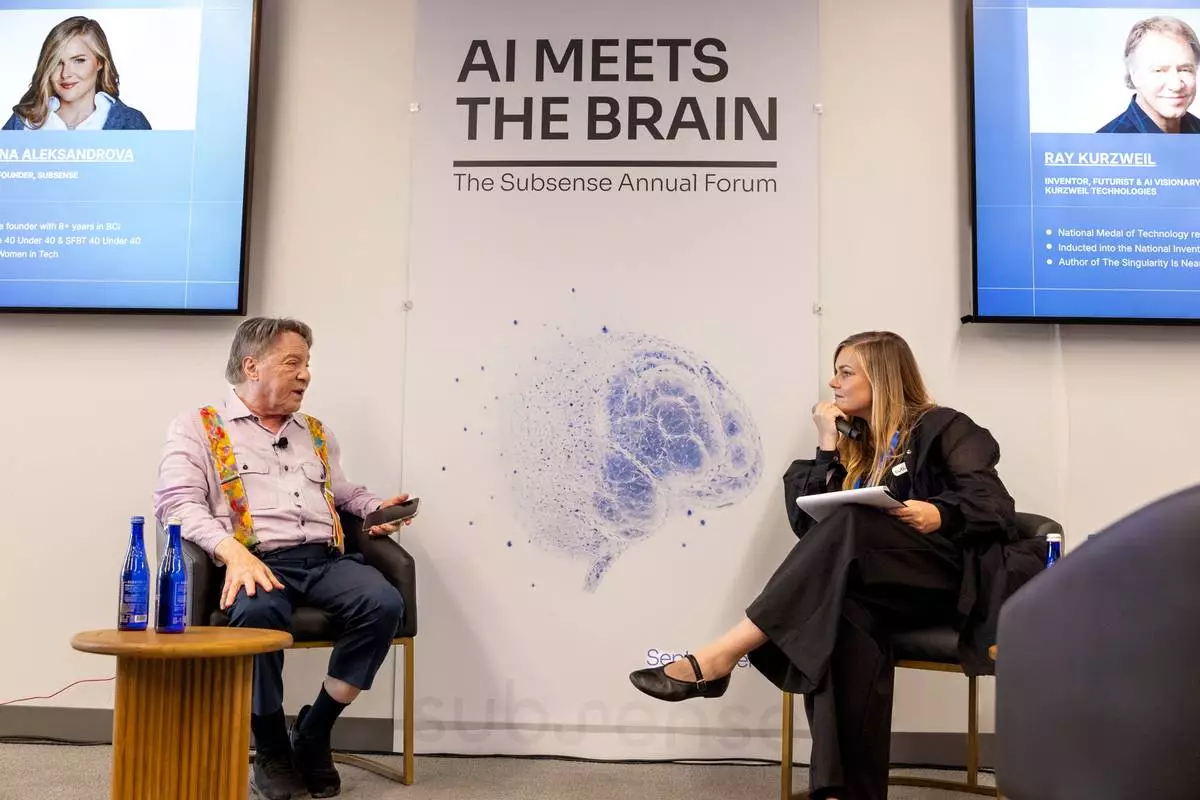
Ray Kurzweil and Tetiana Aleksandrova, co-founder and CEO of Subsense