SALT LAKE CITY--(BUSINESS WIRE)--Sep 15, 2026--
Atomic's Uplink launched today as a standalone product: an SDK that lets AI agents and automated workflows act on a user's real accounts without a company ever touching, storing, or holding that user's credentials. Uplink solves a problem every team building consumer-facing automation eventually hits. Banking, insurance, social media, loyalty, whatever account a user is logged into, the standard way of connecting there, running a cloud browser on a company's own servers, breaks down fast. Sites flag it as a bot, MFA stops it cold, and the company ends up touching, or holding, its users' credentials, a liability most teams don't want and few can insure against.
This press release features multimedia. View the full release here: https://www.businesswire.com/news/home/20260915321909/en/
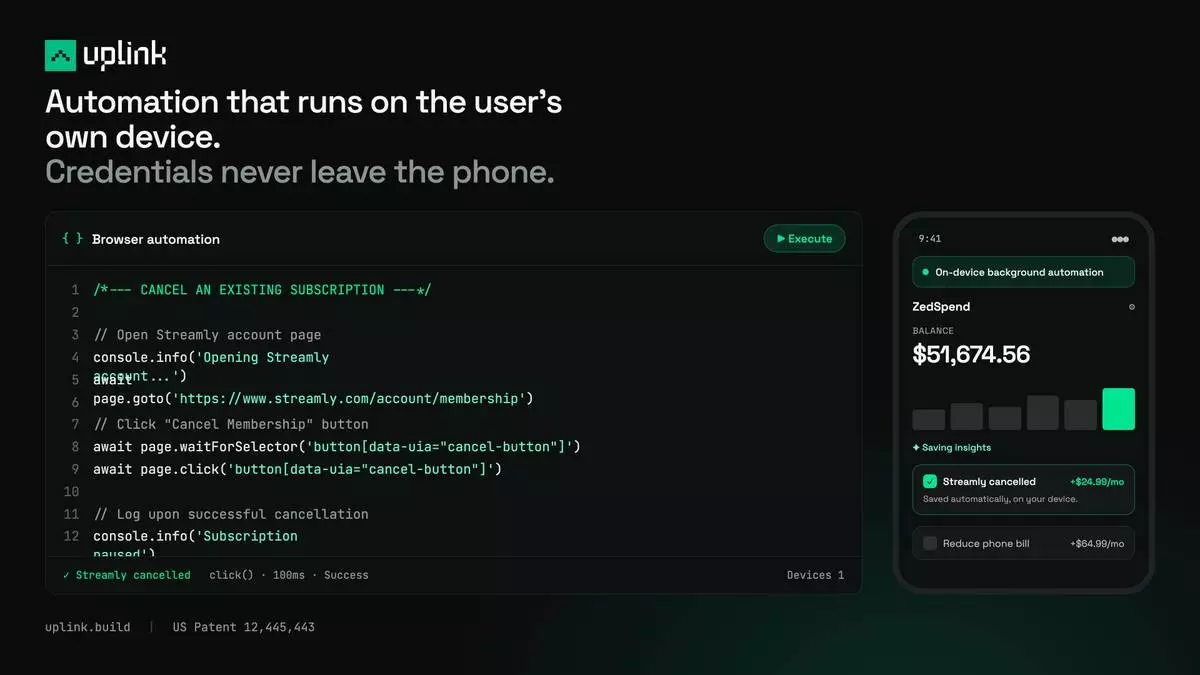
Uplink is built to remove that wall. It's an SDK a company embeds directly into its own app, so that when an app or AI agent needs to log into a user's account, it happens on the user's own device, using the user's own session, never on the company's servers and never through credentials the company has to see, store, or protect. From the user's side, it looks like any other login. They initiate the connection, watch it happen in real time, approve any MFA prompts themselves, and can revoke access whenever they choose. Nothing happens out of view, because nothing can, it's their device.
Uplink started as an answer to a version of this same problem inside Atomic's own payroll connectivity business. Most payroll providers, like Gusto and Paylocity, don't offer an easy, first-class way to access user data, so the user has to log in first. But most users don't actually know their own username and password for these systems, since it's a login they set up once and rarely touch again. Atomic's early approach involved authenticating on its own servers on the user's behalf, which meant frequent blocking, since the request looked nothing like the user's own login. The fix was to move the login onto the user's own device instead, so the site sees exactly what it expects: a person logging into their own account, not a company logging in for them.
That approach was refined over years of production use connecting into payroll and merchant systems to power Atomic's direct deposit switching, payment switching, and bill and subscription management products, and it's been vetted for security and scale by some of the largest financial institutions in the world. Having seen it hold up across millions of highly regulated transactions, Atomic's engineering team pulled the technology out of the company's internal stack and rebuilt it as its own product. This time, it’s available for any company that needs an agent to act on a user's real account, not just limited to payroll or merchant systems.
"Every team we talk to building an app or an agent for consumers runs into the same wall," said Scott Weinert, Cofounder and CTO of Atomic. "They need it to act on a user's real account, and the second authentication is involved, the usual cloud-browser approach breaks. We built Uplink to make that wall go away. The most common reaction we get isn't 'that's better than what we use,' it's 'I didn't think that was possible.' Teams shelved entire product ideas years ago because acting inside a user's account meant bot detection, MFA walls, and holding credentials nobody wants to hold. Uplink makes that assumption wrong, and the fun part is watching people re-open ideas they'd written off."
Built on-device, not in the cloud
Uplink is not a tool developers reach for to run their own automation. It's an SDK a company embeds in its own app, so automation runs on the user's own device, with the user's own credentials and session, not on a server the company controls.
That distinction is what solves the problems cloud-browser automation runs into the moment authentication is involved. Since it's a real device with a real login, there's no bot to detect and no CAPTCHA-solving service to pay for. Proxy services, another major cost of cloud-browser automation, aren't needed either, since the user's own device and connection effectively become the proxy. Uplink can reach systems behind a VPN and support hardware-based MFA, cases that are difficult or impossible for server-side automation. And because credentials never leave the user's device, the company embedding Uplink never touches them, holds them, or takes on the liability of protecting them.
Uplink also works with the hardware and software people already use to log in, Face ID, Touch ID, and existing password managers, rather than working around them. Under the hood, a patented, zero-copy protocol (US 12,445,443) moves data up to 20x faster than traditional automation methods.
Early users already include Odynn, which uses Uplink to power the account connectivity behind its Traveler DNA® product, connecting into travelers' airline and hotel loyalty accounts, and Informative Research, which uses Atomic to let borrowers connect their payroll accounts through AccountChek® for asset, income and employment verification.
Built with AI-native tooling, deployed as an embedded SDK
Building an Uplink integration looks different from running one. Uplink ships with an MCP (Model Context Protocol) server, so developers can use AI coding tools like Claude Code, Cursor, and Windsurf to define what a given login flow needs, without hand-writing scraping logic themselves. Once that integration is built, it ships inside the company's own app as an SDK: the automation that runs against a user's account executes on that user's own device, using their own session, not on Uplink's infrastructure or the company's servers.
"Uplink powers the account connectivity behind Traveler DNA®, a unique Odynn product that aggregates a user's airline and hotel loyalty accounts into a single view of their points, status, and benefits. Uplink enables users to securely sync those accounts directly from their own device. For our bank and fintech partners, that on-device architecture is a requirement, not a nice-to-have. Since moving to Uplink, we've reduced costs and significantly improved the reliability of our loyalty account connection, allowing us to create more seamless, personalized travel experiences for our partners and their users. We're proud to have been one of Uplink's earliest partners to apply the technology beyond its original use case, and it's exciting to see how broadly that same infrastructure is now being used." - John Taylor Garner, Founder and CEO of Odynn
Beyond payroll: insurance, social media, loyalty, and more
Uplink was proven inside one industry, but the wall it removes, bot detection, MFA, and credential liability, shows up anywhere consumer-facing automation, AI-driven or not, needs to act inside a user's account. While Uplink was born inside Atomic, it now operates as its own product, with its own roadmap and customers well beyond fintechs and financial institutions. Early interest already spans:
...and more.
"Our business runs on data consumers choose to share, and we're accountable for how that data gets handled,." said Brian Francis, Head of AccountChek at Informative Research. “Atomic lets the borrower grant permission and complete the connection on their own device, so credentials never reach our systems. When you operate under credit reporting and privacy rules, that matters more than any feature on the list.
Uplink offers a free tier, a set number of sessions and connection time to start, with paid plans that scale with usage from there.
What's next
Atomic plans to grow Uplink into a community platform where developers can build and maintain integrations to third-party services together, with an eventual marketplace where independent developers can publish and monetize integrations they've built.
Uplink is available now at uplink.build, with documentation at docs.uplink.build.
About Uplink
Uplink is an SDK that companies embed in their own apps so AI agents and automated workflows can act on a user's real accounts without ever touching, storing, or holding that user's credentials. It's built by the team behind Atomic's authentication technology, running on a patented protocol (US 12,445,443), and it's been vetted for scale and security by some of the largest financial institutions in the world.
Atomic's Uplink Launches as a Standalone Product, Solving AI Agents' Credential-Liability Problem
Atomic's Uplink Launches as a Standalone Product, Solving AI Agents' Credential-Liability Problem