CEO Brian Rolapp said Tuesday the PGA Tour is not considering a path back for LIV Golf players like the program it offered Brooks Koepka and three other top players at the start of the year.
LIV's future has never been more murky after the rival circuit filed for Chapter 11 bankruptcy last week as it plots a new model no longer bankrolled by the Saudi Arabia sovereign wealth fund. Still to be determined is how many players stick around for the less lucrative “LIV 2.0.”
The other part of the equation is where else they would go.
Koepka got out of the last year of his LIV contract and was offered a path back to the PGA Tour through the “returning member program.” Rolapp then offered that to Jon Rahm, Bryson DeChambeau and Cameron Smith — all major champions since 2022 when LIV launched — and gave them a three-week deadline to accept with no guarantee it would be offered again.
“In terms of where we are today, we are not currently contemplating a returning member program like the one you saw in January,” Rolapp said on a conference call to discuss the eligibility for the new competition model on the PGA Tour that starts in 2028.
“Everyone at the PGA Tour, myself included, has been focused on what is best for the organization.”
Rolapp has leaned into meritocracy in the new model, making players earn their place. Koepka, along with the other players offered a return, had five-year exemptions from winning majors.
Koepka was required to pay $5 million to charity, and he had no access to player equity grants for five years. He also was not eligible for any of the $20 million signature events unless he qualified for them through his play. Koepka failed to get into any of those tournaments, and he did not qualify for the PGA Tour's postseason.
Rahm has been elusive when it comes to his plans. He has one year left on the contract he signed ahead of the 2024 LIV season and now that contract is in doubt because of the Chapter 11 filing.
“There's a long legal process they have to go through before a lot of things fall into place,” Rahm said Tuesday at the BMW PGA Championship on the European tour. “I really can't give you an answer right now. ... Until this current season is done, I really won't be able to give you an answer.”
Rolapp has been guided by making the PGA Tour the ultimate destination in golf, and the two-tier system that includes a Championship Series with stronger fields and higher purses makes it the most attractive place to be.
The likes of Rahm and DeChambeau are two of the biggest pieces missing if golf wants to patch itself together after such a disruptive time brought on by LIV. Rolapp also has to respect his players who watched their peers chase Saudi riches that caused the disruption.
Rolapp said in June when he revealed the bones of the new model, "We do have to account for whatever lingering discipline is left, or rules that have been broken. There’s scar tissue, and that has to be accounted for. That’s not to say we’re going to be punitive, it’s just that we’re a membership organization of rules.”
At least two players who were with LIV are in position to return by earning 10 tour cards available through the European tour — Patrick Reed, who leads the Race to Dubai, and Eugenio Chacarra, who is No. 3 on the list. Both have been out of LIV for more than a year, so the tour's one-year ban has expired. Bernd Wiesberger of Austria also is in position to get a card.
The PGA Tour has not said how many cards it would offer the European tour going forward. They are still negotiating an alliance that provided those cards, and that could be a path back for European tour members like Rahm and Tyrrell Hatton.
See AP’s full golf coverage here

Golfers, from left, Shane Lowry, of Ireland, Brooks Koepka, of the United States, and Rory McIlroy of Northern Ireland, laugh during the first round of the Irish Open golf tournament, Thursday, Sept. 10, 2026, in Doonbeg, Ireland. (Brian Lawless/PA via AP)

Jon Rahm of Spain tees off the 2nd on day two of the Irish Open at Trump International Golf Links in Doonbeg, Ireland, Friday Sept. 11, 2026. (Brian Lawless/PA via AP)
NEW YORK (AP) — Federal authorities charged a dozen people Tuesday for fraudulently collecting more than $10 million in government childcare payments in Southern California, when the operators had few or even no actual children attending their facilities.
The charges, jointly announced in San Diego by the Justice Department and the criminal investigations division of the IRS, are the latest effort by the Trump administration to investigate and charge alleged cases of fraud and waste in government programs.
The 12 defendants said they were operating licensed, at-home childcare facilities in the San Diego area, submitting attendance records and documenting when each child attended and for what times, in order to collect payments from government childcare subsidy programs. However, federal prosecutors say these at-home facilities rarely, if ever, had children. Defendants fraudulently collected from government programs for months or, in some cases, years, prosecutors said.
This scheme is also known as operating a “ghost” daycare, prosecutors said.
“There were no children," Colin McDonald, head of the Justice Department's fraud enforcement division, told a news conference. “There were no daycares. But the taxpayers were paying for all of it.”
The department's fraud division was created in April and this was the first indictment of its type since.
All 12 defendants were arrested Thursday and the charges against them were unsealed Tuesday. Prosecutors said the investigation continues.
Federal prosecutors say some of the defendants were not even in the country when they were submitting claims for childcare payments. One defendant, Turkiya Alawad, 63, was found to be outside the U.S. between Jan. 1, 2024, and Jan. 30, 2024, but at the same time, submitted and collected for childcare payments for the dates they were not away, prosecutors say.
Another defendant, Abdulrahman Alawad, 25, claimed to provide childcare to children in March and April but surveillance footage allegedly shows children entered Alawad’s facility only once, on the day a state inspector showed up. Alawad is alleged to have received more than $300,000 in payments from childcare programs in 2025.
Other defendants collected more than $1 million in childcare subsidy payments, prosecutors said. Jared Koopman, head of the IRS criminal investigations division, told reporters the defendants then used the proceeds to purchase luxury homes, send money overseas through wire transfers, and make large cash withdrawals.
“These are taxpayer-funded programs designed to help working families, children and vulnerable communities," Koopman said. “When those funds are diverted for personal profit, families lose, honest providers lose, taxpayers lose and the public trust in these programs is damaged."
While several of the defendants have similar last names, prosecutors said each investigation and indictment was reached independently.
The indictments in California have similarities to what happened with Minnesota-based Feeding Our Future. Federal prosecutors charged Feeding Our Future with scamming Minnesota and federal taxpayers out of millions of dollars of childcare and meal subsidies.
The alleged daycare fraud case in California is larger than the one with Feeding Our Future, which submitted roughly $4.6 million in claims to the childcare assistance program. However, the Feeding Our Future case was much more focused on fraud in meal subsidy programs than childcare.
The operator of the Feeding Our Future’s childcare facility, Fahima Mahamud, 50, pleaded guilty to conspiracy and wire fraud charges in July. The facility's leader, Aimee Bock, was convicted and sentenced to 41 years in prison in May for fraud and conspiracy charges. She has appealed her conviction.
The Internal Revenue Service’s Criminal Investigations Division had been investigating these childcare facilities going back to at least February. While the IRS is mostly known for the enforcement of tax law, the investigations division is one of the arms of the federal government that often focuses on white-collar crimes.
The Trump administration has put a heavy emphasis on investigating and charging alleged fraud and abuse of government benefit programs. Vice President JD Vance chairs the administration’s task force on the effort. McDonald said the public should expect more investigations and indictments in the coming months.
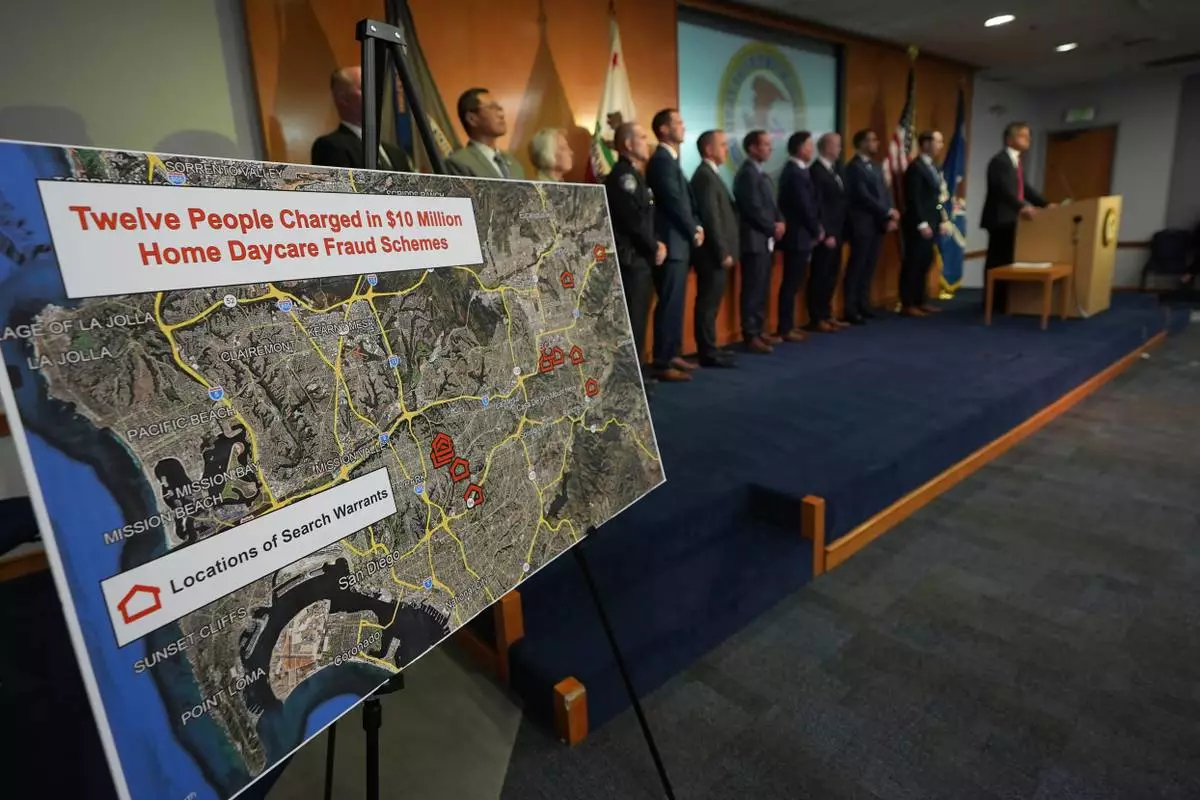
U.S. Attorney Adam Gordon announces charges against a dozen individuals for fraudulently collecting childcare payments during a press event, Tuesday, Sept. 15, 2026, in San Diego. (AP Photo/Gregory Bull)