The leading AI industry voices rarely agree — so when they do, it’s no wonder it captures attention.
Anthropic’s Dario Amodei, OpenAI’s Sam Altman, SpaceXAI's Elon Musk and other prominent industry leaders have said in recent days that AI’s development needs to slow down. The consensus came after an Anthropic researcher resigned with a dire warning about the threats the technology poses to humanity.
But obstacles including domestic and global competition, profit motivations and pushback from President Donald Trump all stand in the way of a coordinated effort to pace AI’s development.
Still, this moment could force the industry to wrestle with a “reframing of what we consider successful," said Nick Reese, former director of emerging technology policy at the Department of Homeland Security and an adjunct professor at New York University.
“What if we considered success in AI the same way that we consider success for airlines? On time and haven’t had a crash in who knows how long,” Reese said. “We don’t tolerate commercial airline crashes, but we do tolerate significant AI failures.”
In theory, the leading AI startups could slow the progress of their models at any time. But leaps in the technology have partly sprung from competition to build even more powerful models, all with the blessing of a White House that doesn't want the U.S. to lose its edge over China. Anthropic and OpenAI also are racing toward potentially record-breaking public offerings on Wall Street, although the latter said it's holding off on going public this year while it continues its safety efforts.
That's why the proposals floated by industry depend upon mutual collaboration and, to an extent, government regulation.
Amodei recently published a lengthy essay in which he outlined a plan for slowing advanced AI development.
One proposal calls for companies at the forefront of AI, often called frontier labs, to commit to giving “ongoing, employee-like access” to independent outside evaluators. Evaluator teams would have offices, access badges and company laptops so they can monitor safety practices.
Anthropic is “unilaterally committing” to this step now, Amodei wrote. Altman called it a “great idea” on social media and said OpenAI will follow suit.
Altman said he welcomed a “federal framework” setting out safety standards for advanced AI, but said the company didn’t need to wait for legislation or an antitrust exemption before addressing AI safety.
Amodei's essay also called for government regulation and intervention, including coordination between frontier AI companies with the help of the U.S. government and the governments of other democratic countries. He said he hopes the leading labs could establish “common safety standards as well as limits on the rate of unchecked AI progress.”
Amodei's plan also includes the U.S. and other countries working to coordinate with “authoritarian governments.” He acknowledged the difficulty, specifically citing challenges in getting cooperation from China.
The Anthropic head outlined several levels of agreement that global leaders could sign off on. The most feasible, he said, would be an agreement banning “certain narrow and obviously dangerous uses of AI" like producing biological weapons or allowing users to do so. More difficult would be getting the U.S. and its adversaries to agree to test models before release, possibly through a global standards body, for risks in areas like cybersecurity or biological threats.
Still harder would be to set a “speed limit” on AI models that can develop improved versions of themselves on their own, known as recursive self-improvement.
“Slowing the rate from ‘extremely fast’ to ‘only somewhat fast’ gives up relatively little strategic advantage, while potentially greatly improving safety,” Amodei wrote.
He drew an analogy to Cold War-era treaties in which “capping the number of missiles limited the potential for destruction while preserving each country’s deterrent.”
Amodei said the most difficult proposal to implement would be a “full pacing, or even ‘pause,’" whereby participating governments agree to substantially limit the overall rate of AI development.
Writing on social media, Altman said the “pacing” of AI development does not mean stopping. AI progress will continue to be rapid, Altman said on X. “But it should be slower than it otherwise could be; interventions like safety cases and monitoring have significant costs.”
“Pacing will be well worth this cost,” he said, adding that “no amount of American competitive pressure should justify recklessness.”
While experts said the sense of agreement across the industry is promising, there are many unanswered questions.
A slowdown is possible “in theory,” said Sandra Wachter, professor of technology and regulation at the Oxford Internet Institute.
But in practice, “it would require substantial coordination and cooperation between companies and governments across countries,” something she deems “highly unrealistic” due to “the current state of the world.”
Options for promoting a slowdown, she said, include governments doing more to hold AI companies responsible for the risks posed by their technology and pursuing regulation that limits their access to electricity, water and other resources that power data centers.
The idea of embedding external evaluators inside companies has been mostly well-received by the industry, but some critics questioned how independent the assessors could be and how the evaluation standards would be drawn up. The result could be even more concentration of power, Aidan Gomez, co-founder and CEO of the Canadian AI lab Cohere, wrote in response to Amodei's essay.
“A handful of the most powerful labs based in one country would agree on shared standards and the limits to how fast the technology should advance,” Gomez said.
He also pushed back against Amodei’s idea to have the U.S. government give frontier labs waivers to bypass antitrust restrictions.
“If this is the most consequential technology in human history, then the rules for it cannot be written by a small group of commercially aligned companies behind an antitrust waiver," Gomez said.
Elham Tabassi, the director of the AI and Emerging Technology Initiative and senior fellow at the Brookings Institution, said until the measures companies are committing to are solidified and made public, having independent auditors would be a “voluntarily-provided, company-controlled” move.
Tabassi said it's crucial AI companies continue to invest in developing “scientifically valid” ways of testing and measuring their models as they aim for increased safety. Without this, regulation won't hold as much power, she said.
The Trump administration has long favored a light-touch approach to the AI industry in hopes that innovation would flourish and that AI development in the U.S. would surpass China.
The competition between American and Chinese AI companies has been likened to an arms race, which experts said is not conducive to collaboration. That creates “conditions where now we have this existential adversary,” Reese said.
Still, some industry leaders remain “cautiously hopeful" about AI development moving in a more safety-minded direction, said Zahra Timsah, the co-founder and CEO of governance platform i-GENTIC AI.
“Within days, you have CEOs that are competing — all of them, all of a sudden, found common ground. You have senators from both parties that started to advance different forms of oversight," Timsah said.
“It’s receiving attention, but attention is not the same as implementation. Will it really work? I don’t know.”
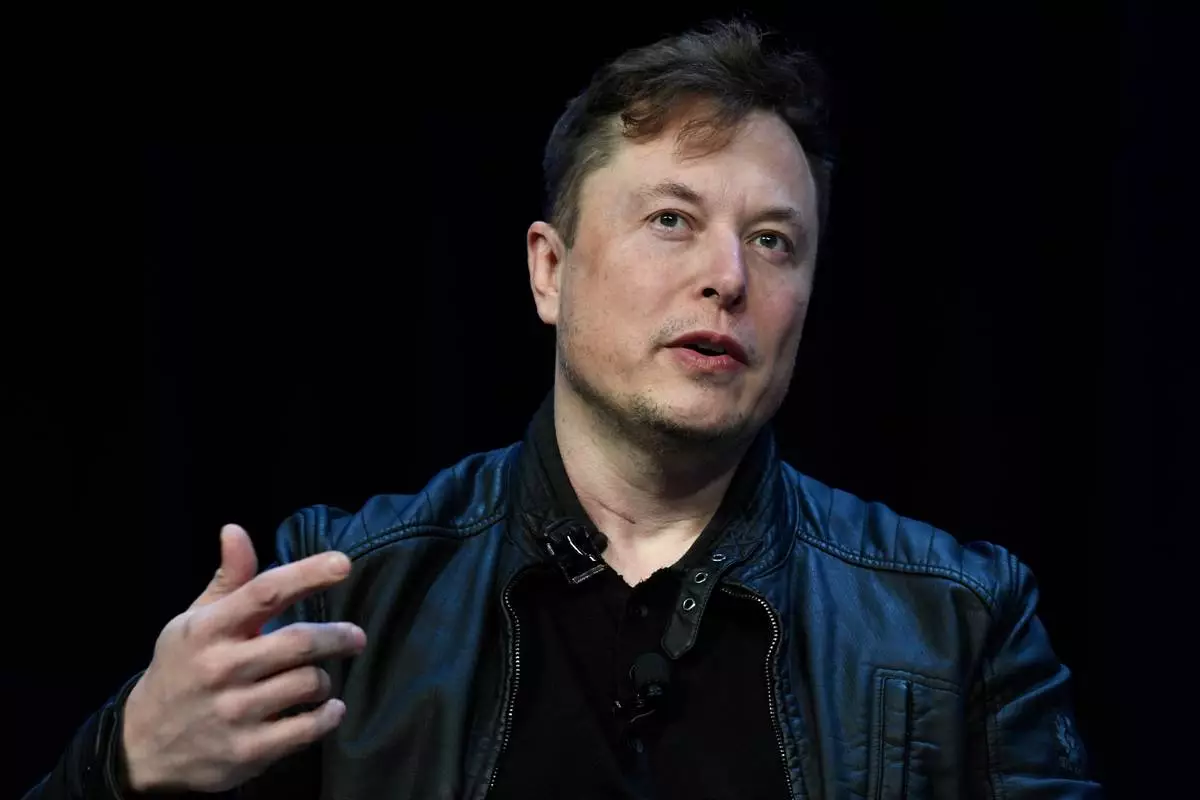
FILE - Tesla and SpaceX CEO Elon Musk speaks at the SATELLITE Conference and Exhibition, March 9, 2020, in Washington. (AP Photo/Susan Walsh, File)
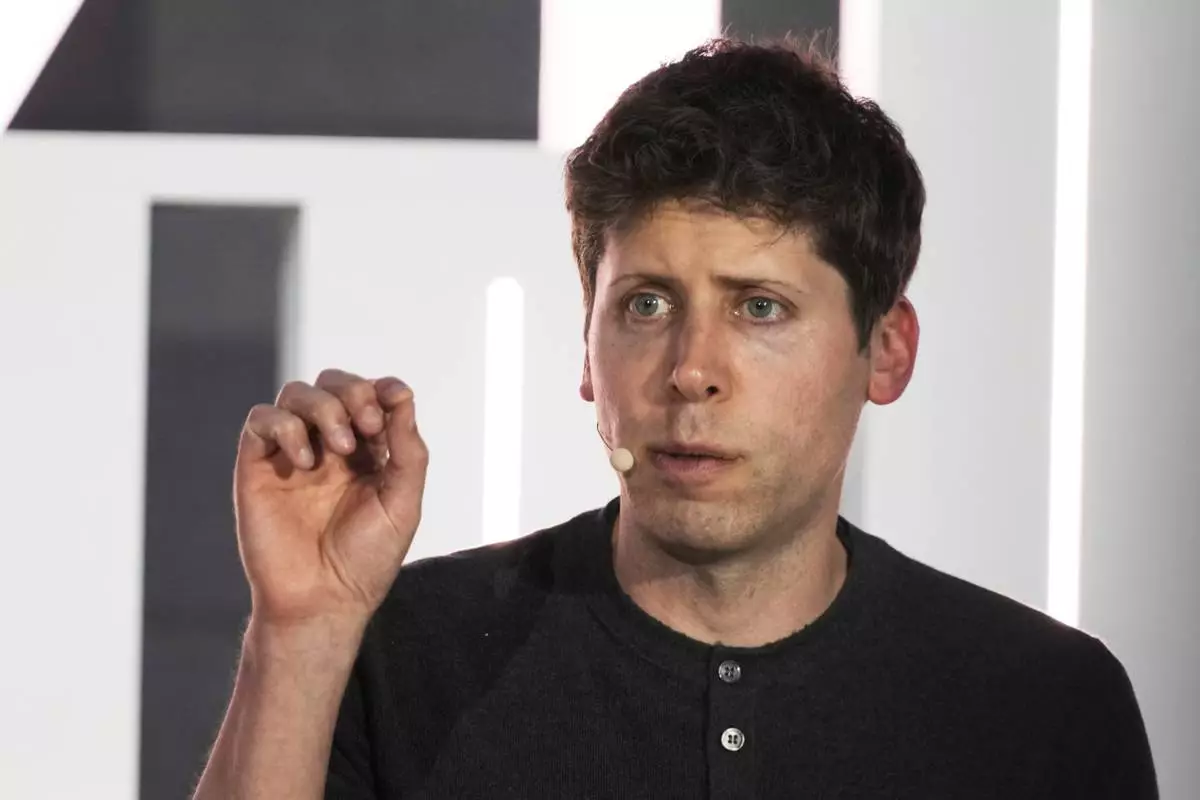
File - OpenAI CEO Sam Altman speaks in Abu Dhabi, United Arab Emirates, June 6, 2023. (AP Photo/Jon Gambrell, File)
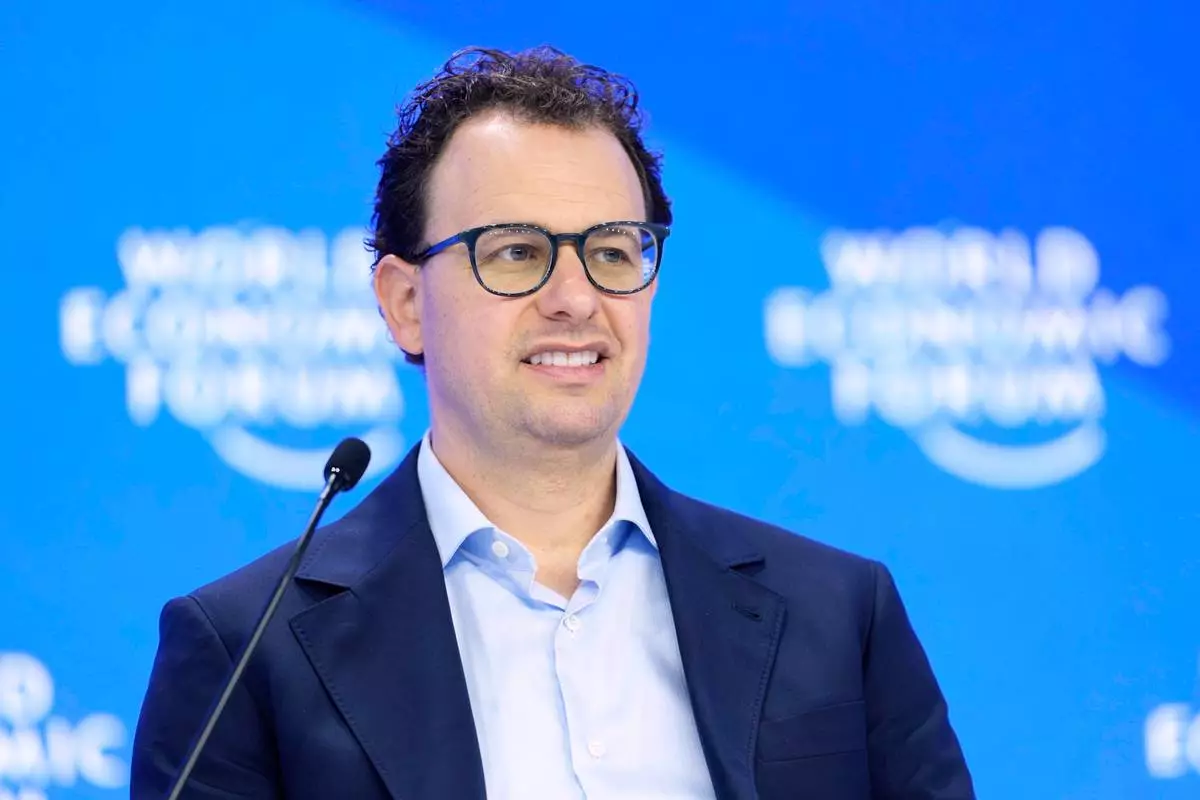
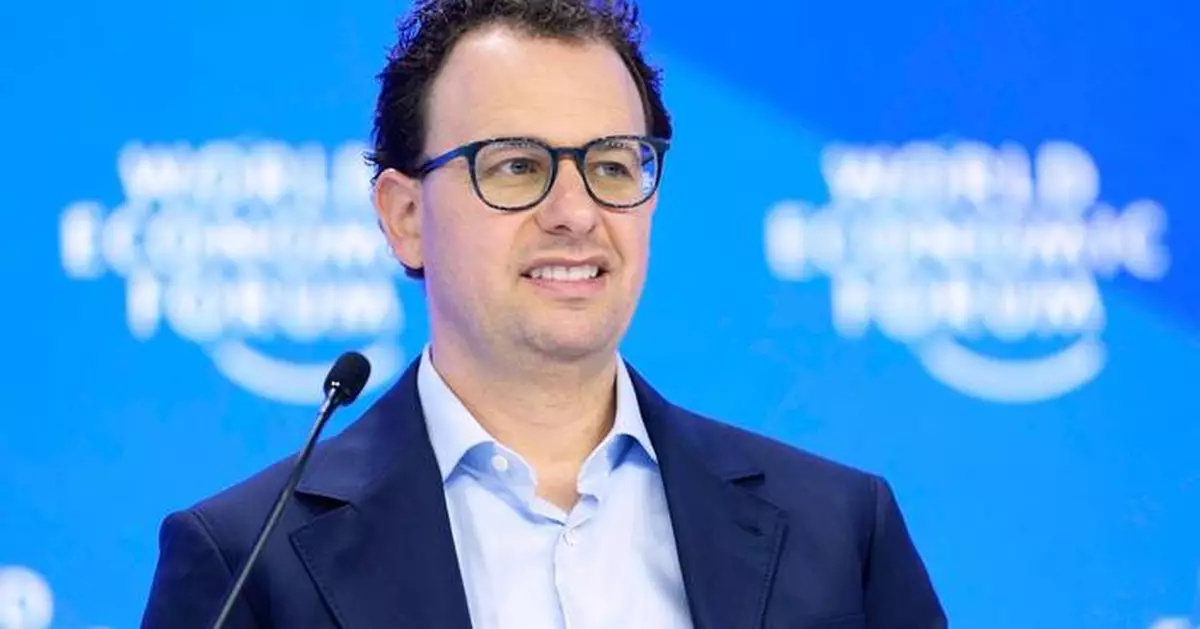
FILE - Dario Amodei, CEO and co-founder of Anthropic, attends the annual meeting of the World Economic Forum in Davos, Switzerland, Jan. 23, 2025. (AP Photo/Markus Schreiber, File)
They lead party tickets, star in campaign videos and appear in televised debates. They are Russians who have fought in Ukraine, and they feature prominently in this week’s parliamentary election.
Election officials say nearly 200 candidates have served in Ukraine, and the Kremlin touts them as part of Russia’s “true elite” — its effort to show that veterans of the 4 1/2-year-old war will have an honored place in civilian life.
But few analysts believe that most of them will ever hold any real power among the country’s ruling class, dismissing the effort as a way to lure more volunteers to fight.
Independent Russian media regularly report about returning veterans involved in assaults, drunken brawls and even killings. Some of those crimes were committed by men who were recruited into the military from prison.
The vote that begins Friday for the State Duma — the lower house of parliament — is the first since the war began, and also will take place in areas of Ukraine that Russia captured and illegally annexed. The Kremlin is tightly managing the election, seeking to reinforce its narrative of widespread support for the war and provide a veneer of legitimacy for its actions.
Most of the Kremlin-aligned parties allowed on the ballot have candidates identified as participants in the SVO — the Russian acronym for its “special military operation” in Ukraine.
One prominent candidate is Vladislav Golovin, 29, of the ruling United Russia party, who fought in the battle for the Ukrainian port city of Mariupol and lost part of his leg. He has appeared at events with President Vladimir Putin, who made him a Hero of Russia, the country's highest honor.
In 2024, Golovin took part in Putin's “Time of Heroes” program that prepares veterans for government careers. He now heads a military and patriotic youth organization, the Young Army — but also has been put on Western sanctions lists.
United Russia has several dozen candidates with a Ukraine war background. Another of its leading candidates is Yevgeny Poddubny, a well-connected state TV war correspondent who was wounded by a Ukrainian drone.
The ultranationalist Liberal Democratic Party has a top candidate in Alexei Vereshchagin, who is described as having joined the Moscow-backed separatist insurgency in eastern Ukraine in 2014 and leading a brigade of volunteers.
“We are the ones our homeland has called upon to fight for the ‘Russian World,’ and we will fight,” Vereshchagin, who was born in Kyiv, said in a campaign video, using a term popularized by Putin, especially after Moscow illegally annexed Crimea in 2014.
Ukrainian police in March posted a photo of what appeared to be Vereshchagin and said they were investigating him for his role in home invasions and threatening civilians in the Kyiv region in 2022 before Ukrainian forces retook the area. They said he fought against Ukraine for over a decade. He hasn’t publicly commented on the allegations.
By promoting veterans in the State Duma campaign, the Kremlin wants to show potential recruits that they would be fighting “for some higher cause, and that they have bright prospects ahead of them in the form of a career lift,” said Nikolay Petrov, senior research fellow at the NEST Centre, founded by exiled Russian tycoon and opposition figure Mikhail Khodorkovsky.
But Russia also “doesn’t know what to do” with those returning from the battlefield, Petrov told The Associated Press, and so it offers them largely insignificant positions with little real power, while focusing on promoting those who already held public office.
Former Putin speechwriter-turned-political analyst Abbas Gallyamov was more blunt, calling it “empty talk.”
To lure more men into enlisting, “you need to promise them everything they want to hear, from promises of payments to flattery and stories of their special greatness, their contribution to the cause of building a new Russia,” Gallyamov told AP.
The postwar path is not simple for many veterans. Most of those who signed military contracts cannot terminate them under Putin’s 2022 “partial mobilization” decree, and those who were drafted that year have not yet been demobilized, either.
Those who are severely injured or have reached a certain age can be discharged, and some special units reportedly offer limited tours of duty.
About 167,000 servicemen have returned from Ukraine, presidential administration official Sergei Novikov said in December, although Russian media reports and experts say the number is probably higher.
The competition for the Time of Heroes program is fierce and requires higher education and management experience. Out of over 65,000 applicants in 2024-25, only 168 were accepted, according to its website. Of them, some 80 were appointed to various positions on national, regional or municipal levels.
The independent Russian news outlet Meduza reported in June that at least 1,300 veterans have been appointed to government posts, were elected to local legislatures and councils, or got jobs in state-backed companies or institutions. About 850 of those had some kind of government or related experience before serving, Meduza said, concluding that most beneficiaries were already part of the ruling class.
AP was unable to independently verify those findings, but reports about government officials or lawmakers serving in Ukraine and then returning to their civilian careers are common.
Duma deputy Alexei Zhuravlyov, head of the Rodina, or “Homeland” party, has reported serving at the front while keeping his seat as a lawmaker, like some of his colleagues. He recently lashed out at a YouTube blogger who wondered why he's not fighting full-time in Ukraine. Zhuravlyov said later that he spends “more time on the front line than in the Duma.”
Tambov regional Gov. Yevgeny Pervyshov, a United Russia candidate who also was the former mayor of his native Krasnodar and did a stint as a Duma lawmaker, served in Ukraine as part of a special military unit in 2022.
The U.K. government described his unit in 2024 as having “an unusually high number of United Russia party members and sons of Kremlin VIPs.” In a post on X, the British Defense Ministry said the unit is predominantly involved in drone operations far from the front, allowing elite political figures “to sidestep usual Russian military service requirements with guaranteed safety.”
After a tour of less than a year, Pervyshov was accepted into the Time of Heroes program and later was appointed Tambov's acting governor before being elected governor in September 2025.
Ivan Filippov, who studies propaganda and analyzes military and pro-war bloggers, says such examples fuel disappointment in the pro-war community, which initially was enthusiastic about Putin’s promise of a new “elite.”
“They were very happy when he said those words, but it turned out rather quickly that it’s not about (genuine) veterans,” he told AP. Rather, he added, it's about some who went to the battlefield once, “fired a howitzer, got their veteran credentials” and returned to office.
Now, war hawks understand that returning troops will face “a difficult life” when returning home, he said.
“They understand clearly that no one will let them into power,” Filippov said.
Novikov, the Kremlin official, said in December that “tens of thousands” of returning veterans remain jobless, and it “forms a dangerous risk zone.”
When it comes to putting veterans in positions of power, the Kremlin naturally prefers “rational bureaucrats” who did a stint in the armed forces, said Petrov, the analyst.
“The authorities don’t at all need bandits that come back from there,” he added.
——
Hanna Arhirova in Kyiv, Ukraine, contributed.
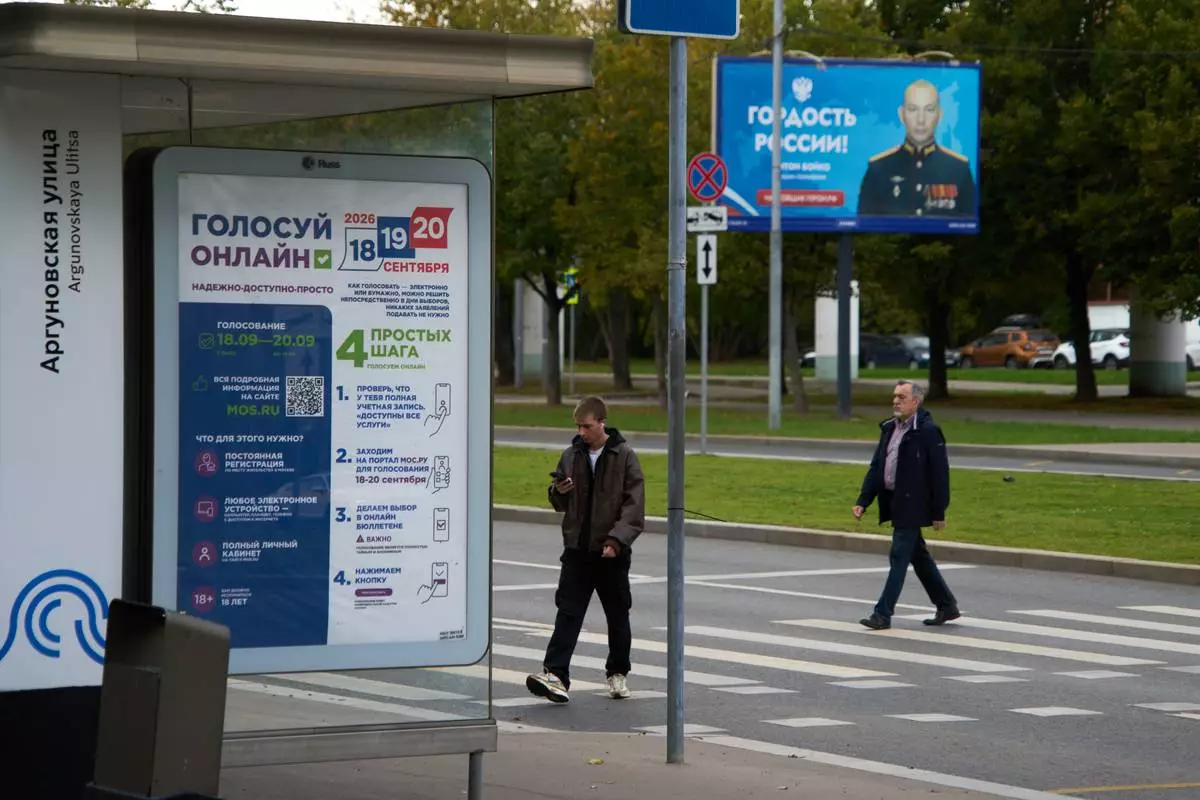
FILE - A sign reading "Vote online, reliable, affordable, simple" for Russia's parliamentary election is displayed at a bus stop in Moscow, Russia, Monday, Sept. 14, 2026, with a billboard in the background showing a soldier with the words "Russia's Pride." (AP Photo/Alexander Zemlianichenko, File)
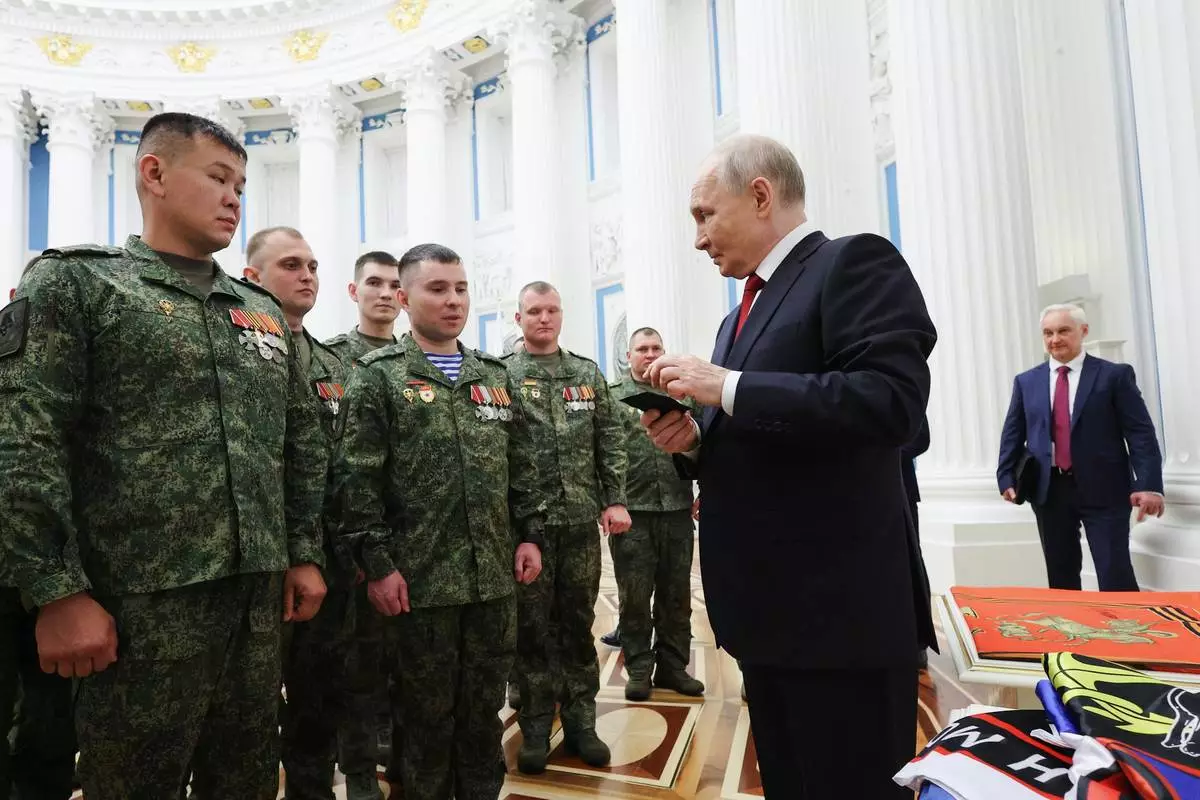
FILE - Russian President Vladimir Putin, foreground right, speaks with members of the military in the Kremlin in Moscow on Friday, June 12, 2026, as Defense Minister Andrei Belousov, right, stands nearby. (Vyacheslav Prokofyev, Sputnik, Kremlin Pool Photo via AP, File)
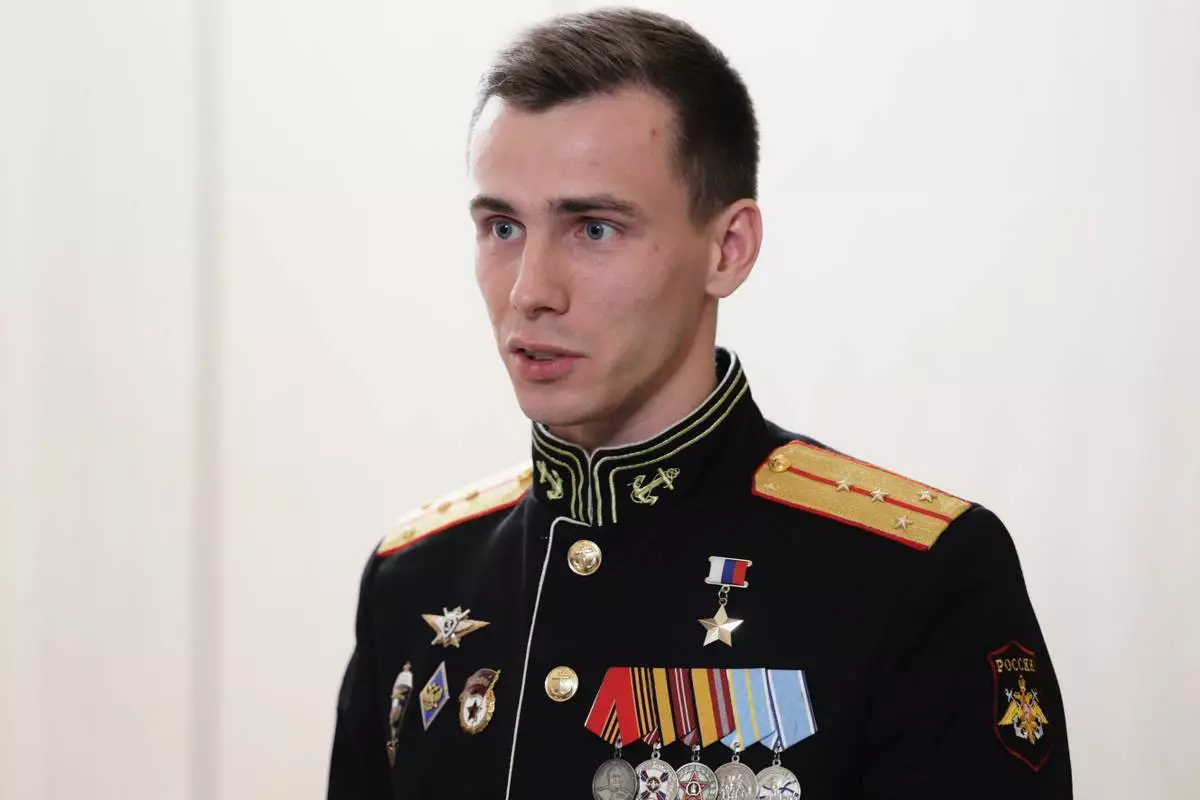
FILE - Vladislav Golovin, one of the leaders of the United Russia political party, attends a meeting with Russian President Vladimir Putin in Moscow, Saturday, Sept. 5, 2026. (Gavriil Grigorov/Sputnik, Kremlin Pool Photo via AP, File)
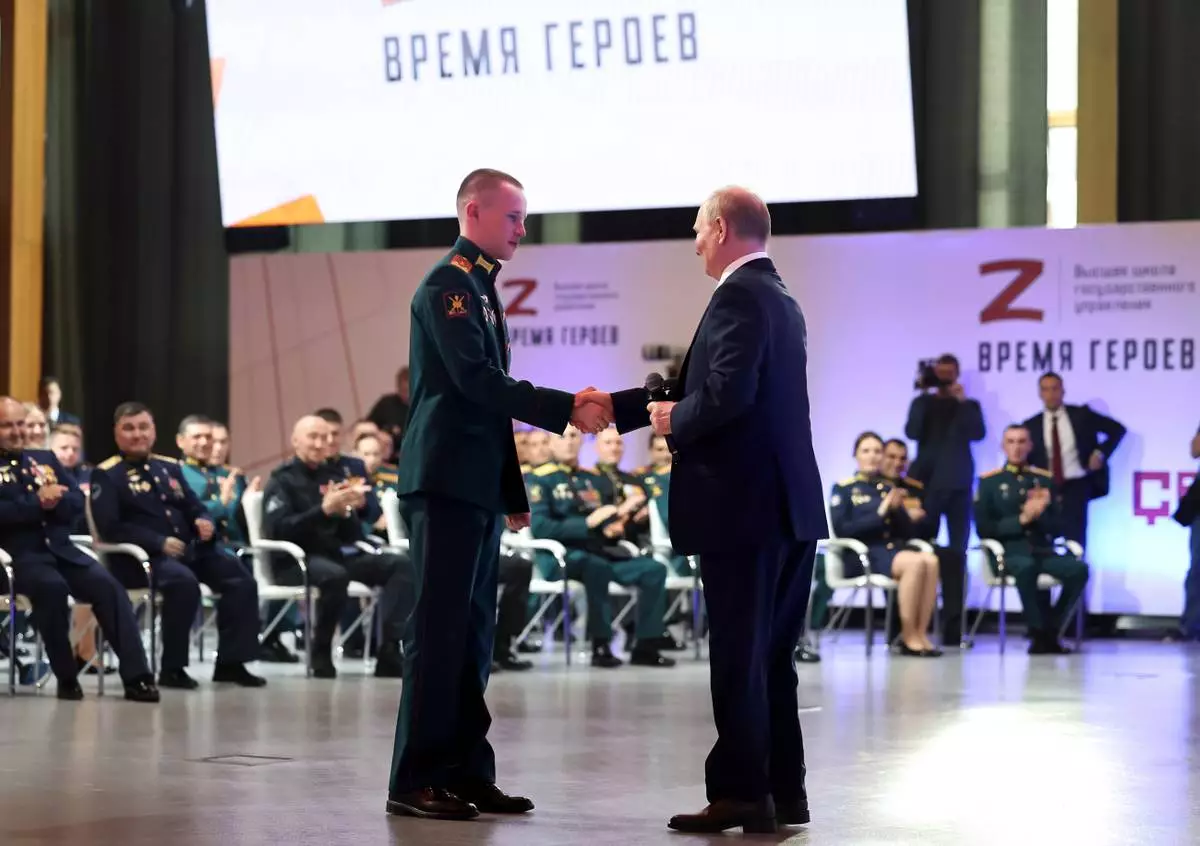
FILE - Russian President Vladimir Putin, right, congratulates Stepan Belov, who was named a Hero of Russia, during a meeting with participants of the "Time of Heroes" project designed to help veterans become government administrators, at a venue outside Solnechnogorsk, Russia, on Friday, June 14, 2024. (Alexander Kazakov, Sputnik, Kremlin Pool Photo via AP)
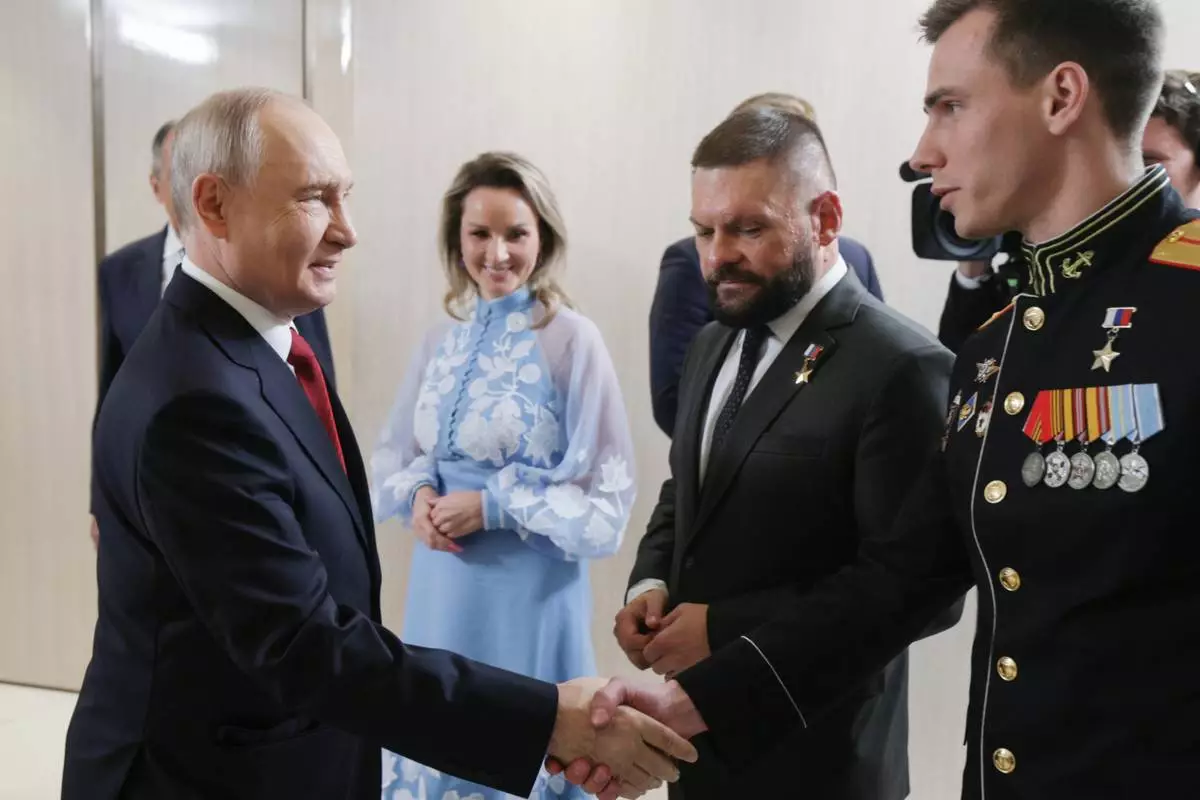
FILE - Russian President Vladimir Putin, left, greets Vladislav Golovin, right, during a meeting with the leaders of the United Russia political party as Presidential Commissioner for Children's Rights Maria Lvova-Belova, center, and military correspondent Yevgeny Poddubny, second right, in Moscow on Saturday, Sept. 5, 2026. (Gavriil Grigorov/Sputnik, Kremlin Pool Photo via AP, File)