THE HAGUE, Netherlands (AP) — Former Philippine President Rodrigo Duterte is due to make his first public appearance in more than a year on Wednesday, after the presiding judge in his case at the International Criminal Court in the Netherlands said she expected the 81-year-old to attend a pretrial hearing.
Duterte, who is facing charges of crimes against humanity, has missed a series of hearings since his arrest last year. Medical reasons were cited for his absence but the court's judges ruled in January that he was healthy enough to stand trial.
Duterte's charges stem from his alleged involvement in dozens of killings as part of his so-called war on drugs while in office, first as the mayor of a southern city in the Philippines and later as president. He denies the charges against him.
“We would expect Mr. Duterte to be here unless there’s some medical issue,” Judge Joanna Korner said during a pre-trial hearing in June.
Wednesday's hearing is to discuss evidence disclosure and come up with a timetable for the trial, which will open in November.
“He’s fully aware that you’ll expect to see him sooner rather than later,” Duterte’s lead counsel Peter Haynes told the judges during the June hearing, referring to his client.
Duterte was arrested in March 2025 and was set to appear in court in The Hague in September last year. However, the hearing was delayed after a pretrial panel of judges granted a “limited postponement” to give the court time to determine whether Duterte was fit enough to take part in the proceedings.
Following an assessment by a panel of medical experts, judges ruled that Duterte is “fit to take part in the pre-trial proceedings.”
The ICC has been looking into mass killings in crackdowns overseen by Duterte since 2018. Estimates of the death toll during Duterte’s presidential term vary, from the more than 6,000 that the national police have reported up to 30,000 claimed by human rights groups.
According to the prosecutors, police and government hit squads carried out dozens of killings at Duterte’s orders, motivated by the promise of money or to avoid becoming targets themselves.
A month after the court in February 2018 announced a preliminary investigation into the violent drug crackdowns, Duterte said the Philippines would withdraw from the ICC.
Last year, judges rejected a request from Duterte’s legal team to throw out the case because of the Philippine withdrawal. Countries cannot “abuse” their right to withdraw from the court’s foundational Rome Statute “by shielding persons from justice in relation to alleged crimes that are already under consideration,” the decision says.
Earlier this year, an attempt by authorities to arrest another man wanted by the ICC in connection with the drug killings dissolved into gunfire in the Philippine Senate in May. No one was hurt. The court had unsealed an arrest warrant for Ronald Marapon dela Rosa, who served as national police chief under Duterte. Dela Rosa went into hiding following the Senate standoff and remains on the run.
Two months later, the Philippine Senate, acting as an impeachment court, opened the trial of Duterte’s daughter, Vice President Sara Duterte. If convicted of the charges, which include amassing unexplained wealth and publicly threatening the family of the current president, Ferdinand Marcos Jr., she may be permanently disqualified from holding public office. She denies the charges.
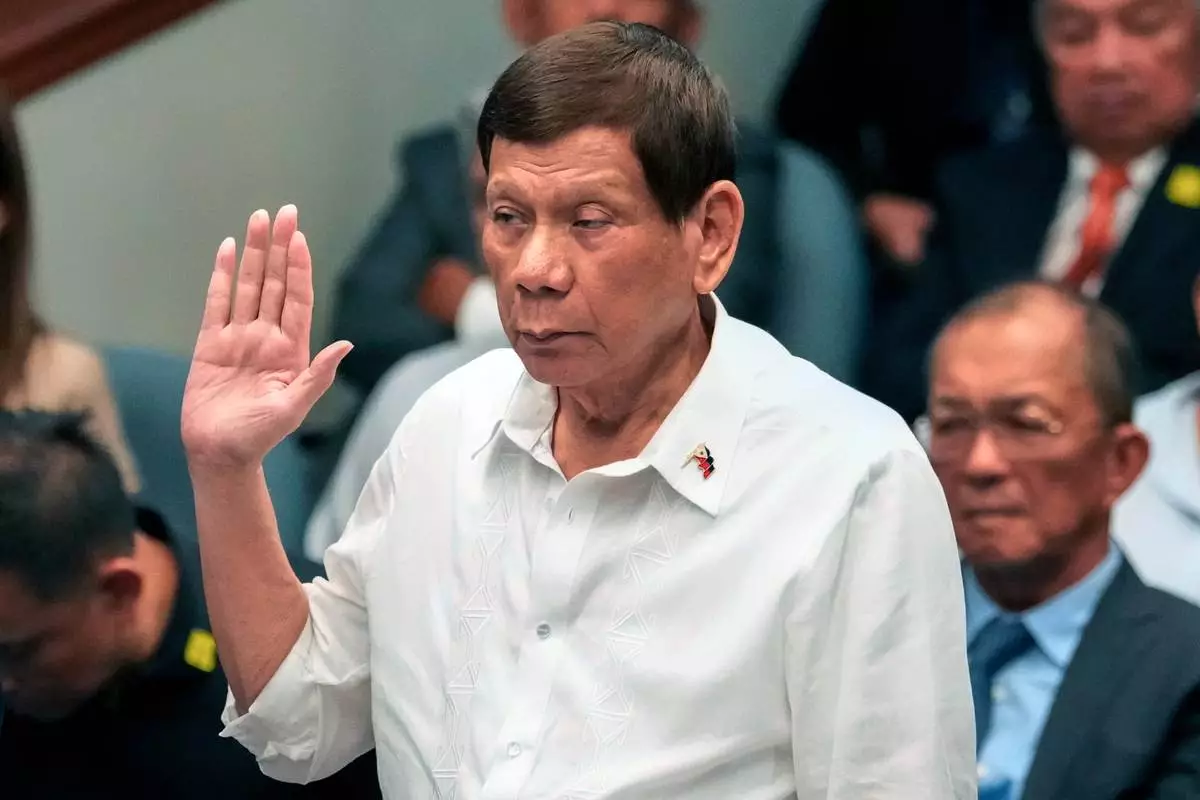
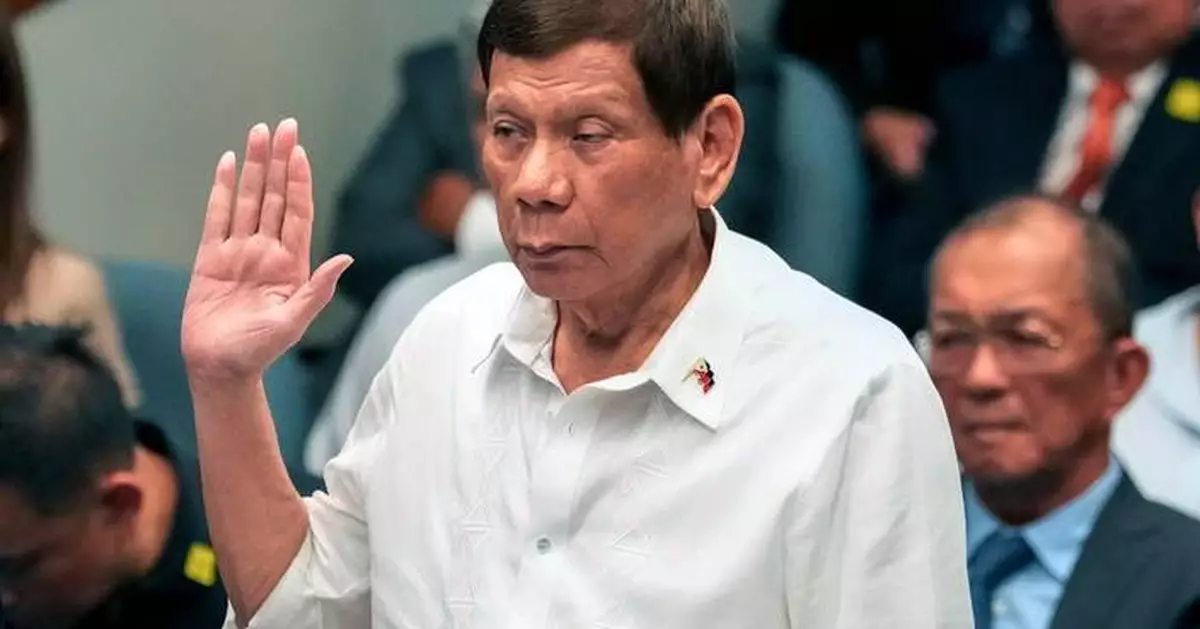
FILE - Former Philippine President Rodrigo Duterte takes oath during a senate inquiry on the so-called war on drugs during his administration at the Philippine Senate, on Oct. 28, 2024, in Manila, Philippines. (AP Photo/Aaron Favila, File)
At various times over the last decade, Saudi Arabia, the United Arab Emirates, the United States, Britain and Israel have carried out punishing air raids on Yemen's Houthi rebels — only to see them grow even stronger.
Now, as the Iran-backed Houthis advance on a key maritime chokepoint and strike Saudi oil facilities, rattling world markets, there is little that can be done to stop them that hasn't been tried before.
That's because the Houthis operate in a large and mountainous territory where they can disperse fighters and military infrastructure while threatening major oil infrastructure and key trade routes. Iran and its allies in Lebanon and Iraq provide expertise, training and sophisticated weapons, according to U.N. and other experts, and the Houthis' hard-line ideology does the rest.
“They are the most committed, the most ideologically pure and the most aggressive” of Iran's regional allies, says Michael Knights, who has written extensively about the Houthis and is now head of research at Horizon Engage, a New York-based strategic advisory.
“They’ve been developed by the Iranians in a fast-track way. Things that took the Lebanese Hezbollah 20 years to develop, the Houthis have developed in five.”
The Houthis have a wide array of ballistic missiles, cruise missiles and drones — many resembling Iranian models — that can reach all the Gulf states as well as Israel. They have also used sophisticated anti-ship missiles and naval drones to strike vessels in the Red Sea, threatening a critical trade route.
Iran denies arming the Houthis, which would violate a U.N. embargo. But smuggled Iranian weapons and parts have been seized from numerous shipments bound for Yemen, and a report by U.N. experts in 2024 documented extensive military ties between the Houthis, Iran and its other allies.
That report estimated that the Houthis had recruited up to 350,000 fighters by 2024, up from just 30,000 in 2015, when Saudi Arabia intervened in Yemen's civil war against the Houthis and imposed a naval blockade.
The Houthis can use relatively inexpensive drones and missiles to target oil and other infrastructure just across the border in Saudi Arabia, as well as tankers off the coast. And while Iran is believed to supply cutting-edge components like guidance systems, the Houthis can manufacture much of their weaponry domestically.
Saudi Arabia boasts an array of U.S.-supplied weapons, including sophisticated aircraft as well as advanced missile defenses used against Iran at the height of the war last spring.
But with supplies of high-end interceptors under pressure, it's unclear how long it can ward off attacks — not only from the Houthis, but from Iran-backed militias in Iraq blamed for an attack that shut down an east-west pipeline crucial for oil exports.
Saudi Arabia went to war against the Houthis in early 2015, after the rebels seized much of northern and central Yemen, including the capital, Sanaa, from Yemen's internationally recognized government. Even then, the Saudis feared the growth of a well-armed Iranian proxy on their border.
Over the next seven years, Saudi Arabia carried out waves of airstrikes against the Houthis, often killing civilians. An array of Yemeni government forces and southern separatists struggled to push the Houthis back, and the battle lines moved little before a 2022 ceasefire.
The following year, after the outbreak of the war in Gaza, the Houthis began attacking Red Sea shipping in what they said was a blockade of Israel. The U.S. and the U.K. launched waves of strikes against the Houthis beginning in January 2024.
The following year, U.S. President Donald Trump ordered an intensified air campaign, with some 2,000 munitions dropped on over 1,000 targets, a U.S. military official told The Associated Press at the time.
The cost of the U.S. munitions alone totaled more than $750 million, while the Houthis destroyed seven U.S. MQ-9 Reaper drones, at a cost of more than $30 million apiece. An over $60 million F/A-18 fighter jet slid off an aircraft carrier.
After weeks of U.S. strikes, the Houthis agreed to stop attacking American ships. But they continued to target Israel, which responded with its own strikes later in 2025, killing the Houthi prime minister along with other senior officials and repeatedly hitting a key port.
The Houthis largely kept to the sidelines in the first several months of the Iran war, but in July, they resumed attacks on Saudi Arabia and declared a blockade on Saudi shipping.
As recent conflicts have shown, air power is rarely effective without ground troops who can move in and seize territory after strikes.
In the case of Yemen, the ground fighters opposed to the Houthis are deeply divided and fought each other as recently as January. They include fighters loyal to the Saudi-backed government and southern separatists supported by the United Arab Emirates — a sometimes rival to the Saudis that withdrew from Yemen in 2019.
“Half of the story is Iranian support, and this is extremely important ... but there’s another half of the story, which is the weakness of their adversaries,” said Thomas Juneau, a professor of international affairs at the University of Ottawa specializing in Iran and Yemen.
“(Yemen's) internationally recognized government is fragmented, it's weak, it's disunited, it's corrupt, and the Houthis have systematically been able to exploit that,” he said.
In recent weeks, anti-Houthi forces have fallen back from one position after another as the rebels have advanced toward the Bab el-Mandeb, a narrow strait between the Red Sea and the Gulf of Aden.
The Saudis appear reluctant to enter another full-scale war with the Houthis. A ground campaign would involve prolonged fighting and high casualties. The U.S., still preoccupied with Iran, also appears keen to stay out. A Saudi mutual defense pact with Turkey and Pakistan signed last month has yet to be activated.
The diplomatic options are also limited. The Houthis are demanding that Saudi Arabia lift its blockade, which would be an admission of defeat in the long-running war and pave the way for even more extensive Iranian aid to the rebels.
“As long as U.S.-Iran tensions are not resolved, there will not be significant progress between Saudi Arabia and Iran,” Juneau said. “The Houthis are in a very intransigent mood right now, and they are absolutely not ready to make any kind of concessions.”
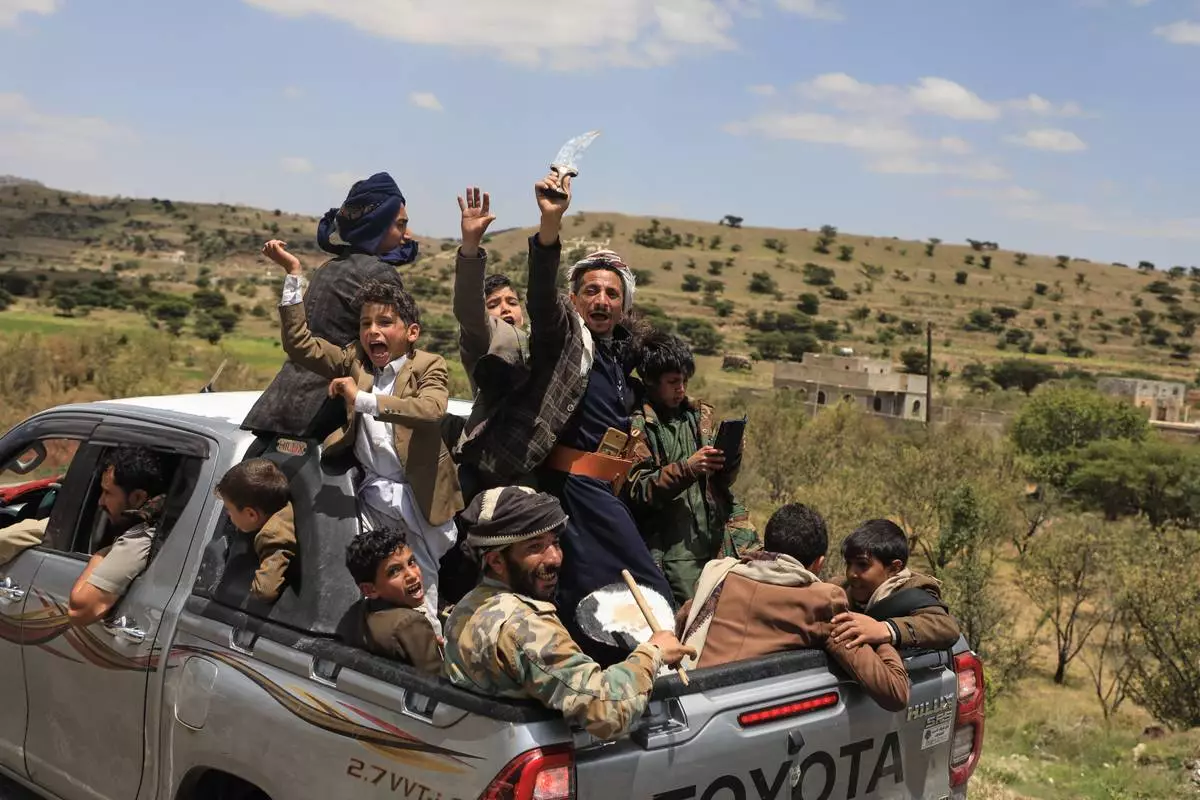
Yemeni civilians celebrate while riding in the back of a pickup truck in the Bani Matar district, Yemen, Saturday, Sept. 12, 2026, as they follow a convoy carrying Houthi prisoners freed in Mokha on its way to Sanaa following the Houthi takeover of the southern Red Sea port city. (AP Photo/STR)