Skip to Content Facebook Feature Image

Egypt's wind power push, tied to manufacturing, offers lessons for Nigeria and Africa

News

Egypt's wind power push, tied to manufacturing, offers lessons for Nigeria and Africa
News

News

Egypt's wind power push, tied to manufacturing, offers lessons for Nigeria and Africa

2026-09-16 13:13 Last Updated At:13:30

NAIROBI, Kenya (AP) — Egypt is betting that building wind turbines at home can help it build a renewable-energy industry, positioning it as a template for Africa’s push for renewable-energy industrialization.

The country signed a deal with China’s SANY Renewable Energy to develop a 2,000-megawatt wind project in the Gulf of Suez alongside Egypt’s first wind turbine manufacturing plant. The project is expected to connect to the national grid within 23 months of final agreements, while the factory is intended to supply Egypt and potentially export equipment across Africa and the Middle East.

Even though Egypt’s project is still in its early stages, energy experts say its emphasis on scale, local manufacturing and technology transfer could offer lessons for other African countries struggling to turn renewable-energy ambitions into functioning infrastructure.

That includes a project in Nigeria, where a 10-megawatt wind farm took nearly two decades to begin producing electricity. The difference highlights a broader challenge for Africa’s renewable-energy push: how to move beyond importing equipment and announcing projects to building the financing, industrial capacity and policy stability needed to deliver them at scale.

“The contrasts are stark,” said Fadhel Kaboub, an associate professor of economics at Ohio's Denison University. “We have a project in Nigeria that took two decades to come online, whereas we have this one project in Egypt that looks like it’s going to really take off.”

Kaboub cautioned that Egypt’s deal is not yet proof of success. But its combination of scale, manufacturing and a Chinese technology partner could give it a better chance of attracting investment and coming to fruition quickly, he said.

“For manufacturing anything to be profitable, efficient and successful, you need economies of scale,” he said. “The problem with every African country is that our internal markets are too small. We don’t have the economies of scale to industrialize one country at a time.”

Egypt’s plan is part of a broader effort to localize renewable energy technology, increase local content, and leverage the country’s trade links to export equipment. The government has said the factory will help reduce reliance on imported equipment while building an industrial base around renewable energy.

That ambition comes with risks.

Kaboub said Egypt needs to ensure that cooperation with SANY results in meaningful technology transfer rather than simply creating another form of dependence on foreign manufacturers.

“If the Chinese partner fully retains control over the technology and there’s really no transfer of technology, then we’re looking at another cycle of dependence,” he said.

Nigeria’s experience illustrates how project design can be as important as the technology itself.

The 10-megawatt Lambar Rimi wind farm in Katsina state was contracted to the French wind turbine manufacturer Vergnet in 2010, with completion scheduled for 2012. The project was funded by the Japan International Cooperation Agency and was designed to use 37 turbines rated at 275 kilowatts each.

The project stalled for years before being taken over by the Katsina state government. It was eventually commissioned in September 2025 after the state added 10 megawatts of solar capacity.

Dr Dola Oluteye, founder of the PATNA Initiative and a senior fellow in energy and transport policy at University College London’s Bartlett School of Environment, Energy and Resources, said the comparison should not be framed simply as Nigeria’s failure versus Egypt’s success.

“The useful question is what Egypt has built into its project structure that Nigeria left unresolved for years,” Oluteye said. “The cost of capital is the binding constraint, not the resource.”

The International Energy Agency says the cost of capital for utility-scale clean-energy projects in Africa is at least two to three times higher than in advanced economies and China. Africa attracts around 2% of global clean-energy spending despite accounting for about one-fifth of the world’s population.

Oluteye said Egypt’s decision to structure the new wind project in local currency is particularly significant because it reduces the currency mismatch that can undermine African power projects that are financed in dollars but earn revenue in local currencies.

The industrial component could also change the economics and politics of future projects.

“While Nigeria purchased 37 turbines, Egypt is attempting to buy the capability to make them,” Oluteye said.

African countries could use their collective market to negotiate better terms from technology providers, including requirements for local manufacturing and technology transfer.

“If we form a negotiating bloc with a joint industrial policy, we can probably get better terms for technology transfer and joint ventures that could transform the continent at scale,” Kaboub said.

For Nigeria, the challenge is therefore not simply finding more wind.

“If something is new, especially in Africa, you want to pilot it first,” Kaboub said, adding that stronger feasibility studies, affordable financing, clearer project ownership and policy continuity are critical.

“The implementation of policy is what is critical, not the fact that you have 50 policies on your website or in your government documents,” he said.

The Associated Press’ climate and environmental coverage receives financial support from multiple private foundations. AP is solely responsible for all content. Find AP’s standards for working with philanthropies, a list of supporters and funded coverage areas at AP.org.
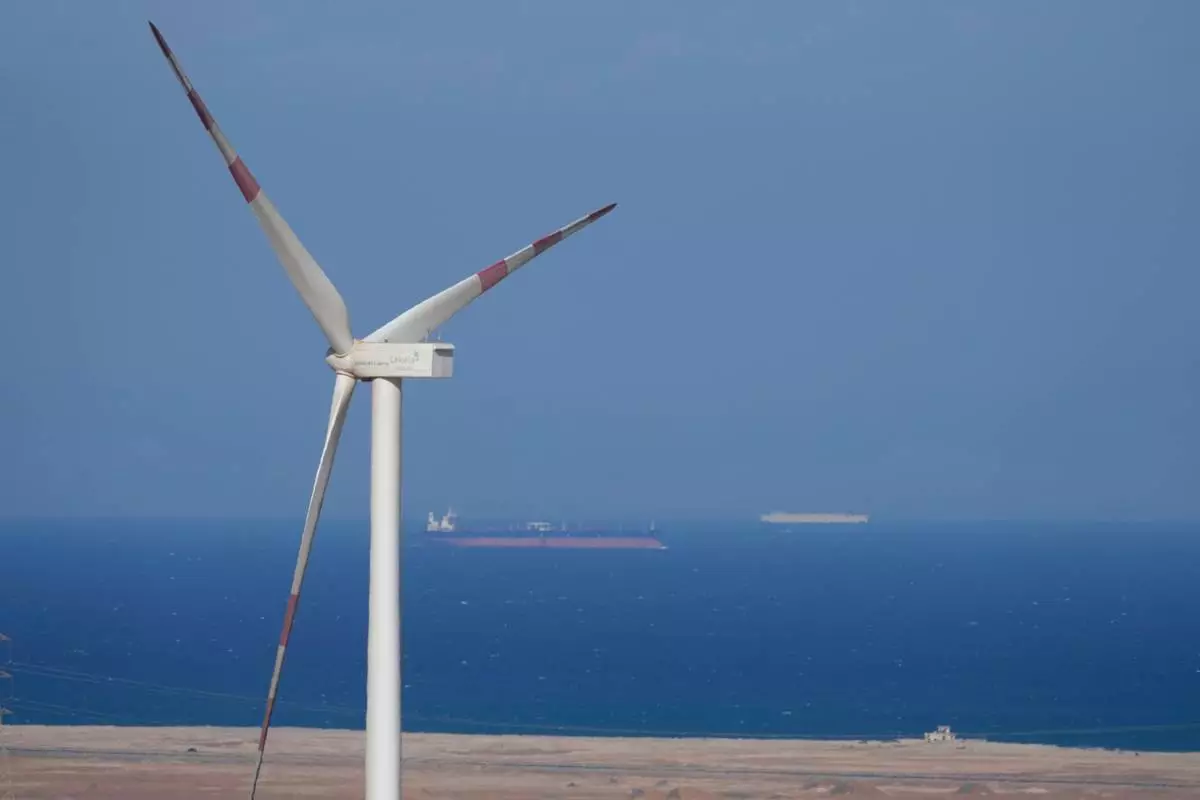
FILE - Cargo ships sail past Lekela wind power station near the Red Sea city of Ras Ghareb, Egypt, Oct. 12, 2022. (AP Photo/Amr Nabil, File)

FILE - Cargo ships sail past Lekela wind power station near the Red Sea city of Ras Ghareb, Egypt, Oct. 12, 2022. (AP Photo/Amr Nabil, File)

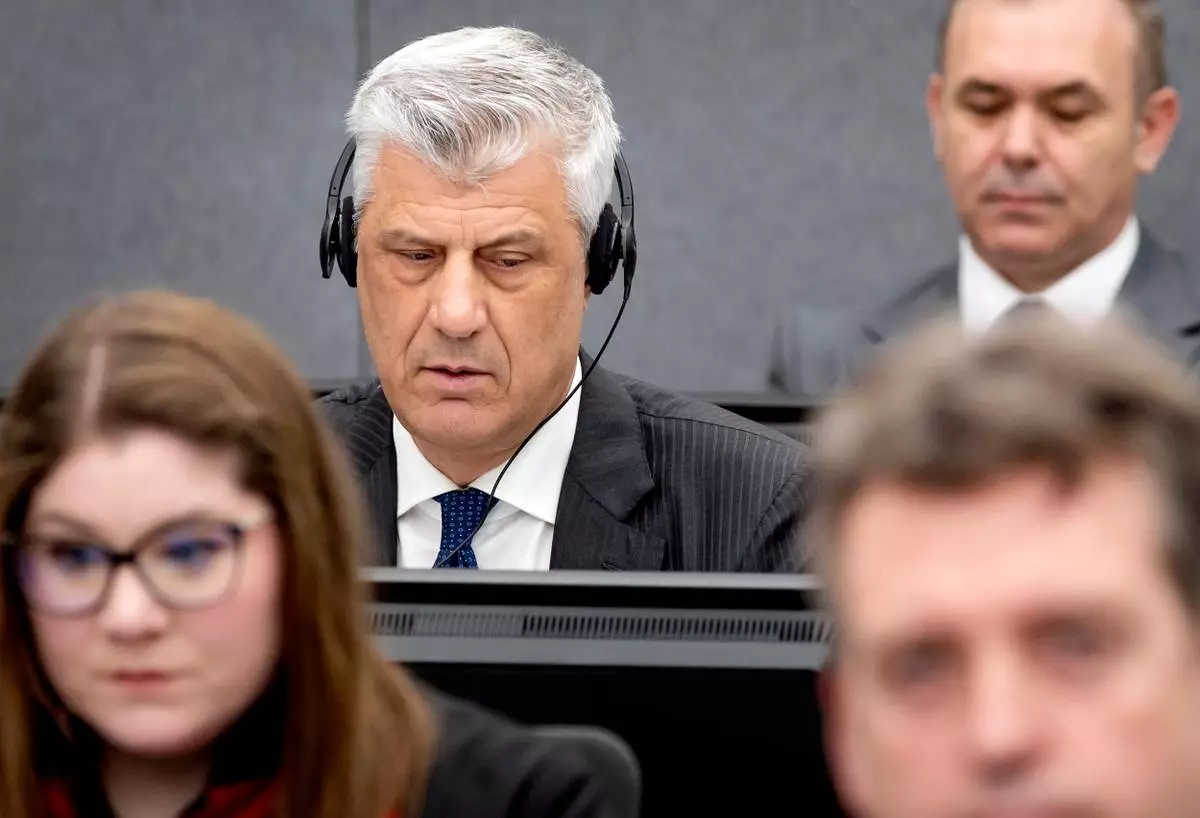
THE HAGUE, Netherlands (AP) — Former Kosovo President Hashim Thaci will learn his fate Wednesday when international judges at a court in The Hague deliver verdicts in his war crimes trial.

Thaci is facing multiple counts of war crimes and crimes against humanity including murder, torture and persecution alongside three other former leaders of the Kosovo Liberation Army who fought Serb forces in the 1998-99 war. They are widely regarded as national heroes in their homeland.

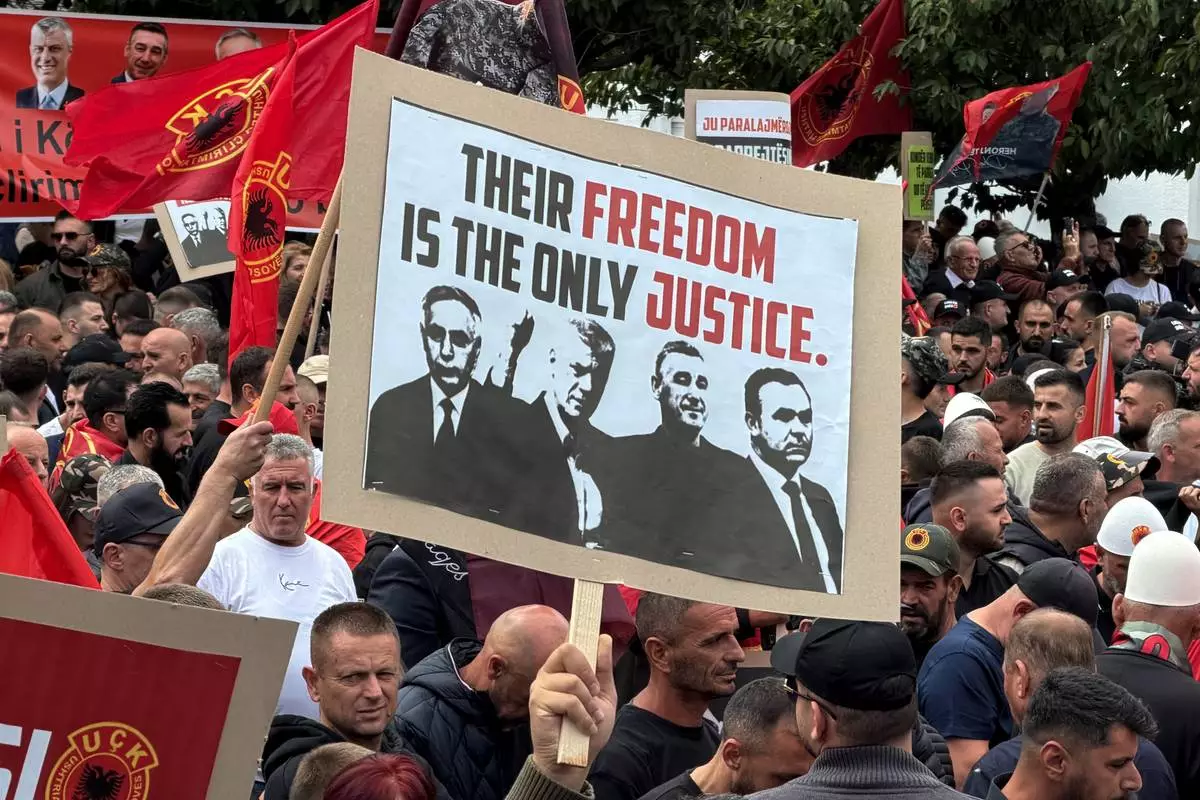
Thousands of people rallied in Pristina over the weekend in support of the four men. The protesters filled a central square in the capital, many carrying red and black Albanian flags.

Portraits of the four former KLA fighters have been plastered across the city along with a huge digital clock counting down to Wednesday's verdicts.

“In the name of the people, declare them innocent," one banner read.

Prosecutors at the Kosovo Specialist Chambers court in The Hague have asked for a maximum 45-year prison sentence for Thaci and the other defendants, Kadri Veseli, Rexhep Selimi and Jakup Krasniqi. They have all denied the charges against them.

“Throughout my life, I stood with the people of Kosovo defending freedom, life and dignity. I was always guided by the Western ideals of democracy, equality and justice,” Thaci told judges in February at the end of his nearly three-year trial.

According to prosecutors, the men targeted political opponents and civilians perceived as collaborators and traitors during their time in the KLA.

The staff at the European Union-backed court are largely international due to fears about witness safety and security. In 2022, the court convicted two leaders of a Kosovo war veterans’ association for intimidating witnesses by publicizing leaked confidential documents.

Thaci also faces a separate trial on charges of intimidating witnesses that will begin later this month.

He was a student who returned from what he described as political exile in Switzerland to join Kosovo’s struggle for independence. He earned the nickname “the Snake” for his ability to evade Serb forces during the conflict.

He was embraced by Western leaders, who invited him to the 1999 peace talks in France in his role as political director of the Kosovo Liberation Army, and was seen as a leader who could guide the country toward independence.

Thaci rose to political power after the war but resigned as president to defend himself before the court in The Hague.

Most of the 13,000 people who died in the war in Kosovo were ethnic Albanians. A 78-day campaign of NATO airstrikes against Serbian forces ended the fighting. About 1 million ethnic Albanian Kosovars were driven from their homes.

In 2008, Kosovo declared its independence from Serbia, a move that Belgrade refuses to recognize. Ties between Kosovo and Serbia remain tense, despite years of negotiations mediated by the European Union and supported by the United States.

Associated Press reporter Molly Quell contributed to this report.

People rally in Pristina, Kosovo, Saturday, Sept. 12, 2026, in support of the former president Hashim Thaci and the other defendants, Kadri Veseli, Rexhep Selimi and Jakup Krasniqi ahead of their verdicts next week at a Netherlands-based court which tried them for alleged war crimes during a 1998-1999 separatist war from Serbia. (AP Photo/Zana Cimili)

People rally in Pristina, Kosovo, Saturday, Sept. 12, 2026, in support of the former president Hashim Thaci and the other defendants, Kadri Veseli, Rexhep Selimi and Jakup Krasniqi ahead of their verdicts next week at a Netherlands-based court which tried them for alleged war crimes during a 1998-1999 separatist war from Serbia. (AP Photo/Zana Cimili)

People rally in Pristina, Kosovo, Saturday, Sept. 12, 2026, in support of the former president Hashim Thaci and the other defendants, Kadri Veseli, Rexhep Selimi and Jakup Krasniqi ahead of their verdicts next week at a Netherlands-based court which tried them for alleged war crimes during a 1998-1999 separatist war from Serbia. (AP Photo/Zana Cimili) ADDITION: adds the names of the former president Hashim Thaci and the other defendants, Kadri Veseli, Rexhep Selimi and Jakup Krasniqi

People rally in Pristina, Kosovo, Saturday, Sept. 12, 2026, in support of the former president Hashim Thaci and the other defendants, Kadri Veseli, Rexhep Selimi and Jakup Krasniqi ahead of their verdicts next week at a Netherlands-based court which tried them for alleged war crimes during a 1998-1999 separatist war from Serbia. (AP Photo/Zana Cimili) ADDITION: adds the names of the former president Hashim Thaci and the other defendants, Kadri Veseli, Rexhep Selimi and Jakup Krasniqi

People rally in Pristina, Kosovo, Saturday, Sept. 12, 2026, in support of the former president Hashim Thaci and the other defendants, Kadri Veseli, Rexhep Selimi and Jakup Krasniqi ahead of their verdicts next week at a Netherlands-based court which tried them for alleged war crimes during a 1998-1999 separatist war from Serbia. (AP Photo/Zana Cimili)

People rally in Pristina, Kosovo, Saturday, Sept. 12, 2026, in support of the former president Hashim Thaci and the other defendants, Kadri Veseli, Rexhep Selimi and Jakup Krasniqi ahead of their verdicts next week at a Netherlands-based court which tried them for alleged war crimes during a 1998-1999 separatist war from Serbia. (AP Photo/Zana Cimili)

FILE - Former Kosovo president Hashim Thaci, top left, appears before the Kosovo Tribunal as he defends himself against charges including murder, torture and persecution allegedly committed during his country's war for independence from Serbia in the Hague, on April 3, 2023. (Koen van Weel/Pool via AP, File)

FILE - Former Kosovo president Hashim Thaci, top left, appears before the Kosovo Tribunal as he defends himself against charges including murder, torture and persecution allegedly committed during his country's war for independence from Serbia in the Hague, on April 3, 2023. (Koen van Weel/Pool via AP, File)

Recommended Articles