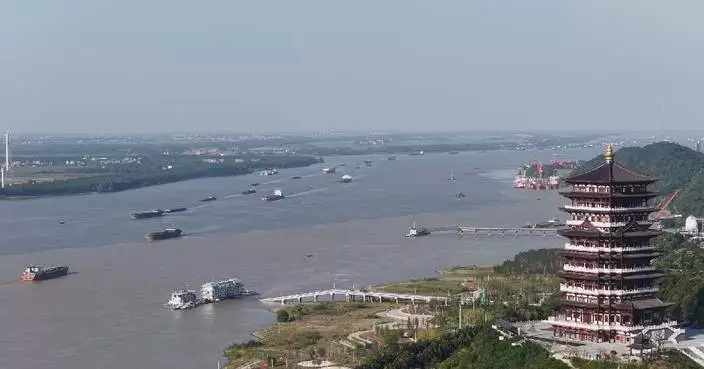
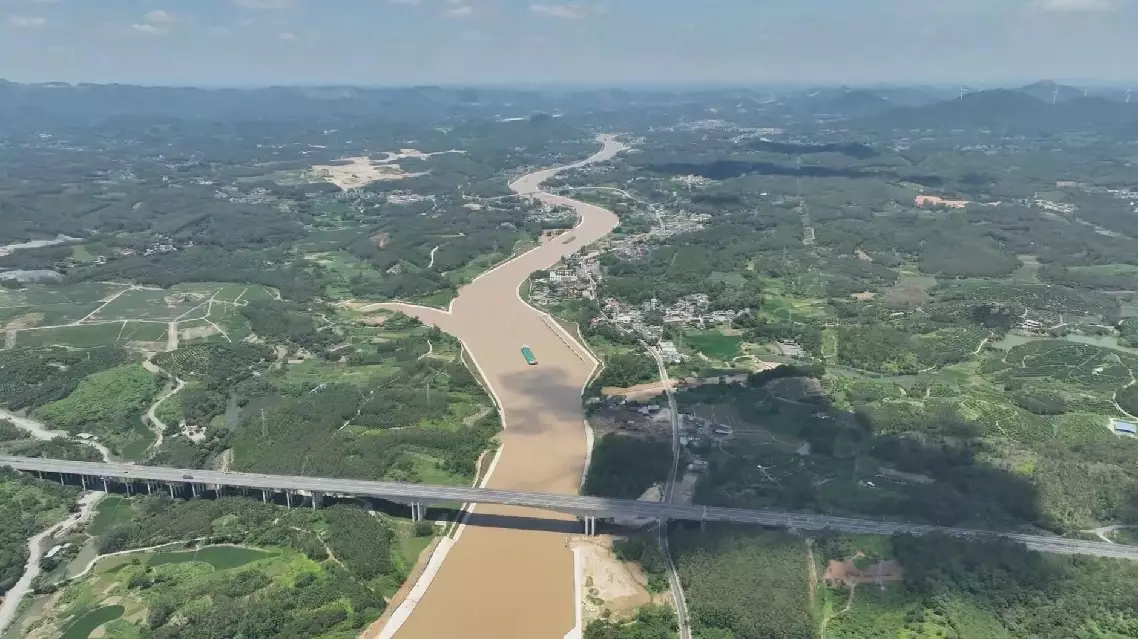
The newly opened Pinglu Canal is set to transform southwest China's trade with the Association of Southeast Asian Nations (ASEAN) members, offering a direct and smarter water route for goods.
China opened the Pinglu Canal on Wednesday, giving its landlocked southwest a shortcut to the coast and overseas markets, particularly those in the Association of Southeast Asian Nations (ASEAN), the country's largest trading partner.
Built at a cost of 72.7 billion yuan (about 10.75 billion U.S. dollars), the 134.2-kilometer canal runs from Nanning, capital of south China's Guangxi Zhuang Autonomous Region, to the Beibu Gulf, the closest maritime outlet for much of southwest China.
The canal stretches along the New International Land-Sea Trade Corridor, a strategic trade route connecting China's inland regions with ASEAN and other global markets. It is the first river-to-sea canal project planned and coordinated at the national level since the founding of the People's Republic of China in 1949.
Designed for vessels of up to 5,000 tonnes, the canal shortens the inland waterway journey for goods from southwest China to the sea by more than 560 kilometers compared with traditional routes through ports in Guangdong Province. It is expected to reduce overall logistics costs by 18 to 30 percent and save more than 5 billion yuan in transportation costs each year.
After opening to navigation, the Pinglu Canal creates two major sea routes - one longitudinal, one lateral - dramatically shortening the distance to ASEAN. The canal cuts transport distance by 560 kilometers and serves as a vital artery for economic exchange.
Since the Pinglu Canal just opened to navigation, on the integrated intelligent dispatch platform for rivers, waterways, and the sea, management personnel can now view in real time the positioning and number of vessels across all waterways and ports in Guangxi, while also conducting real-time vessel dispatch and tracking.
"The platform breaks down information barriers across departments and regions. With just one click, we merge data from ports, locks, shipping, maritime and meteorological sources. AI-powered scheduling now achieves precise coordination between vessels, ports, locks, and cargo," said Lyu Yingying, director of the Water Transport Office at Guangxi Transport Department.
Looking ahead, Guangxi's transport authorities will accelerate the construction of water transport infrastructure and promote the digital and intelligent transformation and upgrading of the region's waterway transport.
"We will accelerate the development of a multimodal water transport system with the Pinglu Canal as a key driver, comprehensively enhance the capacity of the Beibu Gulf international hub seaport, speed up the completion of key 'bottleneck' projects such as the Baise Water Conservancy Hub navigation facilities connecting Yunnan and the Longtan ship lift connecting Guizhou, and accelerate the improvement of the new western land-sea corridor with efficient connectivity among rail, road, and water transport," said Lyu.
Pinglu Canal helps supercharge southwest China-ASEAN trade