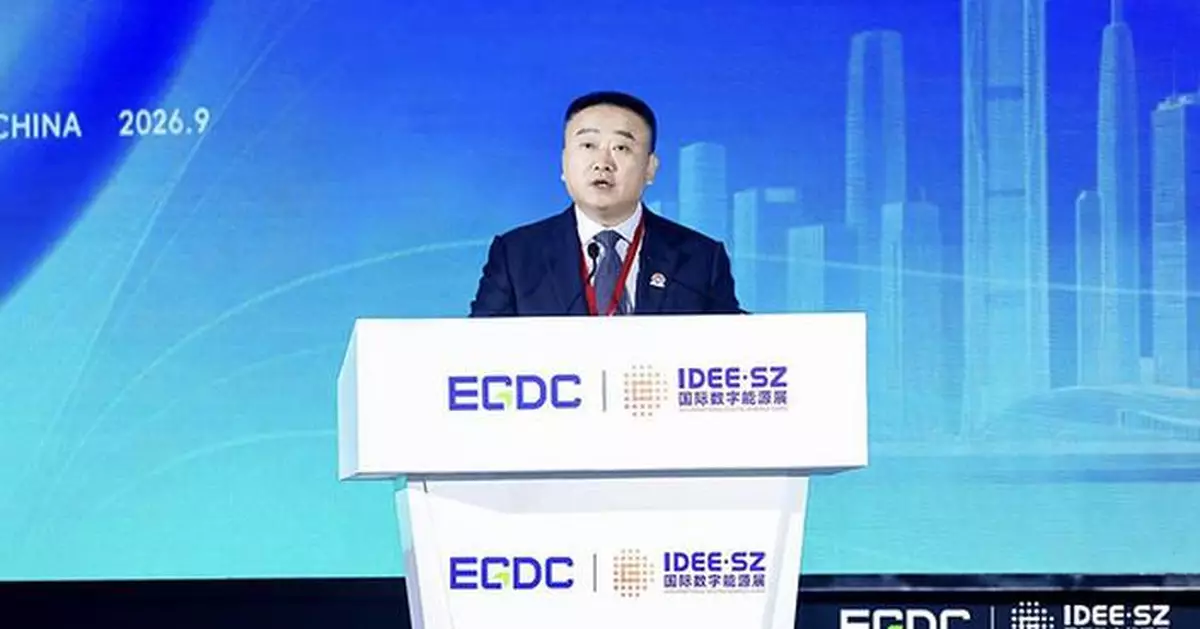
SHENZHEN, China, Sept. 17, 2026 /PRNewswire/ -- The Green Energy Development Conference & International Digital Energy Expo 2026, kicked off in Shenzhen. Zhou Jianjun, Vice President of Huawei and President of Global Marketing, Sales and Services, Huawei Digital Power, attended the opening ceremony and unveiled Huawei's grid-interactive AI data center (AIDC) solution during the key industry achievement release session. This solution aims to tackle the new challenges of power acquisition, high-density power supply, high-density heat dissipation, and complex delivery, operation, and maintenance in AIDC construction during the AI era, by leveraging system-level compute-electricity synergy to maximize tokens per watt.
The Token Factory Era: Compute and Power Deeply Coupled
The global AI industry is rapidly accelerating from R&D to large-scale deployment. The fast iteration of large models and the surging demand for AI applications are driving exponential growth in token consumption. As the basic unit for invoking, consuming, and billing AI services, tokens are becoming increasingly valuable. Major global tech companies, operators, cloud service providers, and energy enterprises are ramping up investments in AI infrastructure. AIDC campuses are scaling from traditional megawatts to hundreds of megawatts or even gigawatts. Power acquisition, power supply and cooling in high-density compute scenarios, delivery, operation, and maintenance capabilities, and construction speed have become new challenges for AIDC construction.
Zhou Jianjun stated: "Electricity is essential for computing. Today, in the AI era, the startup, shutdown, and load fluctuations of a large AIDC campus can all impact grid operations." He emphasized that as the penetration of renewable energy continues to rise, the power grid itself is also evolving, with local grid strength declining and volatility and uncertainty increasing. Future AIDCs must not only adapt to weak grids and maintain stable operation during grid fluctuations, but also support the grid and become a key "grid-friendly" node. Therefore, the integration of generation, grid, load, and storage has become an inevitable choice for AIDC development.
"3+1" Redefining a System-Level Grid-Interactive AIDC Solution
Huawei proposes a "3+1" system redefinition across three domains—Watt (electricity), Bit (digital), and Heat (thermal)—along with the construction model, to build a grid-interactive AIDC solution.
The core of the redefinition is as follows:
Watt (electricity): Shifting from stable power consumption to supporting the power grid.
On the generation-grid-storage side, Huawei enhances the AIDC facility's adaptability to weak power grids and large load fluctuations through grid-forming control and energy storage synergy. The industry's first 1000 V grid-forming inverter FusionSolar series and the world's first 1000 V Smart String Grid Forming ESS Platform LUTERRA, both launched by Huawei, have significantly boosted the grid-forming capability of renewable energy. On the load side, Huawei builds an integrated grid-forming energy router based on the solid-state transformer (SST) technology. Moreover, Huawei has become the first vendor in the industry to pass the wideband oscillation damping test conducted by Shanghai Electrical Apparatus Research Institute, driving UPS in the AIDC era to evolve from "reliable power supply" to "grid-friendly."
Heat (thermal): from "reliability of individual components" to "reliability of the entire system."
The key to AIDC liquid cooling is not just cooling, but controllability; not just the reliability of individual components, but the reliability of the entire system from chips to cooling sources. Huawei's Thermal Management Unit (TMU) and AI-enabled MW-level liquid cooling system provide a paradigm for highly reliable cooling in the AIDC industry.
Bit (digital): from "passive operation and maintenance" to "proactive sensing."
AI capabilities are leveraged to redefine operations, enabling AIDC to achieve proactive sensing, optimization, and protection.
Construction model: from "traditional engineering" to "productization and prefabrication."
AIDC can no longer rely entirely on traditional engineering methods. Through productization, prefabrication, and modularization, Huawei shifts complexity to the factory, leave simplicity to customers, and speed up compute rollout.
System-Level Innovation for the Next-Generation AIDC
Huawei's grid-interactive AIDC solution is not a single product-level innovation, but an end-to-end solution built on system-level innovation. Its core value is clear and compelling: ensuring stable operation of high-value computing power with high reliability, generating more tokens per watt with high energy efficiency, enabling faster rollout of computing power with fast delivery, and supporting the power grid with grid-friendly features despite being a large load.
Zhou Jianjun said, "AI is opening up a new era of industry. In response to the opportunities brought by the AIDC industry transformation, Huawei deeply integrates digital technology, power electronics, thermal management, and energy storage management, and focuses on the new power system and core fields of AIDC to build comprehensive capabilities in renewable energy generation, grid forming and grid connection, power supply for high-density compute, liquid cooling, and compute-electricity synergy. Huawei is willing to work with global customers and partners to drive the AIDC industry toward high-quality, sustainable, and innovative development, enabling each watt to produce more tokens and powering the AI era forward."
** This press release is distributed by PR Newswire through automated distribution system, for which the client assumes full responsibility. **
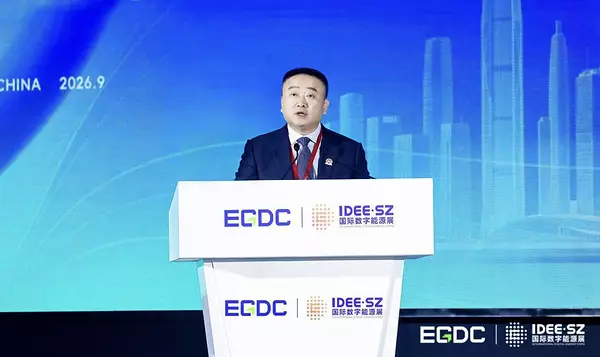
Zhou Jianjun from Huawei: Building a Grid-Interactive AIDC Solution to Maximize Tokens Per Watt
New innovation hub accelerates AI commercialization through research, engineering expertise and global supply chain support
HONG KONG, Sept. 17, 2026 /PRNewswire/ -- Avnet (NASDAQ: AVT), a leading global technology distributor and solutions provider, today joined The University of Hong Kong (HKU) in officially opening the Emerging Microelectronics and Ubiquitous Systems Lab (EMUS Lab), a collaborative innovation hub designed to accelerate AI hardware commercialization by connecting research, innovation, engineering expertise and global supply chain capabilities.
Located at the Data Technology Hub in Tseung Kwan O InnoPark, EMUS Lab focuses on next-generation technologies including edge AI, physical AI, robotics, high-performance computing (HPC) and emerging microelectronics. By bringing together academic research, startups and industry, the Lab provides innovators with access to engineering consultation, GPU computing resources, prototyping support, manufacturability assessments and supply chain expertise needed to transform breakthrough ideas into scalable, market-ready products. Through Avnet's broader ecosystem, including element14, an Avnet company specializing in proof-of-concept development and prototyping, innovators can access the tools, technologies and support needed in the early stages of product development, while leveraging Avnet's engineering, design chain and global supply chain expertise to accelerate the journey from prototype to production.
As AI moves beyond cloud-based models into intelligent devices, robotics and industrial systems, bringing AI into the physical world increasingly depends not only on advanced AI models, but also on the ability to engineer, manufacture and scale AI-enabled hardware. Industry analysts project strong growth in the adoption of edge AI, physical AI and intelligent autonomous systems over the coming decade¹. With its strong research ecosystem, international connectivity and proximity to the Greater Bay Area manufacturing network, Hong Kong is uniquely positioned to accelerate the commercialization of AI-enabled hardware technologies.
Arthur Chung, Vice President, Sales and Supplier Management, Asia, Avnet, said: "Building a great AI model is only the beginning. Turning AI innovation into a reliable, manufacturable and scalable product remains one of the biggest barriers to commercialization. EMUS Lab was created to help innovators bridge that gap by combining research with engineering expertise, supply chain readiness and market access, enabling them to move faster from prototype to product."
Prof. Ngai Wong, Associate Professor at the Department of Electrical and Computer Engineering at HKU Faculty of Engineering, and Director of EMUS Lab, said: "EMUS Lab was established to bridge the gap between cutting-edge research and real-world application. By bringing together researchers, students, startups and industry partners, we are creating an environment where research excellence, engineering expertise and industry needs converge to accelerate AI and microelectronics innovation. Together with Avnet, we are helping transform research outcomes into technologies that deliver meaningful societal and economic impact."
Prior to its official opening, EMUS Lab had already demonstrated measurable impact. Research supported by Avnet-sponsored GPU infrastructure has contributed to publications in Nature family journals and presentations at leading AI conferences including ICLR and ICML, highlighting the Lab's early research impact.
The opening ceremony brought together representatives from Avnet, HKU and local universities, the broader innovation ecosystem, industry partners and the technology community for keynote presentations, a memorandum of understanding signing ceremony, laboratory tours and technology demonstrations.
Accelerating AI Innovation from Prototype to Product
One of EMUS Lab's first major industry engagement initiatives is the DfMA Launchpad for AI MMP Programme, a 12-month co-incubation programme that connects EMUS Lab, Avnet and ecosystem stakeholders to support AI startups.
The programme combines Avnet's engineering and global supply chain expertise with EMUS Lab's advanced research infrastructure and the startup ecosystem of Hong Kong Science and Technology Parks Corporation (HKSTP) to provide technical mentorship, hardware-software co-design, system validation, manufacturability guidance and industry connections, helping startups move more efficiently from prototype development to scalable production.
The programme has already attracted strong interest from the startup community, with 27 startup teams selected to participate, reflecting growing demand for practical expertise that helps accelerate the path from AI innovation to market deployment.
As AI increasingly shifts from experimentation to large-scale deployment, EMUS Lab provides a collaborative platform where academia, startups and industry partners can accelerate AI hardware innovation across healthcare, robotics, industrial automation, smart living and smart city applications. By combining world-class research, startup innovation, engineering expertise and global supply chain capabilities within a single ecosystem, the Lab helps transform breakthrough ideas into products that can be built, scaled and deployed globally, while strengthening Hong Kong's position as a leading hub for AI hardware innovation and technology commercialization.
About Avnet
As a leading global technology distributor and solutions provider, Avnet has served customers' evolving needs for more than a century. Through regional and specialised businesses around the world, we support customers and suppliers at every stage of the product lifecycle. We help companies adapt to change and accelerate the design and supply stages of product development. With a unique viewpoint from the center of the technology supply chain, Avnet is a trusted partner that solves complex design and supply chain issues so customers can realize revenue faster. Learn more about Avnet at www.avnet.com.
About HKU Faculty of Engineering
The Faculty of Engineering is one of the founding Faculties of The University of Hong Kong established in 1912. Since its foundation, the Faculty has kept pace with developments in the engineering world and aims at providing an all-round education for students, equipping graduates not only with knowledge of cutting-edge technology, but also excellent communication and social skills, an innovation mindset, a lifelong learning attitude, professional integrity and international exposure. For more information, visit https://engg.hku.hk.
¹ Source: Deloitte, The State of AI in the Enterprise 2026: The Untapped Edge. Deloitte reports growing adoption of physical AI technologies, with more than half of surveyed organizations already using physical AI and adoption expected to increase significantly over the next two years.
** This press release is distributed by PR Newswire through automated distribution system, for which the client assumes full responsibility. **
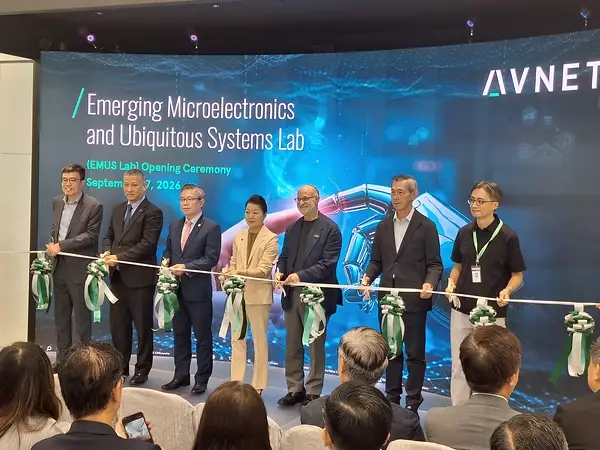
Avnet and The University of Hong Kong Open EMUS Lab to Accelerate AI Innovation and Commercialization in Hong Kong