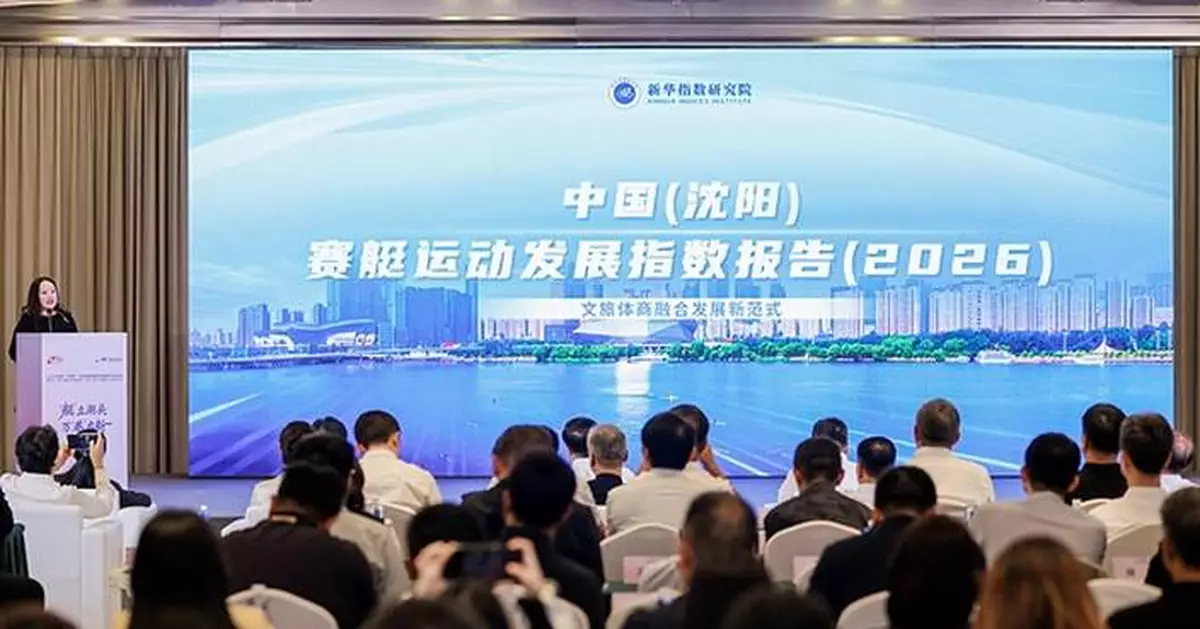
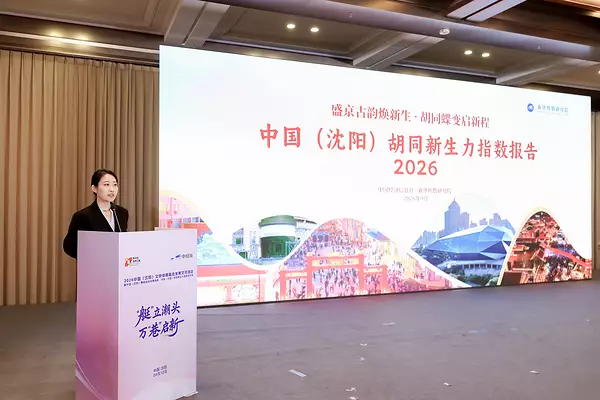
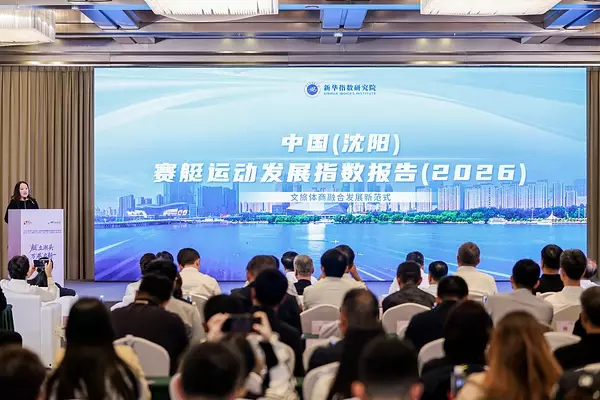
BEIJING, Sept. 17, 2026 /PRNewswire/ -- Two indices reports on development of rowing sport and hutong revitalization in Shenyang, the capital city of northeast China's Liaoning Province, have been officially launched by Xinhua Indices Institute.
The reports -- China (Shenyang) rowing development index report and China (Shenyang) hutong revitalization index report -- were released at the 2026 China (Shenyang) Exchange on Integrated Development of Culture, Tourism, Sports and Commerce held on Sept. 10 in Shenyang.
Co-hosted by the Shenyang Municipal People's Government and the Brand Work Office of Xinhua News Agency, the event brought together guests from government, industry, academia and research institutions to explore new approaches and models for the integrated development of culture, tourism, sports and commerce.
The release of the two indices places the "outward-oriented sports event economy," represented by rowing, and the "inward-oriented revitalization of existing urban assets," represented by hutongs, within the same framework, establishing an annual benchmark for the integrated development of culture, tourism, sports and commerce.
Shenyang will look outward for breakthroughs through the rowing index, leverage sports events to activate its waterfront spaces and further develop itself as a rowing capital, said a municipal official. Meanwhile, the city will tap its internal potential through the hutong index, revitalizing local old hutongs via micro-renewal work.
The city is steadily advancing toward its duo goals of becoming a "rowing capital" and a "famous historical and cultural city." To achieve these goals, Shenyang has hosted the Asian Rowing U19&U23 Championships consecutively along the Hunhe River, while the "rowing in schools" program has been rolled out across the city.
Deep in the hutongs, 67 old hutongs in the city's Fangcheng area have been renovated. Laobeishi hosted more than 6,000 performances to the public throughout the year, while the Bajing coffee alley received more than 2 million visitors annually.
Guo Linwen, deputy director of the Cultural Industries Institute of Renmin University of China, suggested that Shenyang strengthen its cultural identity, break down boundaries between different business formats and apply cutting-edge technologies to enhance immersive experiences.
He recommended using length of stay, the proportion of secondary spending and the number of overnight visitors as key indicators to evaluate project performance.
The event also featured two parallel sessions -- the "Sports +" session and the session on culture, tourism and sports empowering innovation in urban consumption scenarios.
Original link: https://en.imsilkroad.com/p/352216.html
** This press release is distributed by PR Newswire through automated distribution system, for which the client assumes full responsibility. **
Xinhua Silk Road: Two indices on rowing and hutong revitalization in Shenyang launched
Xinhua Silk Road: Two indices on rowing and hutong revitalization in Shenyang launched
New innovation hub accelerates AI commercialization through research, engineering expertise and global supply chain support
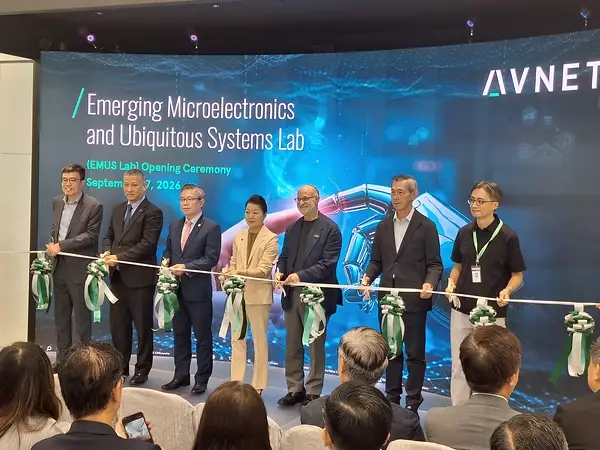
HONG KONG, Sept. 17, 2026 /PRNewswire/ -- Avnet (NASDAQ: AVT), a leading global technology distributor and solutions provider, today joined The University of Hong Kong (HKU) in officially opening the Emerging Microelectronics and Ubiquitous Systems Lab (EMUS Lab), a collaborative innovation hub designed to accelerate AI hardware commercialization by connecting research, innovation, engineering expertise and global supply chain capabilities.
Located at the Data Technology Hub in Tseung Kwan O InnoPark, EMUS Lab focuses on next-generation technologies including edge AI, physical AI, robotics, high-performance computing (HPC) and emerging microelectronics. By bringing together academic research, startups and industry, the Lab provides innovators with access to engineering consultation, GPU computing resources, prototyping support, manufacturability assessments and supply chain expertise needed to transform breakthrough ideas into scalable, market-ready products. Through Avnet's broader ecosystem, including element14, an Avnet company specializing in proof-of-concept development and prototyping, innovators can access the tools, technologies and support needed in the early stages of product development, while leveraging Avnet's engineering, design chain and global supply chain expertise to accelerate the journey from prototype to production.
As AI moves beyond cloud-based models into intelligent devices, robotics and industrial systems, bringing AI into the physical world increasingly depends not only on advanced AI models, but also on the ability to engineer, manufacture and scale AI-enabled hardware. Industry analysts project strong growth in the adoption of edge AI, physical AI and intelligent autonomous systems over the coming decade¹. With its strong research ecosystem, international connectivity and proximity to the Greater Bay Area manufacturing network, Hong Kong is uniquely positioned to accelerate the commercialization of AI-enabled hardware technologies.
Arthur Chung, Vice President, Sales and Supplier Management, Asia, Avnet, said: "Building a great AI model is only the beginning. Turning AI innovation into a reliable, manufacturable and scalable product remains one of the biggest barriers to commercialization. EMUS Lab was created to help innovators bridge that gap by combining research with engineering expertise, supply chain readiness and market access, enabling them to move faster from prototype to product."
Prof. Ngai Wong, Associate Professor at the Department of Electrical and Computer Engineering at HKU Faculty of Engineering, and Director of EMUS Lab, said: "EMUS Lab was established to bridge the gap between cutting-edge research and real-world application. By bringing together researchers, students, startups and industry partners, we are creating an environment where research excellence, engineering expertise and industry needs converge to accelerate AI and microelectronics innovation. Together with Avnet, we are helping transform research outcomes into technologies that deliver meaningful societal and economic impact."
Prior to its official opening, EMUS Lab had already demonstrated measurable impact. Research supported by Avnet-sponsored GPU infrastructure has contributed to publications in Nature family journals and presentations at leading AI conferences including ICLR and ICML, highlighting the Lab's early research impact.
The opening ceremony brought together representatives from Avnet, HKU and local universities, the broader innovation ecosystem, industry partners and the technology community for keynote presentations, a memorandum of understanding signing ceremony, laboratory tours and technology demonstrations.
Accelerating AI Innovation from Prototype to Product
One of EMUS Lab's first major industry engagement initiatives is the DfMA Launchpad for AI MMP Programme, a 12-month co-incubation programme that connects EMUS Lab, Avnet and ecosystem stakeholders to support AI startups.
The programme combines Avnet's engineering and global supply chain expertise with EMUS Lab's advanced research infrastructure and the startup ecosystem of Hong Kong Science and Technology Parks Corporation (HKSTP) to provide technical mentorship, hardware-software co-design, system validation, manufacturability guidance and industry connections, helping startups move more efficiently from prototype development to scalable production.
The programme has already attracted strong interest from the startup community, with 27 startup teams selected to participate, reflecting growing demand for practical expertise that helps accelerate the path from AI innovation to market deployment.
As AI increasingly shifts from experimentation to large-scale deployment, EMUS Lab provides a collaborative platform where academia, startups and industry partners can accelerate AI hardware innovation across healthcare, robotics, industrial automation, smart living and smart city applications. By combining world-class research, startup innovation, engineering expertise and global supply chain capabilities within a single ecosystem, the Lab helps transform breakthrough ideas into products that can be built, scaled and deployed globally, while strengthening Hong Kong's position as a leading hub for AI hardware innovation and technology commercialization.
About Avnet
As a leading global technology distributor and solutions provider, Avnet has served customers' evolving needs for more than a century. Through regional and specialised businesses around the world, we support customers and suppliers at every stage of the product lifecycle. We help companies adapt to change and accelerate the design and supply stages of product development. With a unique viewpoint from the center of the technology supply chain, Avnet is a trusted partner that solves complex design and supply chain issues so customers can realize revenue faster. Learn more about Avnet at www.avnet.com.
About HKU Faculty of Engineering
The Faculty of Engineering is one of the founding Faculties of The University of Hong Kong established in 1912. Since its foundation, the Faculty has kept pace with developments in the engineering world and aims at providing an all-round education for students, equipping graduates not only with knowledge of cutting-edge technology, but also excellent communication and social skills, an innovation mindset, a lifelong learning attitude, professional integrity and international exposure. For more information, visit https://engg.hku.hk.
¹ Source: Deloitte, The State of AI in the Enterprise 2026: The Untapped Edge. Deloitte reports growing adoption of physical AI technologies, with more than half of surveyed organizations already using physical AI and adoption expected to increase significantly over the next two years.
** This press release is distributed by PR Newswire through automated distribution system, for which the client assumes full responsibility. **
Avnet and The University of Hong Kong Open EMUS Lab to Accelerate AI Innovation and Commercialization in Hong Kong