CHICAGO--(BUSINESS WIRE)--Sep 17, 2026--
Litera, the Legal AI platform provider that best unifies the practice and business of law, announced its plugin availability within ChatGPT Enterprise, bringing Foundation Firm AI Search into ChatGPT so eligible Foundation Cloud users can query their firm’s experience data in natural language. Foundation is the growth intelligence backbone for more than 300 law firms, including seven of the eight fastest-growing Am Law 25 firms and six of the 10 firms with the highest profits per equity partner.
This press release features multimedia. View the full release here: https://www.businesswire.com/news/home/20260917666273/en/
In ChatGPT, users can ask strategic questions about what their firm knows, which experience is most relevant, and who has the right experience and relationships for a new opportunity. Responses are grounded in the Foundation records each user is permitted to access.
Litera brings 30 years of legal expertise, Foundation’s legal-specific data model, and each firm’s own governed experience and relationship records. Foundation Firm AI Search connects those strengths, meeting lawyers in ChatGPT while keeping Foundation as the source of firm intelligence.
Foundation customers use that intelligence to support more responsive client service, faster and more accurate RFP responses, and new revenue opportunities. When users need supporting records, citations, record links, or deeper workflows, they continue in Litera or Foundation.
“Frontier intelligence becomes more useful when connected to a firm's own experience and relationships,” said Grant Hewlett, VP, Product for Firm Intelligence, Litera. “OpenAI brings the reasoning. Foundation brings what a firm has done, who led the work, or how its client relationships connect. For years, many of the world’s leading law firms have relied on Foundation to organize their most strategic experience and relationship knowledge. Bringing Firm AI Search plugin in ChatGPT makes that firm intelligence accessible through a prompt, grounded in the Foundation records each user is permitted to access, so firms can put it to work on the next client opportunity.”
A lawyer responding to an RFP can ask, "Show me our most relevant pharmaceutical IP litigation experience for this RFP," and receive a response grounded in the Foundation records they are permitted to access. When the lawyer needs supporting records, citations, record links, or deeper workflows, the work continues in Litera Foundation.
Foundation Firm AI Search plugin works alongside OpenAI frontier capabilities with Litera's legal-specific data model and each firm's own governed experience and relationship records. Each eligible firm searches only its own configured Foundation environment; the capability does not expose another firm's data.
“We believe the next generation of AI for law will be built around what makes each firm distinctive - its expertise, judgment, and way of working. By building alongside Litera, we’re turning that expertise into AI lawyers can use every day, creating new ways for firms to serve their clients and shape the future of legal work.” - Jason Boehmig, GM Legal Industry at OpenAI
Foundation Firm AI Search plugin is available to eligible Foundation Cloud customers through ChatGPT, with an initial rollout to U.S.-based firms.
This announcement coincides with the OpenAI for Law Summit on Thursday, September 17, in New York City.
About Litera
Litera is the Legal AI platform provider that best unifies the practice and business of law, built on 30 years of legal expertise that no AI startup can shortcut, and engineered for the decades ahead. The company combines purpose-built legal technology with Lito, its award-winning Legal AI agent, to Raise The Bar™ for the legal profession worldwide. With AI solutions spanning legal drafting, document comparison, contract review, knowledge management, business development, and more, Litera serves over 15,000 global customers and more than 1 million daily users, including 99% of the Am Law 100. Integrated directly into Microsoft 365 and Google Workspace across devices, Litera delivers the right data, in the right place, at the right time - reducing context-switching so lawyers can practice law, not manage tools, while winning more business, driving efficiency and the deeper client relationships that fuel sustainable growth. For more information, visit litera.com or follow us on LinkedIn.

Litera brings Foundation Firm AI Search into ChatGPT Enterprise through a new plugin
It's a challenging time for Russia to hold a parliamentary election, even one whose outcome is all but assured.
The economic and political climate has been seriously affected by 4½ years of full-fledged war with Ukraine. Swarms of enemy drones have inflicted massive damage on Russian oil refineries and logistical facilities. The public, which no longer sees the fighting as something distant, is increasingly nervous.
United Russia, the main Kremlin party, is poised to keep its overwhelming grip on the State Duma alongside a few other parties aligned with President Vladimir Putin. Still, authorities have tightened control over the first wartime balloting for the lower chamber of parliament since the 2022 full-scale invasion.
The Kremlin stifled even the slightest signs of dissent before three days of voting that began Friday in Russia's Far East. The only party that dared to criticize the war was unceremoniously removed from the ballot, and a few anti-war politicians have been imprisoned or forced to flee abroad.
For the first time, the election includes residents of four Ukrainian regions that Moscow illegally annexed after the invasion. Ukraine has called the vote illegal.
With the result predetermined and Putin’s political dominance under no immediate threat, analysts say the Kremlin sees the election as a key effort to mobilize public support for the war and legitimize its action.
“Your choice and resolve will once again demonstrate that millions of people stand behind our fighters, that we are a united people, bound by shared values, historical memory, and love for the Motherland,” Putin said in an address before the vote.
A summer marked by Ukraine's long-range drone strikes brought the war home for millions of Russians.
The attacks exacerbated problems for the economy, which has plunged into stagnation after an initial boost from massive military spending. The government raised taxes and increased domestic borrowing to keep the growing budget deficit under control.
Strikes on Russian oil refineries sparked a severe fuel crisis that peaked in June, eased for a few weeks and then returned in August.
Adding to the pain was a series of attacks on warehouses of online retailers Wildberries and Ozon. Hundreds of thousands of individual sellers lost their merchandise, sending a shock wave through the economy.
All this dampened the public mood. Polls recorded a dip in Putin’s approval ratings, even though they remained high, with the independent Levada Center showing it at 76% in August, down from 87% in September 2025.
Even some senior members of Russia’s elite openly expressed discontent.
Andrei Klepach, chief economist of the state VEB.RF bank, warned of possible internal turmoil.
“We won’t win the competition in this war of attrition,” he said at a seminar. “Our costs are mounting. I’m almost sure that we will come to face a social crisis.”
Klepach was dismissed the day after his comments were published.
Putin acknowledged the attacks inflicted significant damage but insisted the economy can weather it. He said Ukraine had opened a “Pandora's box,” inviting massive retaliation.
Russia intensified attacks on Kyiv and other cities with missiles and new jet-powered drones, exploiting Ukraine’s shortage of defensive interceptors. Moscow also dramatically stepped up its barrage on Black Sea ports, disrupting Ukrainian exports of grain and other agricultural products, a key source of revenue.
Amid the escalation, fears mounted that the Kremlin was mulling a massive mobilization.
A partial mobilization of 300,000 reservists in 2022 prompted hundreds of thousands of Russians to flee abroad, undermining domestic stability. Since then, the Kremlin has relied on volunteers to fight, offering comparatively high wages and other benefits. Military experts warned, however, that the flow of volunteers has ebbed while massive losses have continued.
Ukrainian President Volodymyr Zelenskyy repeatedly claims the Kremlin is considering a postelection mobilization, which Putin dismissed as “nonsense.”
At a Sept. 5 Kremlin meeting with U.S. envoys Steve Witkoff and Jared Kushner and a subsequent call with President Donald Trump, Putin said Russia holds the upper hand on the battlefield, signaling he will keep his maximalist demands for striking a peace deal.
In July, the Central Election Commission cleared 11 parties for the parliamentary ballot, including Yabloko, the only one to openly criticize the war.
Weeks later, however, the country’s Supreme Court removed Yabloko from the ballot. It was acting on an appeal from the nationalist Motherland party that called liberal Yabloko’s anti-war stance akin to seeking the violation of Russia’s territorial integrity.
Kremlin-watchers described the move as an apparent sign of infighting between elements of the government who wanted a semblance of competition to increase voter turnout, and those who feared Yabloko's presence could bring open criticism of the war and political instability.
“The risks that the campaign would turn into a struggle for and against peace — that is, a dispute about the war — were quite high, and this clearly was not part of the plan,” said Tatyana Stanovaya of the Carnegie Russia Eurasia Center.
Maxim Kruglov, a deputy chairman of Yabloko and former member of Moscow's city council, was convicted in June of spreading false information about the military and sentenced to seven years in prison.
Last month, a court in the Pskov region convicted Yabloko member Lev Shlosberg of speaking out against the war and sentenced him to over 11 years.
Half of the Duma's 450 seats are filled by approved parties and the other half by the winners of races in single-constituency races. Yabloko was banished from the party list voting.
Then, authorities methodically barred individual Yabloko members from running in most of its single-constituency races for the Duma and regional legislatures.
Liberal politician and war critic Boris Nadezhdin, who tried to challenge Putin in the 2024 presidential election, left Russia last month, fearing imprisonment after he was designated as a “foreign agent” and barred from seeking office.
United Russia, which controls over two-thirds of the Duma's seats, is set to maintain its dominance of the lower house despite public fatigue with the war and the worsening economy. Some Russian reports indicate the Kremlin has slightly lowered its target for United Russia but expects it to retain full control of parliament.
“United Russia may be allowed to slip a little … to bring its actual sort of declared results more in line with probably its real results,” said analyst Mark Galeotti, who heads the Mayak Intelligence consultancy, adding that the Kremlin will ensure it “is still absolutely dominant within the Duma.”
One aim of the elections is showing they are “legitimating rituals to give the impression that mass consensus is behind the Kremlin,” he said.
Other members of the “systemic opposition” — the Communist Party, the Liberal-Democratic Party and A Just Russia Party, which all follow Putin’s course and strongly support the war — are expected to retain their parliamentary presence.
While Ukraine's attacks have fueled broad anxiety, they also could bring a demand for a tougher response against Kyiv, “as long as they don't have to be involved in it,” Galeotti said in a podcast.
Chris Weafer, CEO of the Macro-Advisory Ltd., said that while Ukraine's attacks have affected public morale, there's no immediate threat to the Kremlin’s political domination.
“There has been a ‘rally around the flag’ anyway since the start of conflict and the opinion polls consistently show the very high level of support,” he said.
While the results are predetermined, “the public narrative and particularly the turnout” is what's important to the Kremlin to claim broad public support for its action, Weafer added.
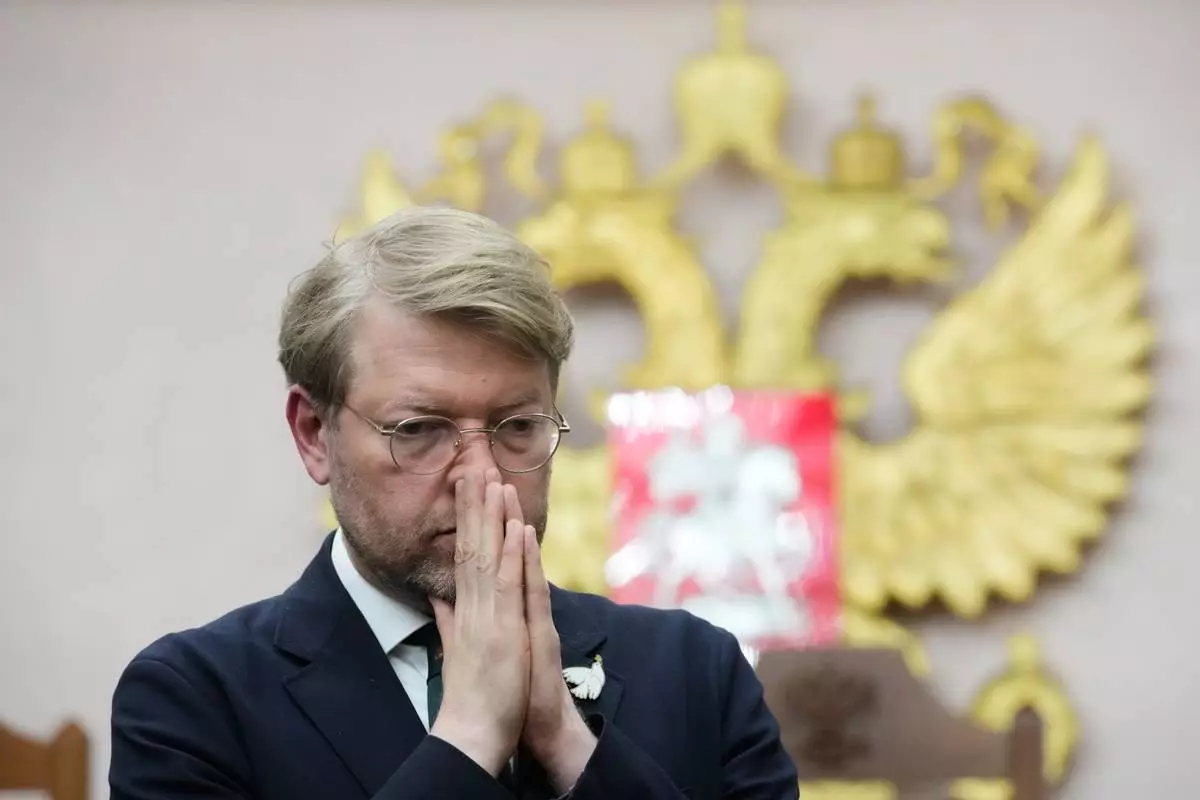
FILE - Yabloko party leader Nikolai Rybakov stands at a hearing to bar his party from the parliamentary election at Russia's Supreme Court in Moscow, Monday, Aug. 10, 2026. (AP Photo/Pavel Bednyakov, File)
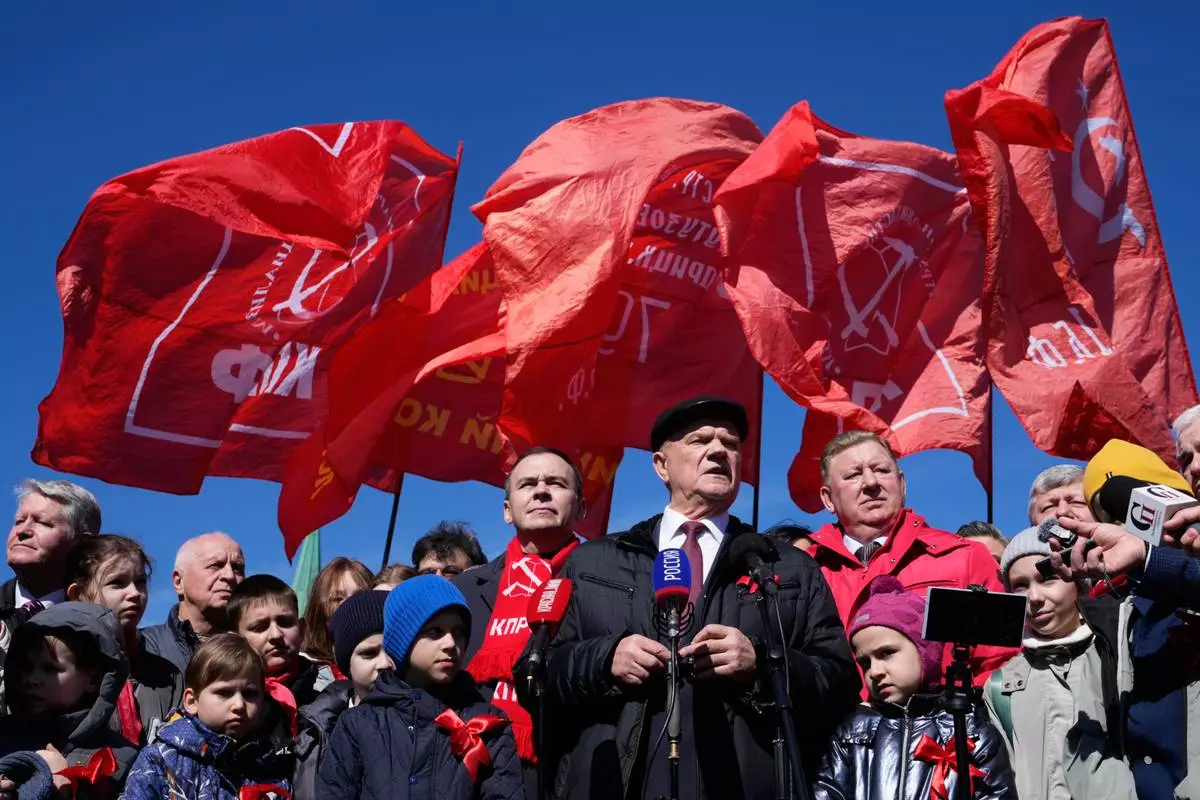
FILE - Russian Communist Party leader Gennady Zyuganov, center, speaks to journalists after laying flowers at the mausoleum of USSR founder Vladimir Lenin in Red Square, in Moscow, marking the 156th anniversary of his birth on Wednesday, April 22, 2026. (AP Photo/Pavel Bednyakov, File)

FILE - A plume of black smoke is seen over St. Petersburg, Russia, Wednesday, June 3, 2026, after a Ukrainian drone attack. (AP Photo, File)
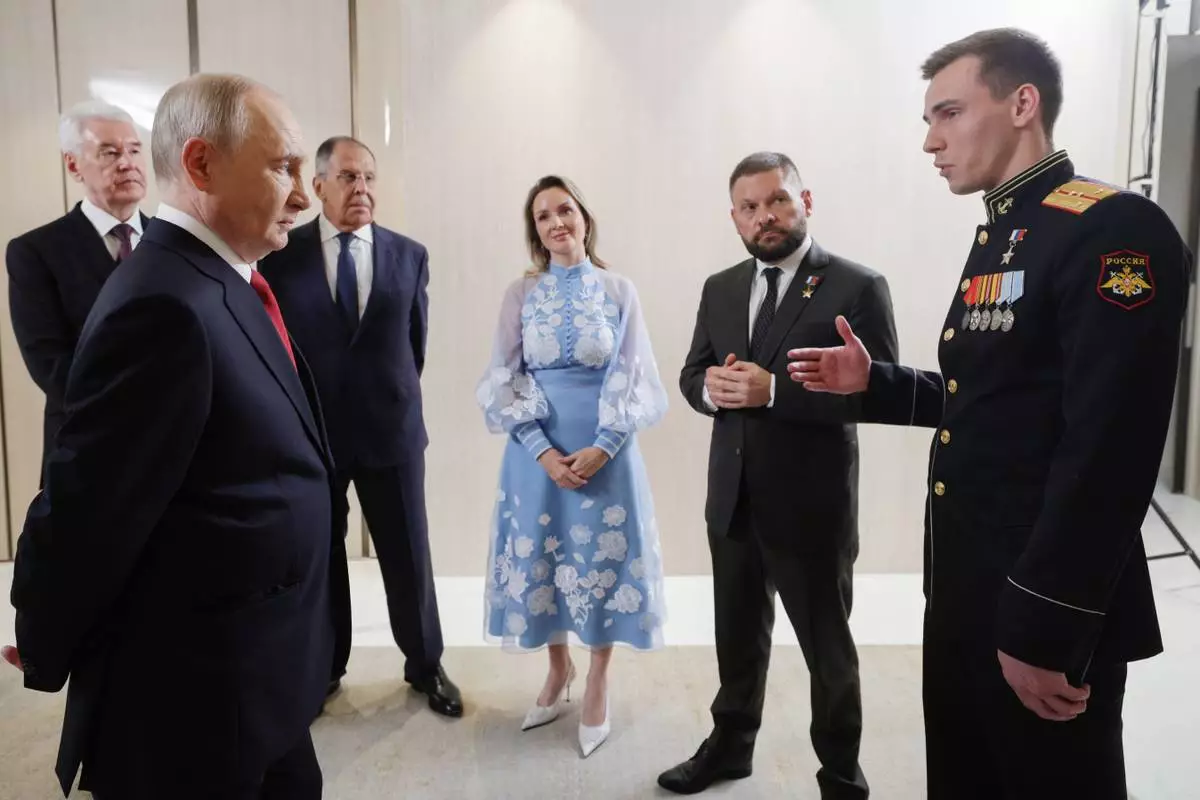
FILE - Russian President Vladimir Putin, foreground left, meets with United Russia party leaders, from left, Moscow Mayor Sergei Sobyanin; Putin; Foreign Minister Sergey Lavrov, background second right, Presidential Commissioner for Children's Rights Maria Lvova-Belova, center; war correspondent and Hero of Russia Yevgeny Poddubny, second right; and Chief of the Yunarmiya main headquarters Vladislav Golovin, in Moscow, on Saturday, Sept. 5, 2026. (Gavriil Grigorov/Sputnik, Kremlin Pool Photo via AP, File)
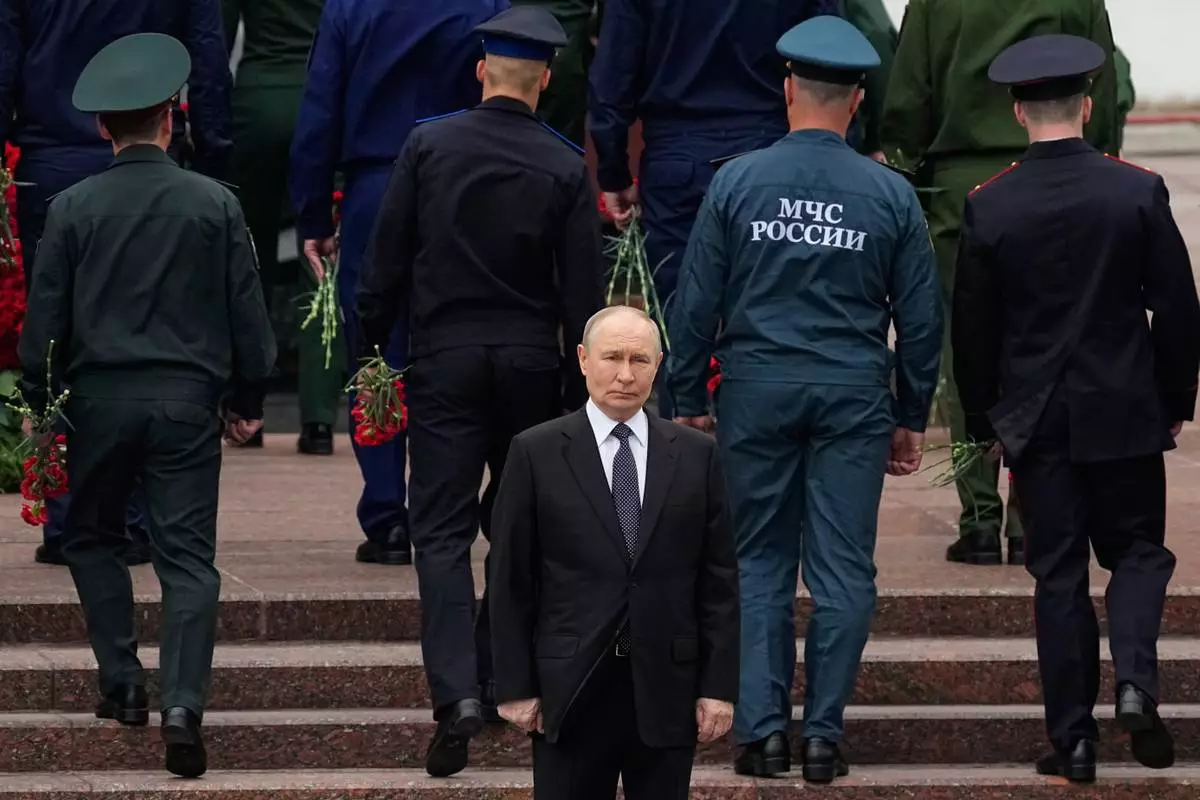
FILE - Russian President Vladimir Putin attends a wreath-laying ceremony at the Tomb of the Unknown Soldier by the Kremlin wall in Moscow on Monday, June 22, 2026, marking the 85th anniversary of the invasion of the Soviet Union by Nazi Germany in World War II. (AP Photo/Alexander Zemlianichenko, Pool, File)