More than 2,400 fishing boats on Wednesday departed ports in Wenzhou City, east China's Zhejiang Province, as the summer moratorium in the East China Sea officially ended, marking the start of the busy fishing season.
After a four-and-a-half-month summer fishing ban, boats once silent in the ports of Pingyang and Dongtou are again seeing a hive of activity with preparations. Fishermen loaded supplies, checked nets, and coordinated with local officials focusing on maritime safety, all before receiving the midday signal that opened the highly anticipated season.
At the signal, a fleet of 2,430 vessels surged out to sea, marking the official return to work.
"We're very excited and hope for a good catch, a good haul and a safe return with our boats full," said Ren Yongguo, a fishing vessel skipper.
"I've been working in the fishing industry for more than 30 years. After waiting for four and a half months, I'm very excited today. The fishing season opens at 12 o'clock. I wish all my fellow fishermen a smooth voyage and a full catch," said Wu Siyuan, a fishing vessel skipper.
With the moratorium lifted, fishermen are optimistic for a productive, safe, and successful fishing season in the East China Sea.
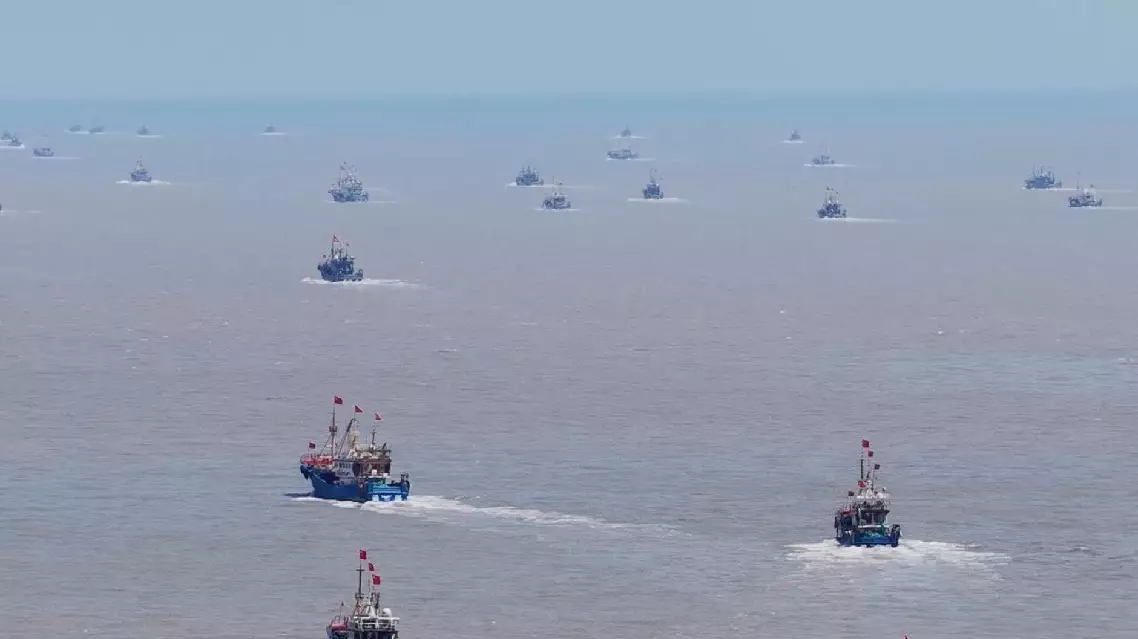
Over 2,400 boats sail out as East China Sea fishing ban ends
The Pinglu Canal is expected to unlock new opportunities for deeper economic cooperation between China and the Association of Southeast Asian Nations (ASEAN), according to ASEAN Secretary-General Kao Kim Hourn.
Speaking on the sidelines of the 23rd China-ASEAN Expo, which opened Thursday in south China's Nanning, Kao stressed the strategic role of the new waterway in boosting regional trade.
In an interview with China Global Television (CGTN), Kao said that the newly opened canal provides China's landlocked southwest with a crucial direct gateway to maritime routes, paving the way for faster trade with its top commercial partner.
Built at a cost of 72.7 billion yuan (about 10.84 billion U.S. dollars), the 134.2-kilometer canal runs from Nanning to the Beibu Gulf, the closest maritime outlet for much of southwest China.
The canal stretches along the New International Land-Sea Trade Corridor, a strategic trade route connecting China's inland regions with ASEAN and other global markets. It is the first river-to-sea canal project planned and coordinated at the national level since the founding of the People's Republic of China in 1949.
"This is a canal of a significant historical dimension, meaning that it would not only benefit China alone. There are provinces in China that can use the canal do a lot of transportation, particularly water transportation to lower the cost. But for us, because we do a lot of trade between the two sides, meaning that we have to use port to port. There are a lot of ports in China, and there are a lot of ports in ASEAN. And as in China, our relationship, we are neighbors as defined by the geography. And this canal open new opportunities for both sides. I hope that provinces in China will take advantage of this great opportunity to deepen our economic cooperation," said Kao Kim Hourn.
China's trade with ASEAN exceeded 1 trillion U.S. dollars for the first time last year. In the first seven months of 2026, total trade between the two sides reached 744.41 billion U.S. dollars, an increase of 24.7 percent year on year, accounting for 21.8 percent of China's total foreign trade during this period.

Pinglu Canal to deepen China-ASEAN economic cooperation: secretary-general