China's international operation center for the digital RMB launched CBETS LIFT on Friday at a China-ASEAN financial forum in south China's Nanning, introducing a digital yuan framework for cross-border trade settlement and financing.
The center, set up by the People's Bank of China, said the service was designed to ease frictions in cross-border payments and trade finance.
CBETS LIFT, offered through the center's Cross-border e-CNY Transfer Services platform, or CBETS, provides a single framework for domestic financing, cross-border payments and receipts, offshore investment and the repatriation of funds to China.
The service also integrates trade data, payment flows and transaction documents across trade, shipping, freight and financing activities, the center said.
CBETS LIFT has been tested in multiple live transactions covering imports and exports. The launch came as China and Laos introduced cross-border digital-payment links, with some Lao banks connecting to CBETS and beginning to offer the service.

China launches digital yuan service for cross-border trade
Twenty crested ibises are set to be released into the wild in Tianshui, northwest China's Gansu Province on Sunday, and preparations at their breeding base are in their final stage on Saturday.
The birds currently live at the Longmen Forest Farm of the Xiaolong Mountain Forestry Protection Center, the country's third relocation and rewilding site for the species. The crested ibises were introduced from Yangxian County in northwest China's Shaanxi Province, and the towering steel mesh cage that serves as their home stands about 10 stories high.
The cage covers an area of 5,024 square meters, with a rise of 35 meters and a diameter of 80 meters, making it one of the highest-standard wild-training enclosures in China.
Its circular design gives the birds a continuous flight path, allowing them to fly in loops to build endurance and muscle strength. Thanks to the favorable climate and environment, a complete ecosystem has taken shape around the site — which has also attracted natural predators of the ibises, making the multi-layered protection essential.
Inside the cage, a fully simulated natural environment includes lawn, wetland and forest.
The two wetland areas cover one-third of the enclosure, with shallows and deep-water zones where keepers release loaches for the ibises to practice wading and foraging with their long beaks.
A feeding shed is fitted with a heated water trough to keep the surface from freezing in winter, while a shelter shed provides refuge for young birds during extreme weather such as blizzards and hail.
Various trees are distributed throughout, as crested ibises are particular about nesting sites, generally choosing tall broad-crowned trees with abundant lateral branches, such as oaks and oil pines.
A bird-watching platform allows keepers to record the birds' feeding, flight and roosting daily, data that complements footage from 16 high-definition monitoring systems to form detailed monitoring logs.
Next to the main cage stand two smaller enclosures with distinct functions. A chick-rearing cage of about 230 square meters currently houses 10 young birds, which will stay for roughly a year until they learn to forage independently and fly short distances, before moving into the main cage for the next stage of training.
A separate rescue cage provides treatment and recovery space for injured birds — for instance, during breeding season, crested ibises may abandon their nests when frightened or disturbed, requiring timely human intervention to save the chicks.
These carefully designed facilities have allowed the ibises to grow up healthy, laying a solid foundation for their return to the wild.
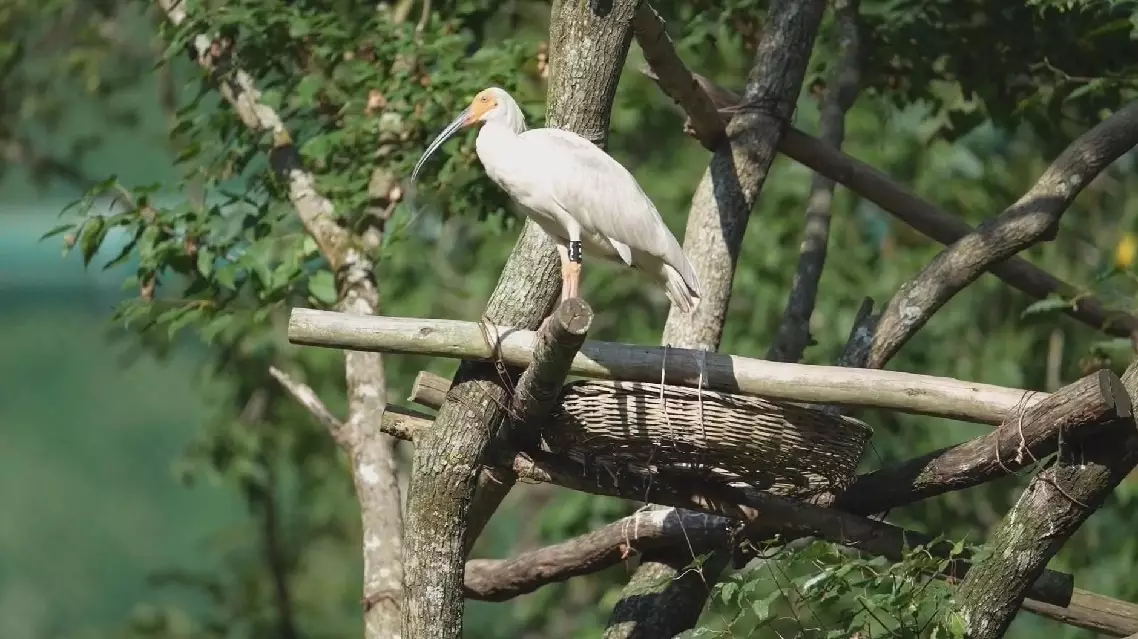
20 crested ibises to be released into wild in Gansu