UNITED NATIONS (AP) — The U.N. General Assembly is launching into its yearly meeting of world leaders, a week of diplomacy, dealmaking, speechmaking — and lingo.
Here is some of the key vocabulary, decoded.
UNGA: Shorthand (often pronounced “UN'-gah”) for the U.N. General Assembly's “High-level Week,” when presidents, prime ministers, monarchs and other top leaders of all 193 U.N. member countries are invited to speak to the world and each other. New Yorkers sometimes just groan “General Assembly” to describe what many experience as a week of epic traffic, but the assembly isn't just this meeting. It's a body that discusses many global issues and votes on resolutions throughout the year.
GENERAL DEBATE: The centerpiece of the week, it gives each country's leader (or a designee) the microphone for a state-of-the-world speech. This year's theme is “restoring trust, managing transformation" and ensuring the 81-year-old United Nations “delivers for all.” But speakers often opine on the planet's biggest issues and hot spots, spotlight domestic accomplishments and needs, air grievances and try to exude statesmanship. While the “debate” is more a series of speeches than an interactive discussion, rebuttals are allowed at the end of each long day, and some embittered neighbor nations routinely go multiple rounds.
BILATERAL (or “bilat,” for short): Private meetings between high-ranking officials of two countries. Many UNGA veterans say the gathering's real value lies in these tête-à-têtes and other personal, off-camera encounters among decision-makers.
MINISTERIAL: Applies to meetings of cabinet-level officials, such as foreign ministers, from different countries.
SECURITY COUNCIL: The U.N.'s most powerful component, charged with maintaining international peace and security. The 15-member council can enact binding (though sometimes ignored) resolutions, impose sanctions and deploy peacekeeping troops. While this week is the General Assembly's show, the council generally also holds a high-wattage meeting or two.
P5: The Security Council's five permanent members with veto power. Under a structure set up in 1945, they are China, France, Russia, the United Kingdom and the United States.
E10: The Security Council's 10 elected, nonpermanent members. The General Assembly elects them for two-year terms in seats allocated by region. Calls for council reform are an UNGA staple. One major complaint is the lack of permanent members from Africa and the Latin America-Caribbean region, though some other nations also have angled for years for a permanent presence.
G77: Stands for the “Group of 77 and China,” a developing-countries interest group that formed within the U.N. in 1964. Despite its name, it actually now has 134 members.
COP31: A major U.N. climate conference coming up in November in Antalya, Turkey.
1.5 DEGREES: A crucial climate threshold. Under the 2015 Paris climate accord, countries agreed to work to limit warming to 1.5 degrees Celsius (2.7 degrees Fahrenheit) over preindustrial times. The goal has long seemed elusive, and the U.N. acknowledged this month that the planet will surpass that threshold in the next few years.
SDGs: The U.N.'s “ sustainable development goals,” which range from combating climate change to eliminating hunger and poverty to achieving gender equality. The U.N.'s member countries unanimously adopted the goals in 2015 as a 15-year action plan, but the pace is seriously lagging.
SIDS: At the U.N., this stands for some 39 “small island developing states.” UNGA is an important platform for them to elevate concerns such as climate change and the existential threat they face from projections of rising seas and intensifying storms, often a painfully timely subject at a meeting that falls in the thick of the Atlantic hurricane season.
BRICS: A developing-economies coalition that initially included Brazil, Russia, India, China and South Africa and has grown to 11 countries. There are many international groups centered around regional, economic, defense or other ties, but BRICS nations boast about half the world’s population and a lot of its resources and economic activity. The group has been a venue for China and Russia to project influence and work to counter the West. It also is struggling with internal divisions.
NGO: “Nongovernmental organization,” such as an advocacy group, charitable foundation or nonprofit relief organization.
LDCs: Very poor nations that are known at the U.N. as “ least-developed countries.” Forty-four nations currently meet the criteria, which include a gross national income of $1,088 or less per person per year.
IFIs: International financial institutions, including the World Bank and the International Monetary Fund, which were established at a 1944 U.N. conference in Bretton Woods, New Hampshire. Critics see the Bretton Woods duo as sclerotic entities that have badly failed poor and developing countries. The institutions have defended their work while saying they are trying to evolve.
MULTILATERALISM: Global or near-global partnership that is united and collectively develops enduring rules and shared norms. The idea undergirds the U.N. itself, though many warn it's under threat.
MULTIPOLAR: A scenario in which there are several different and sometimes competing centers of power, not a single superpower or two.
MULTISTAKEHOLDER: An approach to big projects and problem-solving that incorporates not only governments but businesses, NGOs and possibly others. Fans see this concept as key to the future of world cooperation. But some progressive groups view it as a sell-out to big corporations and other powers that be.
TWO-STATE SOLUTION: A concept for resolving the Israeli-Palestinian conflict by establishing an independent Palestinian nation living in peace alongside Israel. The framework was set down in the 1993 Oslo Accords and embraced by the U.N., but progress toward implementing it stalled long before the recent Israel-Hamas war in Gaza and the expansion of Israeli settlements in the occupied West Bank. Most of the international community considers the settlements illegal.
SOUTH-SOUTH COOPERATION: Collaboration among countries, organizations and people in what is known as the Global South. The term refers to developing nations that are largely, though not exclusively, in the Southern Hemisphere and generally want a bigger say in their own development and in international affairs.
UNILATERAL COERCIVE MEASURES: A usually critical way of describing sanctions imposed by one country in hopes of spurring some action in another.
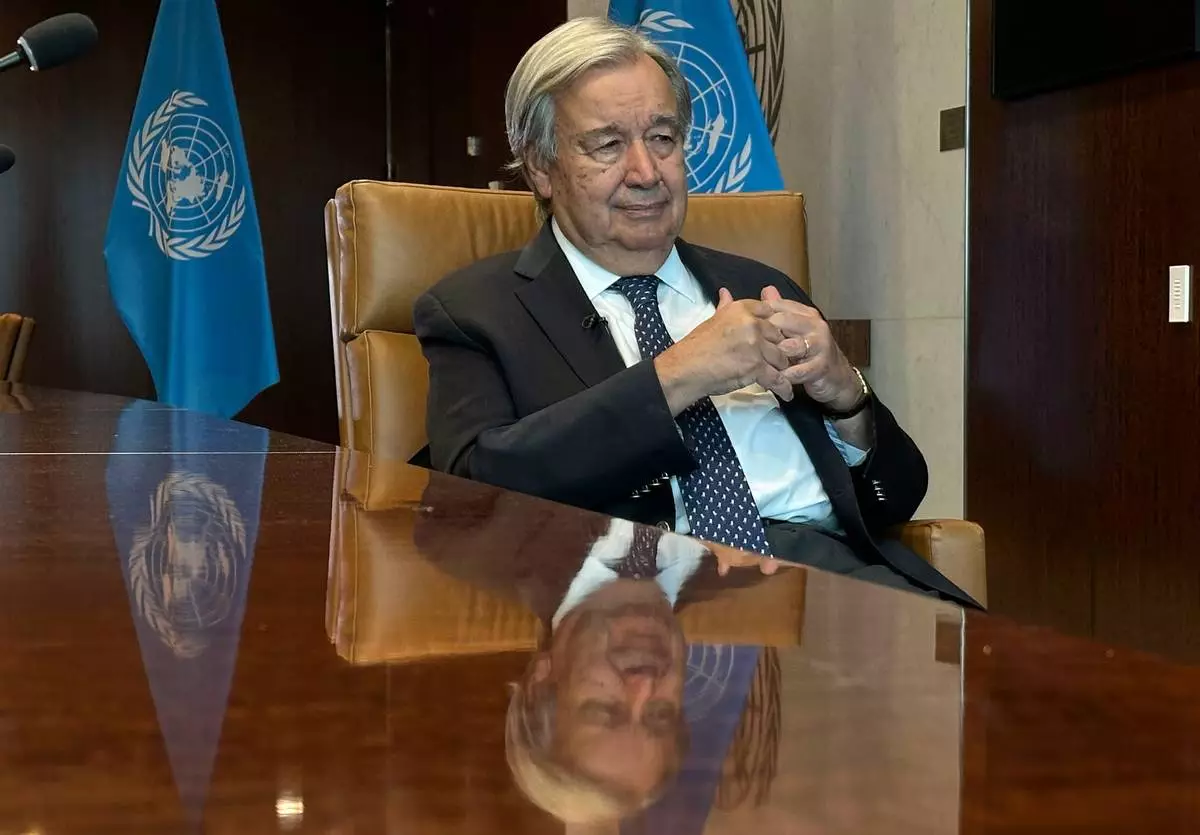
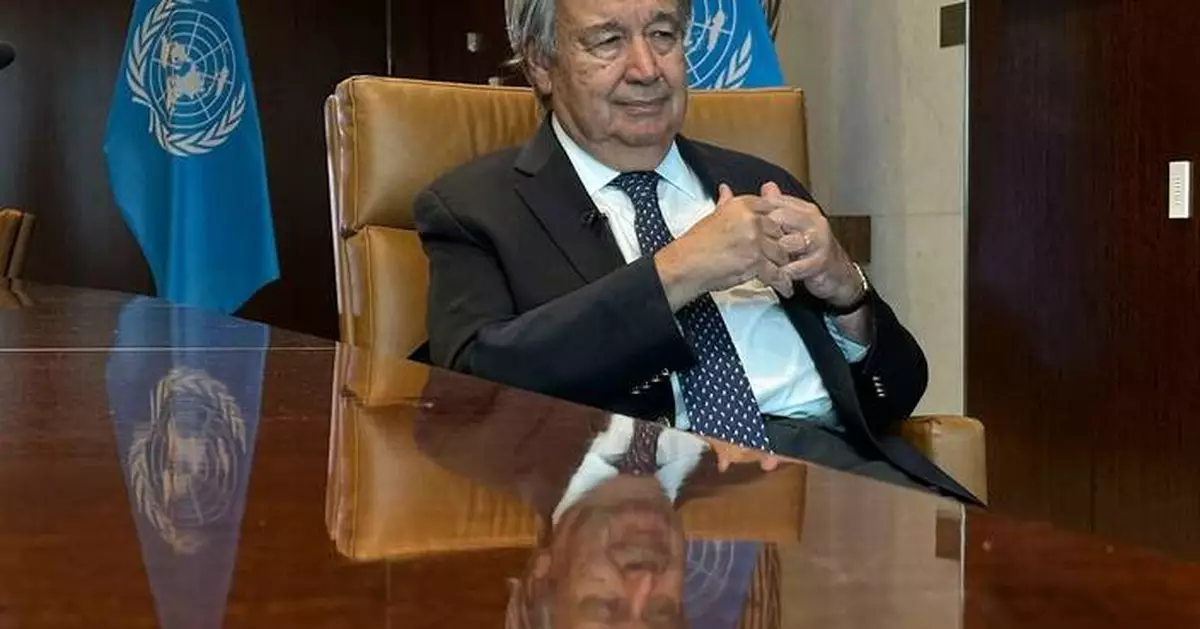
The United Nations Secretary-General Antonio Guterres speaks during an interview with The Associated Press at the United Nations headquarters, Thursday, Sept. 17, 2026. (AP Photo/David R Martin)
Saudi Arabia warned of a “hostile aerial threat” and issued a string of emergency alerts across the kingdom, including in its capital, late Friday and early Saturday.
Also Saturday, Iran’s state TV reported that a man was executed after being convicted on charges of spying for Israel’s intelligence agency Mossad.
Here is the latest news from the Middle East on Saturday. Full coverage is available here.
Saudi Arabia warned of a “hostile aerial threat” after issuing emergency alerts, and at least one explosion was heard in Riyadh.
The alert in Riyadh was the first for the Saudi capital since the latest escalation with Yemen's Iran-backed Houthi rebels.
No casualties or damage were reported after the alerts were lifted. Saudi authorities didn't say what prompted the alerts or the cause of the audible explosions, but they previously reported intercepting incoming Houthi missiles and drones.
The U.N.’s most powerful body said late Friday that the Houthis' military escalation, attacks and threats “risk further expanding the conflict, threatening maritime security and international trade,” while undermining regional and international efforts to secure peace in Yemen.
It warned that continued escalation would exacerbate the already dire humanitarian situation in the country.
The council's 15 members called for “practical cooperation” to prevent the Iran-backed Houthis from acquiring arms, military training, financing and other military-related assistance needed to carry out their attacks. They stressed that all countries must enforce the U.N. arms embargo against the rebel group.
Iran's state TV reported on Saturday that a man identified as Hossein Pedram was executed after being convicted on charges of spying for Israel’s intelligence agency Mossad.
The report said Pedram passed on to Israel classified information on “sensitive military sites” in Iran's Isfahan province. It didn't say how he accessed the classified information.
Pedram was reportedly arrested after those sites, which included missile bases, were targeted in the 12-day air war by the U.S. and Israel against Iran in June last year.
A recent surge of executions in Iran prompted an international outcry by human rights groups.
Gaza’s Health Ministry and Shifa Hospital officials said one man was killed in the Shijaiyah neighborhood of Gaza City. Another man, identified as the son of the ministry's director general, was killed as he walked in the Jabaliya refugee camp in northern Gaza.
The Israeli military said it struck “several military operatives” and that it would provide more details later.
The heaviest fighting between Israel and Hamas has subsided since a ceasefire took effect last October, but Israeli fire has killed more than 13,780 Palestinians in Gaza since then, according to health officials in the territory.
The U.N. agency for Palestinian refugees (UNRWA) says more than 280,000 children in Gaza are attending school in tents and heavily damaged classrooms after years of war.
At a UNRWA-run school in Nuseirat, some classrooms have no desks, leaving children to sit on blankets on the floor. Still, some families say that a return to school brings back a familiar sense of routine that was upended by war.
UNRWA education program chief Tawfiq al-Hourani said the agency hopes to restore conditions for schooling to the state they were three years ago when it operated 182 fully equipped schools. He said 95% of those schools have since been lost.
Pakistan's Foreign Minister Ishaq Dar discussed uninterrupted energy supplies and safe passage for commercial ships during a telephone call Saturday with his Iranian counterpart Foreign Minister Abbas Araghchi.
Pakistan’s Foreign Ministry said in a statement that Dar underscored the importance of ensuring that ships pass safely and quickly, citing the potential effects of disruptions on developing countries and global supply chains. The statement did not provide details of Araghchi’s response.
Pakistan has faced rising energy prices as the tensions spiked, increasing pressure on Prime Minister Shehbaz Sharif’s government. An Islamist party has threatened to march on the capital, Islamabad, unless the government lowers fuel prices.
Iran’s state TV reported Saturday that the Tehran prosecutor’s office filed charges against race organizers after women participated without covering their hair because “legal and Islamic Sharia” wasn’t observed.
The country's ruling theocracy requires women to wear scarves that cover their hair and loose-fitting clothes that hide their entire bodies.
Footage circulated online showing many women running the 10-kilometer (6-mile) race without the mandatory hair covering. Habib Sotoudehnejad, head of Tehran’s sports department, said Saturday that about 5% of participants violated race rules.
The race was run separately for men and women.
Hard liners in Iran seek harsh penalties against women who appear in public without covering their hair.
Syria’s Defense Ministry on Saturday held a funeral for 11 soldiers killed a day earlier during an explosion in the village of Ayash in the eastern province of Deir el-Zour.
The ministry did not give a reason for the blast that also wounded several other members of the military.
The Britain-based Syrian Observatory for Human Rights said the blast occurred in an arms depot at a military post. A similar explosion near the northwestern town of Sarmada earlier this month killed 14 people and wounded 11.
Turkey's banking watchdog, the Banking Regulation and Supervision Agency, revoked the operating license for the Istanbul branch of Iran's Bank Mellat.
The agency said Saturday that it made the decision to protect depositors or the stability of the Turkey's financial system.
The announcement comes as the United States is demanding other countries tighten economic measures against Iran.
Bank Mellat has been subject to Western sanctions for years and was named in 2019 as having links to the paramilitary Revolutionary Guard Corps. The U.S. Treasury Department earlier this month imposed sanctions on a Turkish investment bank and two subsidiaries over alleged ties to Iran.
This report will be updated throughout the day as new developments emerge.
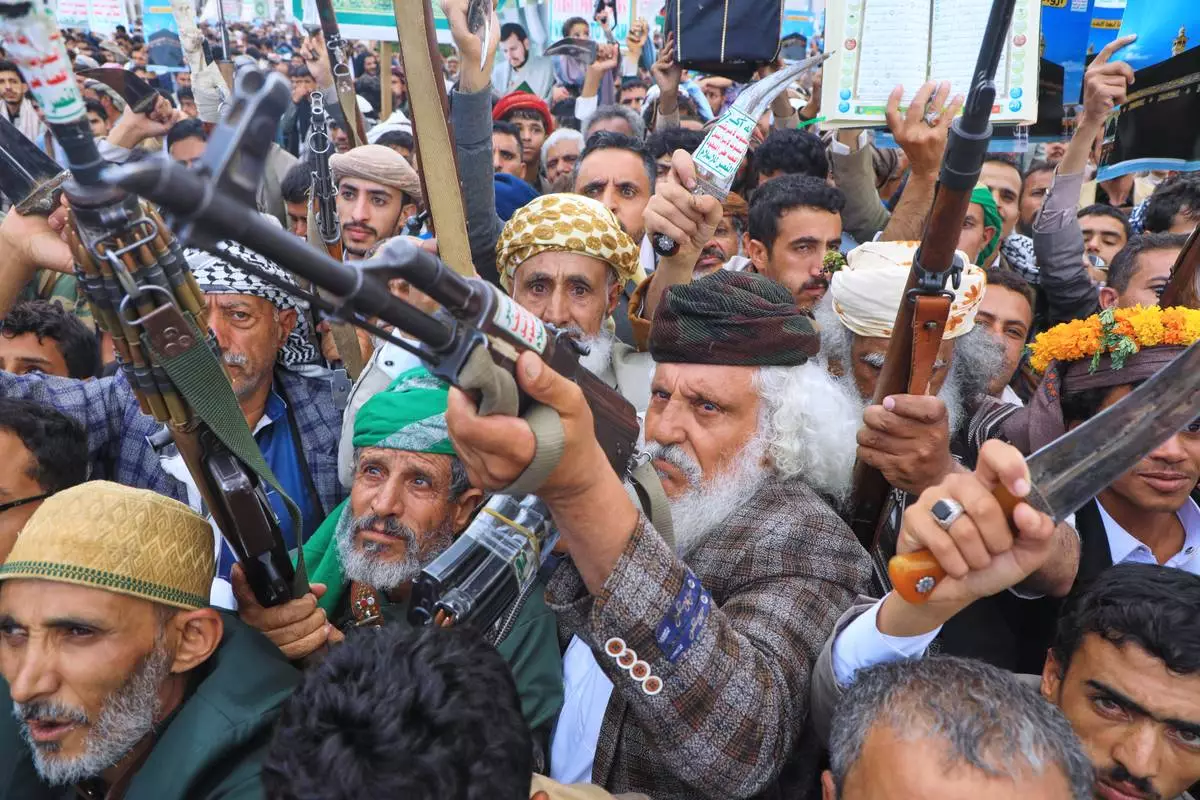
Supporters of Yemen's Houthi rebels raise their rifles during a rally in support of the group and to protest Saudi Arabia's accusation that the Houthis targeted Islam's holiest site of Mecca, in Sanaa, Yemen, Friday, Sept. 18, 2026. (AP Photo/Osamah Abdulrahman)
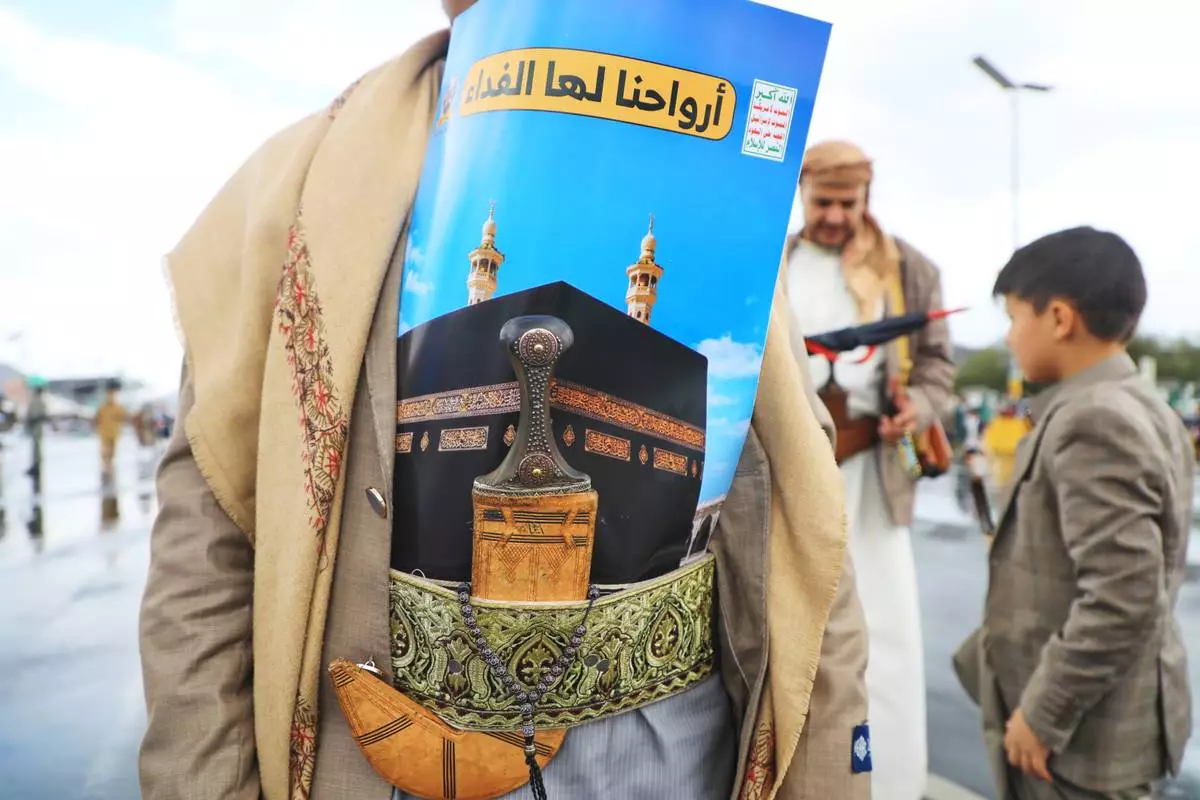
A supporter of Yemen’s Houthi rebels wears a poster showing the Kaaba at the Grand Mosque, tucked into a decorative sash above a dagger, during a rally to protest Saudi Arabia's accusation that the Houthis targeted Islam's holiest site, in Sanaa, Yemen, Friday, Sept. 18, 2026. Arabic reads, "Our souls are sacrificed for it". (AP Photo/Osamah Abdulrahman)
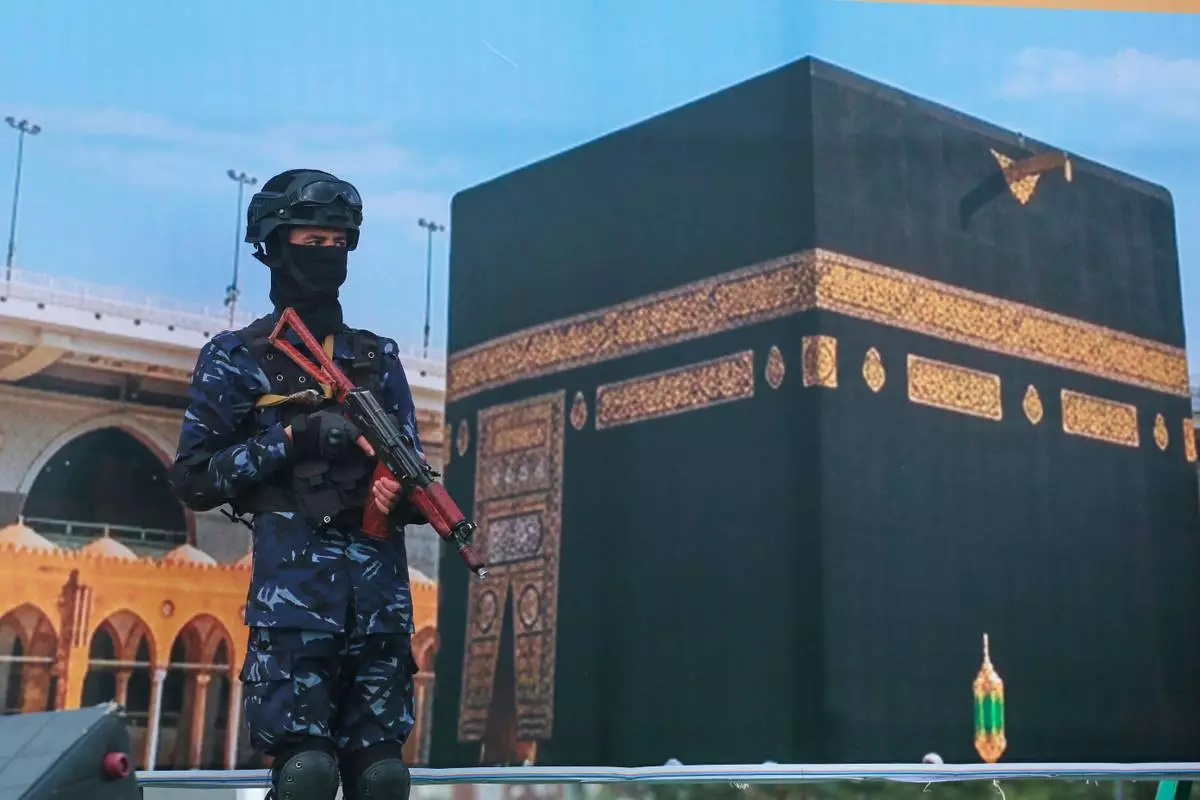
A soldier from Yemen's Houthi rebels stands in front of a giant banner of the Kaaba, during a rally to protest Saudi Arabia's accusation that the Houthis targeted Islam's holiest site in Sanaa, Yemen, Friday, Sept. 18, 2026. (AP Photo/Osamah Abdulrahman)