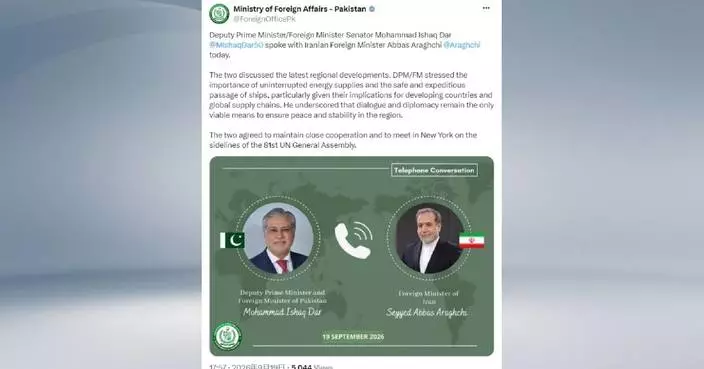
An anonymous high-ranking Iranian source said on Saturday that Qatar and Pakistan, acting as mediators, have informed Iran that the United States is ready to negotiate and reach an agreement.
There has been no official information on the matter from either Iran or the United States so far.
In an interview with Qatar's Al Jazeera published on Saturday, Secretary of Iran's Supreme National Security Council Mohsen Rezaei said that Qatar, acting as a mediator, has conveyed Iran's conditions for negotiations to the U.S. side and is awaiting a response from U.S. President Donald Trump.
Rezaee said that the conditions Iran has proposed for negotiations include ending hostilities on all fronts, releasing frozen Iranian assets, and lifting the anti-Iran naval blockade. He said that Iran is continuing consultations with mediators Qatar and Pakistan, and that Qatar has already conveyed these conditions to the U.S. side.
Rezaee said that Iran has not yet decided whether to withdraw from the Treaty on the Non-Proliferation of Nuclear Weapons (NPT), adding that any decision on the issue will depend on Washington's behavior.

United States ready to negotiate, reach agreement with Iran: Iranian source
Chinese specialists have successfully corrected a giant panda's crooked jaw using an orthodontic technique adapted from human treatment, in the first such procedure performed on this species.
The treatment, jointly carried out by the Chengdu Research Base of Giant Panda Breeding and West China Hospital of Stomatology, restored the panda's ability to bite and chew normally. Related research was published in July in The Angle Orthodontist, a leading international orthodontic journal.
Beixia, a male giant panda born in 2022, suffered a jaw injury shortly after birth and its left forelimb also had to be amputated following irreversible damage. By around three months old, his lower jaw had begun to deviate to the left, causing milk to leak from his mouth and raising concerns that he could eventually struggle to chew bamboo, which posed a serious threat to his survival.
With Beixia's jaw still developing, veterinarians and orthodontists decided to use the panda's natural growth potential to correct the asymmetry. They digitally scanned his mouth and designed a customized fixed appliance, with three orthodontic elastic bands to apply gentle traction and guide the jaw toward more symmetrical growth.
Long Hu, an orthodontist at West China Hospital of Stomatology, said it was the first time a growth-modification technique used in human orthodontics had been applied to a giant panda.
"At the time, we deliberated whether to proceed with the treatment while the panda was still young or wait until it reached adulthood. Ultimately, following a multidisciplinary consultation, we decided that the procedure needed to be performed without delay during its youth. We performed an intraoral scan for Beixia, and then used 3D digital design to create an orthodontic appliance intended to shift the mandible back into alignment and correct the deviation," Long said.
The treatment lasted about six months. The bands were removed before each feeding and put back afterward. At first, Beixia would push at them with his tongue or paw at his mouth, requiring caregivers to watch closely to prevent the bands from coming loose or being swallowed.
The treatment reflects increasingly refined veterinary care for China's captive giant panda population, which reached 808 by the end of 2025.
The panda base also plans to establish more systematic oral health records for giant pandas and further advance research and clinical applications in panda dentistry.
"The collaboration between our two teams successfully applied the concept of correcting dentofacial growth deformities -- originally developed for humans -- to giant pandas, thereby providing a novel clinical approach and treatment strategy for addressing such deformities in wildlife," said Han Xianglong, head of the West China Hospital of Stomatology.
Follow-up examinations showed that Beixia's jaw deviation had largely been corrected, and normal sucking, chewing and swallowing functions had been restored. Now four years old, he can eat normally and remains active and playful.
"Beixia is now four years old -- a sub-adult. Although it underwent orthodontic surgery, its ability to feed has remained completely unaffected; it is eating very well indeed," said Mao Yongyi, a keeper at the Chengdu panda base.
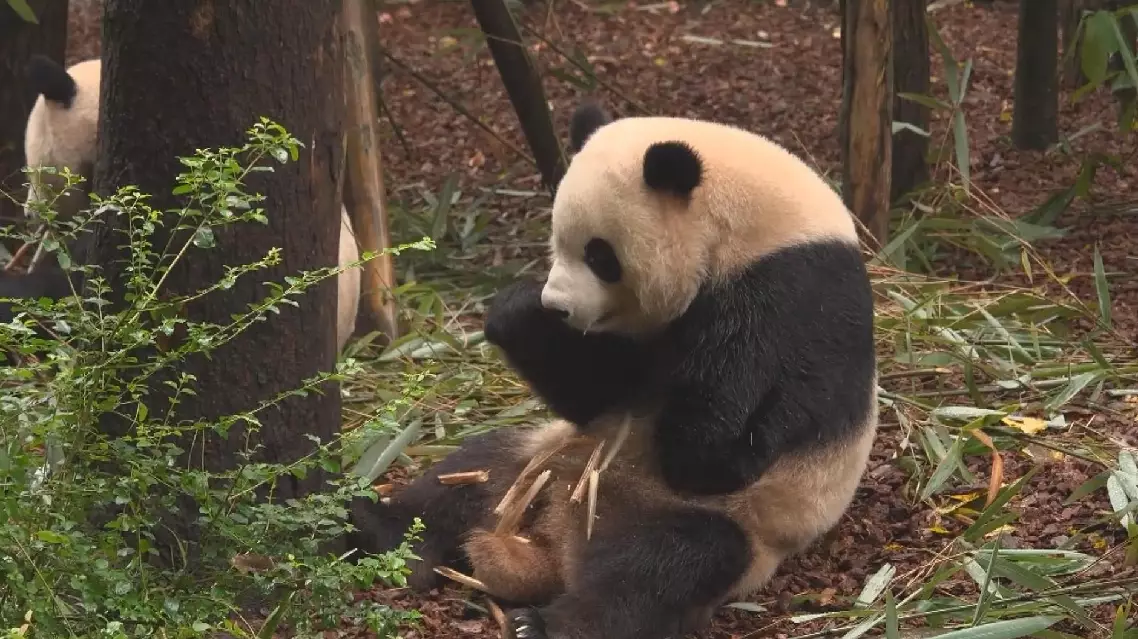
Chinese specialists correct giant panda's crooked jaw in first-of-its-kind procedure