China has launched artificial intelligence (AI) literacy courses in primary and secondary schools across multiple cities this autumn semester, marking a key step in the country's drive to integrate AI education into local curriculum systems while stressing responsible use of the technology.
The new courses, which range from "understanding AI" and "using AI" to "using it well" and even "questioning AI," are part of a broader effort to prepare students for a future in which intelligent tools are woven into everyday work and study.
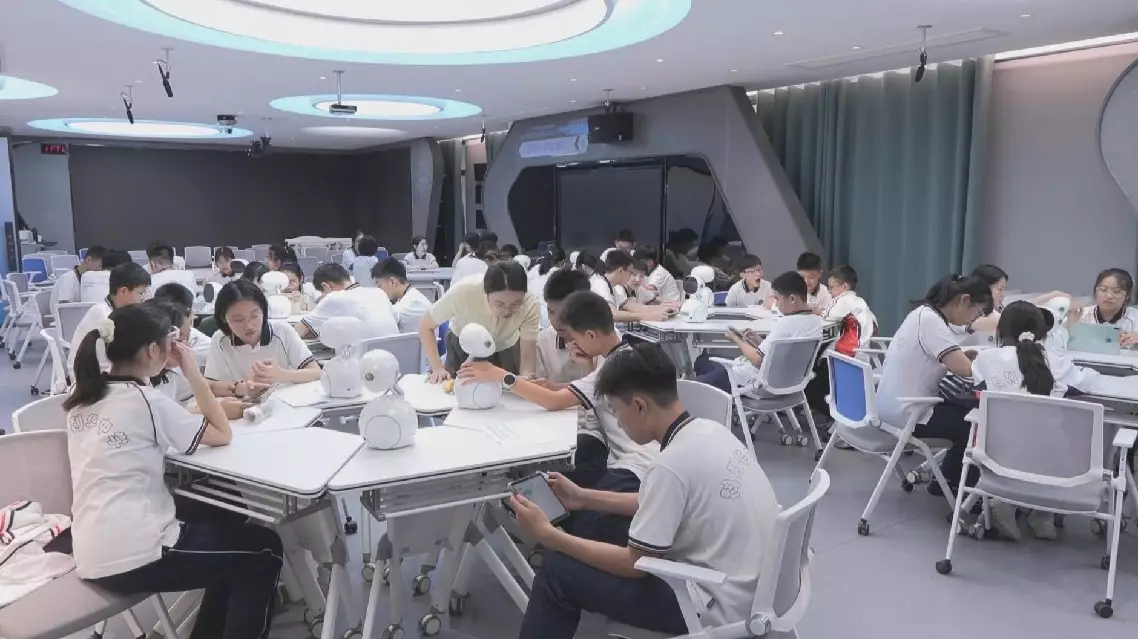
At Nanjing Kelihua Middle School in east China's Jiangsu Province, the first AI literacy lesson of the new term took the form of immersive human-machine interaction. Centered on image recognition, the class had students write simple programs on tablets to simulate how a smart fruit vending machine identifies what is placed in front of it, breaking down the principles behind the technology through hands-on practice.
A student at the school shared his sense of achievement after working through repeated debugging attempts.
"Today we debugged the program over and over and failed many times, but when the robot finally recognized the orange, we were all really happy. I realized that image recognition isn't magic. It's built on massive amounts of training data," said Liu Yanzhe, a student at the school.
Beyond standalone courses, many schools are embedding AI tools into regular academic subjects, with a clear principle: AI should support learning, never replace the thinking process.
At Beijing National Day School, AI acts as an on-demand assistant rather than the focus of lessons. Students use it to look up information about ancient stone arch bridges in Chinese class, or analyze the economic transformation of resource-based cities in geography class.
"We let students experience the process of collaborating with AI while carrying out real-world tasks," said Song Yan, director of the school's information center.
The school holds that AI is a tool to broaden students' horizons, but only on the condition that the learning process itself is preserved. Cultivating students' ability to use AI wisely matters far more than simply teaching them technical operations.
"We first let the students think for themselves, and after they've thought it through, they need to fill out a task sheet. On the sheet they first present their thinking without AI, and then AI is used to help the students come up with methods for those problems," said Dou Wentao, a politics teacher at Beijing National Day School.
Such AI education models are now expanding rapidly across the country. Since the start of this autumn semester, several provincial-level regions have issued local curriculum guidelines and teaching frameworks to set clear standards for AI literacy courses.
Jiangsu Province has fully rolled out AI literacy courses across primary and secondary schools, achieving universal coverage for every campus and every student.
East China's Shandong Province has mandated AI-related courses in compulsory education: no less than 6 class hours per academic year for grades 1-2, and no less than 8 class hours for grades 3-9. Senior high schools in the province will also offer an optional selective module titled "Introduction to Artificial Intelligence".
Going forward, China's Ministry of Education will accelerate the popularization of AI education in primary and secondary schools, and advance the full integration of AI education into local curriculum systems.
The ministry also plans to strengthen AI education bases in schools and support rural and remote-area schools in delivering AI courses through national platforms, with the aim of building a vertically integrated, full-stage AI education system by 2030.
China rolls out AI literacy courses to integrate tech across school curriculums