Flagship global ecosystem event highlights AI in engineering workflows, broader AEC and manufacturing capabilities, and deeper customer and partner collaboration.
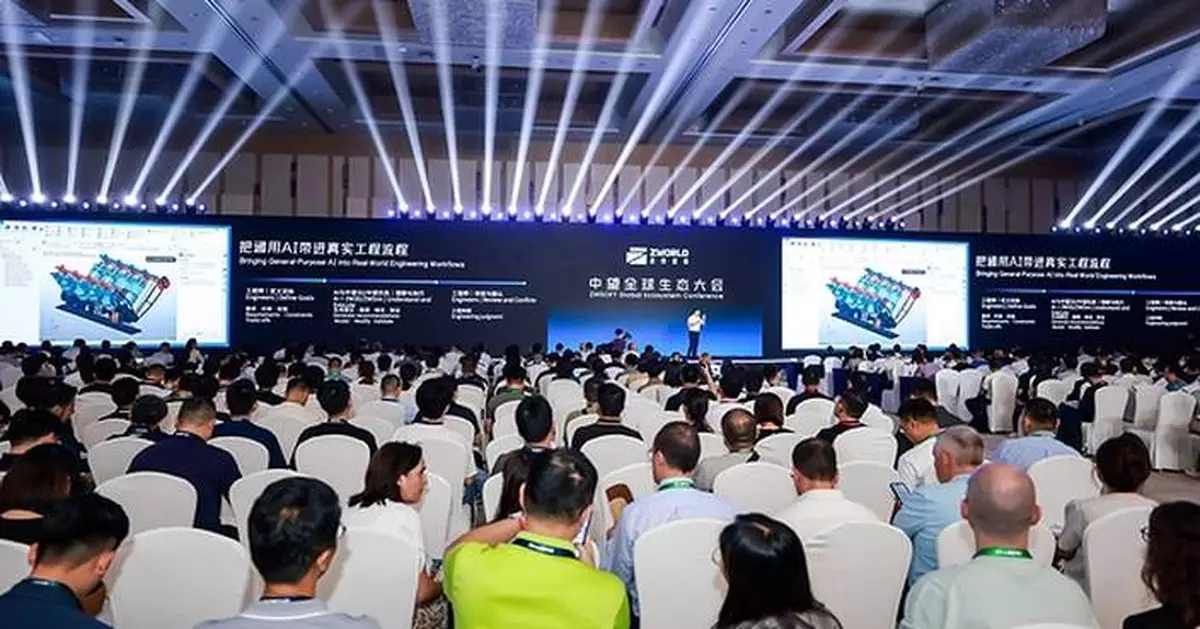
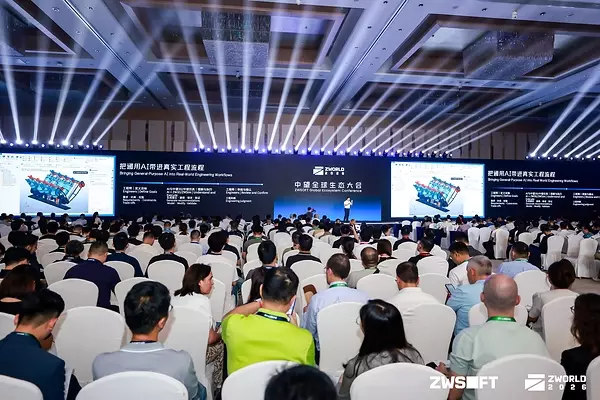
GUANGZHOU, China, Sept. 21, 2026 /PRNewswire/ -- At ZWorld 2026, ZWSOFT outlined the next stage of its technology and global ecosystem strategy, focusing on bringing AI into professional engineering workflows, expanding around a stronger CAD foundation, and working more closely with customers and partners to turn technology into practical industry value.
Held from September 15 to 17 in Guangzhou under the theme "Design the Future. Together.", ZWorld is ZWSOFT's flagship global ecosystem event, bringing together customers, partners, industry experts, and ZWSOFT teams from around the world.
Across three days of technology discussions, customer stories, product showcases, and partner exchanges, three themes stood out: AI is moving closer to real engineering work; the workflows around CAD are becoming broader and more connected; and ecosystem capability matters more as customer needs grow more specialized.
AI Moves to Real Engineering Workflow
AI was a central topic at ZWorld 2026, but the discussion went beyond adding isolated AI features to existing software.
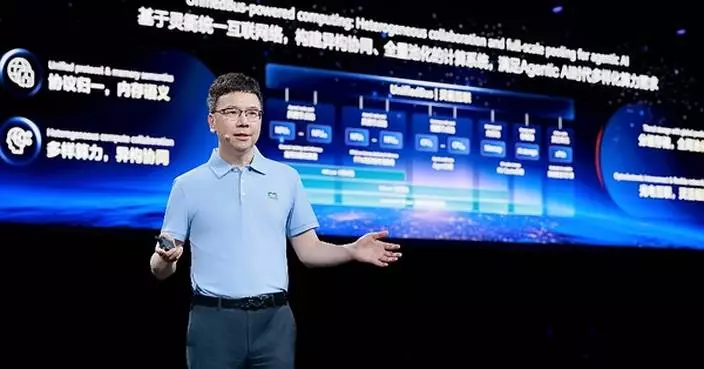
In his opening keynote, ZWSOFT CEO Mason Liu shared the company's perspectives and exploration around AI + CAD. ZWSOFT also presented new AI developments around ZW3D, ZWCAD, the ZWSOFT CAx AI Agent Platform, and a strategic partnership with Tencent Cloud.
The goal is to explore how AI can work inside professional engineering processes by understanding engineering information, applying accumulated knowledge, executing repetitive tasks, and supporting engineers across more complete workflows.
ZTE provided a concrete example of how this could translate into engineering practice. In an ongoing AI + CAD research and validation project with ZWSOFT, ZTE is applying AI to fixture design, including 3D model generation, design-rule checking, 2D drawing generation, and synchronized updates following design changes.
In one test scenario, ZTE reported that generating a complex test-fixture model was reduced from around six hours of manual design to about 10 minutes of AI generation plus one hour of engineering review, delivering close to a sixfold efficiency improvement. AI-assisted drawing generation also reduced a process that previously took around 1.8 hours to within 30 minutes, including manual checking and adjustments.
Building Beyond CAD
ZWorld 2026 also made clear that strengthening core CAD technology remains fundamental to ZWSOFT, even as the workflows around it continue to expand.
In AEC, ZWSOFT presented a path that starts with CAD and extends into interoperability, cloud collaboration, BIM, and more connected project workflows. The company shared progress around ZWBIM and early customer experience with ZWCAD 365, showing how desktop CAD, cloud collaboration, and BIM-oriented workflows can work together.
In manufacturing, ZW3D WuKong represents another part of that evolution. The new generation of ZW3D is built around a redesigned architecture for machinery engineering, with advances in parametric modeling, large assemblies, engineering drawing automation, and other core workflows.
ZWSOFT CTO Tim Fu also discussed the technology decisions and engineering challenges behind the platform and its Overdrive Kernel, underscoring ZWSOFT's continued investment in foundational technologies.
Across AEC and manufacturing, the approach is consistent: strengthen the engineering foundation first, then connect more of the data, workflows, applications, and collaboration around it.
From Technology to Ecosystem Capability
A third message from ZWorld 2026 was that technology alone does not create market impact.
Customers need software that fits real engineering environments. Technology and application partners extend platforms into specialized workflows. Local partners need the technical, marketing, sales, and customer-success capabilities to bring those solutions to market effectively.
That ecosystem dimension was visible throughout ZWorld, from customer visits and the Global VAD Roundtable to the International Forum and final-day Partner Enablement sessions at ZWSOFT's global headquarters.
The discussions went beyond product features to how ZWSOFT and its partners can jointly create demand, improve customer engagement, strengthen technical delivery, and build more scalable local capabilities. Dedicated AEC and manufacturing tracks also gave partners closer access to product roadmaps, go-to-market programs, and ZWSOFT product and business teams.
For ZWSOFT, the message from ZWorld 2026 is broader than any single product release: strengthen the core technologies behind its software, connect more engineering workflows around them, and build an ecosystem capable of turning those technologies into practical value across industries and markets.
That gives practical meaning to this year's theme, "Design the Future. Together." As engineering software evolves, ZWSOFT sees customers, partners, developers, technology providers, and engineering professionals all playing a role in shaping what comes next.
About ZWSOFT
Founded in 1998, ZWSOFT is a world-leading All-in-One CAx Solutions Provider, offering products including ZWCAD and ZW3D to support professionals across architecture, engineering, construction, and manufacturing. Serving 1.4 million users in more than 90 countries and regions, ZWSOFT develops its core technologies in-house to deliver trusted, efficient, and accessible design solutions. Guided by its mission to Empower Sustainable Innovation, ZWSOFT is committed to helping professionals worldwide design, create, and build a better future.
** This press release is distributed by PR Newswire through automated distribution system, for which the client assumes full responsibility. **
At ZWorld 2026, ZWSOFT Outlines Its Next Chapter in Engineering Software
Tencent Esports Competition Solution (ECS), a first-of-its-kind designed for large-scale intercontinental esports competitions, provides end-to-end technical support across 11 esports events, helping safeguard fair play and consistent competition across one of the most complex esports programmes in Asian Games history
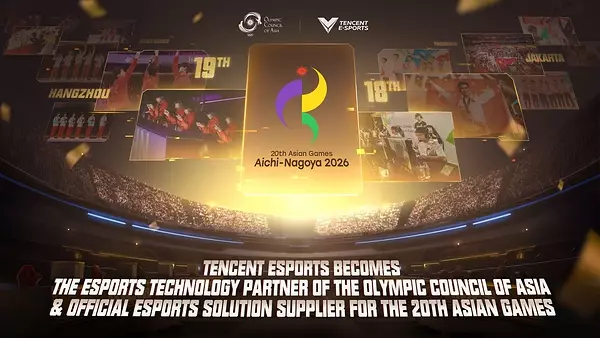
TOKONAME, Japan, Sept. 21, 2026 /PRNewswire/ -- Esports will return as an official medal event for the second time at the 20th Asian Games, with its largest programme in Asian Games history set to take place from September 22 to October 2 at Hall D of the Aichi Sky Expo in Japan. Featuring 11 events across six game categories and multiple publishers, the programme will bring together different games, devices and technical environments within a single multi-sport competition, requiring teams to coordinate across different game engines, version management systems and device formats. Tencent Esports Competition Solution (ECS) will provide end-to-end technical support across all 11 esports events.
Designed to support referees, competition operations and monitoring teams throughout the competition lifecycle, ECS covers everything from pre-match equipment checks and real-time match monitoring to post-match review and record management.
Creating a Consistent Competition Environment Across 11 Events
Unlike professional esports leagues, where technical and operational workflows can be built around the requirements of an individual game, a multi-sport event needs multiple titles, teams and competition officials to operate within a consistent framework.
ECS operates across three key stages of competition. Before a match, the Inspection Station supports checks of player peripherals, devices and the competition environment, while maintaining check-in records. During competition, the Monitoring Console tracks more than 30 indicators in real time, including device and network status, and brings together multiple video sources such as Player POV, Observer View (OB) and Hand Cam.
Following each match, the Review Room provides competition officials with access to match records and footage for post-match review, information retention, record summaries and video archiving.
Building on Asian Games Experience
ECS builds on Tencent Esports' previous experience supporting esports at the 19th Asian Games, where its technical team supported 217 matches with zero technical incidents.
Ahead of the 20th Asian Games, ECS underwent three test events between January and June 2026 in Japan, Singapore and Vietnam. These provided opportunities for the technical team to test and validate the solution across different venues, competition environments and network conditions.
The team subsequently moved into the Asian Games venue earlier this month to conduct integrated system testing ahead of the official competition.
"Esports entering multi-sport events means that its competition processes need to align with the standards of fairness established across traditional sports," said Yati Zhang, Director of Tencent Esports. "ECS translates areas that have traditionally relied on manual experience, such as equipment checks, live monitoring and officiating support, into technical processes that can be recorded, traced and reviewed. We hope ECS can serve beyond a single event and provide a reusable technical foundation for esports competitions across Asia and other competitive environments."
Developing Infrastructure for Esports Beyond a Single Event
The deployment of ECS also reflects the growing focus on building more standardised competition infrastructure as esports becomes further integrated into Asia's wider sporting ecosystem.
As part of the Olympic Council of Asia's (OCA) 10-year strategic partnership with Tencent Esports from 2025 to 2035, OCA Director General Husain Al-Musallam has highlighted the evolution of Asian esports from "event participation" towards a new phase centred on "co-building technology and systems".
"As esports continues to develop across Asia, establishing more standardised and institutionalised competition systems will be an important long-term direction," said Husain Al-Musallam, Director General of the Olympic Council of Asia. "The adoption of Tencent Esports' Competition Solution at the Asian Games represents another step towards this goal. We hope this collaboration can contribute to the development of competition systems, technical standards and the wider esports ecosystem, helping establish an Asian benchmark for the sport.
With ECS deployed across all 11 esports events at the 20th Asian Games, Tencent Esports is extending its role beyond supporting individual competitions towards developing technical infrastructure that can be applied across increasingly complex esports environments.
The Asian Games deployment will provide another large-scale test of how standardised technical solutions can support esports within a multi-sport setting.
About Tencent Esports
Tencent E-sports, established on December 9, 2016, is the world's leading and most influential e-Sports brand and event operator. Tencent E-sports has eight categories of top e-Sports titles, with events covering over 90 countries and regions. In 2023, the global viewing volume exceeded 100 billion times. Leading various professional and comprehensive aspects, including e-Sports events, education, technology, industry ecosystem, franchising, and e-Sports standards, Tencent E-sports is promoting e-Sports as a new industry. Following e-Sports becoming an official event at the Hangzhou Asian Games, Tencent E-sports launched the "Empower Esports Worldwide Series" in June 2024. This initiative aims to join hands with industry partners globally and promote e-Sports cultural exchange and long-term cooperation through open communication. The first batch of exchange activities will be held in Saudi Arabia, France, Japan, and China.
** This press release is distributed by PR Newswire through automated distribution system, for which the client assumes full responsibility. **
Tencent Esports Competition Solution to Power Esports Competition at the 20th Asian Games