TOKYO (AP) — Asian shares mostly rose early Tuesday, as the market mood turned positive from the overnight rally on Wall Street.
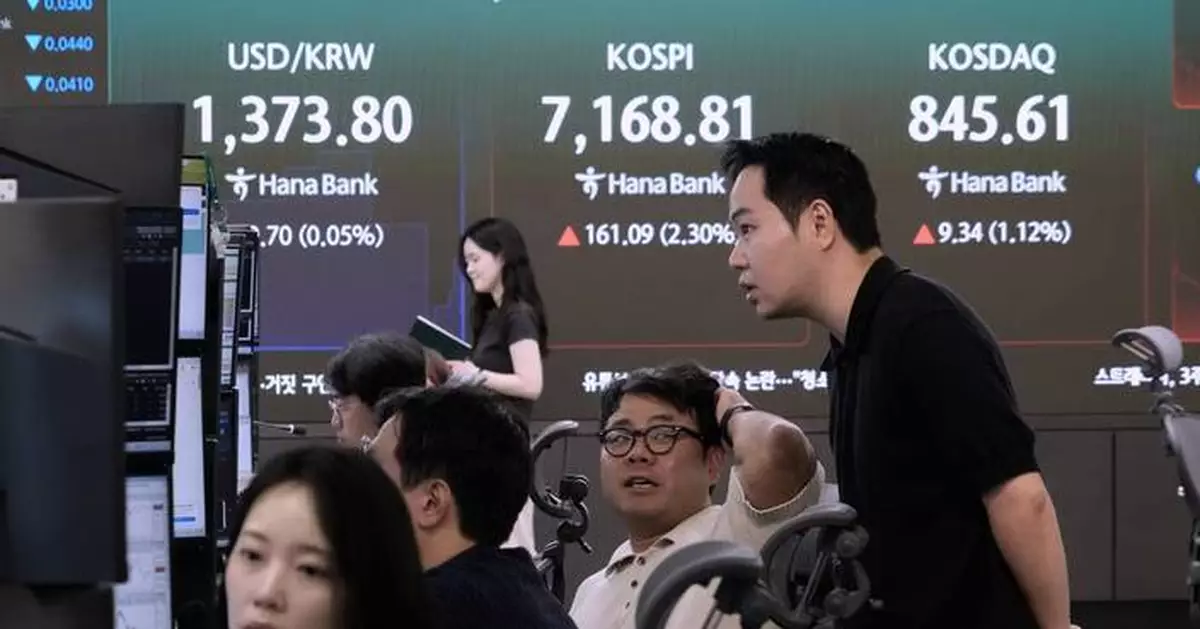
Australia's S&P/ASX 200 added 02% in early trading to 8,748.20. South Korea's Kospi jumped 1.6% to 7,120.25. Hong Kong's Hang Seng gained nearly 0.6% to 25,185.26, while the Shanghai Composite rose 0.4% to 3,964.45. Tokyo markets were closed for an extended holiday and trading resumes Thursday.
Wall Street climbed to the edge of its all-time high Monday. The S&P 500 jumped 1.5% and pulled within 0.4% of its record set last month. The Dow Jones Industrial Average added 366 points, or 0.7%, and the Nasdaq composite leaped 2.3% to its own all-time high as chip stocks and other companies in the artificial-intelligence industry led the way.
Stocks have been getting help from the recent decline in oil prices, although they rose in Asian trading. In energy trading, benchmark U.S. crude gained 0.43% to $96.19 a barrel. Brent, the international standard, rose 0.65% to $100.99 a barrel.
That’s still much higher than its roughly $72 price from earlier this summer, but it’s down from the nearly $110 it touched last week.
Oil prices have been swinging as some crude passed through the Strait of Hormuz to get to customers, though nowhere near as much as the industry would like because of conflicts in the Middle East.
Monday’s pullback in oil prices helped lower the pressure coming from the bond market. The yield on the 10-year Treasury eased to 4.95% from 5.01% late Friday after crossing above the 5% threshold last week for the first time since 2023.
Global markets are also getting a boost recently from AI stocks, which are continuing to strengthen following their worldwide slide at the start of last week. Leaders of the industry have recently warned a slowdown is needed in the industry’s development for the safety of humanity.
All told, on Wall Street, the S&P 500 rose 114.20 points to 7,764.70. The Dow Jones Industrial Average added 366.19 to 52,048.83, and the Nasdaq composite climbed 599.55 to 27,122.09.
In currency trading, the U.S. dollar edged up to 157.43 Japanese yen from 157.31 yen. The euro cost $1.1474. up from $1.1469.
AP Business Writer Stan Choe contributed to this report.
Yuri Kageyama is on Threads: https://www.threads.com/@yurikageyama

A screen shows the Korea Composite Stock Price Index (KOSPI), SK Hynix and Samsung Electronics Co. stock price at the foreign exchange dealing room of the Hana Bank headquarters in Seoul, South Korea, Tuesday, Sept. 22, 2026. (AP Photo/Ahn Young-joon)
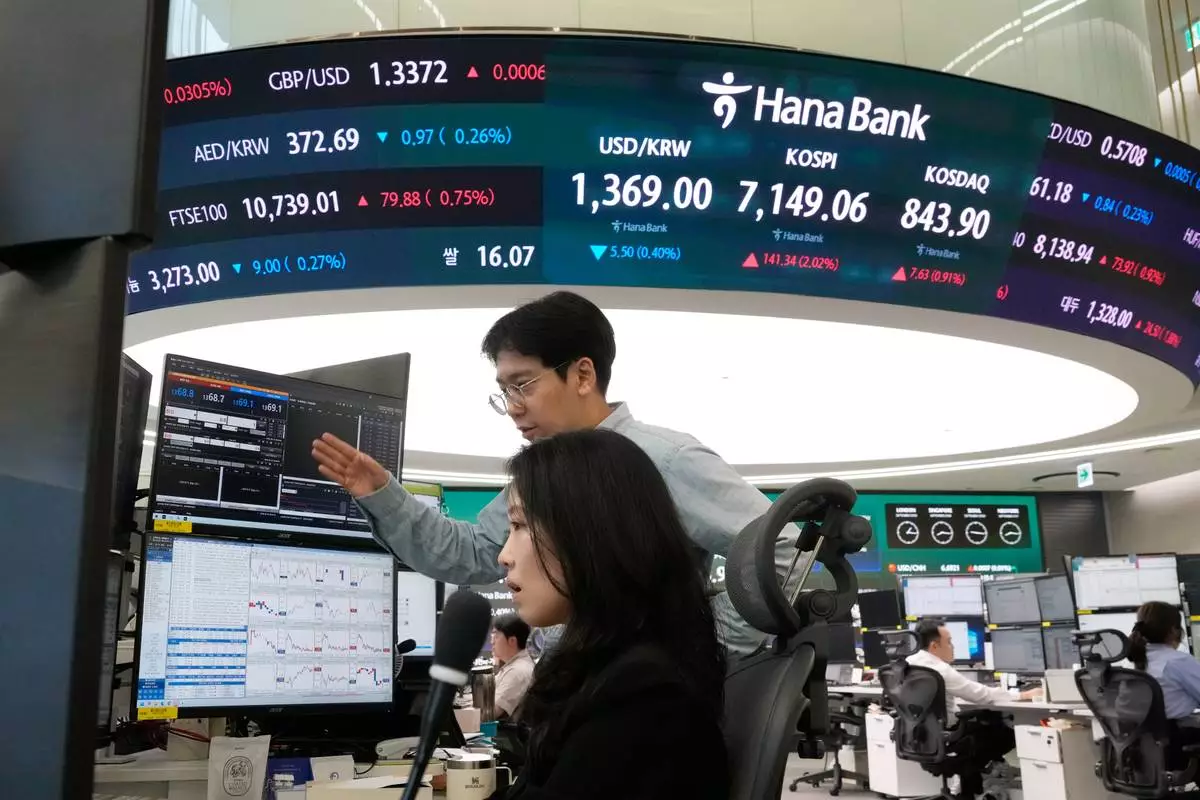
Currency traders work at the foreign exchange dealing room of the Hana Bank headquarters in Seoul, South Korea, Tuesday, Sept. 22, 2026. (AP Photo/Ahn Young-joon)
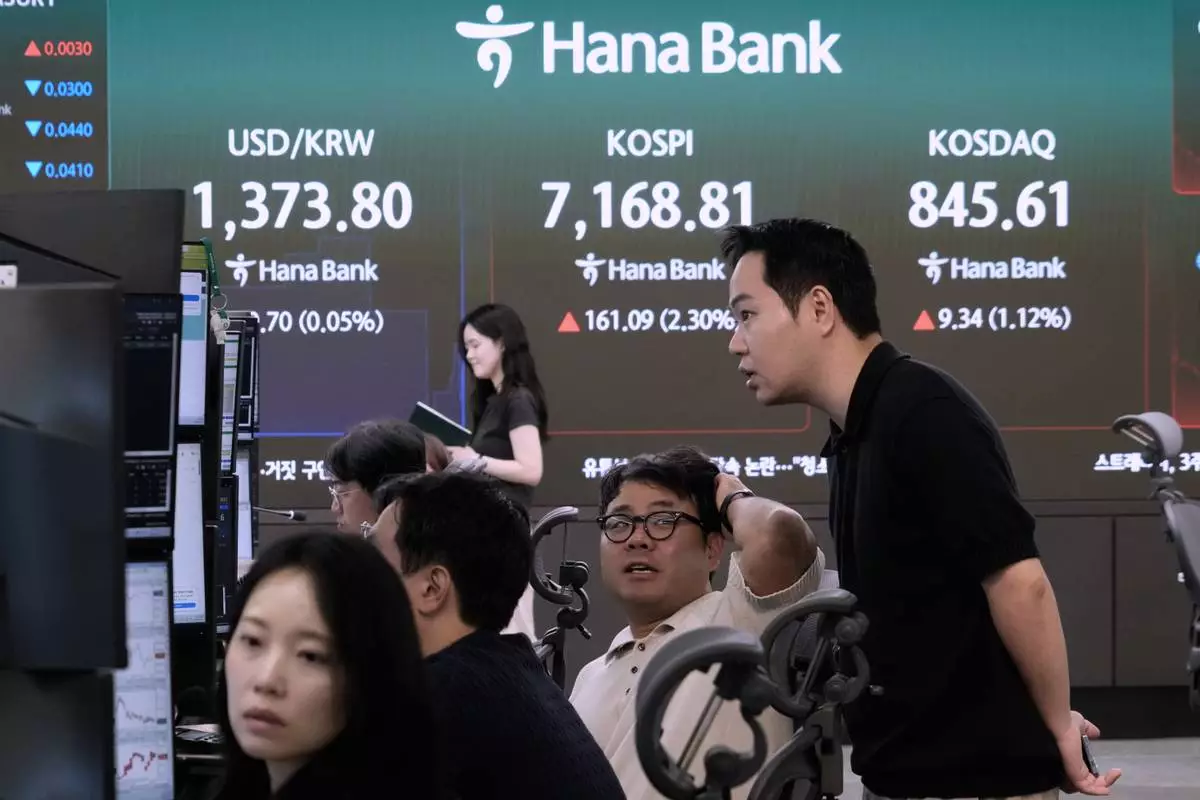
Currency traders work near a screen showing the Korea Composite Stock Price Index (KOSPI) and the foreign exchange rate between U.S. dollar and South Korean won at the foreign exchange dealing room of the Hana Bank headquarters in Seoul, South Korea, Tuesday, Sept. 22, 2026. (AP Photo/Ahn Young-joon)
SEOUL, South Korea (AP) — North Korea said Tuesday its latest missile tests involved a new weapons system of “great significance,” with photos indicating it launched a missile previously described as hypersonic.
North Korean leader Kim Jong Un said the weapon’s development would strengthen the country’s war readiness and give its enemies an “incurable headache,” the North’s official Korean Central News Agency said. He did not describe what the weapon was.
Kim observed Sunday’s tests with his teenage daughter, widely seen as a potential successor.
South Korea’s military detected North Korea firing two short-range missiles three hours apart from the eastern coastal Wonsan area Sunday. South Korea’s Joint Chiefs of Staff said the missiles flew about 450 and 600 kilometers (280 miles and 370 miles) toward the sea, while Japan’s military said they landed in waters outside the country’s exclusive economic zone.
The launches extended a recent run in military displays, including live-fire exercises and the commissioning of a new warship, as Kim continues to flaunt his growing nuclear program despite U.S. calls to revive diplomacy.
Following years of intensified testing, Kim now has an extensive arsenal of nuclear-capable missiles, including long-range weapons potentially capable of reaching the U.S. mainland and shorter-range systems designed to overwhelm missile defenses in South Korea and Japan.
Among the weapons North Korea has tested in recent years are various missile systems fitted with purported hypersonic weapons, which are designed to travel at more than five times the speed of sound. Their speed and maneuverability are intended to help them evade regional missile defenses, but some experts have questioned whether they have consistently reached the speeds claimed by the North during tests.
KCNA’s photos of Sunday’s tests showed what appeared to be two missiles tipped with conical, finned vehicles being fired from launcher trucks. Kim is seen looking at a monitoring screen that identifies the missile as a Hwasong-11Ma, a system North Korea has previously described as hypersonic.
Graphics on the screen showed a missile trajectory overlaid on a map, along with figures for a speed of 2,146 meters (1.3 miles) per second, an altitude of 35.8 kilometers (22 miles) and a range of 908.2 kilometers (564 miles). The reported distance exceeded the flight range announced by South Korea’s military. Jang Do-young, a spokesperson for South Korea’s Joint Chiefs of Staff, said the military was assessing the details from the North Korean report and cautioned that the North’s claims about missile capabilities “cannot be 100% trusted.”
The launches were the latest in a series of weapons demonstrations by North Korea even after U.S. President Donald Trump scaled back a joint military exercise with South Korea last month in an apparent effort to revive diplomacy with Kim, who has called such drills invasion rehearsals. Kim’s sister and senior official, Kim Yo Jong, dismissed Trump’s overture, saying that shortening the drill would not change its “provocative, aggressive nature.”
North Korea has a long history of ratcheting up pressure on South Korea when it doesn’t get what it wants from the United States, and Kim Jong Un has recently taken a particularly hostile stance toward Seoul, suspending virtually all inter-Korean cooperation and dialogue and declaring the South a permanent enemy.
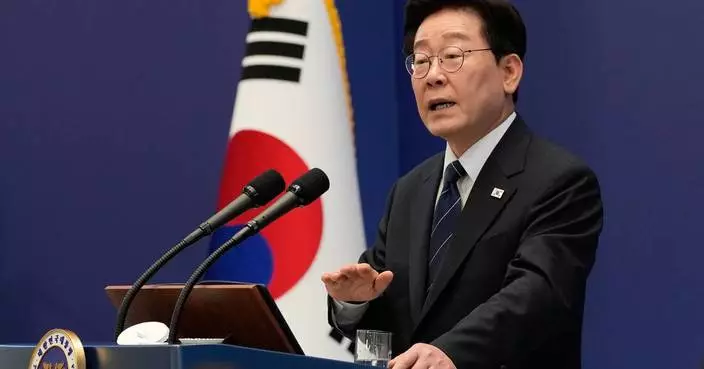
In a written response to questions by The Associated Press, liberal South Korean President Lee Jae Myung, who favors engagement with the North, expressed hope Tuesday that a resumption of Trump-Kim diplomacy would help reopen dialogue between the two Koreas. He called for a practical, step-by-step approach to North Korea’s denuclearization, with incentives offered as Pyongyang makes progress toward eliminating its nuclear weapons.
Emboldened by his advancing nuclear arsenal and deepening ties with Russia and China, experts say Kim likely sees himself as having greater leverage in any renewed diplomacy with Trump. His government has said Washington must first drop its “hostile policy” — a term Pyongyang mainly uses to describe U.S.-led sanctions and joint U.S.-South Korea military drills — and abandon demands for North Korea’s denuclearization as a precondition for talks.
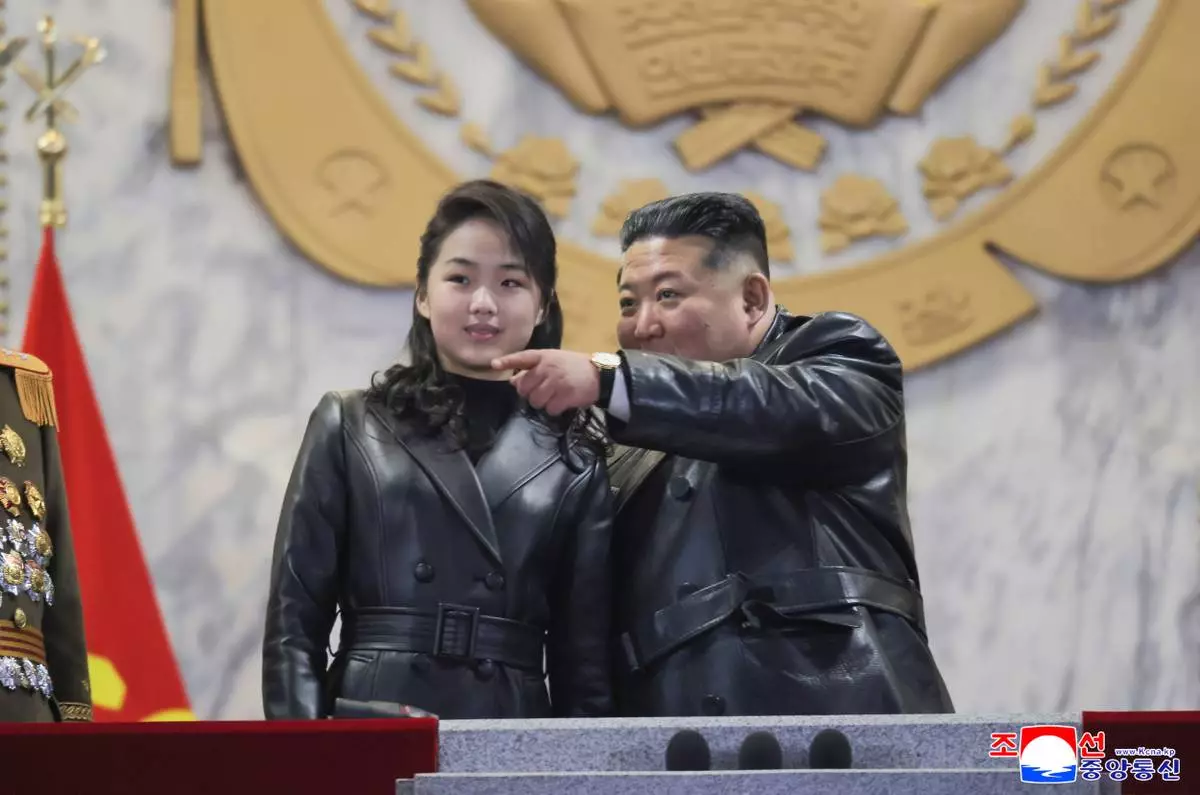
FILE - In this photo provided by the North Korean government, its leader Kim Jong Un attends a parade with his daughter in Pyongyang, North Korea, on Feb. 25, 2026 as the North wrapped up the Workers' Party congress. Independent journalists were not given access to cover the event depicted in this image distributed by the North Korean government. The content of this image is as provided and cannot be independently verified. Korean language watermark on image as provided by source reads: "KCNA" which is the abbreviation for Korean Central News Agency. (Korean Central News Agency/Korea News Service via AP, File)
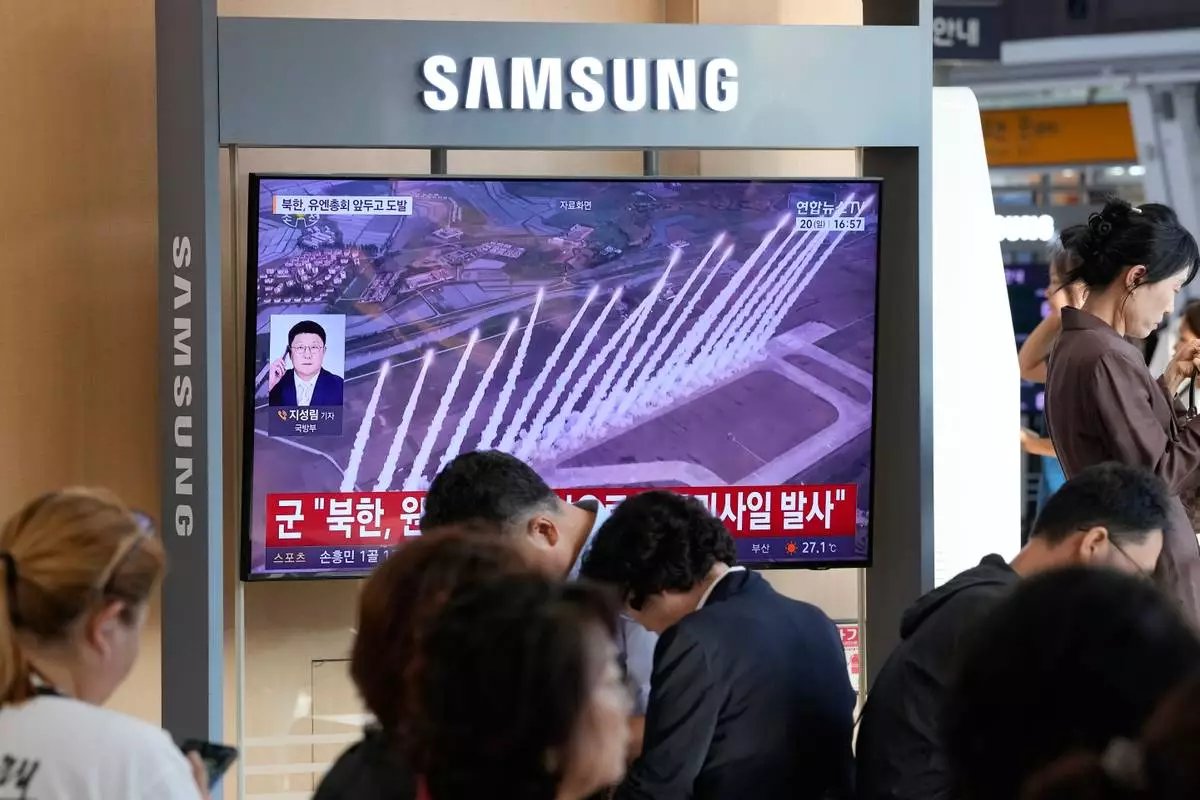
A TV screen shows a file image of a North Korean missile launch during a news program at Seoul Railway Station in Seoul, South Korea, Sunday, Sept. 20, 2026. (AP Photo/Ahn Young-joon)