
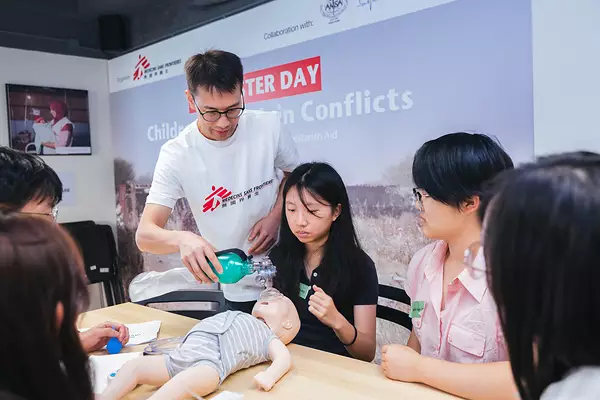
HONG KONG, Sept. 22, 2026 /PRNewswire/ -- Médecins Sans Frontières (MSF) Hong Kong held an "MSF Taster Day" workshop at its office last Saturday (19 September), attended by nearly 70 first- to third-year medical and nursing students from local universities. Guided by MSF aid workers, participants experienced practical clinical skills used in MSF projects and learned about the different healthcare needs of children affected by conflict, deepening their understanding of medical humanitarian work.
This year's event theme was "Children's Healthcare in Conflict". Participants learned that war not only causes direct casualties, but can also destroy infrastructure and health systems, force large numbers of people to flee their homes, and disrupt access to food and basic healthcare. Vulnerable populations including children and newborns can be particularly affected. According to data published by the World Health Organization (WHO) in 2024, undernutrition is linked to nearly half of all deaths among children under five globally. Food shortages and disruptions to healthcare are common in conflict settings, increasing the risk of malnutrition among affected children. Over time, malnutrition can weaken the immune system, making children more vulnerable to illness and complications, and becoming life-threatening in severe cases.
Students Experience Clinical Skills Used in MSF Projects
The workshop showed that children affected by conflict need more than life-saving care for war-related injuries. They also need continued access to healthcare such as vaccination, mental health support, nutritional treatment and pain management.
Three Hong Kong MSF aid workers, including obstetrician-gynaecologist Dr. Rayman Wong, emergency nurse Chiu Cheuk-pong and paediatric nurse Fok Shun-yat, demonstrated how simple tools can be used to provide care for children in settings with limited medical resources. These included using a bag-valve-mask device to help newborns breathe, providing Kangaroo Mother Care for preterm and low-birth-weight babies, assessing and managing pain in newborns, using mid-upper arm circumference (MUAC) tapes to screen children for malnutrition, and treating malnourished children with ready-to-use therapeutic food (RUTF).
A second-year medical student from The Chinese University of Hong Kong, who attended the event for the first time, said: "The Taster Day was a valuable experience. It helped me understand that, for children affected by conflict, survival is only the most basic need. They also need other forms of healthcare as they grow. The experiences shared by the three MSF aid workers also left a deep impression on me. They made me realise how important medical humanitarian assistance can be for patients living through crises. For some people, it may be one of the few sources of life-saving support available to them. The event also encouraged me to think about how I could use my professional skills in the future to help people who need them most."
Spotlight on the Rohingya Crisis and Children's Health in Refugee Camps
The Taster Day also featured exhibition panels on the Rohingya crisis, nine years after the mass displacement of Rohingya people from Myanmar in 2017, helping participants learn more about this protracted yet often forgotten humanitarian crisis. According to United Nations data, around 1.3 million Rohingya refugees were living in Bangladesh as of early 2026, more than half of them children.
Last month, MSF published findings from Kutupalong Hospital in Cox's Bazar, Bangladesh, drawing on clinical observations and facility-based data collected between 2021 and 2025. The report highlighted that Rohingya children are arriving for medical care later and in more serious condition, while their healthcare needs are becoming increasingly complex, particularly in relation to malnutrition and mental health.
MSF aid worker Chiu Cheuk-pong worked in Bangladesh in 2017 as part of MSF's response to the Rohingya crisis, screening and treating malnourished Rohingya children who had fled Myanmar. "Nine years on, the Rohingya crisis is receiving less attention from the international society, while its consequences continue to affect a generation of young Rohingya growing up in the camps," Chiu said.
"As international humanitarian funding has been significantly reduced, Rohingya refugees are finding it increasingly difficult to access basic food and healthcare. Children are increasingly struggling to access the essentials they need to survive and grow. I hope participants will share what they learned and experienced at the Taster Day, helping more people understand the Rohingya crisis."
About MSF
MSF is an independent international medical humanitarian organisation. We are committed to providing emergency medical assistance to people affected by armed conflict, epidemics and natural disasters, and those who have been excluded from the health care system. MSF will only provide assistance based on people's needs, regardless of race, religion, gender or politics.
** This press release is distributed by PR Newswire through automated distribution system, for which the client assumes full responsibility. **

70 Hong Kong Medical and Nursing Students Explore Children's Healthcare in Conflict at MSF Taster Day
70 Hong Kong Medical and Nursing Students Explore Children's Healthcare in Conflict at MSF Taster Day