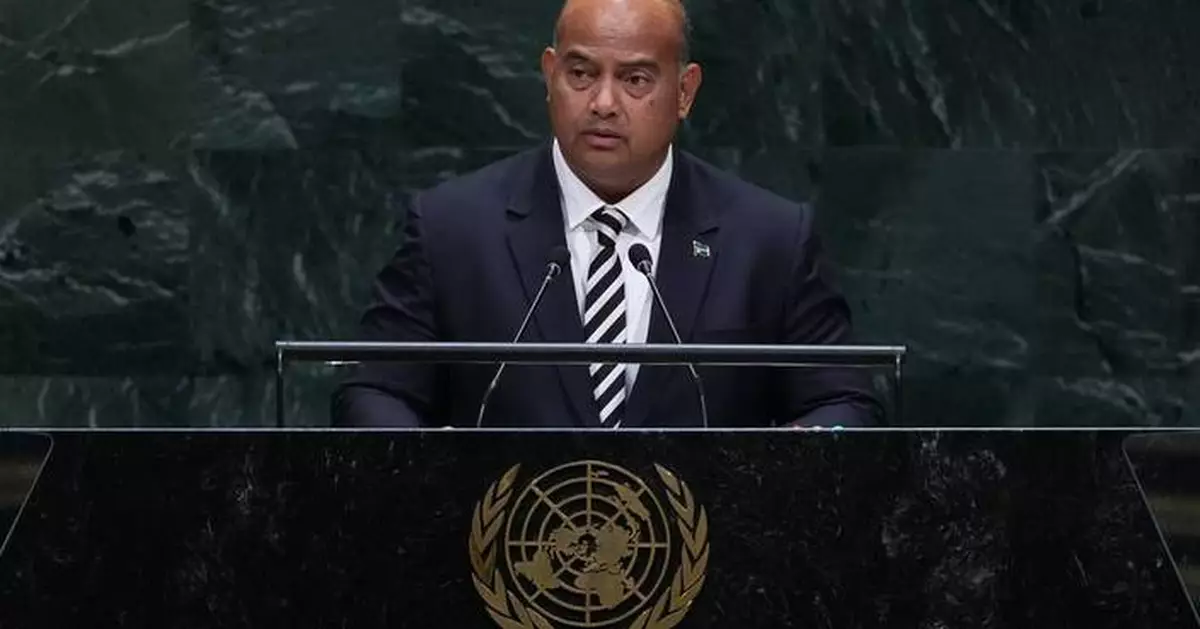
NEW YORK (AP) — His voice forceful and proud, he rose in front of the world's largest gathering of leaders on behalf of his nation and announced that he had something important to say. The tiny South Pacific island nation of Nauru, its president said, had altered its name — and reclaimed its heritage in the process.
“I have traveled far,” David Adeang said Tuesday at the United Nations.
What was known to the world for many years as Nauru, Adeang said, was returning to the name and pronunciation of its past: Naoero.
“There are moments in the life of a nation when its people are called to remember who they have always been,” Adeang said in his speech at the U.N. General Assembly in New York. “This is such a moment for us.”
Though the names are similar and, in essence, the same word, the shift in spelling and pronunciation represents the nation's effort to recast — rebrand, even — itself for its own people as much as for the outside world. He called it not a change but an effort to “affirm a truth.”
“For many years, the world has known our country as Nauru. Nauru is how our name sounded to those who found it hard to say, and the world kept it,” Adeang said. “But it is not the name our people used among themselves.”
The nation, an eight-square-mile island with about 12,000 people, became independent in 1968 after longtime colonial rule under the United Kingdom, New Zealand, Australia and Germany. It announced the renaming in August after signaling its intent in February.
The country’s international code is changing from NRU to NRO and its people will be known as dei-Naoero instead of Nauruan. Commonly known abroad by the pronunciation of Now-roo, the new name is spoken as Now-ero.
Across the past century, other nations have renamed themselves or tweaked their names for various reasons, from modernization to rejection of colonialism.
The African nation of Eswatini changed its name from Swaziland in 2018. In Africa, Dahomey became Benin after a 1975 coup and Rhodesia became Zimbabwe in 1980 after shedding colonial rule. Siam became Thailand in 1939 to foster ethnic unity and shed a foreign label.
Turkey, meanwhile, has been officially named Turkiye since 1920 but requested in 2022 that the United Nations use the spelling and pronunciation as its name in English as well — in part to avoid confusion by underscoring that the bird wasn't the word.
The list goes on. Persia became Iran. Burma became Myanmar. Upper Volta is now Burkina Faso, Gold Coast is Ghana and Ceylon is Sri Lanka.
A name, obviously, is a pivotal and intimate expression of a nation's identity on any stage, domestic or international. Adeang's remarks Tuesday reflected this as he carefully pronounced the name to differentiate it from its former pronunciation.
“We do not make this choice to erase our past. We make it because we honor it,” he said. “That name carries the memory of our ancestors, our language, and our identity. It has been there all along. Never lost, never absent. Today, we restore Naoero.”
And then, after completing his address about the issues that face his people — rising seas, economics, respect on the global stage — he concluded his address with three words:
“Say our name.”
Ted Anthony has written about international affairs for The Associated Press since 1995.
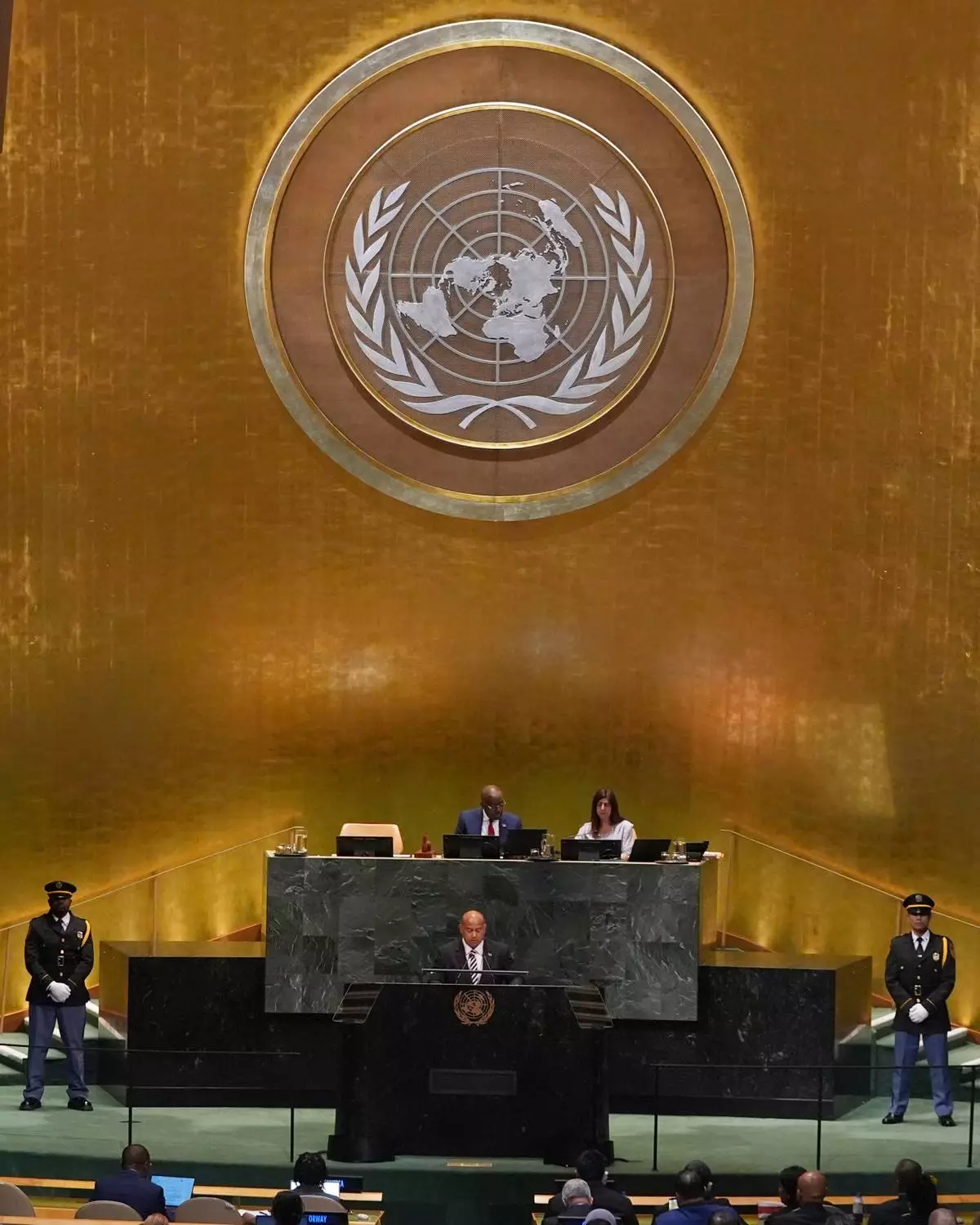
President of Naoero, David Ranibok Adeang addresses the 81st session of the United Nations General Assembly at U.N. headquarters Tuesday, Sept. 22, 2026. (AP Photo/Frank Franklin II)
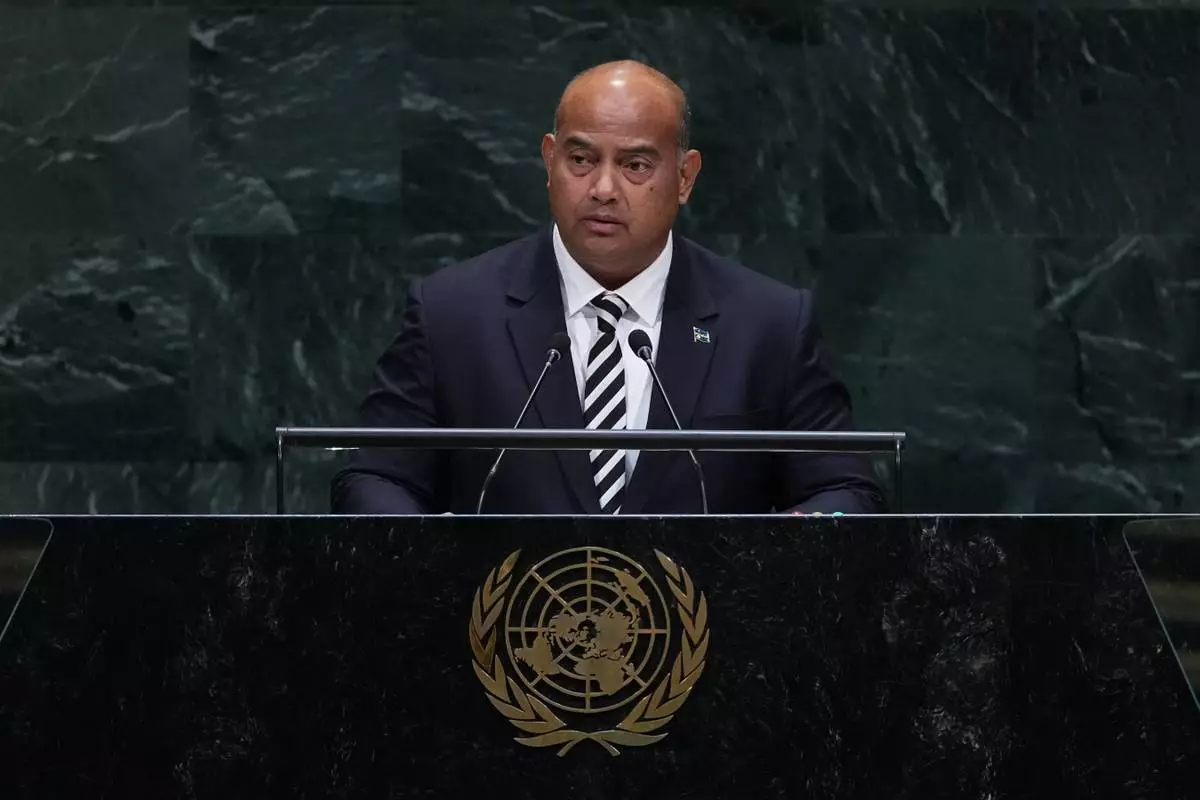
President of Naoero, David Ranibok Adeang addresses the 81st session of the United Nations General Assembly at U.N. headquarters Tuesday, Sept. 22, 2026. (AP Photo/Frank Franklin II)
President Donald Trump said U.S. and Iranian officials met Tuesday, shortly after he threatened in his address to the U.N. General Assembly that he may “annihilate” the Islamic Republic if a deal isn’t reached soon to end nearly seven-month war. Trump told reporters about the meeting but offered few details about the talks.
Trump returned to the U.N. General Assembly at a tumultuous moment for the world — and for his presidency.
The president used his address to tick off progress — including adding private sector jobs, stemming illegal migration and curbing crime — before defending his decision to start a war with Iran. He accused Iran of stalling to make a deal to fully reopen the Strait of Hormuz and negotiate an endgame to the war until after the midterm elections in the U.S.
The global economy, meanwhile, continues to roil from the war.
Trump later held talks with new British Prime Minister Andy Burnham and Japanese Prime Minister Sanae Takaichi.
Also, Trump is hosting Chinese leader Xi Jinping in Washington this week as economic and tech competition escalates between the two countries. Both leaders are aiming to stabilize fragile ties, though no major agreements are expected. The meeting itself is seen as significant given the deep differences and a lack of trust between the United States and China.
Here's the latest:
In his inaugural speech at the U.N. General Assembly, British Prime Minister Andy Burnham said world leaders must set up global standards to oversee artificial intelligence because “fundamental decisions on this technology are too important to be left to chance.”
Burnham said the U.K. will try to persuade other countries to adopt rules on transparency and access to AI models — and, even tougher, to get tech companies to sign on, too.
He said AI has immense potential but will also be “a source of disruption to the way we live and work — and a multiplier of risk.”
Burnham also said Russia and other states are using AI-augmented misinformation and disinformation to corrode democracy, something he said Britain has faced in the decade since it voted to leave the European Union. He said he has asked British security chiefs to set up a National Center for Information Defense to counter the threat.
Sen. Tim Kaine says it’s time for his Republican colleagues to back a war powers resolution to halt the president’s military actions.
“When he’s standing before the U.N. today and saying that, you know, his decision is whether to annihilate Iran — who talks like that?” said Kaine, the Democrat from Virginia.
The Senate is expected to try again this week to pass a war powers resolution, but most have fallen short of the support needed in the GOP-controlled chamber.
“We have spent 250 years as a nation, not perfect, trying to be a strong and reliable neighbor. He’s trying to turn us into a global bully,” Kaine said. “And it’s time for my colleagues to quit letting him do it.”
The Trump administration’s whole-of-government effort to find and prosecute noncitizens illegally on state voter rolls has resulted in about 1,600 voter fraud cases that have led to 160 arrests, Homeland Security Investigations senior official Matthew Millhollin said in a press briefing Tuesday.
Those numbers fall far short of the hundreds of thousands of noncitizen voters that Trump and the Department of Homeland Security have previously suggested were on the rolls. They also represent a tiny fraction of the country’s more than 211 million active registered voters.
Ahead of November’s midterms, which will determine control of Congress for the final two years of his term, Trump has taken extensive measures to try to crack down on noncitizen voting. It’s something he claims is rampant and marring elections across the nation. But research shows it is incredibly rare.
▶ Read more
“Fundamentally, you know, we just we need more capable allies; we need allies that just have more stuff in their inventory,” Matthew Whitaker said while participating in a panel discussion in Iowa alongside NATO Secretary-General Mark Rutte.
Whitaker also argued at the talk sponsored by the Chicago Council on Global Affairs that the capabilities of America’s allies have been “hollowed out by the illusory peace dividend post-collapse of the Soviet Union” and that U.S. allies “don’t have the ability to participate in what we would need them to do.”
Whitaker did, however, praise the ability to use the bases of European allies, noting that they were crucial in both the bombing of Iranian nuclear sites and the ongoing war with Iran.
The president has arrived at the Lotte Palace Hotel for a reception with fellow leaders and senior officials from around the globe.
Trump is expected to have a brief engagement with Venezuelan Interim President Delcy Rodriguez during the gathering.
It will be the first meeting between the two leaders since Trump in January ordered a U.S. military operation to capture then-President Nicolás Maduro and swept him off to New York City to face federal narco-terrorism and drug trafficking charges. Maduro’s lawyers have objected to the U.S. military action that snatched him from power.
British Prime Minister Andy Burnham said failure to deliver a two-state solution will “corrode trust” in politicians who have talked about the issue but not taken action.
Burnham chaired a meeting at the U.N. General Assembly on Tuesday on the issue, alongside French President Emmanuel Macron, Canadian Prime Minister Mark Carney and Saudi Foreign Minister Faisal bin Farhan.
Burnham told delegates from dozens of countries that the U.K. has banned trade with Israeli settlements in the West Bank because the “E1” settlement expansion plan is “a deliberate attempt to block a two-state solution.”
He said: “We all live in an era of low trust in politics. Many people in this room, many politicians around the world, have spoken for decades about a two-state solution. But if we fail to back those words with deeds, we will further corrode trust in the political, diplomatic and international process.”
Ukrainian President Volodymyr Zelenskyy says the war with Russia would end if U.S. President Donald Trump applies more pressure on Russian President Vladimir Putin and if China and India stop buying oil from Russia.
“It’s enough to stop them — they will not have enough money,” Zelenskyy told The Wall Street Journal on Tuesday following a day spent at the United Nations.
Zelenskyy said Russia’s energy sales to China, India and Turkey are propping up Russia’s economy.
During the same interview, Zelenskyy said that Trump on Tuesday did not ask him to stop bombing Russian oil refineries. However, he acknowledged that the issue has been raised before by American partners over concerns of rising energy prices.
But Zelenskyy said Ukraine has to respond strongly to Russian attacks on its own energy infrastructure.
This week’s summit between U.S. President Donald Trump and China’s Xi Jinping is unlikely to produce a meaningful breakthrough, say analysts who study relations between the world’s two biggest economies.
“The visit is likely to be heavy on optics and symbolism but light on substantive progress,’’ Edgard Kagan of the Center for Strategic and International Studies wrote Tuesday.
Louise Loo, head of Asia economics for Oxford Economics, likewise wrote Tuesday that the “most likely outcome’’ is merely an extension of a U.S.-China trade truce that is scheduled to expire in November.
“More substantive deliverables are possible,’’ Loo wrote, “but are likely to remain concentrated in areas where concessions are relatively easy to reverse. These could include lower tariffs on lower-tech, non-strategic goods; additional Chinese purchases of U.S. agricultural products and aircraft; the removal or reduction of China’s 15% tariff on U.S. LNG; and firmer commitments to improve the flow of rare-earth and magnet export licenses.’’
Later the delegation’s head, Cuban Foreign Affairs Minister Bruno Rodríguez, rejected what he called the “falsehoods” and “slanders.”
“The US government is unable to accept that Cuba is, and has the right to be, a fully independent and sovereign country,” Rodríguez wrote on X.
“The economic blockade, including the energy siege, only threatens Cuba and the rest of the nations. It is an act of genocide and collective punishment. We are a country of peace and we deserve peace,” he said.
The joint military command said in a statement that his threats during his speech to the U.N. General Assembly were intended for “domestic propaganda” rather than reflecting realities on the ground.
The statement added that repeated U.S. threats amid what it described as military “wear and tear” showed “strategic desperation,” warning that Iran is “in full preparedness to inflict even more severe, crushing, and unpredictable blows” to the U.S. and Israel.
The former vice president said it is “abhorrent” for the president to strip CNN, Politico and MS Now of their White House press credentials.
“That man is afraid of the voice of the people and that the people understand and know what he’s doing,” she told reporters after an event with Democratic Michigan Senate nominee Abdul El-Sayed.
The media outlets have filed a joint federal lawsuit challenging Trump’s actions as a violation of the First and Fifth amendments.
As Harris has ramped up her political activity in this midterm election year, she has navigated Trump carefully. She criticizes her 2024 presidential campaign rival when asked, as she did during her book tour last year. But she has not been as aggressive as some other potential 2028 presidential candidates in issuing statements or social media posts at every notable turn of Trump’s turbulent second presidential term.
In a Senate floor speech on Tuesday, Mississippi Sen. Roger Wicker said that had the White House asked him for advice, he would have suggested that Trump not invite the Chinese leader “based on all of the troubling issues we have with President Xi and the Chinese Communist Party.”
Wicker suggested a list of topics that Trump could discuss with Xi at the state dinner on Thursday, even though “I would not have scheduled such a thing.”
“As guests converse over the meal, the president might inquire about the purposes of China’s massive military buildup, or about China’s clear support for Iran,” Wicker said.
Wicker said that “during every minute of dialogue” Trump should keep in mind that “his guest is a brutal, unelected and oppressive dictator who seeks to dominate his neighbors and whose massive military arsenal is aimed directly at the United States of America.”
The former vice president and Michigan Senate nominee spent more than an hour sitting side-by-side at a Black-led birth center for a roundtable about Black maternal health and mortality.
“I’m here to support Dr. El-Sayed because on this subject, I know he will be a champion,” Harris said.
It is Harris’s opening campaign trip of the midterms’ fall campaign stretch.
For El-Sayed, it was an opportunity to have the first Black vice president vouch for him in Wayne County, where he struggled with Black voters in his narrow primary victory last month.
Harris said the election was a chance to provide a “stopgap” against the Trump administration.
She will attend a local NAACP event later Tuesday.
Acting Deputy Attorney General Trent McCotter said during a news conference that 34-year-old Damon Matai Seei was arrested on Tuesday and appeared in federal court in Salt Lake City to be arraigned.
It wasn’t immediately clear who Seei’s attorney was.
Prosecutors said Seei discarded the mail-in ballots in a dumpster soon after his shift began in early June, when Utah was conducting a primary election. Officials did not give a motive, but Melissa Holyoak, the U.S. attorney for Utah, said Seei indicated there was no political agenda.
The Trump administration has pledged an additional $31 million in flood assistance for Nepal as it struggles to recover from devastating floods that hit the Nepalese-Chinese border last month.
The new funding announced on Tuesday on the sidelines of the United Nations General Assembly brings the total amount of U.S. flood aid to $36 million since the August 26th disaster, two senior officials said.
Several million dollars of the assistance is being devoted to forensic analysis and identification of victims. Sixty-nine Americans remain missing and are presumed dead on the Nepalese side of the border.
The U.S. president said that his two diplomatic representatives, Steve Witkoff and Jared Kushner, had “a very productive meeting today” with Iranian mediators.
Trump suggested there is momentum for a peace deal with Iran. The president has previously that the war with Iran that began at the end of February would only last a few weeks, only for the conflict to continue and keep energy prices elevated.
Trump was speaking at a meeting of the Gulf Cooperation Council and was joined by officials from Bahrain, Iraq, Jordan, Kuwait, Oman, Qatar, Saudi Arabia and the United Arab Emirates.
The oil industry’s top lobbying group is warning the Trump administration that a possible ban on diesel exports could exacerbate refining challenges and hurt consumers.
Trump said Tuesday he has asked Treasury Secretary Scott Bessent to examine whether an export ban could help stem rising domestic diesel prices, which have spiked above $6 per gallon.
Mike Sommers, president and CEO of the American Petroleum Institute, said that while he understands “Americans are hurting from rising diesel costs driven by an unprecedented disruption to global refining capacity” because of the Iran war, an export ban “would only compound the problem.”
Sommers said “the answer is more supply and more flexibility — not new restrictions that risk making a difficult situation worse.”
Farm state senators, including Republicans, have urged an ban on diesel exports.
The president has asked members of the U.S.-created “Shield of the Americas” bloc to collectively impose sanctions on two dozen criminal gangs and cartels that his administration has accused of “narcoterrorism” throughout the Western Hemisphere.
Trump made the call at a meeting with leaders and senior officials from the bloc held at United Nations headquarters on Tuesday on the sidelines of the annual U.N. General Assembly. Should the group agree, its members will join the United States in blacklisting 24 gangs as “foreign terrorist organizations.”
That designation brings with it a variety of sanctions depending on each nation’s laws and opens them up to potential military action.
“I’m asking all nations in the Shield of the Americas to formally designate narcoterrorists as common threats to stability and apply crushing sanctions against all 24 US designated foreign terrorist organizations,” Trump said. It was not immediately clear if all the members had agreed.
The former vice president and 2024 presidential nominee is at Birth Detroit, a Black-led birth center, with Michigan’s Democratic Senate nominee.
Harris and El-Sayed are sitting beside each other at a U-shaped table with community representatives to talk about policies that affect health outcomes for Black women and their children.
El-Sayed needs to shore up his support among Black voters as he tries to hold a critical Senate seat for Democrats. El-Sayed’s primary opponent, Rep. Haley Stevens, carried the Detroit area and Republican nominee Mike Rogers has been campaigning there hoping to limit the usual Democratic advantage.
For Harris, the visit launches the public phase of her midterm campaigning for fellow Democrats. Some Democrats around the country have said they don’t want the 2024 presidential nominee’s help as she considers whether to seek the presidency again in 2028.
Harris lost Michigan narrowly two years ago.
Ukraine has continued to press the U.S. for more Patriot interceptors to defend against Russia’s ballistic missiles, but is yet to get any confirmation, President Volodymyr Zelenskyy told reporters at the United Nations on Tuesday
“They are positive to help us, but I didn’t get the very concrete answer,” Zelenskyy said.
Defense experts say the U.S. has been experiencing a global shortage of Patriot interceptors because many have been expended to defend against Iranian attacks on U.S. and allied bases in Middle East.
Zelenskyy spoke of the urgency of needing the weapons, which can shoot down Russia’s more advanced ballistic missiles. The shortage in Ukraine has left Kyiv and other cities increasingly exposed to devastating attacks.
“I’m asking United States to help me now, to help our people, to save our people,” he said.
U.S. Secretary of Education Linda McMahon described HBCUs as “engines of opportunity” in announcing the funding increase during a White House summit of school leaders.
Trump has long called himself a champion of HBCUs. During his first term, Congress added $250 million a year for HBCUs. And last year the administration redirected nearly $500 million in federal funding toward HBCUs and tribal colleges, an investment covered primarily by cuts to other colleges serving large numbers of minority students.
Trump also signed an executive action last year that pledged the annual White House summit, an advisory board and other support for HBCUs. While that executive action won praise from some Black universities, it drew pushback from the NAACP, which described the president’s executive action as hypocritical coming on the heels of efforts to dismantle diversity, equity, and inclusion initiatives across the country.
The first lady held a luncheon in New York City for members of her Fostering the Future Together program.
Several upcoming events will be hosted by her counterparts during the ASEAN summit in the Philippines, a European regional meeting in Poland and a Caribbean regional meeting in St. Kitts and Nevis.
Melania Trump said she will host a meeting during the G20 summit in Miami in December.
Nearly 60 countries have joined the program, which encourages countries to support children through technology and education.
She also announced new partnerships with several leading technology companies. Tim Cook, the immediate past CEO of Apple, was in the audience.
“The future of our world will be determined by what we do for our children today,” Melania Trump said.
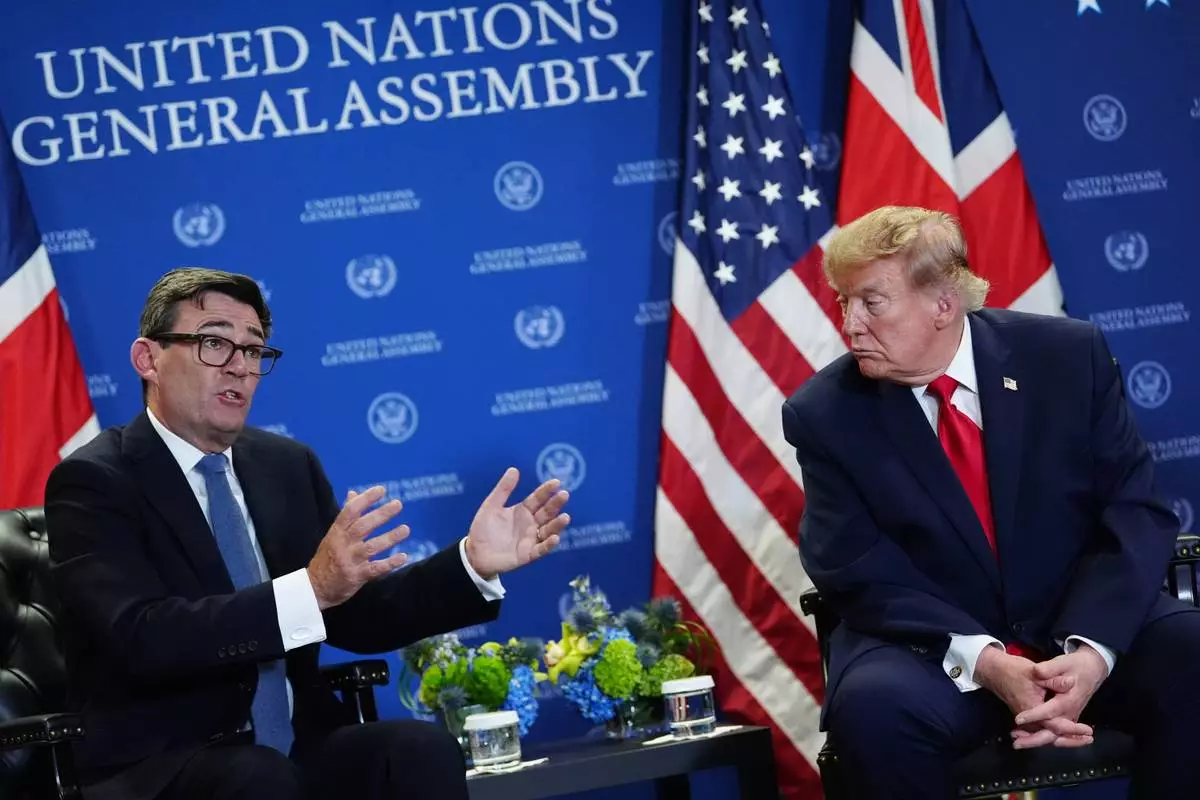
President Donald Trump meets with Britain's Prime Minister Andy Burnham during the United Nations General Assembly, Tuesday, Sept. 22, 2026, at the UN headquarters. (AP Photo/Julia Demaree Nikhinson)
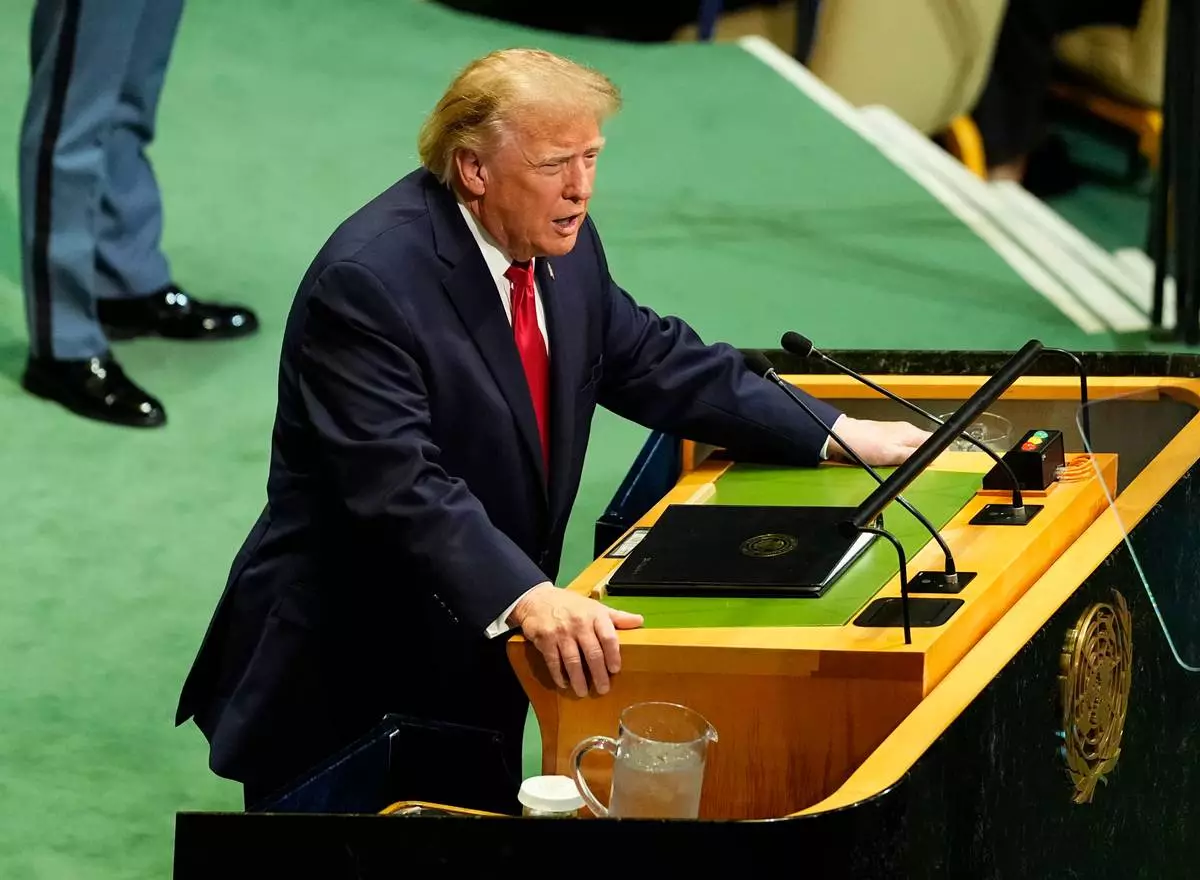
President Donald Trump speaks at the United Nations General Assembly (UNGA) at the UN headquarters on Tuesday, Sept. 22, 2026. (Justin Tang/The Canadian Press via AP)
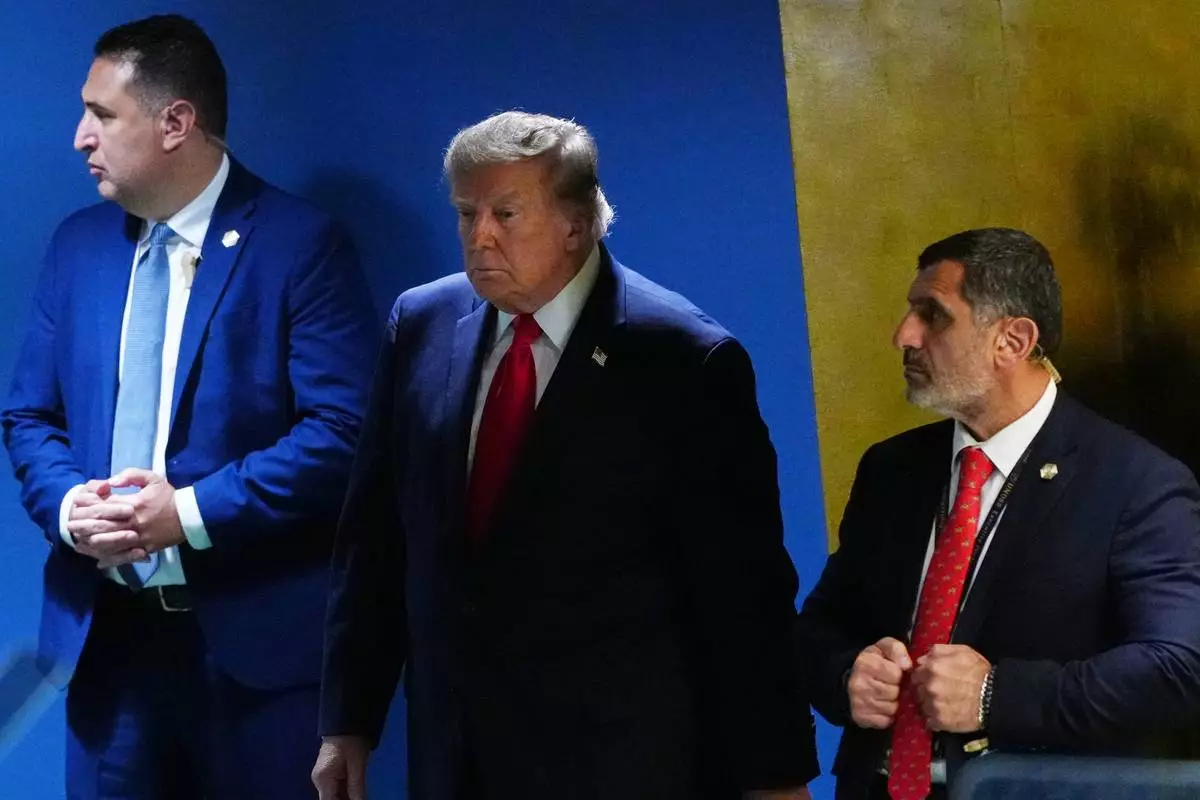
President Donald Trump arrives to speak to the United Nations General Assembly, Tuesday, Sept. 22, 2026, at the UN headquarters. (AP Photo/Julia Demaree Nikhinson)
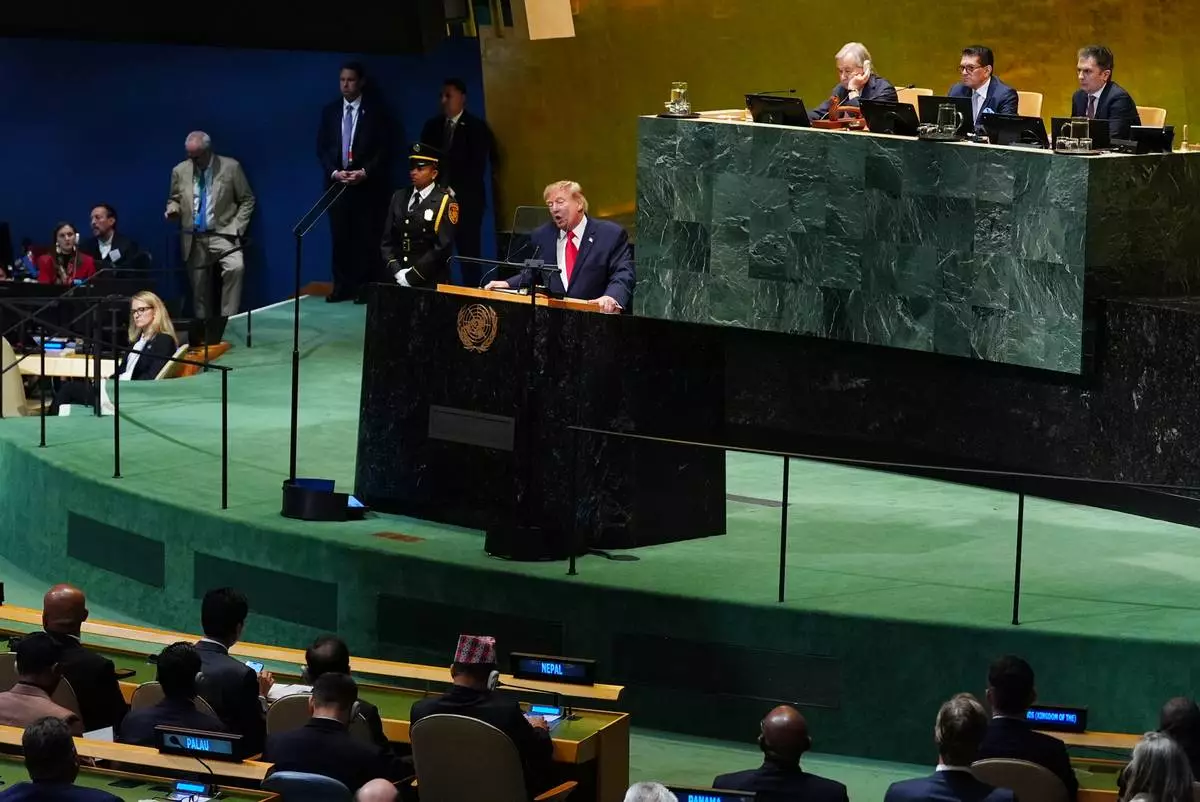
President Donald Trump speaks to the United Nations General Assembly, Tuesday, Sept. 22, 2026, at the UN headquarters. (AP Photo/Julia Demaree Nikhinson)
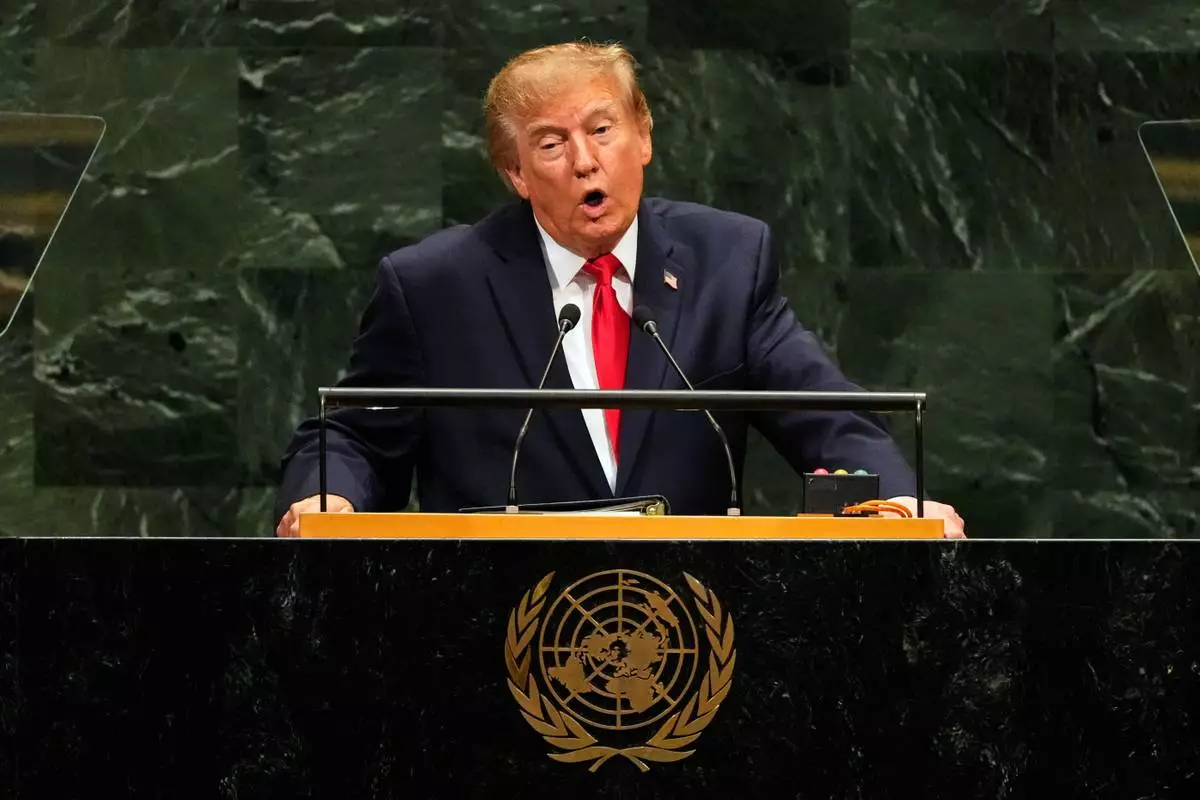
United States President Donald Trump speaks during the 81st session of the United Nations General Assembly at United Nations headquarters, Tuesday, Sept. 22, 2026. (AP Photo/Seth Wenig)
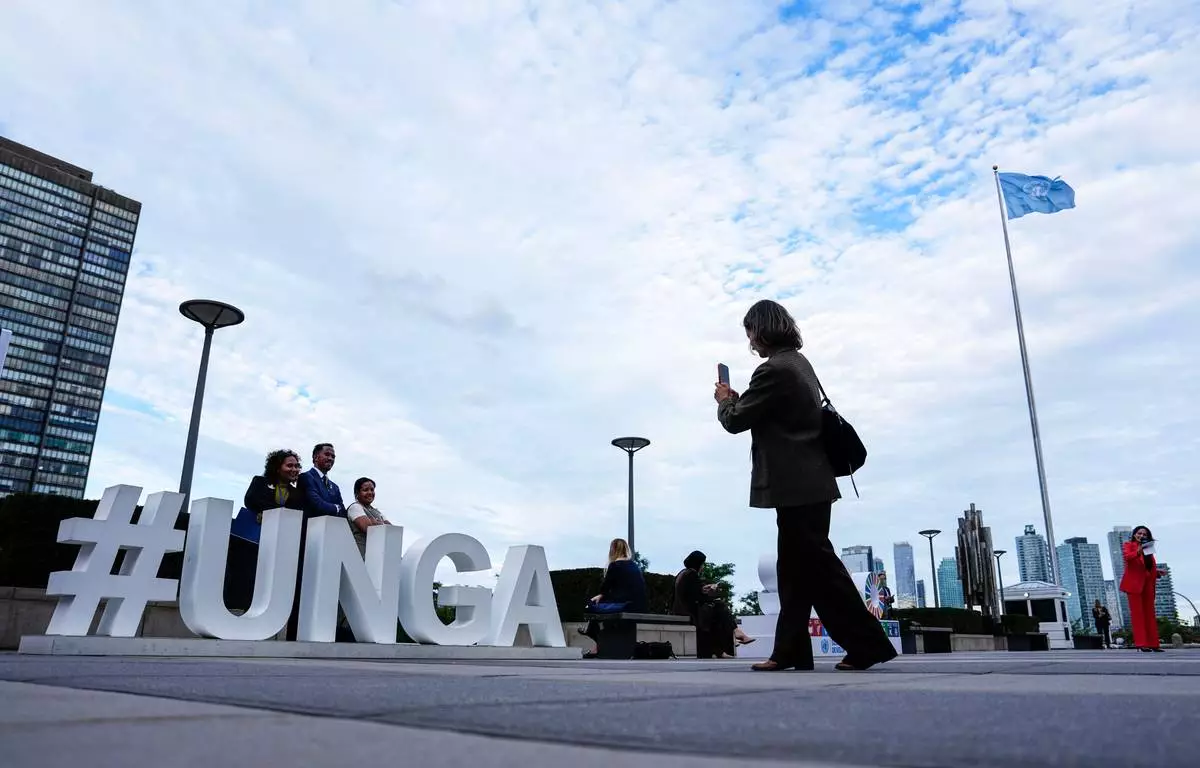
People pose as they arrive for the United Nations General Assembly (UNGA) at the UN headquarters, Monday, Sept. 21, 2026. (Justin Tang/The Canadian Press via AP)
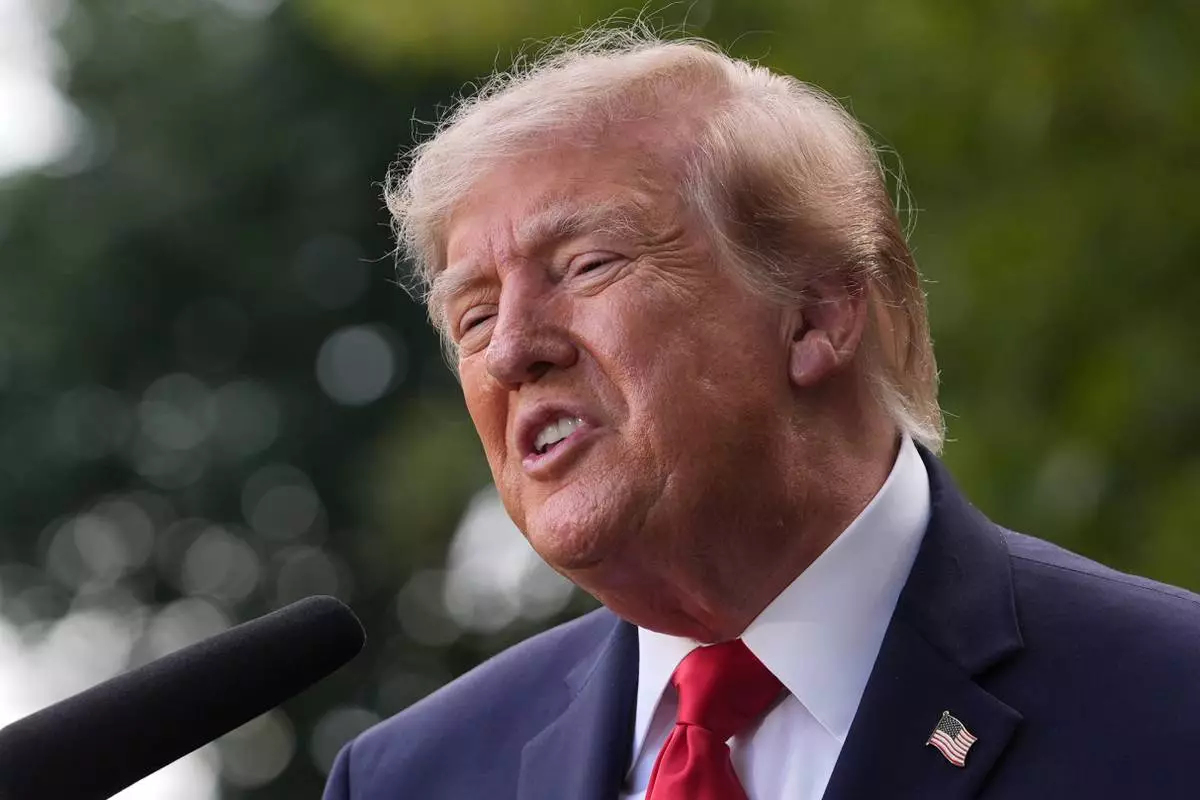
President Donald Trump and New York City Mayor Zohran Mamdani speak to reporters at Gracie Mansion, Monday, Sept. 21, 2026, in New York. (AP Photo/Julia Demaree Nikhinson)