DALLAS--(BUSINESS WIRE)--Sep 23, 2026--
Jacobs (NYSE: J) has been reappointed to National Grid’s Asset Health Intervention Programme, securing the Central region and expanding its role to include the Southeast and Southwest regions. The five-year program focuses on renewing U.K. critical infrastructure to meet the future needs of consumers as reliance on electricity increases.
This press release features multimedia. View the full release here: https://www.businesswire.com/news/home/20260923053734/en/
Jacobs will provide multidisciplinary detailed design, design assurance and construction support, working with National Grid’s Asset Operations teams to safely deliver upgrades on live network assets. Valued at more than $13 million (£10 million), the program covers more than 800 transmission assets across the U.K.’s Central, Southeast and Southwest regions. The work includes replacement and refurbishment of aging substation assets using standardized, programmatic solutions to improve efficiency, reduce costs and support a resilient electricity network as demand grows and the U.K. advances toward net-zero emissions.
Jacobs Executive Vice President Fiachra Ó Cléirigh said: “Reappointing Jacobs and expanding our role across multiple regions reflects the strength of our delivery and the trusted relationship we’ve built with National Grid. By combining global delivery capabilities with local teams, we’re helping modernize critical infrastructure while improving efficiency, scalability and long-term network resilience.”
The program further expands Jacobs’ support of the U.K. transmission system as the country’s renewable and clean energy generation mix has grown from approximately 5% to 50% over the past 20 years, according to U.K. government statistics.
Under the program, Jacobs, as sole supplier across the three regions, will deliver detailed design, data collection and construction support for the replacement and refurbishment of key transmission assets, including circuit breakers, disconnectors, surge arresters, instrument transformers and through-wall bushings. The regional programs include delivery of more than 1,380 asset replacements combined with ad-hoc emergency works to maintain supply security while developing standardized designs aligned with National Grid standards and minimizing disruption to live operations.
National Grid Operations Director Paul Gallagher said: “Partnerships such as this are a key part of how we efficiently maintain a safe, reliable and resilient system for our customers and consumers. Our Asset Health Intervention Programme is designed to maximize the performance of our assets over their lifecycle. Jacobs is one of a number of partners supporting delivery on this important work.”
Delivery will be led by a dedicated U.K.-based team, working closely with teams across Jacobs’ global business. This integrated, collaborative approach enables Jacobs to scale resources as needed, draw on the right specialist experience, and apply consistent design solutions, digital tools and automation to efficiently execute high-quality outcomes across a high volume of asset health interventions.
This award builds on Jacobs’ long-standing relationship with National Grid and reinforces the company’s role as a key delivery partner supporting large-scale transmission investment in the U.K. and U.S. This includes Jacobs’ role on the General Management Consultancy Framework, supporting business service operations, and the Design & Project Services Framework, which enables the full electricity and gas transmission lifecycle across the U.K. By leveraging lessons learned from previous programs and applying standardized, digitally enabled design approaches, Jacobs is helping establish a repeatable model for efficient asset renewal across the network.
At Jacobs, we're challenging today to reinvent tomorrow – delivering outcomes and solutions for the world’s most complex challenges. With approximately $12 billion in annual revenue and a talent force of approximately 47,000, we provide end-to-end services in advanced manufacturing, cities & places, energy, environmental, life sciences, transportation and water. From advisory and consulting, feasibility, planning, design, program and lifecycle management, we’re creating a more connected and sustainable world. See how at jacobs.com and connect with us on LinkedIn, Instagram, X and Facebook.
Jacobs employs more than 6,000 people across the U.K., operating from 15 core offices and over 35 additional sites. Working with HM Government, local authorities and the private sector, Jacobs helps shape and deliver the nation’s most critical infrastructure, energy, environmental and community programs — creating social value by improving resilience, driving economic growth and enhancing quality of life.
Certain statements contained in this press release constitute forward-looking statements within the meaning of the Private Securities Litigation Reform Act of 1995. Forward-looking statements are statements that do not directly relate to any historical or current fact. When used herein, words such as "expects," "anticipates," "believes," "seeks," "estimates," "plans," "intends," "future," "will," "would," "could," "can," "may," and similar words are intended to identify forward-looking statements. We base these forward-looking statements on management's current estimates and expectations, as well as currently available competitive, financial and economic data. Forward-looking statements, however, are inherently uncertain. There are a variety of factors that could cause business results to differ materially from our forward-looking statements including, but not limited to, uncertainties as to, the timing of the award of projects and funding and potential changes to the amounts provided for under the Infrastructure Investment and Jobs Act and other legislation and executive orders related to governmental spending, including any directive to federal agencies to reduce federal spending or the size of the federal workforce, and changes in U.S. or foreign tax laws, including the tax legislation enacted in the U.S. in July 2025, statutes, rules, regulations or ordinances, including the impact of, and changes to tariffs and retaliatory tariffs or trade policies, that may adversely impact our future financial positions or results of operations, as well as general economic conditions, including inflation and the actions taken by monetary authorities in response to inflation, changes in interest rates and foreign currency exchange rates, changes in capital markets, the possibility of a recession or economic downturn, and increased uncertainty and risks, including policy risks and potential civil unrest, relating to the outcome of elections across our key markets and elevated geopolitical tension and conflicts, among others. For a description of these and additional factors that may occur that could cause actual results to differ from our forward-looking statements, see our filings with the U.S. Securities and Exchange Commission. The company is not under any duty to update any of the forward-looking statements after the date of this press release to conform to actual results, except as required by applicable law.
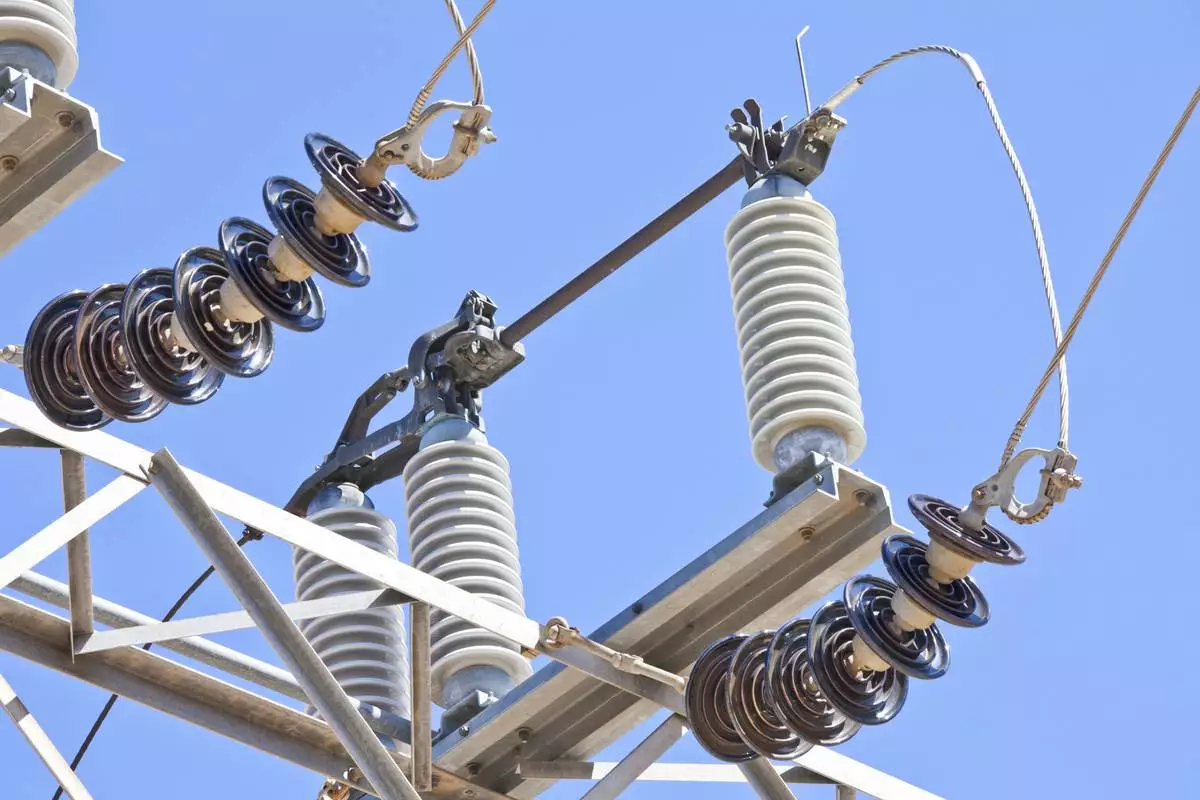
The program covers more than 800 transmission assets across the U.K.
CAIRO (AP) — It took Houthi rebels less than 48 hours to seize Yemen's Red Sea coast from pro-government forces in a resounding blow to U.S. interests and Washington's regional allies.
But the Houthis didn’t do it alone. Iranian Revolutionary Guard advisers were in the field helping direct the battle, people familiar with the offensive told The Associated Press, marking Iran’s most direct intervention in favor of its longtime ally since Yemen’s civil war erupted in 2014.
The intervention shows how Iran has built the Houthis into a major regional partner able to open a new front in the wider war with the U.S. The rebels’ biggest land grab in years, along with the closure of a key Saudi pipeline, strengthened their ability to choke off Saudi Arabia’s oil exports, pushing up global fuel prices and giving Iran greater leverage. The United States has seemed reluctant to help its ally Saudi Arabia, even as the Houthis have gained momentum in Yemen's revived civil war.
The AP spoke to 10 officials and soldiers to assemble an account of the Houthi offensive. They included a senior Houthi official, two regional officials, a top Yemeni military commander and a member of Yemen's ruling presidential council. They spoke on condition of anonymity to discuss internal decision making.
The Houthis' swift, 115-kilometer (75-mile) assault exploited divisions among forces allied with Yemen's Saudi-backed, internationally recognized government. The Houthis penetrated the internal communications of one of the main forces, the National Resistance, allowing them to track its movements and sow confusion.
As pro-government forces beat a frantic retreat, the leader of the National Resistance fled to Saudi Arabia. The key port city of Mokha was abandoned as residents left in the night, allowing the Houthis to roll in unopposed on Sept. 10. Their seizure of strategic islands nearby further enhanced their ability to attack Saudi oil shipments in the Red Sea.
The Houthis had not conducted a major campaign along the coast since 2017, when government forces drove them out of the area. Since then, the Houthis had focused on trying to capture the oil-rich province of Marib in central Yemen.
A truce took hold in 2022. The following year, the Houthis began attacking Red Sea shipping over the war in Gaza, attacks that continued until a punishing U.S. bombing campaign in 2025. After the U.S. and Israel attacked Iran in February, the Houthis largely kept to the sidelines.
Last year, Iran began providing the Houthis with stepped-up training and logistical support on more advanced missiles, drones and uncrewed attack boats, said Mzahem Alsaloum, a security analyst who has followed Iranian-backed groups for nearly a decade and now runs a private intelligence firm.
In July, the Houthis renewed their attacks on Saudi Arabia after accusing it of striking the airport in the rebel-held capital, Sanaa. That strike appears to have been aimed at halting a flight from Tehran.
Alsaloum and the senior Houthi official said the Iranian flight, which later landed, brought Revolutionary Guard advisers, who joined other advisers from the Guard — and Iran's Lebanese ally, Hezbollah — already based in Yemen.
In early August, the Houthis resumed attacks on government forces, focusing on the city of Taiz, in the mountains overlooking the coast, and firing missiles and drones at Mokha.
The Houthi official said Iranian advisers had previously focused on strategic planning and were not in the field. But in the latest escalation, they were “present at all levels,” he said, including planning tactical maneuvers and working with front-line commanders.
The two regional officials, who are regularly briefed on the latest developments in Yemen, also said Iran provided direct support that helped the rapid advance.
Alsaloum said that in addition to helping in a command role, the Iranian advisers analyzed communications and satellite intelligence, capacities the Houthis were lacking.
Iran's U.N. mission did not respond to requests for comment.
The National Resistance, with some 30,000 fighters, was the strongest pro-government force along the coast. But it had not been involved in major fighting since 2017.
For a month, Houthi forces bombarded its positions with 130 ballistic missiles and 145 suicide drones, according to a National Resistance spokesman, Maj. Gen. Sadiq Dwaid. He said its fighters were stretched over 170 kilometers (100 miles), from Mokha into the mountainous interior, against what he estimated were 75,000 Houthi fighters.
In early September, the Giants Brigade, another militia, came to its aid, helping it to temporarily push back the rebels. But the Giants Brigade had not coordinated with the National Resistance, angering its field commanders, one government official said.
The two forces had a longtime rivalry rooted in the past struggle between Saudi Arabia and the United Arab Emirates over control of the anti-Houthi movement. That struggle led to the UAE abruptly pulling out of Yemen in January.
There was no “unified command,” said the senior military official. “This was a priceless opportunity for the Houthis.”
On Sept. 9, the Houthis advanced south toward Mokha through a narrow mountain valley, heavily bombarding their opponents.
Having breached their communications, the Houthis were able to listen in and exploit divisions, one of the government officials said, adding that National Resistance leaders lost contact with several field commanders.
By the afternoon, the Houthis had seized the mountain road and a nearby military base, cutting off government supply lines to Mokha. Lt. Gen. Tariq Saleh, the leader of the National Resistance, was forced to flee and then took refuge in Saudi Arabia.
At around 6 p.m. that night, orders went out to National Resistance field units to retreat back to Mokha. When thousands of fighters began arriving, the forces stationed in the port city thought a major Houthi attack was imminent and began to flee, two National Resistance fighters told the AP.
A Mokha resident, Issa Gubwani, said he saw fighters in military vehicles and pickups streaming out of the city. “They left us to face our fate,” he said. Tens of thousands of residents joined the exodus.
The Houthi official said that when the rebels rolled in early on Sept. 10, “the city was empty.”
The senior government military official said Yemeni forces were stunned that Saudi warplanes didn’t strike the Houthis as they advanced on Mokha. The Saudi government media office did not respond when asked for comment.
The Houthis seized weapons and military equipment, including armored vehicles, rockets, artillery shells and ammunition, most of it from the UAE and Saudi Arabia, two government officials said. The rebels displayed some of the captured weapons in a televised parade.
The National Resistance said it lost 500 fighters in the battles; that could not be independently confirmed. The Houthis have not announced their losses.
As government forces work to regroup, supporters of the various militias have been trading blame and accusations of treason online. The Houthis are meanwhile building defenses around the newly captured territories, according to the Houthi official.
“Losing the West Coast is not the end of the battle; rather, it marks the beginning of a fiercer battle,” Brig. Gen. Walid Ziyad, a senior National Resistance commander, declared on social media.
Associated Press reporters Sarah El Deeb in Beirut, Ahmed al-Haj in Aden, Yemen, and Lee Keath and Victoria Eastwood in Cairo contributed to this report.
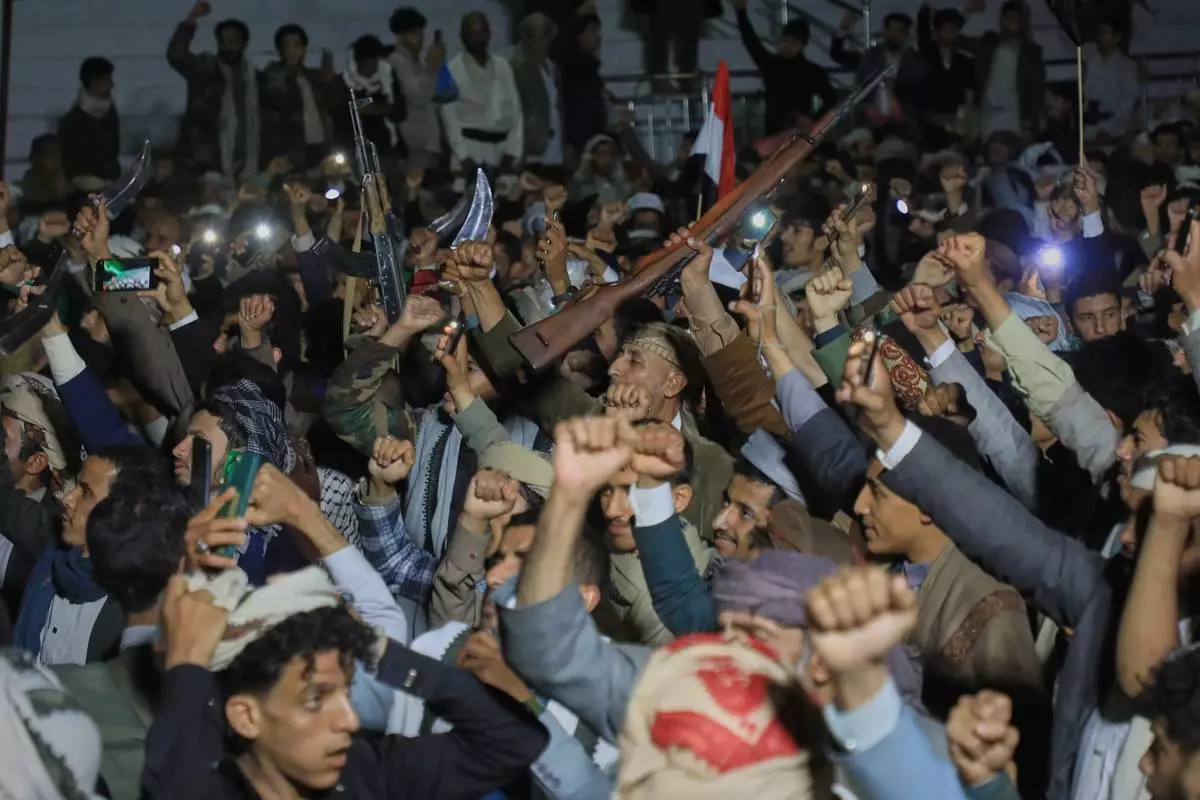
Supporters of Yemen's Houthi rebels raise rifles and their fists during a rally organized to celebrate the group's capture of Mayun Island in the strategic Bab el-Mandeb Strait, in Houthi-controlled Sanaa, Yemen, Friday, Sept. 11, 2026. (AP Photo/Osamah Abdulrahman)
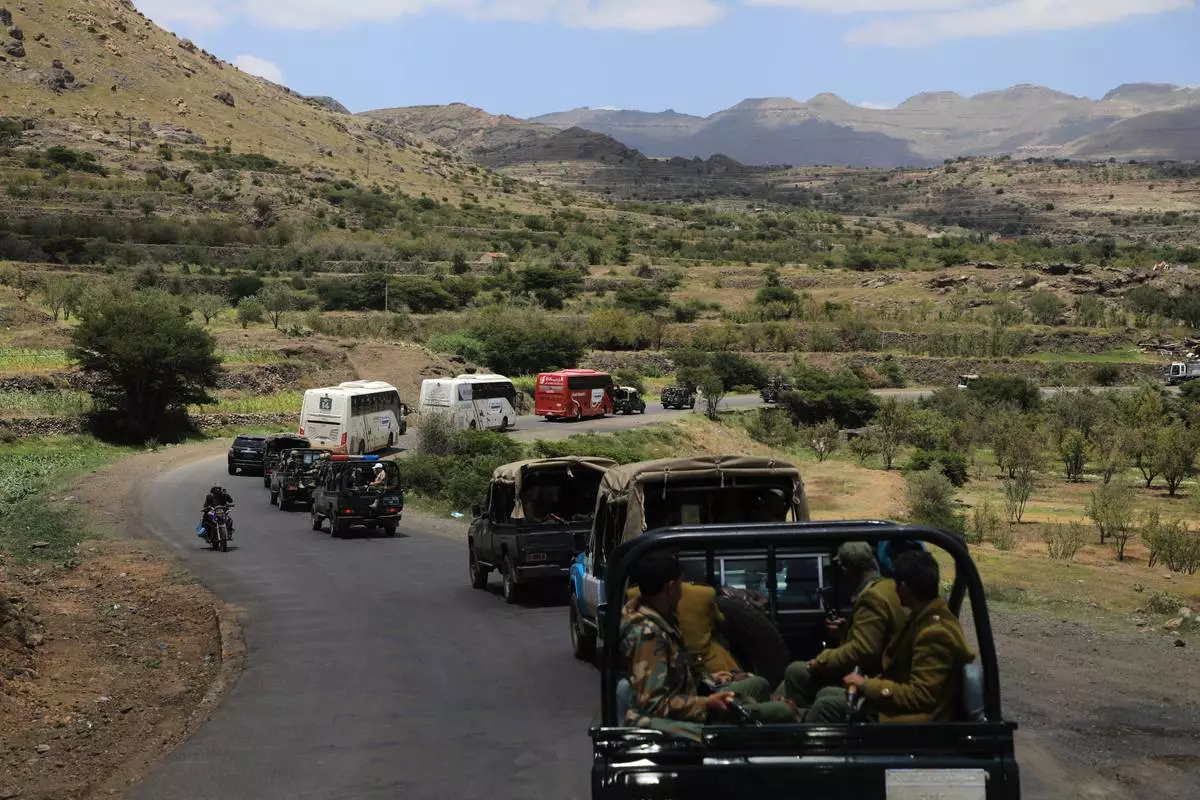
Houthi fighters escort a convoy carrying prisoners freed in Mokha through the Bani Matar district on its way to Sanaa, Yemen, Saturday, Sept. 12, 2026, following the Houthi takeover of the southern Red Sea port city. (AP Photo/STR)
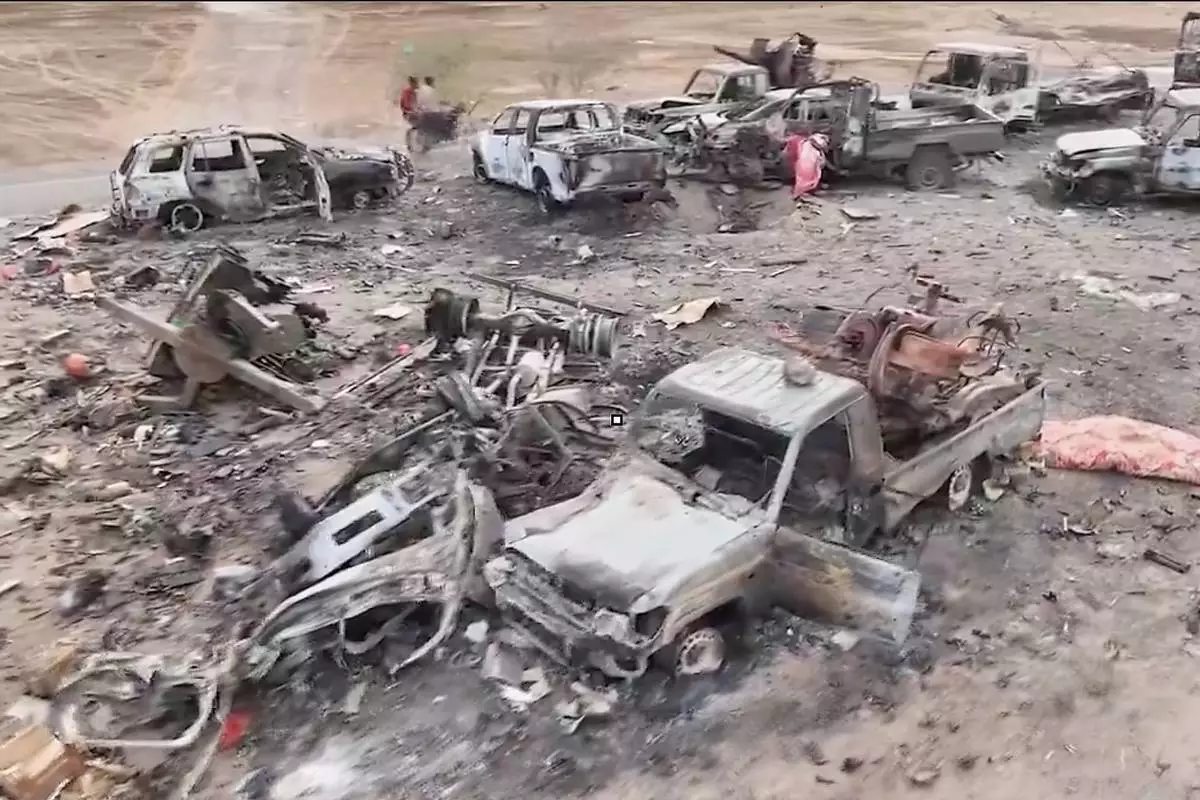
This image taken from undated video released by the Houthi-run Al-Masirah television channel on Saturday, Sept. 12, 2026, shows damaged vehicles on a road between the Dhubab and Amri junctions in Yemen, according to the channel. (Al-Masirah TV via AP)
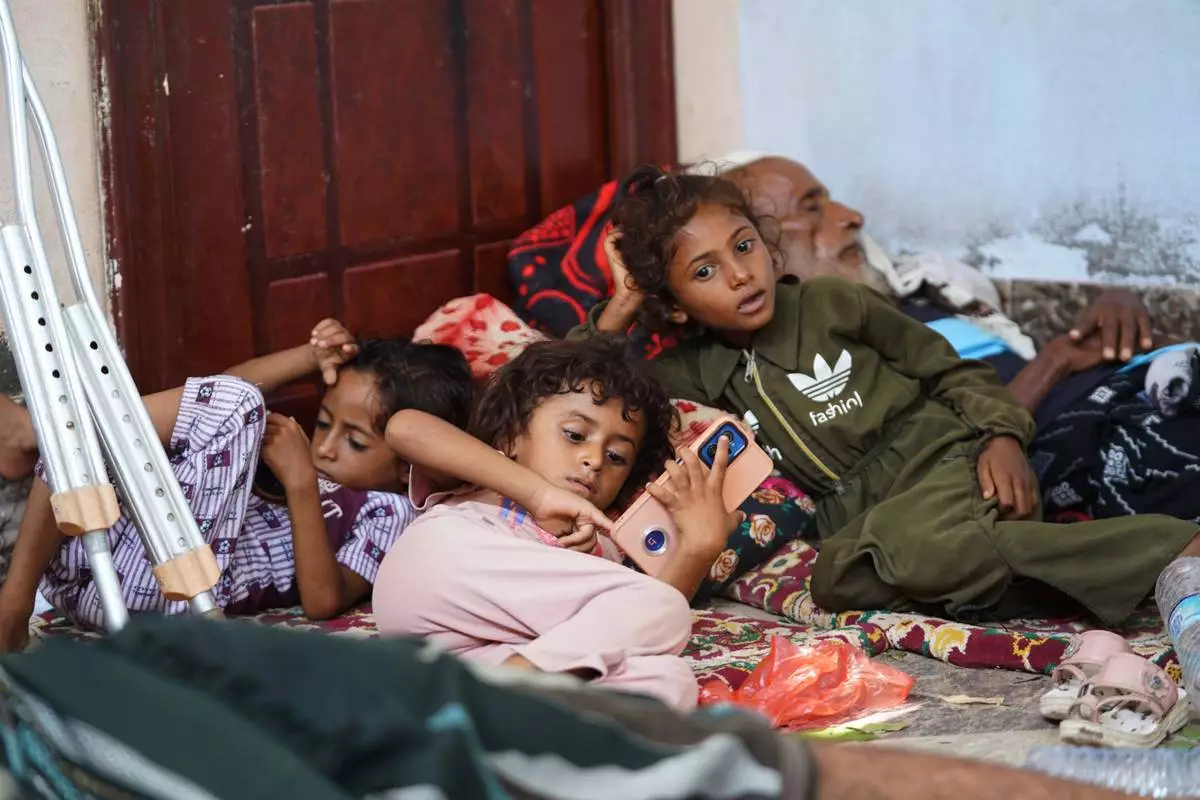
Displaced Yemenis rest at a temporary shelter in the Dar Saad district of Aden, Yemen, Saturday, Sept. 12, 2026, after fleeing Houthi attacks in the western coastal cities of al-Khokha and Mokha. (AP Photo/Abdulnasser Alseddik)
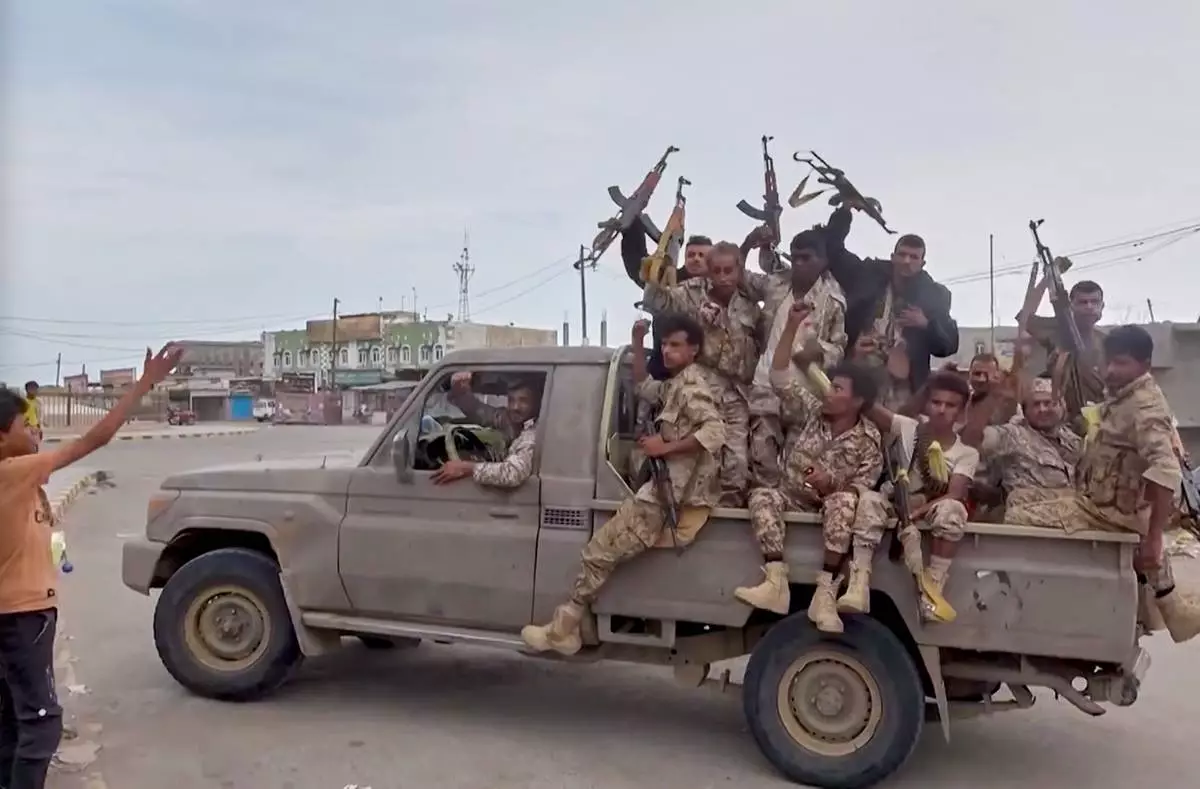
This image taken from undated video released by Al-Masirah TV, a channel owned by Yemen's Houthi rebels, on Friday, Sept. 11, 2026, shows, according to the channel, Houthi fighters chanting atop a pickup truck in Khawkhah, Hodeida province, Yemen. (Al-Masirah TV via AP)