Tesla CEO Elon Musk has praised China's remarkable progress and rising prosperity of its average citizen over the years, attributing the rapid growth to the leadership of President Xi Jinping.
Musk made the remarks in an interview with China Media Group at Tesla's engineering headquarters in Silicon Valley, ahead of Xi's state visit to the United States.
"I've seen it firsthand. If you visit China and you see the amount of progress that happens from one year to the next or even within a year, it's very visible, like you can see the new buildings, the new infrastructure. And it's also obvious to see that just walking around the streets, the increased prosperity of the average Chinese citizen has increased tremendously. That's happened under President Xi while he's been the leader of China, so he's clearly done an excellent job and is very capable," Musk said.
At the invitation of President Donald Trump, Xi left for the United States on Wednesday afternoon for a state visit and a high-stakes meeting with Trump.
With the upcoming visit, the two presidents are expected to complete reciprocal visits within months. The trip will be Xi's second state visit to the United States following his first in 2015.
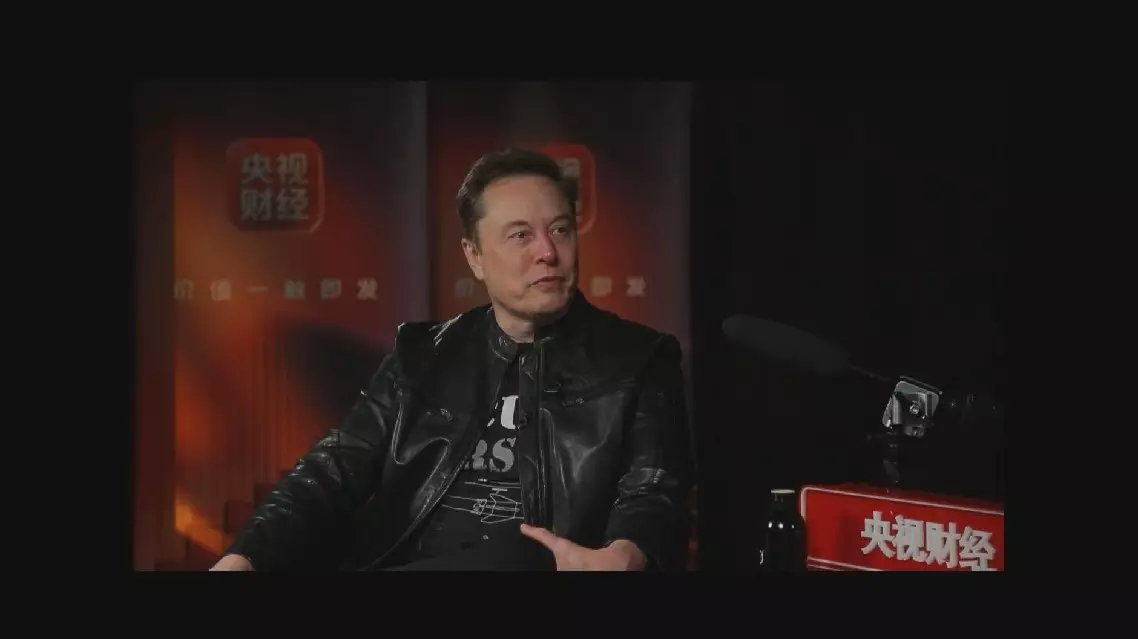
Musk attributes China's continued development to Xi's leadership
Global economic growth is projected to stand at 2.9 percent in 2026 and 3.0 percent in 2027, according to the Economic Outlook Interim Report released by the Organization for Economic Cooperation and Development (OECD) on Wednesday.
Growth in the advanced G20 economies, as well as in the G20 emerging-market economies, is projected to remain broadly stable, the report said.
The report also forecasted inflation levels for the two years, predicting that some major economies will see price rises that outstrip global growth levels. G20 headline inflation is expected to rise from 3.4 percent in 2025 to 4.1 percent in 2026, before easing to 3.6 percent in 2027.
In the advanced G20 economies, headline inflation is projected to rise from 2.5 percent in 2025 to 3.2 percent in 2026, before falling to 2.6 percent in 2027, while in emerging-market G20 economies it is expected to increase from 4.1 percent to 4.8 percent before easing to 4.3 percent.
The OECD noted that the projections are based on a technical assumption that Brent crude prices and TTF gas prices will peak in the fourth quarter of 2026 and then decline steadily through the end of 2027.
The assumed Brent crude price path is broadly consistent with the "short disruption" scenario in the OECD's June 2026 Economic Outlook, while the assumed gas price path is about 60 percent higher.
Persistent uncertainty over the evolution of the conflict in the Middle East remains a key risk to the baseline projections, the OECD warned, adding that constraints on exports through the Strait of Hormuz, additional disruptions to alternative export routes such as the Bab al-Mandeb Strait, or further significant damage to energy production facilities in the region could prompt a further sustained rise in energy prices and potentially lead to shortages of key commodities, particularly in net importing countries.
Low European gas reserves and uncertain scope for sustained further reductions in oil inventories in some countries could exacerbate supply disruption risks.
Further monetary policy rate adjustments may be needed, the OECD said, noting that faced with renewed energy price shocks, stronger-than-expected demand pressures, and above-target inflation in many economies, central banks need to ensure that underlying inflation pressures are durably contained.
The OECD also called for further structural policy reforms to help economies cope with future supply shocks, including diversifying energy supply, improving energy efficiency, enhancing product and labor market adjustment, and ensuring workers have adaptable skills.

Global economic growth projected at 2.9 pct in 2026: OECD