Multinational tech companies have brought their latest products to the 5th Global Digital Trade Expo currently underway in China, looking to tap more growth opportunities in the vast Chinese market.
Running from September 23 to 27 in Hangzhou, the capital of east China's Zhejiang Province, the five-day expo has attracted more overseas delegations than all previous editions combined. The event covers an exhibition area of 170,000 square meters, with international exhibitors accounting for more than 20 percent of exhibition space.
Among the most popular products at the exhibition is Tesla's driverless electric vehicle, the Cybercab, which has drawn widespread attention from visitors.
With no steering wheel, no pedals and no traditional rearview mirrors, the Cybercab is the world's first mass-production model designed specifically for autonomous driving.
It does not use lidar or high-definition maps for navigation, but relies solely on eight onboard cameras, using pure vision analysis and end-to-end neural network technology to achieve autonomous driving.
In the intelligent healthcare exhibition area, the brain-computer interface booth of U.S. medical tech giant Medtronic is also drawing crowds.
It is Medtronic's first time at the Digital Trade Expo with and the company is exhibiting a device that integrates artificial intelligence (AI) and brain-computer interface technology to read brain signals and customize personalized diagnosis and treatment plans for Parkinson's patients.
"This product is the world's smallest and lightest brain pacemaker. Its unique sensing technology can detect abnormal electrical signals in the patient's brain and then analyze and organize them," said Cai Xinqiang, manager of Medtronic’s neuromodulation business for Medtronic in China.
According to the organizers, a major highlight of this year's expo is the strong presence of leading international companies, including 55 Fortune Global 500 companies.
"This year's expo has drawn more than 2,000 exhibitors, including over 400 from overseas. It has brought together leading global companies such as Google, Amazon and Tesla, as well as companies that have participated in the expo for five consecutive years," said Li Yang, secretary-general of the GDTE organizing committee's secretariat.
The Digital Trade Expo is using AI as a link to connect global business opportunities. According to Qiu Sheng, vice president of Amazon China, overseas tech giants are exploring partnerships within China's intelligent innovation and manufacturing ecosystem.
"China has the world's most complete manufacturing system, the most vibrant digital innovation ecosystem, and a large community of entrepreneurs eager to expand globally. So, we see enormous potential. Through the expo, we can efficiently connect businesses with cross-border e-commerce players and achieve win-win outcomes," he said.
As of now, more than 50,000 professional buyers from 163 countries and regions have registered for the event, including over 12,000 international buyers. The pre-arranged international procurement list has reached 1.085 billion U.S. dollars.
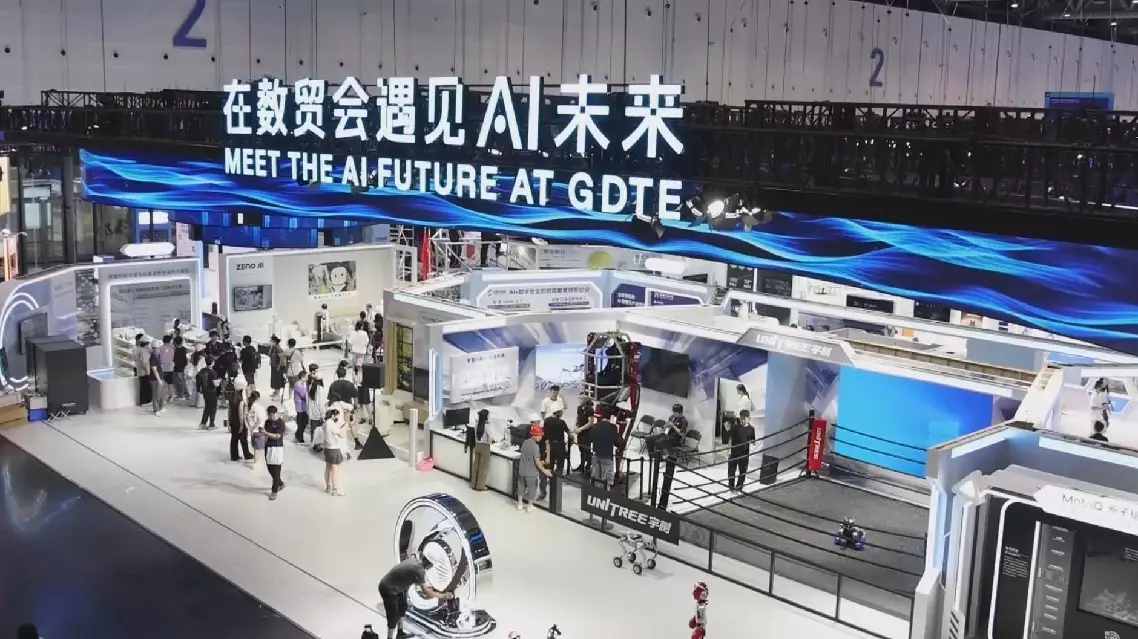
Global tech giants head to Digital Trade Expo for China market opportunities