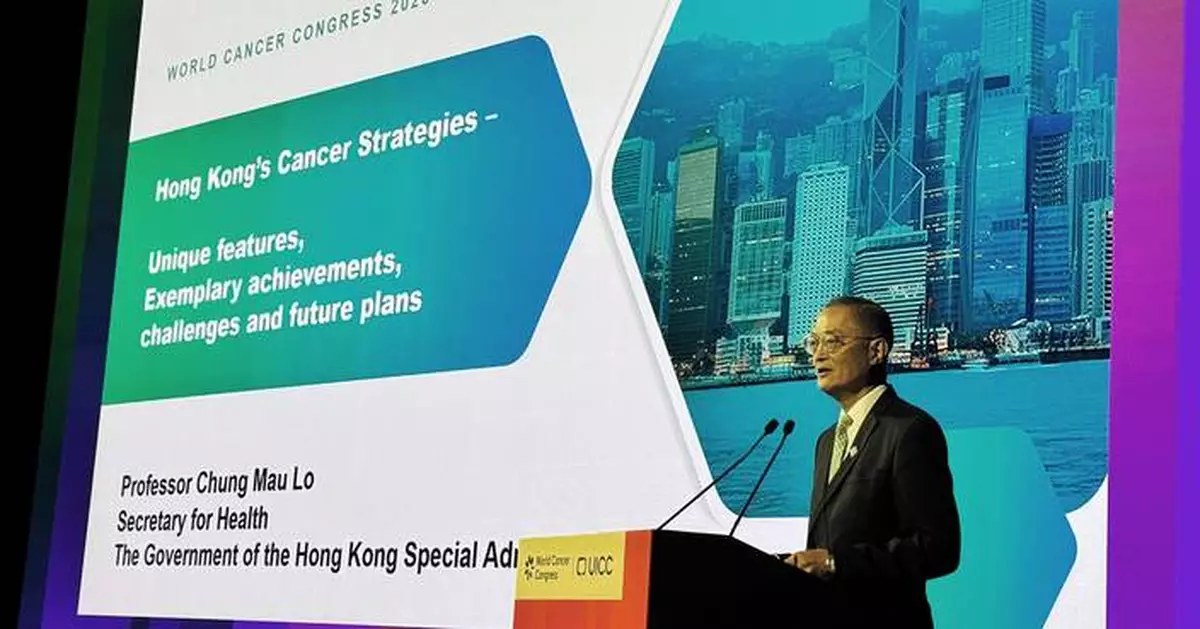
Speech by Secretary for Health at plenary session of World Cancer Congress 2026
Following is the speech by the Secretary for Health, Professor Lo Chung-mau, at the plenary session of the World Cancer Congress 2026 today (September 24):
Professor Jeff Dunn (Former President of the Union for International Cancer Control), Dr Cary Adams (Chief Executive Officer of the Union for International Cancer Control), Professor Jie He (Director of the National Cancer Center), distinguished guests, ladies and gentlemen,
Good morning. On behalf of the Health Bureau of the HKSAR (Hong Kong Special Administrative Region), I need to thank the UICC (Union for International Cancer Control) and the Hong Kong Anti-Cancer Society for hosting this World Cancer Congress in Hong Kong for the first time, and to welcome everyone to Hong Kong.
Following the two talks on global and national perspectives on cancer control, I would offer the Hong Kong SAR's perspective. Under the unique constitutional advantages of "one country, two systems", our city manages to put the ambitions of reducing cancer burden into practice through prevention, early diagnosis, equitable treatment and sustained research.
Hong Kong has the world's highest life expectancy - 88.7 years for women and 83.3 years for men in 2025 - attributed to a combination of active urban lifestyles and safe environment, public health policies, and accessible affordable public healthcare as a safety net.
With nearly one in four citizens over the age of 65, cancer is the leading cause of death, accounting for nearly 30 per cent of all deaths. The top five cancers are lung, breast, colorectum, prostate and liver, while the top cancer deaths were lung, colon, liver, pancreas and breast. While the number of new cancer cases continues to rise with an ageing population and more advanced diagnostics, our age-standardised cancer mortality rates have steadily declined by over 40 per cent in the last three decades with an annual decline of 2.8 per cent per year for men and 1.7 per cent for women in the last decade, indicating that Hong Kong is making significant life-saving progress against cancer.
Achievements/past and present
Such progress in cancer control would not be possible without policy support, strategic planning, co-ordination and investment from the Government. Hong Kong established the Cancer Coordinating Committee, to formulate the Hong Kong Cancer Strategy, setting out the overall direction for cancer control covering seven aspects: (1) cancer surveillance, (2) prevention, (3) screening and early diagnosis, (4) timely and effective treatment, (5) technology and support, (6) survivorship and palliative care, as well as (7) research. The Hospital Authority (HA), as our largest public cancer service provider, published a Strategic Service Framework for Cancer Services, and the Hong Kong Cancer Registry established since 1963, maintains a comprehensive population-based cancer database for surveillance with coverage reaching 97 per cent.
Prevention
Cancer is not only treatable but preventable, notably by vaccination against oncovirus and a healthy lifestyle. The HongKong Childhood Immunisation Programme provides free universal mandatory vaccines for eligible Hong Kong children to cover 12 infectious diseases that include two oncovirus, hepatitis B virus and human papilloma virus HPV. HBV vaccination for all newborns since 1988, together with prenatal HBV screening and the widespread availablilty of anti-viral treatment, have resulted in a remarkable control in liver cancer. The number of new cases dropped by 8.2 per cent and deaths by 7.6 per cent in the last decade. School-based HPV vaccination for primary school girls has achieved a coverage rate of over 90 per cent among 15-year-old girls, achieving the vaccination target of the WHO (World Health Organization)'s global strategy to eliminate cervical cancer.
Promoting a healthy lifestyle such as tobacco control remains our primary strategy for cancer prevention. Through concerted community efforts, smoking prevalence in Hong Kong has dropped from 23.3 per cent in the 1980s to a historic low of 8.5 per cent last year. To further minimise tobacco harms, we have put in place 10 new tobacco control measures to be implemented in phases. The World Health Organization's World No Tobacco Day Award to me this year is a tremendous encouragement, and due recognition of Hong Kong's efforts in tobacco control.
Apart from tobacco, we are actively addressing obesity, a major risk factor for several common cancers. In response to the national Weight Management Year initiative and the WHO Acceleration Plan to Stop Obesity global framework, we launched Hong Kong's first Action Plan on Weight Management this year to promote healthy lifestyles across the city.
Screening
Catching cancer early by screening is another critical pillar of our cancer strategy. Since 2004, we have expanded our government-subsidised screening efforts step by step, starting with the Cervical Cancer Screening Programme, followed by the Colorectal Cancer Screening Programme, and most recently the Breast Cancer Screening Pilot Programme. The majority of cancer cases identified through these screening programmes are found at earlier stages, leading to better outcomes. Early this year, we launched the Hepatitis B Co-care Scheme to provide risk-based screening and long-term surveillance for control of chronic hepatitis B and to further combat liver cancer.
Treatment
For those unfortunate patients who have cancer, the public hospitals in Hong Kong have established oncology centres in each cluster to provide advance comprehensive cancer service from diagnosis to treatment and palliative care. Our public healthcare system is heavily funded by a recurrent annual budget from the Government and serves as a safety net to provide universal health coverage including equitable and affordable cancer care for all, with a 95 per cent subsidy rate further protected by a copayment waiver system and an annual cap. It was just announced last week in the Chief Executive's 2026 Policy Address that we will further enhance our integrated cancer care system.
At the community level, the District Health Centres will promote a Life Course Preventive Care Plan, identifying those with cancer-related risk factors for management and screening. The Hospital Authority has been strengthening diagnostic and treatment facilities and capacity for cancer, and will commission a new oncology Centre in the Kowloon East Cluster. It will facilitate the introduction of innovative cost-effective cancer drugs and advance therapy products into the drug formulary to ensure an equitable and affordable access for all patients. The cancer case manager programme, launched in 2010/11, will be extended to cover more cancer patients. A multidisciplinary teams service framework will be strengthened to support cancer survivors in the community, and to provide integrated palliative care across the care continuum.
In addition to the integrated Chinese-Western medicine cancer care pilot programme in the HA, the newly opened first Chinese medicine hospital will offer cancer patients treatments that draw on the strengths of both traditions.
Apart from prevention diagnosis and treatment, the Government has long supported linical research with cancer designated as a priority funding area through the Health and Medical Research Fund. Under its Research Translation Strategy, we place emphasis on research with high translational value and a current commissioned study is to assess AI-assisted low-dose CT (computed tomography) to screen for lung cancer in high-risk asymptomatic individuals. The results of the study will help to formulate our local screening strategy.
Moving forward
Looking ahead, as Hong Kong just released its First Five-Year Plan last week with the strategic goal to develop into a health and medical innovation hub, we will gear up to enhance cancer control in a sustained, evidence-based manner, powered by biotechnology, as well as policy innovation from the Government.
First, we will get life-saving innovative cancer drugs and devices to patients faster than ever before by reforming our drugs and medical device regulatory regime with phased implementation of the proactive "primary evaluation", establishment of the Hong Kong Centre for Medical Products Regulation, building the Greater Bay Area Clinical Trial Collaboration Platform, and launching the Office for Introducing Innovative Drugs and Medical Devices in the Hospital Authority.
Second, we will promote precision medicine for personalised cancer care by increasing genetic and related testing capacities to support more targeted cancer treatment options. With the Government's support, the Hong Kong Genome Institute is carrying forward the Hong Kong Genome Project, performing large scale whole-genome sequencing to enable precise diagnoses of hereditary cancers, enabling personalised treatment for patients, as well as offering preventive options for their families.
Third, we are implementing the five-year eHealth+ development plan to transform our territory-wide electronic health record system, eHealth, into a comprehensive healthcare information infrastructure that integrates data sharing, service delivery and care journey management. For cancer patients, eHealth+ can ensure continuous and personalised care, while avoiding unnecessary repeated examinations and reducing medical costs. In the longer term, as eHealth+ builds a central database of cancer-related health data for Hong Kong, it will become an invaluable resource for research to formulate evidence-based cancer control strategies.
Finally, we have AI. AI holds enormous promise - for earlier detection, more accurate diagnosis, and more efficient care delivery. But it must be introduced carefully, ethically, and in a way that complements, rather than replaces, the judgement of clinicians. Our approach will be deliberate: we will ensure that AI is adopted in a co-ordinated manner with proper governance, so that its benefits reach patients safely and equitably.
These are not isolated initiatives. Advanced biotechnology, precision medicine, digital health and AI are pillars of the same vision - a vision of a healthcare system that is smarter, more personalised and more responsive to the needs of every patient.
These developments are not just about Hong Kong. Hong Kong has the unique advantage of enjoying strong support from the motherland while being closely connected to the world. We will continue to leverage this position to foster healthcare co-operation within and beyond the Guangdong-Hong Kong-Macao Greater Bay Area, contributing to the important national strategy of "Healthy China". Our city serves as a bridge - connecting Eastern and Western approaches to cancer care, translating cutting-edge oncology research into equitable and affordable clinical application, and turning visionary public health policy into global life-saving practice. Leveraging our unique constitutional advantage of "one country, two systems", we are perfectly placed to foster global partnerships and advance the shared mission of this Congress.
In closing, as Hong Kong welcomes the World Cancer Congress for the first time, we hope this Congress will spark new ideas, forge new collaborations, and renew our collective resolve to reduce the global burden of cancer.
On that note, I wish you all a memorable and fruitful conference. And for those delegates from outside Hong Kong, I wish you a wonderful stay. Thank you.
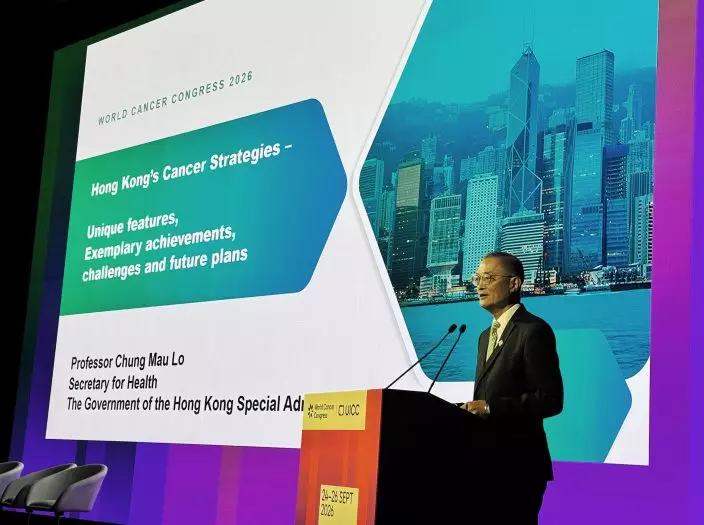
The Secretary for Health, Professor Lo Chung-mau, delivers a speech at the plenary session of the World Cancer Congress 2026 today (September 24). Source: HKSAR Government Press Releases